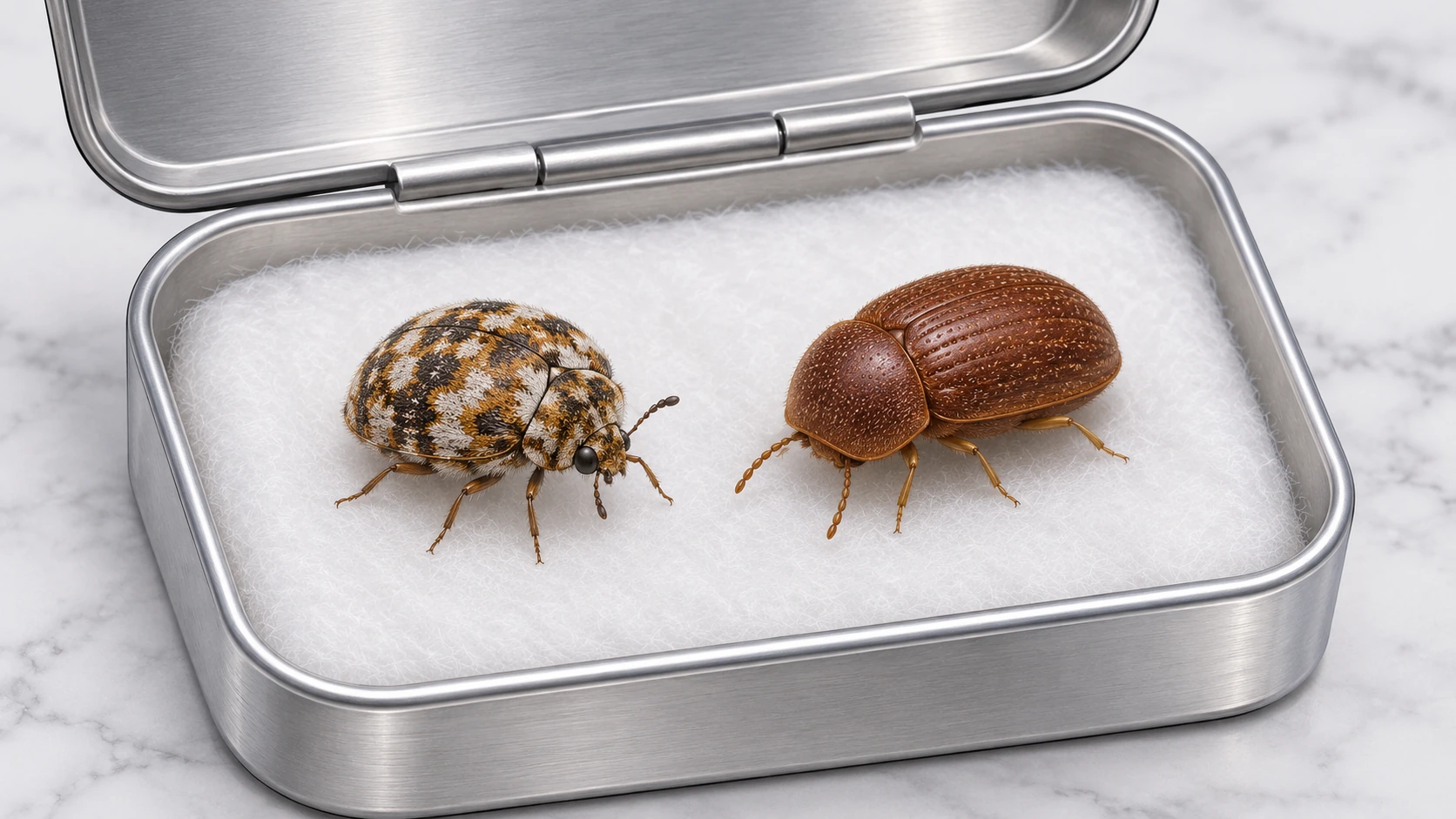
The easiest way to tell a carpet beetle from a drugstore beetle is to examine its body shape, head, and wing covers. Drugstore beetles are small, uniformly reddish-brown insects with a rounded, humpbacked profile and a head that is largely hidden when viewed from above. Carpet beetles vary more in appearance. Some are almost round with mottled white, brown, and black markings, while others are elongated and uniformly dark.
Their larvae provide another useful difference. Carpet beetle larvae are generally elongated, brownish, and conspicuously hairy or bristly. Drugstore beetle larvae are small, creamy-white grubs with brownish heads and curved bodies. Although drugstore beetle larvae have fine hairs, they lack the characteristic dark, elongated appearance of common carpet beetle larvae.
The materials surrounding the insects can help narrow the possibilities. Drugstore beetles frequently develop in dried foods, spices, cereals, and other stored products. Carpet beetle larvae commonly occupy wool, fur, feathers, accumulated animal hair, and dead insects. However, some carpet beetle species also infest stored foods, and drugstore beetles can attack unusual nonfood materials. A pantry sighting alone cannot establish which beetle you have.
For homeowners, the most reliable identification combines the insect’s anatomy with evidence of where its larvae are developing.
Carpet Beetle vs. Drugstore Beetle at a Glance
The comparison below focuses on features that are useful when examining a specimen or tracing the source of an infestation.
| Feature | Carpet beetle | Drugstore beetle |
|---|---|---|
| Scientific classification | Family Dermestidae, including several household species | Stegobium paniceum, family Ptinidae |
| Adult size | Common household species are generally about 2–5 mm | Usually about 2.25–3.5 mm |
| Adult color | Mottled or uniformly dark, depending on species | Uniformly brown to reddish-brown |
| Adult body shape | Rounded or elongated oval | Oval to cylindrical, with a humped profile |
| Head from above | Appearance varies; not enclosed by the same pronounced hood | Mostly concealed beneath the pronotum |
| Wing covers | May have colored scales or a comparatively uniform dark surface | Fine lengthwise rows of pits or grooves |
| Antennae | Structure varies among carpet beetle species | Three enlarged segments at the tip |
| Larvae | Often brownish, elongated, densely hairy or bristly | Cream-colored, curved grubs with fine hairs |
| Typical food association | Animal-derived fibers, dead insects, hair, and some stored foods | Dried foods, spices, cereals, pet foods, and other stored products |
| Common household discovery | Windows, closets, rugs, furniture, storage areas | Pantries, food packages, spice cabinets, windows |
The size ranges overlap, so measurements alone are rarely decisive. Both are genuine beetles with hardened wing covers, and adults of both groups can fly.
The more informative details are the outline of the head and thorax, the surface of the wing covers, and the appearance of any larvae found nearby.
What Does an Adult Drugstore Beetle Look Like?
An adult drugstore beetle, Stegobium paniceum, is typically about 2.25 to 3.5 millimeters long. Its body is brown to reddish-brown and appears oval from above, with a somewhat cylindrical, humpbacked profile when viewed from the side.
The front portion of its thorax forms a hoodlike covering over the head. This structure is called the pronotum. Because the head bends downward and is partly concealed by the pronotum, the insect may appear almost headless when examined from above.
That profile is one of the most practical differences between a drugstore beetle and many common carpet beetles.
The adult’s hardened wing covers also have fine, lengthwise rows of punctures. Under magnification, these appear as closely spaced grooves or lines running from the front toward the rear of the beetle.
Another identification feature is the antenna. Its final three segments are enlarged, forming an elongated club. This is particularly useful for distinguishing drugstore beetles from cigarette beetles, which have more uniformly saw-toothed antennae.
The adult’s hooded head, three-segmented antennal club, and lengthwise wing-cover markings are established diagnostic features of Stegobium paniceum.
A homeowner generally cannot see all of these details without magnification. The insect may be only slightly larger than a sesame seed, so a close photograph or preserved specimen is often necessary.
The brown color is a starting clue, not a final identification. Numerous unrelated household beetles have a similar color.
What Does an Adult Carpet Beetle Look Like?
Carpet beetles are a group of beetles rather than a single species. This makes the comparison less straightforward because an adult varied carpet beetle looks different from an adult black carpet beetle.
The varied carpet beetle, Anthrenus verbasci, is usually about 2 to 3 millimeters long. It has a broadly oval, almost rounded body covered with tiny scales that create an irregular mixture of white, brown, yellowish, and black.
When those markings are intact, the difference from a uniformly reddish-brown drugstore beetle is usually obvious.
However, the scales can wear away. An older or damaged varied carpet beetle may look darker and less distinctly patterned, making color-based identification less dependable.
The black carpet beetle, Attagenus unicolor, presents a more difficult comparison. Adults are generally about 3 to 5 millimeters long and have elongated oval bodies that range from dark brown to black.
A small black carpet beetle photographed in poor lighting might be mistaken for a brown pantry beetle. The difference is clearer when its body proportions, antennae, and wing-cover surface are visible.
The adult characteristics of household carpet beetles include these differences in shape, coloration, and size among common species.
Unlike the drugstore beetle, a typical adult carpet beetle does not have the same strongly hooded, humpbacked outline. Its antennae also follow the structural patterns of the particular carpet beetle species rather than the characteristic three-segmented terminal club of a drugstore beetle.
For a closer look at the variation within the group, the differences between varied and black carpet beetles are particularly relevant when the specimen lacks obvious markings.
The Head and Thorax Are Often More Useful Than Color
A uniformly brown insect is difficult to identify from color alone. The shape of its head and thorax can provide a stronger clue.
In a drugstore beetle, the pronotum arches over the downward-facing head. Viewed from the side, the front of the body appears rounded and elevated, producing a humpbacked silhouette.
From directly above, the head may be almost completely hidden.
A carpet beetle’s head and thorax are arranged differently. Although the head may be small and difficult to see, the body generally lacks the pronounced hoodlike profile characteristic of the drugstore beetle.
A side-view photograph can therefore be more useful than another photograph taken directly above the insect.
If you have a suspected drugstore beetle, place the specimen in a clear container and examine it against a plain background. A phone camera with a macro attachment or an ordinary magnifying glass may help reveal the outline.
Avoid relying on an insect-identification application that uses only a blurred image of the back. Both species are small enough that automated identification can overlook their diagnostic structures.
The visual identification of drugstore beetles includes the concealed head and distinctive wing-cover grooves, which become much easier to recognize in a sharply focused close-up.
Can You Tell Them Apart by Their Wing Covers?
Wing-cover details are useful, especially when the body color is ambiguous.
Drugstore beetles have fine longitudinal rows of punctures on their hardened wing covers. These markings produce a lined or grooved appearance under magnification.
The rows are subtle. They should not be expected to look like deep scratches to the naked eye.
Varied carpet beetles, by contrast, have patterned scales covering much of the adult body. Those scales create their characteristic mottled coloration rather than a uniformly reddish-brown surface with fine parallel grooves.
Black carpet beetles have darker, relatively uniform wing covers. The presence or absence of a mottled pattern therefore cannot separate every carpet beetle species from a drugstore beetle.
The wing-cover features should be considered together with the head profile and antennae.
A brown beetle with a concealed head, a humped thorax, and clear lengthwise rows of pits is consistent with a drugstore beetle. A small, rounded beetle covered in irregular pale and dark scales is much more consistent with a varied carpet beetle.
When only one character is visible, the identification may remain uncertain.
Carpet Beetle Larvae vs. Drugstore Beetle Larvae
The larvae are usually easier to distinguish than uniformly dark adult beetles, provided they are intact and visible.
Carpet beetle larvae are commonly brownish, elongated, segmented, and covered in conspicuous hairs or bristles. Drugstore beetle larvae are creamy-white, curved, and grub-like, with brownish head capsules.
Both possess hairs, but their overall appearance is different.
Carpet Beetle Larvae Have an Elongated, Bristly Body
The larva of a varied carpet beetle is generally brownish and visibly banded or segmented, with dense hairs and sometimes noticeable tufts near the rear.
A black carpet beetle larva is more elongated and often carrot-shaped, with a brushlike collection of hairs at the posterior end.
These insects do not look like pale, curled pantry grubs. Their darker color and prominent body covering are often recognizable even in ordinary close photographs.
Carpet beetle larvae also leave shed skins as they grow. These empty skins may retain their elongated shape and visible hairs, making them useful evidence even after the live larvae have moved elsewhere.
An intact shed skin found inside a wool sweater or under a natural-fiber rug can provide a better clue than an unidentified adult on a distant windowsill.
The distinctive appearance of carpet beetle larvae includes differences among species, so not every larva will have identical banding or tail tufts.
Drugstore Beetle Larvae Are Pale and Curved
Drugstore beetle larvae are small, whitish to cream-colored grubs with darker heads. More developed larvae tend to have a curved or C-shaped posture.
Their bodies have fine hairs, but these are not arranged into the same conspicuous brown bristles and rear tufts characteristic of many household carpet beetle larvae.
Drugstore beetle larvae commonly develop within food or other suitable stored materials. Someone may find them in flour, spices, dog treats, or another dry product rather than crawling openly across a carpet.
The pale body can also blend into light-colored food, making larvae difficult to see until the contents of a package are disturbed.
The documented larval form and feeding locations of drugstore beetles provide useful clues when the adults are absent.
However, a cream-colored grub in a pantry is not automatically a drugstore beetle. Several stored-product beetles produce pale larvae, and species-level identification may require examining the head, legs, hairs, and other structures.
Do Carpet Beetles and Drugstore Beetles Eat the Same Things?
Their food preferences overlap, but the places where they most commonly become household pests are different.
Carpet beetle larvae are strongly associated with animal-derived materials. Wool, fur, feathers, animal hair, dried insects, and other protein-containing debris can support development.
This is why carpet beetle infestations are frequently discovered in wool rugs, stored textiles, upholstered furniture, and places where pet hair accumulates.
Drugstore beetles are especially associated with dry stored products. Their larvae can feed on bread, flour, cereal products, pasta, dried herbs, spices, pet food, and various other materials.
The name “drugstore beetle” comes from its historical association with stored medicinal products and materials found in pharmacies. The species is also called the bread beetle or biscuit beetle in some regions.
Those names do not describe three different insects. They refer to Stegobium paniceum.
The complication is that drugstore beetles can use some nonfood materials, while certain carpet beetle species may also attack dried stored products.
For example, finding beetle larvae in dry pet food supports the possibility of a stored-product infestation, but it does not conclusively separate these insects. Both the actual specimen and the infested product need to be examined.
The varied stored-product diet of drugstore beetles includes dry foods and some unexpected nonfood materials. Their broad feeding ability is one reason that an infestation source may be overlooked.
The same caution applies when evaluating what carpet beetle larvae actually eat. Species differences matter, and household location should support anatomical identification rather than replace it.
Finding the Beetle in a Pantry: Which Is More Likely?
A drugstore beetle is a strong possibility when small, reddish-brown adults repeatedly appear near dried foods or emerge from a particular stored product.
Spices are especially worth inspecting. Drugstore beetles can develop in products that many homeowners would not expect insects to eat, including dried peppers and some strongly flavored seasonings.
Dried pasta, cereal products, flour, dog treats, and stored decorative plant materials may also support development.
Carpet beetles are less strongly associated with the typical pantry environment as a group, but some species can infest stored products. An adult carpet beetle could also have wandered into the kitchen from elsewhere.
The decisive question is whether you can identify a breeding source.
An adult on a kitchen window may have flown there after emerging from a pantry product. Alternatively, it could have entered from outdoors or come from a textile infestation in another room.
Repeated findings of pale larvae inside a dry food package, especially when accompanied by reddish-brown adults with hooded heads, strongly support drugstore beetles.
Finding elongated, bristly carpet beetle larvae among stored animal-derived materials suggests a different source.
If several species are possible, a broader comparison of carpet beetles with stored-food beetles can help narrow the candidates before you choose a response.
Finding the Beetle in a Closet or on a Rug
Carpet beetles deserve closer consideration when larvae or their shed skins are discovered among wool clothing, natural-fiber rugs, fur accessories, or furniture containing animal-derived materials.
Their larvae can feed in protected areas without being seen for long periods. Damage may appear as irregular holes, thinning patches, or surface grazing.
Drugstore beetles are not commonly associated with this particular pattern of household textile damage, although their diet is broad enough that unusual material associations should not be dismissed without examining the insect.
Suppose a homeowner finds an adult brown beetle crawling over a wool blanket. That sighting alone cannot identify the source of the damage.
If the blanket also contains elongated, hairy larvae or their discarded skins, carpet beetles become a much stronger possibility.
If the same room contains a box of old dried flowers or an infested food product, a drugstore beetle may have wandered onto the blanket without feeding there.
The materials supporting larval development are more informative than the surface where an adult happens to be resting.
This is also why a single adult carpet beetle in a bedroom does not automatically mean clothing or furniture is infested. Adults can move away from breeding sites, and some enter homes from outdoors.
Both Beetles Can Appear Near Windows
Windowsill sightings are a common source of confusion because adults of both groups can fly and may be attracted to light.
Adult carpet beetles are frequently encountered on windowsills, particularly when they have emerged indoors or entered from outdoor vegetation.
Drugstore beetles can also fly, and adults may gather around windows after emerging from stored products.
Therefore, an unidentified beetle on a window frame cannot be assigned to either group based on that location alone.
A useful investigation compares the actual insects and checks plausible source areas.
If several small, rounded, mottled beetles appear near a window, carpet beetles are a reasonable possibility. Look for larvae in susceptible fabrics, accumulations of animal hair, dead insects, or other organic materials nearby.
If the beetles are uniformly reddish-brown with a humpbacked profile, inspect nearby dry foods and stored products for drugstore beetle development.
Repeatedly vacuuming the windowsill may remove visible adults, but it will not necessarily address the source if larvae are developing in a concealed location.
An adult sighting identifies activity. Finding the breeding material explains where the insects are coming from.
What if the Beetle Is Too Small to Identify?
A clear side view and a close photograph of the antennae may provide enough information to distinguish the species.
Use a plain background and include something for scale. A ruler marked in millimeters is better than an object of uncertain size.
Take one photograph directly above the specimen and another from the side. The overhead view may show color and wing-cover markings, while the side view can reveal the drugstore beetle’s concealed head and humped profile.
Avoid crushing the insect before photographing it because damage to the thorax, antennae, or wing covers may remove the very features needed for identification.
If you find larvae, photograph those separately. The elongated, brown, bristly form of many carpet beetle larvae contrasts with the curved, pale form of drugstore beetle larvae.
When the insect remains uncertain, preserve an intact specimen in a secure container. A cooperative extension diagnostic service or qualified pest professional may be able to identify it.
Be careful with automated identification results. An application may correctly recognize a small brown beetle while assigning it to the wrong family or species.
That distinction matters because several unrelated pantry and household beetles share a similar appearance.
What Should You Do After Identifying the Beetle?
Once the insect is identified, locate the material supporting its larvae before deciding on a control method.
For a suspected drugstore beetle infestation, inspect susceptible dry foods and stored products. If larvae, beetles, or characteristic damage are present inside a package, isolate and discard the infested material. Check neighboring products for activity and clean up accumulated food debris.
For carpet beetles, examine materials containing wool, feathers, fur, pet hair, and dead insects. Vacuum accessible debris and inspect nearby fabrics for larvae or cast skins.
The precise removal method will depend on the material, the size of the infestation, and whether the insects can be reached. An infestation concealed in upholstery requires a different response from a single infested food package.
Do not spray insecticide onto stored food or food-contact surfaces. Removing contaminated products and cleaning their storage areas is safer and more directly addresses the breeding source.
Similarly, an unidentified adult beetle on a windowsill is not a reason to treat an entire home with insecticide.
The initial approach to getting rid of carpet beetles begins with identifying the source rather than applying a treatment based on the insect’s color alone.
If the infestation persists or the insects continue appearing without an identifiable source, a more detailed inspection for carpet beetles can help determine whether a hidden area is supporting development.
Frequently Asked Questions
Are drugstore beetles a type of carpet beetle?
No. Drugstore beetles belong to the species Stegobium paniceum in the family Ptinidae. Carpet beetles belong to the family Dermestidae. Both are beetles, but they are classified in different families and have different typical household feeding associations.
Are drugstore beetles smaller than carpet beetles?
Their sizes overlap. Drugstore beetles are generally about 2.25 to 3.5 millimeters long, while common household carpet beetles vary in size by species. Some varied carpet beetles are smaller than drugstore beetles, and some black carpet beetles are larger. Size alone cannot reliably identify them.
Can a black carpet beetle look like a drugstore beetle?
Yes. A dark, elongated carpet beetle may resemble a brown pantry beetle in poor lighting or a blurry photograph. The drugstore beetle’s hooded head, reddish-brown color, and fine lengthwise wing-cover markings provide useful distinguishing features.
Do drugstore beetles have hairy larvae?
Yes. Drugstore beetle larvae have fine hairs, but they are generally pale, curved grubs. Carpet beetle larvae are usually more elongated, brownish, and conspicuously bristly. Hairiness alone is not sufficient for identification.
Do drugstore beetles eat carpets or clothing?
Drugstore beetles are primarily recognized as stored-product pests, and they can consume a surprisingly broad range of dry materials. However, typical damage to wool clothing or carpets, especially when accompanied by bristly larval skins, is more suggestive of carpet beetles or clothes moths. The actual insect should be identified before assigning the damage to either species.
Can drugstore beetles come from dog food?
Yes. Dry pet food and treats can support drugstore beetles. Carpet beetles and other stored-product insects may also occur in some animal foods, so a contaminated package does not identify the species without a specimen.
Why are drugstore beetles on my windowsill?
Adult drugstore beetles can fly and may move toward light after emerging from an infested product. Their presence on a windowsill does not prove the window is the breeding site. Inspect susceptible stored materials and compare the insect’s anatomy before deciding where the infestation originates.
Is a drugstore beetle the same as a cigarette beetle?
No. They are different species that closely resemble one another. Drugstore beetles have lengthwise rows of pits on their wing covers and antennae ending in three enlarged segments. Cigarette beetles have comparatively smooth wing covers and saw-toothed antennae. This distinction may require magnification.
The Bottom Line
Carpet beetles and drugstore beetles can look similar because they are tiny household beetles whose adult sizes overlap. Both can fly, both may appear on windowsills, and their feeding materials can sometimes overlap.
A drugstore beetle is typically uniformly reddish-brown, with a concealed head, a humped thorax, and fine longitudinal rows on its wing covers. Carpet beetles include mottled, rounded species and darker, more elongated species, making a single color rule unreliable.
Their larvae often provide the clearest distinction. Carpet beetle larvae are generally elongated and bristly, while drugstore beetle larvae are pale, curved grubs.
Finding the insect’s breeding source strengthens the identification. Dry foods and spices are particularly suggestive of drugstore beetles, while wool, fur, feathers, and accumulated animal hair commonly support carpet beetle larvae.
If the specimen is too small or damaged to identify confidently, preserve it and examine the surrounding materials before choosing a treatment. Correct identification helps prevent unnecessary pesticide use and directs attention to the actual source of the infestation.