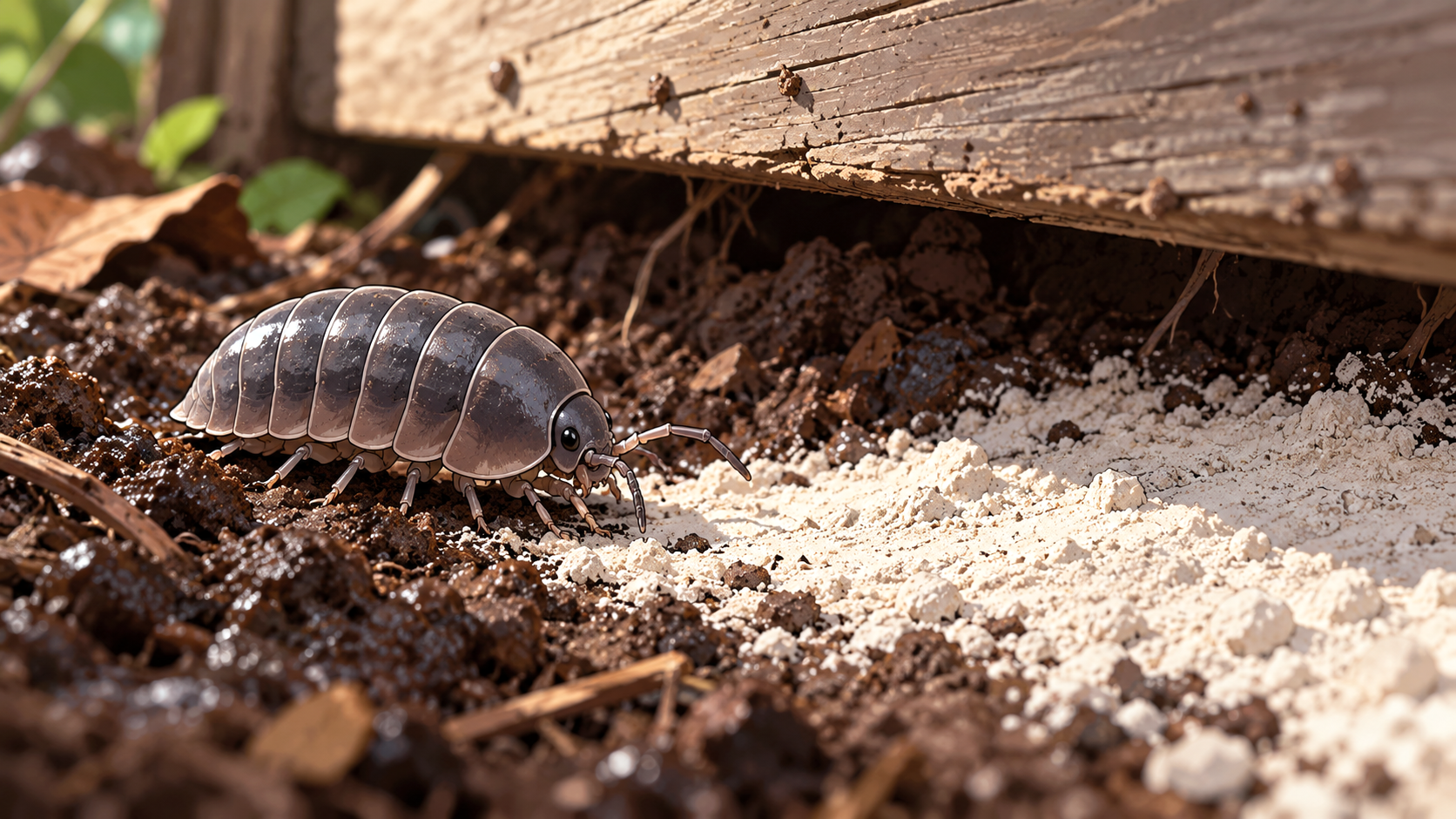
Diatomaceous earth can help reduce roly-polies when they crawl through a dry, appropriately labeled product, but its usefulness drops in wet or persistently damp locations. Because roly-polies favor moisture, that limitation is especially important in gardens. Diatomaceous earth is better treated as a targeted dry barrier than a complete solution for a large population.
Direct field evidence measuring diatomaceous earth specifically against roly-polies is limited compared with the extensive research on its effects against insects. Recommendations for pillbugs therefore need to separate established properties of the material from results demonstrated only in other arthropods.
Diatomaceous Earth Works by Increasing Water Loss
Pesticidal diatomaceous earth consists largely of silica derived from fossilized diatoms. Rather than poisoning a pest through a conventional neurotoxic mechanism, the particles interact physically with the body surface. Modern experimental work has shown that exposure can increase cuticular permeability and water loss in susceptible insects, while the material also absorbs lipids associated with the protective outer surface.
Roly-polies are already unusually dependent on humid conditions because they are terrestrial crustaceans with limited resistance to desiccation. Their survival without adequate moisture changes dramatically with humidity, making water balance central to their survival. A dry desiccant encountered while they move across the soil surface can therefore work against a physiological vulnerability they already possess.
Canadian pest-control guidance specifically lists diatomaceous earth as an option for sowbugs and pillbugs and describes it as remaining active as long as the powder stays dry. British Columbia’s home and garden pest-management guidance similarly recommends diatomaceous earth along seedling rows when additional control of damaging sowbugs is required.
A Wet Garden Works Against the Property You Want From the Dust
Roly-polies congregate in moist protected places around soil and organic debris, putting diatomaceous earth in an awkward position as a garden treatment. The sites most likely to contain pillbugs are often the sites most likely to wet the powder through irrigation, rainfall, damp soil or condensation.
Moisture can reduce the performance of desiccant dusts. Laboratory experiments with several insecticidal dusts found that steam exposure and prolonged storage at high relative humidity significantly reduced their effectiveness. Tests of diatomaceous earth against stored-product beetles have likewise found that efficacy can vary with relative humidity, temperature, pest species, dose and the properties of the particular diatomaceous earth. In one controlled comparison, lower grain moisture produced greater mortality across the tested species and DE sources.
Those insect experiments do not provide a mortality rate for roly-polies in a vegetable bed. They establish why claims such as “diatomaceous earth always works even when wet” are unreliable. A garden application repeatedly soaked by sprinklers or rain cannot be expected to behave like dry dust maintained under controlled conditions.
Placement Matters More Than Covering the Entire Garden
Where a registered product permits outdoor garden use against pillbugs, a narrow application around vulnerable plants or along a known movement route makes more sense than blanketing soil indiscriminately. Roly-polies occasionally damage seedlings and low-growing produce, so treatment has a clearer purpose when fresh plant injury has actually been attributed to them.
The dust must also remain somewhere the animals will contact it. Thick piles are not inherently more effective than a correctly applied labeled rate, and excessive dust increases unnecessary exposure. Application instructions vary among products, making the pesticide label the controlling source for where, how and at what rate a particular formulation can legally and safely be used.
Timing can affect how long a dry application remains useful. Applying immediately before irrigation or forecast rain gives the dust little opportunity to remain in the condition required for its desiccating action. If a product label allows reapplication after wetting, follow its specific directions rather than automatically adding another layer whenever the surface looks damp.
Diatomaceous earth also leaves the environmental conditions supporting the population unchanged. Persistent moisture, dense shelter and decaying organic material can continue supporting roly-polies after a treated strip becomes ineffective. An existing garden problem is therefore more reliably addressed by combining any appropriate targeted treatment with changes to moisture, shelter and plant exposure.
Not Every Bag of Diatomaceous Earth Is a Garden Pesticide
Diatomaceous earth is sold for different purposes, and products are not interchangeable merely because the package contains the same broadly named material. Pesticidal use requires a product registered for that purpose and a label permitting the intended application. In Canada, a pest-control product should carry a Pest Control Products registration number; in the United States, pesticide labels specify approved pests, sites and directions for use.
Formulation can affect performance as well. Studies comparing different diatomaceous earths have found that physical and chemical characteristics can produce markedly different insecticidal efficacy. Results obtained with one commercial pesticide formulation therefore cannot automatically be assigned to food-grade, pool-grade or another DE material.
Pool-filter diatomaceous earth is especially inappropriate as a substitute for a registered garden pesticide. Processing can alter the silica composition, and pesticide recommendations should be based on the actual labeled product rather than the assumption that any white diatomaceous powder will perform identically.
“Natural” Does Not Mean the Dust Should Be Breathed
Diatomaceous earth has relatively low toxicity through many ordinary exposure routes, but airborne dust can irritate the respiratory tract. The pesticide fact sheet for diatomaceous earth notes that inhalation can irritate the nose and nasal passages and that large inhaled exposures may cause coughing and shortness of breath. Dust can also irritate the eyes and dry the skin.
Avoid creating airborne clouds while applying it and follow the protective measures on the product label. Registered labels may require precautions involving ventilation, eye exposure or respiratory protection; an EPA-approved diatomaceous-earth pesticide label, for example, instructs users to avoid breathing the dust and use adequate ventilation.
Outdoor placement also deserves restraint. Diatomaceous earth acts physically rather than recognizing a target species, so exposed beneficial arthropods that contact pesticidal dust may also be affected. Restricting an application to the smallest relevant area reduces unnecessary exposure compared with spreading it broadly through a garden where most roly-polies are simply participating in decomposition.
Diatomaceous Earth Makes the Most Sense for a Dry, Localized Problem
A narrow band of labeled DE can be reasonable where confirmed pillbug damage is occurring and the treatment can remain dry long enough for animals to cross it. It becomes a poor fit for permanently wet mulch, frequently irrigated soil or locations repeatedly exposed to rainfall. Those conditions favor the roly-polies living around the plants while undermining the desiccating material intended to suppress them.
Indoors, dry cracks and crevices can preserve the dust better, but most pillbugs that wander into ordinary living areas already face severe dehydration. Routine indoor pesticide application is consequently unnecessary in many cases; drying damp areas and stopping continued entry address the conditions responsible for recurring sightings.
Questions About Using Diatomaceous Earth for Roly-Polies
How quickly does diatomaceous earth kill roly-polies?
There is not a reliable universal time that can be given for roly-polies. Performance depends on contact, formulation, dose and environmental moisture, and much of the detailed experimental timing available for diatomaceous earth comes from other arthropods rather than pillbugs.
Can you mix diatomaceous earth with water and spray it for roly-polies?
Only if the specific pesticide label permits that application method. Wetting removes the dry condition responsible for desiccant action during application, and the deposited material would need to function according to the directions and claims established for that particular product after drying.
Will diatomaceous earth harm earthworms?
Do not assume that a broad soil application affects only roly-polies. Diatomaceous earth is a nonspecific physical material, and unnecessary distribution through soil increases exposure to nontarget organisms. Targeted surface placement permitted by the label avoids treating areas that do not require intervention.
Can roly-polies become resistant to diatomaceous earth?
Diatomaceous earth acts through physical effects on the body surface rather than the conventional biochemical target used by many insecticides. That mode of action makes conventional target-site pesticide resistance a poor description of treatment failure; moisture, insufficient contact and differences among formulations can instead determine whether an application performs well.