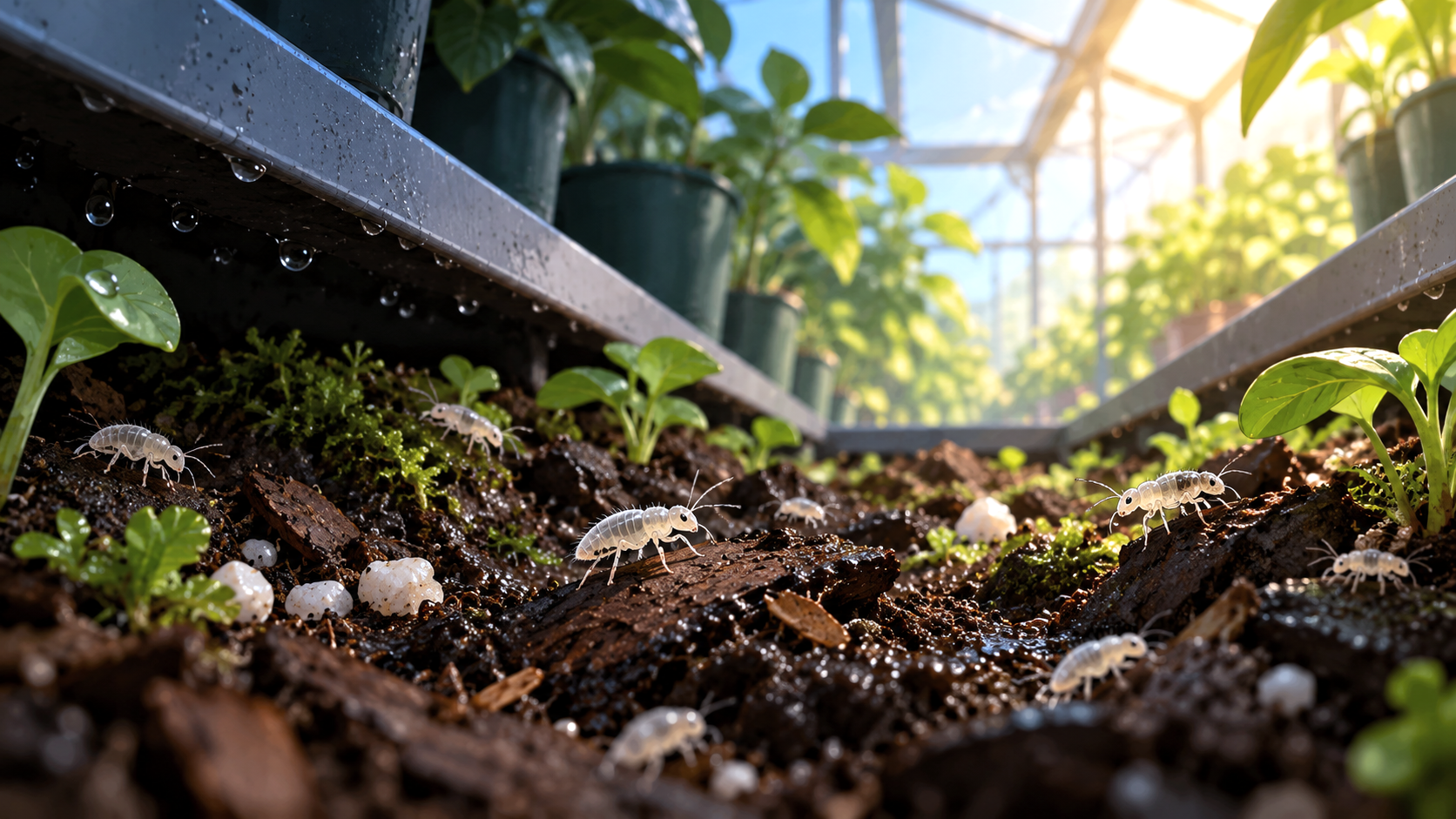
Seeing springtails moving around at night can make them look like classic nocturnal pests. Their actual activity is more complicated. Springtails are not universally nocturnal. Different species can be active during the day, at night, or across both periods, and activity can change with temperature, moisture, habitat, and season. Some field studies have even recorded greater springtail activity during daylight and evening hours than during the middle of the night.
Springtails Are Not Strictly Nocturnal
Calling all springtails nocturnal would be misleading because Collembola includes thousands of species occupying very different environments. Springtails occur in soil, leaf litter, mulch, decaying wood, vegetation, freshwater margins, caves, and even snow. Their activity patterns are not identical across that range.
A field study of a springtail community in an agricultural habitat found that overall activity varied substantially during a 24-hour period. Springtail catches were generally highest between noon and midnight and lowest between midnight and 6 a.m. The researchers also found differences among individual species.
That makes “Are springtails nocturnal?” a question without a single yes-or-no answer for every species. A better description is that springtails have species- and environment-dependent daily activity patterns.
Springtails Can Be Active During the Day
Daytime springtail activity is easy to miss because most species spend their lives in places where we rarely watch them. The great majority develop in soil, while others occupy leaf litter, compost, mulch, and similarly sheltered habitats. (extension.colostate.edu)
Those microhabitats can remain dark and moist even at midday. A springtail moving through damp soil beneath mulch at 2 p.m. is technically active during the day, although it is not exposed to the bright conditions a person standing above the soil experiences.
Some species are much more conspicuous. Snow fleas can become active on the surface of snow during suitable winter conditions. Their appearance in broad daylight is a particularly clear example of why springtails as a group should not be labeled strictly nocturnal.
Nighttime Activity Depends on the Species and Habitat
Night can provide favorable surface conditions for some springtails because temperatures often fall and relative humidity rises. Moisture matters greatly to springtails, which thrive in humid environments and are vulnerable to drying conditions. Their close association with high humidity, damp soil, and organic debris helps explain why time of day alone is a poor predictor of when they will move.
Research also shows that some springtail communities contain substantial night-active populations. A grassland experiment that separated daytime and nighttime captures recorded springtails during both periods, with greater activity-density at night in that particular study.
That does not contradict research finding higher daytime activity elsewhere. Instead, the difference illustrates the central point. There is no universal springtail schedule. Species, weather, soil conditions, vegetation, temperature, and moisture can all change when springtails are active.
Why You May Notice Springtails at Particular Times
The hour on the clock may matter less around a home than what has just happened to the environment. Springtails need moisture, so changes that make a surface wetter or more humid can make them easier to notice.
Houseplant springtails provide a simple example. They live in damp potting mixes and become particularly noticeable after plants are watered. That burst of visible activity is tied to the condition of their habitat rather than darkness itself.
Outdoor populations can also shift when moisture conditions become unfavorable. Springtails may leave landscaping during dry weather in search of humidity, while heavily saturated soil can push them toward drier ground. (extension.psu.edu) Large numbers appearing around a patio, foundation, pool, or doorway can therefore reflect a recent change in moisture rather than a day-versus-night cycle.
This is why we would not use the time you spotted them as a primary identification clue. Their small size, body shape, and characteristic jumping behavior are much more useful. Our guide to what springtails look like covers those features in detail.
Light and Time of Day Are Different Questions
Whether an animal is nocturnal and whether it responds to light are related questions, but they are not interchangeable. A springtail can be active during daylight while remaining underneath leaf litter or within damp soil. Likewise, a springtail moving at night can encounter and respond to artificial lighting.
Springtails may sometimes move toward light around buildings, which can contribute to their appearance near doors and windows. However, light responses vary among springtails, just as their daily activity patterns do.
For that reason, seeing springtails around a lit window at night does not prove that darkness triggered their activity. We cover the light-response question separately in are springtails attracted to light?, where light itself is the focus rather than the animal’s daily activity cycle.
Moisture Is Usually a Better Clue Than the Clock
For a homeowner trying to understand why springtails suddenly appeared, we would pay much more attention to where they are appearing and how damp that location is than whether the sighting happened at 10 a.m. or 10 p.m.
Indoor springtails are strongly associated with moisture. They commonly turn up around plumbing leaks, damp basements, bathrooms, kitchens, and overwatered houseplants. (extension.umn.edu) Persistent indoor populations can also occur where high humidity supports mold growth. (extension.psu.edu)
So a recurring group of springtails around a wet basement wall deserves attention because of the moisture conditions, not because they become visible after sunset. The same principle applies to damp bathrooms and saturated potting soil. Our guides to what attracts springtails and how springtails get into houses cover those causes without turning the activity question into an infestation guide.
What to Watch When Springtails Keep Appearing
Instead of checking only at night, look at the same location at different times and after changes in moisture. A population may become more visible after watering, rain, irrigation, or changes in indoor humidity. You may also see them when outdoor conditions force them away from their usual habitat.
Where they repeatedly gather gives you more useful information than the hour when you first noticed them. Large indoor numbers commonly point toward a moisture issue, and reducing excess moisture often causes springtail populations to decline. (extension.umd.edu)
If you are trying to determine whether a few sightings have become a persistent indoor problem, look for the broader signs of a springtail infestation rather than waiting until nighttime to inspect.
Other Questions About When Springtails Are Active
Does rain make springtails more active?
Rain can change where springtails become visible. They thrive in moist environments, but heavily saturated soil can also drive them from their usual habitat. As a result, springtails may suddenly appear on foundations, sidewalks, patios, and other surfaces after wet conditions alter the moisture level around them.
Are springtails active in winter?
Some are. Snow fleas are springtails that become active during suitable winter conditions and can gather on snow as the ground begins to thaw. Their dark bodies can make these gatherings surprisingly noticeable against a white surface.
Why do springtails suddenly appear after I water a houseplant?
Watering makes springtails living in potting soil easier to notice. They prefer damp growing media and are often particularly visible immediately after watering. Repeated sightings in a pot therefore tell you more about the soil’s moisture than about the time of day.
Can springtails stay active indoors year-round?
Springtails can persist indoors where suitable moisture remains available. Houseplant soil is one example because it can support springtails throughout the year. Bathrooms, basements, and other persistently damp locations can also provide favorable conditions.