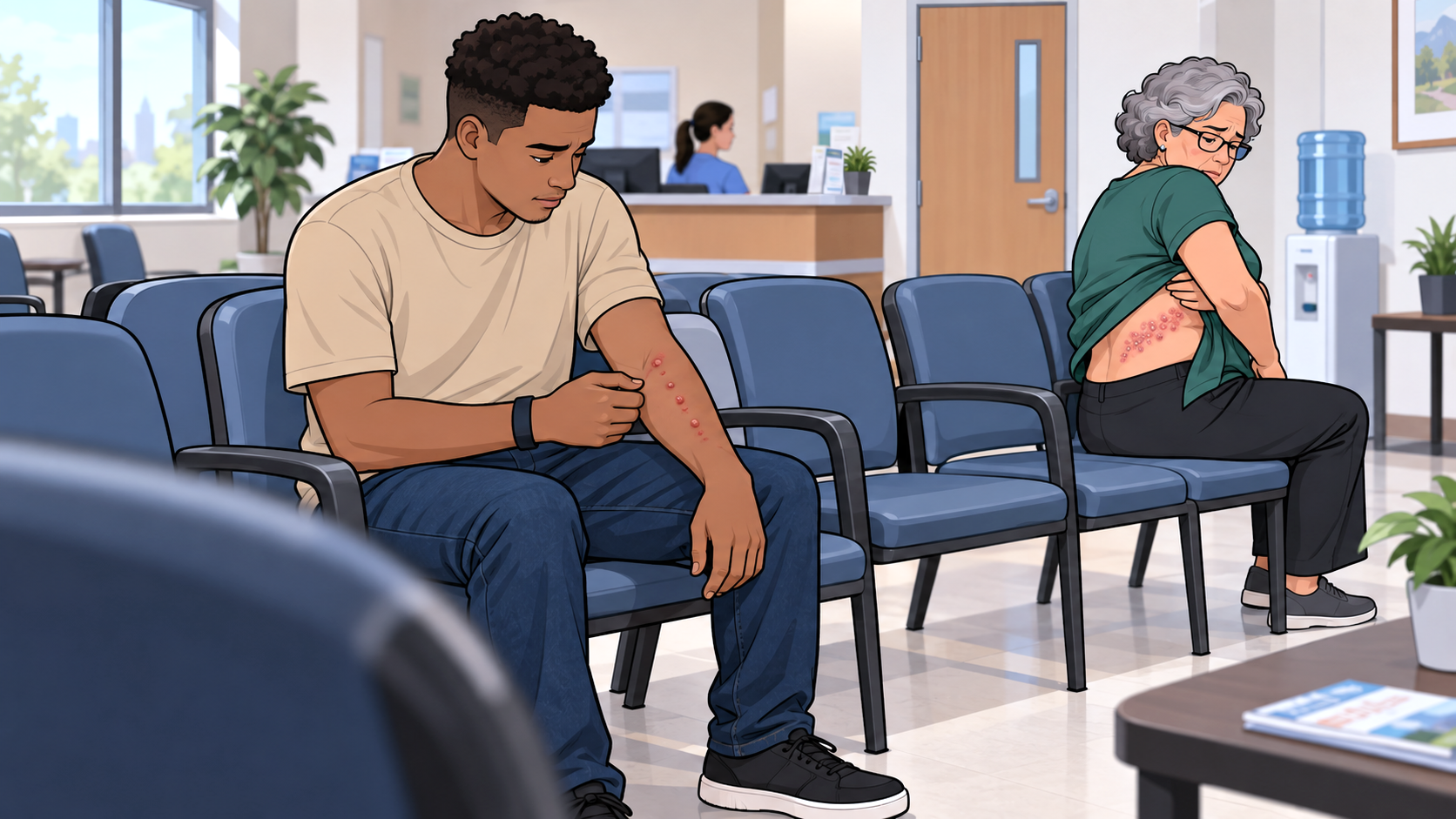
A cluster of red bumps can make bed bug bites and shingles look confusingly similar in a photograph. Once you stop looking at individual bumps and pay attention to what happened before the rash, where it sits on the body, and how it changes, the comparison becomes much more useful. Shingles has a neurological component that bed bug bites do not, and that often changes the story before the skin has fully declared what is happening.
Bed bug bites usually cause itchy, swollen marks that may be scattered or grouped on exposed skin. Shingles typically causes pain, burning, itching, or tingling followed by a blistering rash, usually limited to one side of the body or face. Appearance alone cannot safely distinguish every case, so suspected shingles deserves prompt medical evaluation.
Shingles Can Announce Itself Before You See Much on the Skin
With bed bugs, the insect feeds first and the visible skin response follows. Bed bugs inject anesthetic and anticoagulant substances while feeding, so most people do not feel the actual bite. Marks may become noticeable one to several days later, although reactions vary considerably between individuals. That delayed response is covered more closely in our guide to a typical bed bug bite reaction. Bed bug bites can appear after the feeding event.
Shingles can begin from the opposite direction. Pain, burning, itching, or tingling may develop in an area several days before the characteristic rash appears. Once the rash develops, clusters of fluid-filled blisters form in the affected area and later scab. Pain or tingling can precede the shingles rash, which means an unexplained patch of sensitive or painful skin can be part of the illness before there is an obvious blistering eruption.
That sequence is more informative than asking whether the first red spots look like bites. Bed bug reactions begin because an insect fed on the skin. Shingles develops when varicella-zoster virus, the virus responsible for chickenpox, reactivates in the body. The two conditions therefore arrive at a skin eruption through entirely different processes. Shingles develops when varicella-zoster virus reactivates.
Follow the Rash Across the Body, Not Just Across a Photograph
Distribution provides another important clue. A shingles rash most commonly develops in one or two adjacent dermatomes, areas of skin supplied by particular sensory nerves. It often appears as a band on one side of the torso or on one side of the face, and it usually does not cross the body’s midline. The typical one-sided distribution of shingles is one of its more useful clinical characteristics once the rash has appeared.
Bed bug bites do not follow a dermatome. Marks may be random or appear in a line, and they commonly occur on skin available to the insects while a person sleeps. Individual reactions range from no physical signs to swollen, itchy marks and, rarely, serious allergic reactions. If the arrangement of several marks is causing confusion, our article on why bed bug bites can appear in lines or clusters explains that pattern separately.
Still, location should be treated as evidence rather than a home diagnostic test. Shingles can occur in places other than the torso, including the face, while atypical presentations can occur. Bed bug reactions also vary enough that no single arrangement of bumps proves their cause. A rash that seems medically concerning deserves medical assessment rather than an attempt to make it fit a perfect internet picture.
Blisters Change the Comparison Considerably
A developed shingles rash is characteristically blistering. Clusters of small fluid-filled blisters form in the affected area, with new blisters potentially appearing over several days. The lesions then dry and scab, typically scabbing over within about 7 to 10 days, while the rash generally clears within 2 to 4 weeks. The progression of a shingles rash from blisters to scabs helps explain why photographs taken on different days can look surprisingly different.
Typical bed bug bite reactions are different. They can produce slightly swollen, irritated areas that itch, while stronger reactions can cause enlarged marks or painful swelling. That does not give bed bug bites one dependable appearance, however. Our guide to a swollen reaction after a bed bug bite covers why some people’s marks become much more pronounced than others.
We would therefore be cautious with any comparison that reduces the answer to “red bumps versus blisters.” An early shingles rash may not yet resemble the mature blistering images people recognize, and bed bug reactions themselves are variable. The changes over time, one-sided distribution, associated sensations, and medical examination provide much more context.
Pain Means Something Different in These Two Conditions
Pain deserves more attention here because shingles is not simply an itchy rash that happens to blister. Burning, tingling, sensitivity, or pain can occur before the eruption and continue while the rash is present. Some people later develop postherpetic neuralgia, a form of nerve pain that persists after the shingles rash has cleared. Long-lasting nerve pain is the most common complication of shingles.
A bed bug bite itself is usually not felt while the insect feeds. Later skin reactions can itch or become irritated, and allergic responses can sometimes cause painful swelling. Scratching can also damage the skin and contribute to a secondary infection. If the main question is what the feeding event itself feels like, our guide to whether bed bug bites actually hurt explains that part of the process in more detail.
Pain alone still cannot diagnose shingles. Plenty of skin problems can hurt, burn, sting, or itch. What makes pain especially relevant in this comparison is its relationship to the rash. Pain or tingling confined to an area before a one-sided blistering eruption fits the recognized clinical course of shingles far better than the ordinary sequence of a bed bug bite reaction.
Your Bedroom Can Provide Evidence That Your Skin Cannot
When bed bugs are genuinely responsible, the investigation does not have to end with the rash. Bed bugs leave physical evidence in the environment. Live insects, shed skins, eggs, dark fecal spotting, and rusty or reddish stains around sleeping areas can all support an infestation finding. Physical evidence is more reliable than bites for finding bed bugs.
That environmental evidence becomes particularly valuable when a rash could have another medical cause. Instead of repeatedly comparing photographs, inspect mattress seams, the box spring, bed frame, headboard, and nearby hiding areas. Our detailed bed bug mattress inspection guide covers the places around a bed that deserve attention.
Finding nothing does not automatically rule out a small infestation, but a rash by itself does not establish one either. Bite marks can resemble other insect bites, hives, eczema, fungal infections, and other skin problems. Some people exposed to bed bugs show no skin reaction at all. Skin bites are a poor indicator of a bed bug infestation, so the situation described in our guide to bites with no signs of bed bugs deserves a wider look rather than an automatic infestation diagnosis.
Suspected Shingles Changes What You Should Do Next
Waiting several nights to see whether more “bites” appear is a poor approach when shingles is a realistic possibility. Antiviral medicines used for shingles work best when treatment begins early. Medical guidance recommends contacting a healthcare provider promptly when shingles is suspected, with treatment offering the greatest benefit when started within the first few days after the rash appears. Early medical treatment for shingles can reduce symptoms and complications.
A rash on the face deserves particular urgency because shingles involving the face can threaten the eye and vision. A shingles rash on the face requires prompt medical attention. Rather than spending that window trying home remedies for presumed insect bites, seek medical evaluation.
Meanwhile, a separate bed bug inspection can continue if there is a real reason to suspect an infestation. The two investigations do not compete with each other. A clinician evaluates the rash, while physical evidence in the sleeping area answers the pest question. If you need to work through the latter systematically, our guide to checking a home for bed bugs keeps that investigation focused on evidence rather than skin appearance.
Other Questions When Shingles and Bed Bug Bites Look Similar
Can shingles appear as several separate spots?
Shingles typically follows one or two adjacent dermatomes and usually remains on one side of the body, but the eruption does not have to look like one perfectly continuous patch. New vesicles can form for several days, and a few scattered blisters may occur around the main eruption. A healthcare professional can assess an uncertain presentation, especially when pain or other symptoms accompany it.
Can shingles itch instead of hurt?
Yes. Although shingles is strongly associated with pain, people can experience itching or tingling in the affected area as well. Symptoms vary, so the absence of severe pain does not by itself exclude shingles. Shingles can cause pain, itching, or tingling.
Can bed bug bites appear only on one side of your body?
They can. Sleeping position, exposed skin, and where insects gain access can result in marks appearing more heavily in one area. A one-sided collection of suspected bites therefore does not prove shingles, just as it does not prove bed bugs. For bed bugs, environmental evidence remains necessary because skin symptoms from bed bugs are not specific enough to identify an infestation by themselves.
Can you have shingles without the classic rash?
Shingles can cause pain, itching, or tingling before the rash develops, so there may be a period when the characteristic eruption is not yet visible. Clinical diagnosis is more difficult in the absence of a rash. Persistent unexplained one-sided pain or tingling that raises concern for shingles is therefore a reason to contact a healthcare professional rather than waiting for a textbook-looking rash.
Could scratching bed bug bites make them look more like a skin disease?
Scratching can irritate and damage bite sites, and intense scratching can contribute to secondary skin infection. That can change how the affected skin looks and feels, making visual self-diagnosis even less reliable. Our guide to an infected bed bug bite covers that complication separately.