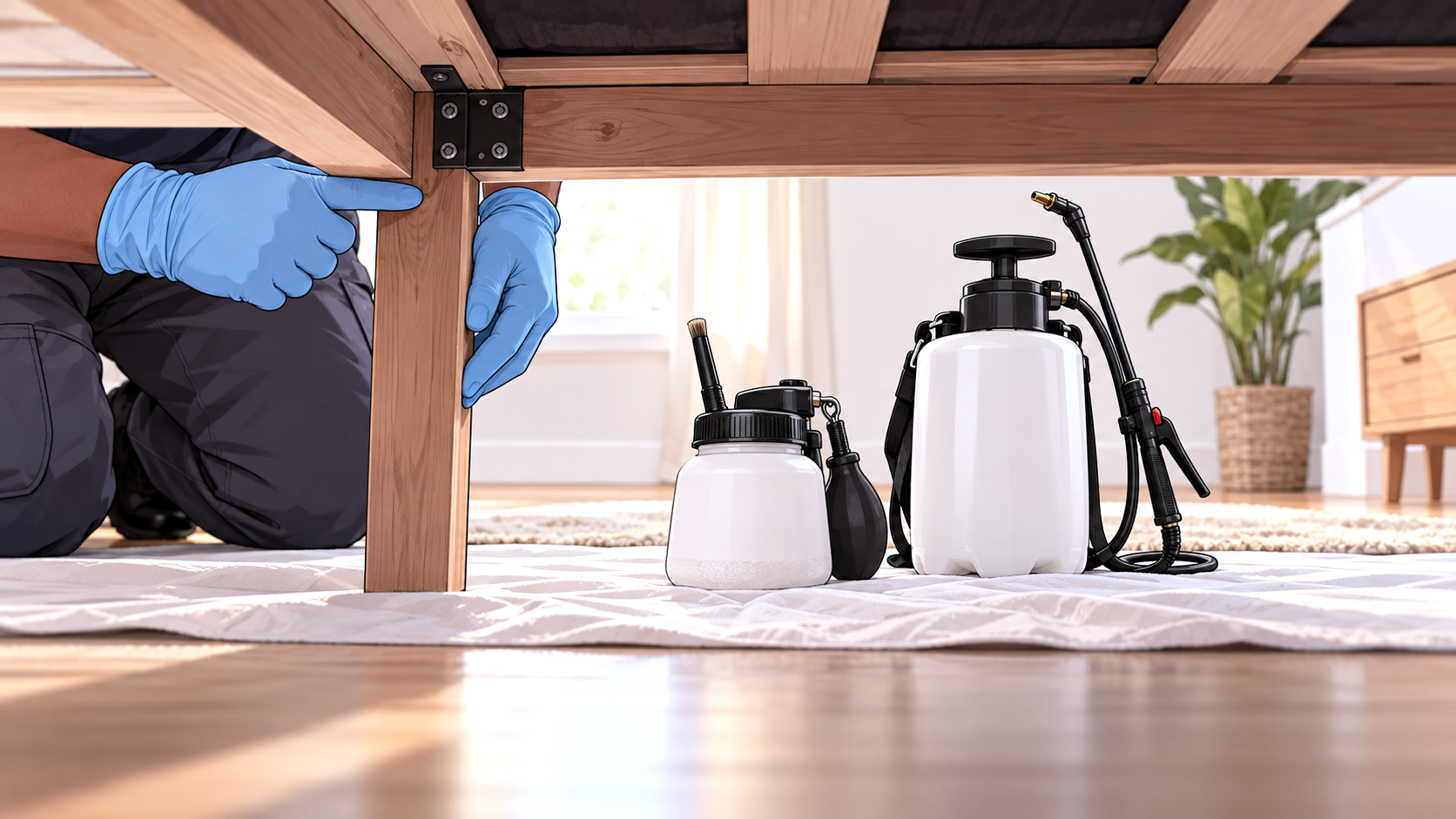
Neither bed bug powder nor spray is universally better. Desiccant powders are usually stronger for long-term residual control in dry, protected cracks and voids, while appropriately labeled sprays are more useful when a liquid can directly reach an occupied harborage or leave an effective residue on a permitted surface. Many successful treatments use both formats for different jobs.
Powder Has the Advantage Where a Residue Needs to Remain for a Long Time
Desiccant powders such as silica gel and pesticide-grade diatomaceous earth work after bed bugs crawl through the deposit. Instead of disrupting the nervous system, they damage the waxy layer that limits water loss, causing dehydration. EPA identifies desiccants as a separate bed bug pesticide class and notes that their physical action makes conventional physiological resistance far less likely than with pesticides that attack specific biochemical targets.
A correctly placed dust can remain useful for an extended period inside dry wall voids, cracks, bed-frame joints, and other protected locations where it is not removed or wetted. Bed bugs encountered weeks later can still pick up an effective dose. That persistence gives powders an important role against insects emerging from concealed bed bug harborages after the initial treatment.
The advantage disappears when dust is placed where it becomes wet, vacuumed away, blown into the air, or bypassed entirely. Product choice also matters because different desiccants can vary greatly in speed and effectiveness.
Spray Is Better When You Need to Treat an Accessible Harborage Directly
Liquid sprays can coat mattress seams, bed-frame joints, baseboards, furniture crevices, or other sites when the exact product label permits those applications. Direct contact may produce much faster mortality than waiting for an insect to cross a powder deposit, while some liquid formulations also leave a residual insecticide after drying.
Experimental work with a reduced-risk aerosol found 100% mortality from direct spray and more than 90% mortality after brief contact with dried residue in laboratory nymphs. Direct application also killed more than 90% of the tested eggs. Those results show an advantage that dust alone cannot always provide: an appropriate spray can place insecticide directly onto exposed bugs or eggs during treatment.
Performance varies enormously among spray formulations, however. Active ingredients, resistance, treated surface, application coverage, and residual life all affect the result, which is why bed bug sprays can range from useful to disappointing.
Resistance Often Favors a Desiccant Powder Over a Pyrethroid Spray
Many liquid bed bug sprays contain pyrethrins, pyrethroids, or combinations that include them. Resistant bed bug populations can survive doses that readily kill susceptible strains. EPA therefore recommends using different pesticide modes of action when resistance contributes to failure.
Desiccant powders approach the insect through physical dehydration instead. A bed bug resistant to permethrin or another pyrethroid does not automatically become resistant to silica damage. This makes an effective desiccant particularly valuable when repeated neurotoxic sprays have produced poor results.
Not every spray depends on pyrethroids. Registered bed bug products also include neonicotinoids, pyrroles, biochemical pesticides, insect growth regulators, and combination formulations, so the meaningful comparison is not simply “powder versus liquid.” The active pesticide class behind the product can be more important than its physical form.
Powders Are Poor Choices for Open Surfaces
Dust should not be broadcast across carpets, mattresses, bedroom floors, or other exposed areas simply to increase the chance that bugs will encounter it. Heavy applications create unnecessary particulate exposure and may be easier for insects to avoid. EPA restricts desiccant use to the locations specified by the particular pesticide label and warns that only registered pesticide-grade desiccants should be used for bed bugs.
A light deposit in an appropriate protected route can be more useful than a visible mound of powder. The goal is for moving bugs to contact the pesticide while keeping the material where occupants are unlikely to disturb or inhale it.
Sprays have similar location restrictions. A liquid being easier to apply does not mean it can be used freely on sheets, pillows, mattresses, clothing, or upholstered furniture. The exact label determines which sites are legal and safe. Pesticide labels specify where and how bed bug products may be applied, regardless of whether the formulation is a dust, aerosol, or liquid concentrate.
Sprays Lose Their Advantage When the Liquid Cannot Reach the Bug
A spray only works where an effective dose reaches the insect or leaves a residue the bug later contacts. Bed bugs occupying deep cracks, enclosed frame cavities, wall voids, or inaccessible furniture spaces may remain beyond the treatment zone.
Applying progressively larger amounts of liquid does not guarantee deeper penetration and can exceed label directions. Total-release foggers illustrate the limitation particularly well: airborne insecticide may fill the visible room while failing to enter the narrow protected spaces where bugs are resting. EPA warns that fogger pesticide does not reliably reach bed bug cracks and crevices.
A carefully placed dust can be more useful in some of those protected pathways because it remains after application and contaminates insects that travel through later. Conversely, a spray can be superior on an accessible occupied seam where direct treatment is possible immediately.
Using Powder and Spray Together Can Cover Different Exposure Routes
Field research supports combining treatments rather than forcing one formulation to perform every job. In apartment trials, an integrated program using dust along with steam, encasements, interceptors, and targeted aerosol applications produced major reductions in bed bug populations. Another study found that a dust-band treatment reduced mean bed bug numbers by about 95% over 12 weeks, performing better than the comparison treatment based on conventional spray service.
The useful division is straightforward: a spray can address accessible bugs and labeled surfaces during the initial treatment, while a residual powder can remain inside suitable cracks and travel routes after the liquid has dried or degraded. Steam can kill bugs immediately on suitable exposed harborages, while residual pesticides continue acting against later movement.
This complementary approach also reduces the temptation to repeatedly soak a room with one pesticide. Excessive spraying does not compensate for inaccessible insects, resistance, or poor placement.
Choose the Product by the Treatment Site, Not Just by Form
A powder is usually more useful in dry, undisturbed cracks and voids. A spray is usually more useful where the label allows precise treatment of an accessible seam, joint, or surface. Neither should be expected to eliminate bugs that never encounter it.
EPA has registered hundreds of bed bug products spanning several pesticide classes, and its bed bug pesticide search tool allows products to be filtered by treatment location and formulation. That is more useful than choosing whichever bottle promises the fastest kill.
An infestation spread through several rooms or pieces of furniture also requires a different strategy from a few localized harborages. The extent of bed bug activity should determine how broad the treatment needs to be, while the overall eradication process may include pesticide treatment alongside monitoring, heat, steam, vacuuming, laundering, and encasements.
Questions About Bed Bug Powder and Spray
Which works faster, bed bug powder or spray?
A spray that directly contacts a susceptible bed bug can act much faster. Desiccant powders generally require the insect to pick up particles and then lose enough water to die.
Which usually lasts longer?
A dry desiccant placed in an undisturbed protected location can remain effective for a long time. Spray residual life varies greatly with the active ingredient, formulation, surface, cleaning, and environmental conditions.
Can you spray over bed bug powder?
Usually avoid wetting a desiccant unless the label specifically directs otherwise. Liquid can disturb or reduce the usefulness of the dust. When both methods are used in the same area, treatment order and placement should keep the residual dust dry.
Should powder be applied before or after vacuuming?
Remove accessible bugs and debris first, then apply residual dust to appropriate locations after the area is ready. Vacuuming can remove exposed bed bugs, but vacuuming a freshly dusted crack would also remove the pesticide deposit.
Do powders kill bed bug eggs?
Dust lying near an attached egg does not guarantee egg mortality because the egg does not crawl through the deposit. Newly hatched nymphs may encounter residual powder afterward.
Can a spray kill eggs better than powder?
Some formulations have demonstrated ovicidal activity when eggs receive sufficient direct exposure, but performance varies by active ingredient and product. The label and efficacy data for the specific spray matter.
Can you use powder and spray on a mattress?
Only where the individual product label explicitly permits application. Do not assume a bed bug product can be placed on a sleeping surface merely because it is sold for indoor pest control.
Does seeing dead bugs mean the pesticide treatment worked completely?
No. Immediate mortality only shows that some insects received an effective dose. Continued monitoring for live bugs, new fecal spotting, cast skins, and other evidence of continuing bed bug activity is needed after treatment.