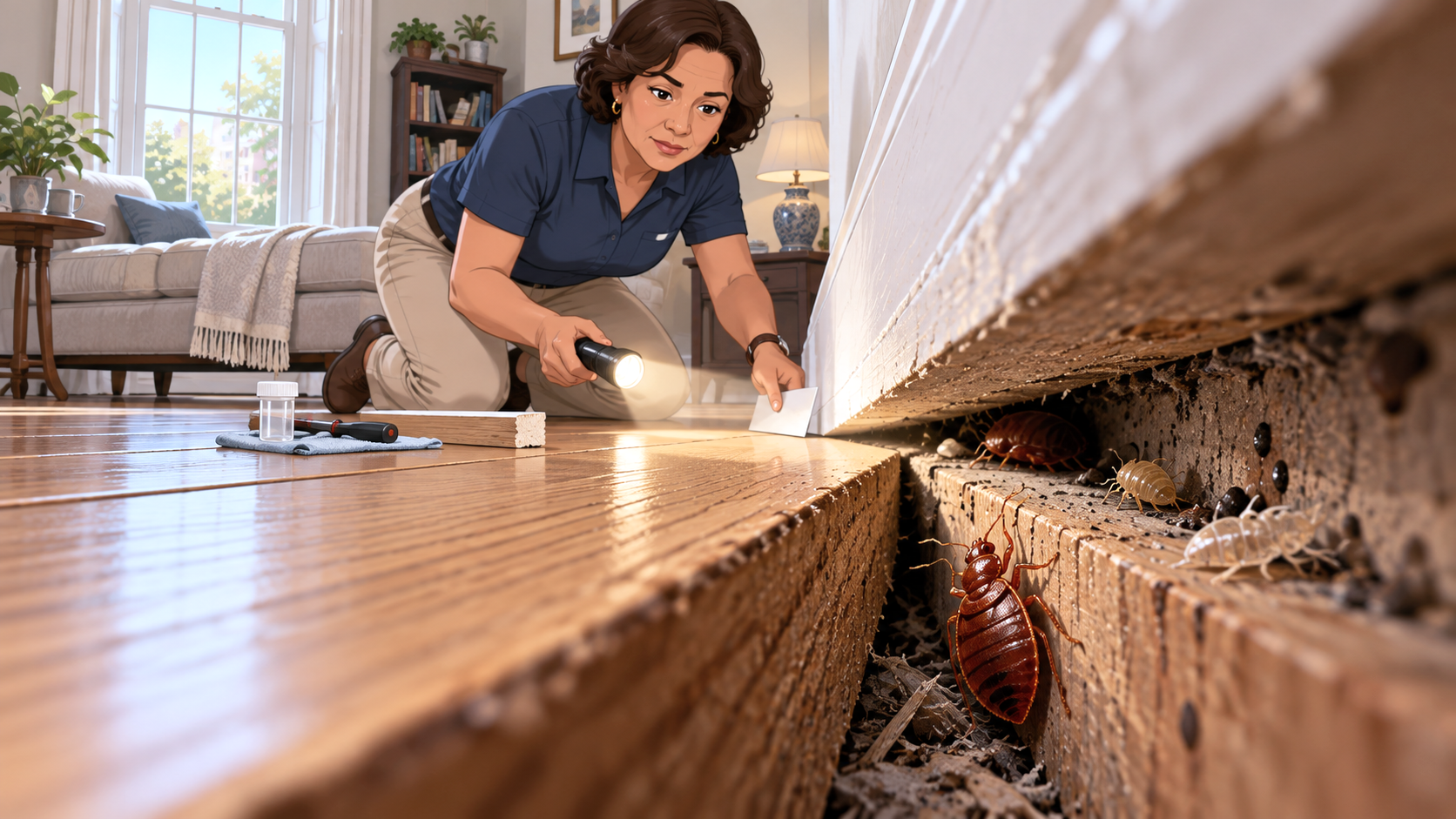
Hardwood flooring may look like an unlikely place for a bed bug to hide, especially compared with a mattress or upholstered furniture. The exposed wood itself isn’t usually the attraction. The gaps around and between boards are what matter. Bed bugs can hide in hardwood floors when cracks, gaps, or other openings give them enough space. They don’t burrow into solid wood or create holes themselves. Instead, they use existing floorboard gaps and nearby wall-floor junctions as harborages, particularly when those spaces are close to where people sleep.
A smooth, tightly fitted hardwood floor offers fewer obvious hiding places than an old floor filled with cracks, but hardwood doesn’t make a room bed-bug-proof.
Bed Bugs Hide Between Floorboards, Not Inside Solid Wood
Bed bugs are adapted to squeeze into extremely narrow spaces. The EPA notes that a crack wide enough to hold the edge of a credit card can potentially conceal a bed bug, which explains why flooring doesn’t need a large visible opening to become usable.
On hardwood, the places worth inspecting are gaps between boards, cracks in damaged boards, spaces where flooring meets baseboards, and openings around trim or other structural features. Bed bugs aren’t tunneling into the wood. They are taking advantage of spaces that already exist.
This is similar to what happens along the perimeter of carpet and rugs. In both cases, protected edges and gaps are more relevant than the broad exposed floor surface.
Older Hardwood Floors Can Offer More Hiding Places
Hardwood naturally responds to changes in moisture. Boards can expand when they absorb moisture and contract as they dry, which is why gaps can appear or become more noticeable under certain conditions.
Older, damaged, or poorly fitted flooring may therefore contain more accessible cracks than a tightly installed floor with very small joints. That can create additional potential harborages, but the age of a floor alone doesn’t tell you whether bed bugs are living underneath it.
Location matters too. A suitable floorboard gap beside an occupied bed is more relevant during an inspection than assuming every seam across the room is equally likely to contain bugs.
Bed bugs normally remain close to places where hosts rest, although established infestations can spread farther into a room. Finding activity around the floor should therefore prompt a broader inspection of the bed, furniture, and room perimeter rather than an attempt to examine every floorboard in isolation.
Vacuuming Can Remove Exposed Bed Bugs From Floor Cracks
Vacuuming is useful when bed bugs are accessible enough to be physically removed. A narrow attachment can help reach floor edges and some accessible cracks, although it cannot guarantee removal of everything hidden deep inside them.
The EPA recommends vacuuming as one physical component of bed bug control and emphasizes disposing of the vacuum contents carefully afterward. Cornell similarly recommends thorough vacuuming as part of an integrated approach.
Eggs present an additional problem because they are attached to surfaces. Vacuuming therefore shouldn’t be treated as proof that a floor crack is clear after one pass.
Our closer look at vacuuming for bed bugs explains where the method helps and where its limitations become important.
Sealing Floorboard Cracks Can Remove Hiding Places
One advantage of an accessible crack is that it may be possible to eliminate the harborage itself.
Cornell’s bed bug management guidance specifically recommends sealing crevices discovered during an inspection. For cracks in floorboards, Cornell suggests consulting someone familiar with the material because the appropriate filler can differ from the silicone caulk commonly used around windows or baseboards. It also notes that varnishing wood floors can eliminate hiding spots.
The EPA likewise recommends sealing small cracks and crevices as part of bed bug management because doing so reduces the protected spaces available to them.
That doesn’t mean sealing a few floor gaps eliminates an infestation. Bugs may already be established in the bed frame, mattress, box spring, furniture, baseboards, or other structural openings. Sealing works as one part of a broader control plan, not as a substitute for finding and addressing the population.
Don’t Assume Floor Activity Started in the Floor
Finding a bed bug in a hardwood gap doesn’t establish that the flooring is the center of the infestation.
The most productive inspection still begins around the sleeping area. Check the mattress, box spring, bed frame, headboard, and nearby furniture before expanding to flooring and structural gaps. The EPA identifies those bed-associated locations as common hiding places and notes that bed bugs may occupy more distant locations when an infestation becomes heavy.
Pay particular attention to the perimeter where the floor meets the wall. Gaps around baseboards provide another protected route and can connect what looks like floor activity with spaces along or inside a wall.
If bed bugs repeatedly appear from floor cracks despite cleanup and monitoring, the possibility of a deeper or more widespread infestation deserves professional assessment rather than increasingly aggressive work on the flooring itself.
Questions About Bed Bugs and Hardwood Floors
Can bed bugs live underneath hardwood flooring?
They can use accessible gaps and structural voids associated with flooring, but seeing a bed bug enter a floorboard crack doesn’t tell you how far beneath the surface it traveled. They don’t need to burrow through wood because existing cracks and voids can provide shelter.
Are engineered hardwood and solid hardwood different for bed bugs?
There isn’t good evidence showing that bed bugs specifically prefer one over the other. For an infestation, the more relevant question is whether the installed floor contains accessible gaps, cracks, edges, or other protected spaces.
Should you replace hardwood flooring because of bed bugs?
Usually not as a first response. Bed bug control should address the infestation throughout the room rather than assuming the flooring itself needs replacement. Accessible hiding places may be vacuumed, treated appropriately, or sealed as part of an integrated plan.
Should gaps between hardwood boards be sealed?
Sealing suitable cracks can reduce bed bug hiding places, but the material and method should be appropriate for the flooring. Cornell specifically recommends considering professional advice when filling floorboard cracks rather than assuming ordinary caulk is suitable for every wood floor.