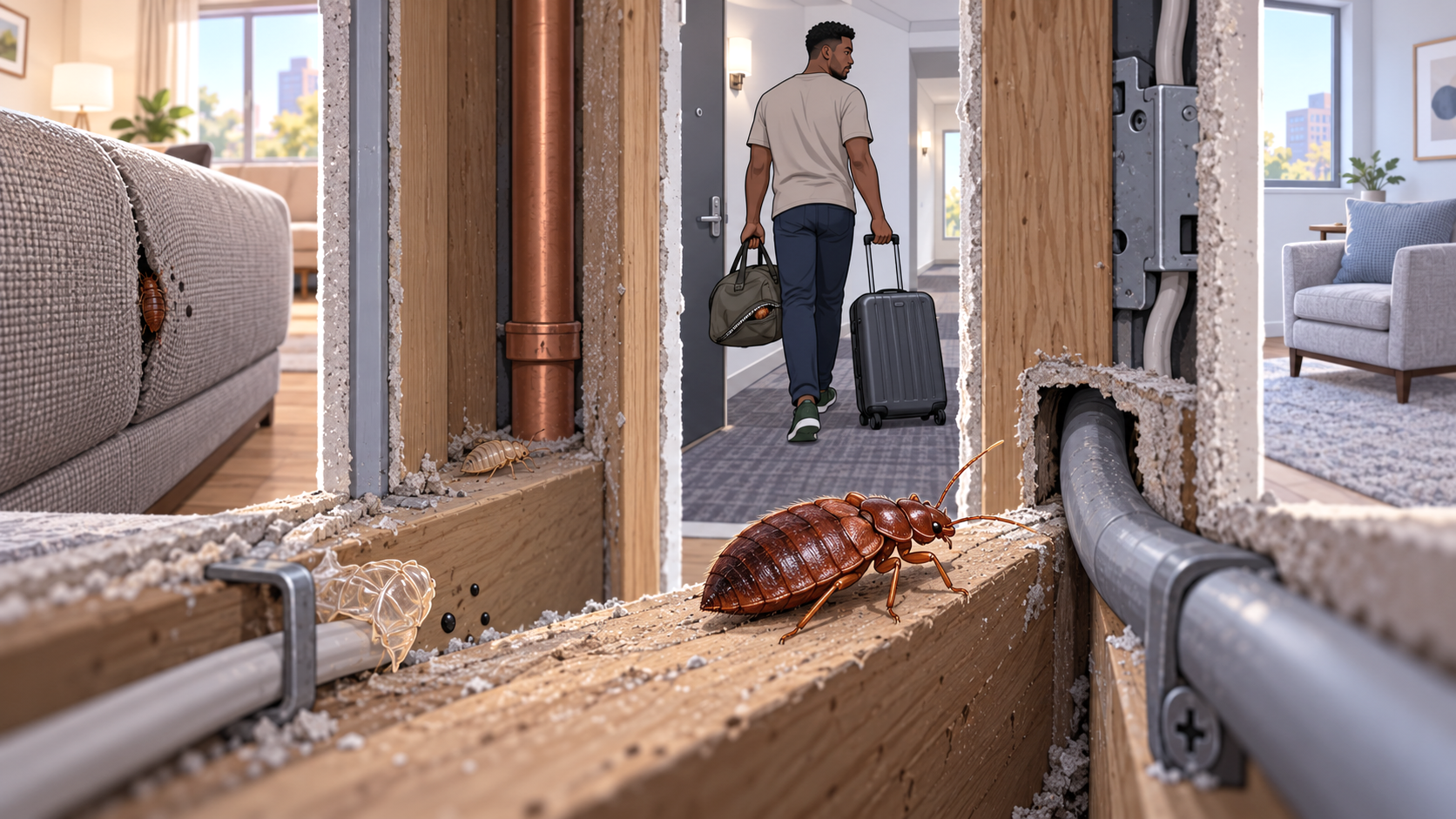
Bed bugs spread in two fundamentally different ways. They can crawl from one location to another on their own, and they can hitchhike much farther distances on belongings such as luggage, clothing, furniture, bedding, and bags. Inside a home or apartment building, active crawling can move an infestation into additional rooms or neighboring units. Between unrelated homes, hitchhiking on transported belongings is usually the more important mechanism. Treatment mistakes can also make control harder. Some products fail to reach bed bugs in protected harborages, while forceful steam or inappropriate pesticide use may disturb bugs without eliminating the infestation.
Bed Bugs Can Spread From Room to Room by Crawling
Bed bugs don’t fly or jump, but they are capable crawlers.
Most activity tends to concentrate around places where people regularly sleep or rest because bed bugs need repeated access to blood meals. As an infestation develops, however, bugs can be found farther from the original bed or furniture.
Field research has documented active bed bug movement within apartment buildings. In one mark-release-recapture study, marked bed bugs moved from their release apartments into neighboring units, demonstrating that bed bugs can disperse between apartments rather than relying exclusively on people to carry them.
They may travel along floors, walls, hallways, and structural openings. In multi-unit buildings, gaps around pipes, wiring, baseboards, wall voids, and other connections can provide potential routes between units.
That is why bed bugs spreading between apartments can require inspection beyond the apartment where they were first discovered.
Belongings Can Move Bed Bugs Much Farther
Hitchhiking allows bed bugs to travel distances they couldn’t realistically cover by crawling.
The EPA describes bed bugs as excellent hitchhikers that can be transported in luggage, folded clothing, bedding, furniture, boxes, and other belongings.
A backpack placed beside an infested bed, a suitcase left open in a hotel room, or furniture moved from an infested property can potentially carry a hidden bug to another location.
Bed bugs don’t have to remain permanently on clothing for this to happen. A bug only needs to enter a fold, seam, pocket, bag, or other protected location long enough for the object to be transported.
This is the primary distinction between movement within an infestation and long-distance spread. Crawling can expand an infestation locally, while hitchhiking allows bed bugs to appear in entirely separate homes, hotels, workplaces, and other buildings.
Moving Things Between Rooms Can Spread Bed Bugs
Once an infestation is discovered, unnecessary movement of untreated belongings can transport bed bugs to previously unaffected areas.
Clothing, bedding, bags, upholstered items, boxes, and other objects from an infested room should therefore be handled carefully. Don’t simply move everything into another bedroom or hallway while preparing for treatment.
The EPA recommends placing potentially infested clothing and bedding into sealed plastic bags before moving them for laundering. Once items have been successfully treated, place them into clean bags rather than returning them to potentially infested containers.
Dryer-safe clothing and bedding can be treated using dryer heat. The details of using a clothes dryer against bed bugs matter because washing alone isn’t as dependable as appropriate dryer heat for killing bed bugs.
Can Foggers Make Bed Bug Control Harder?
Total-release foggers, commonly called bug bombs, aren’t recommended as the sole method of bed bug control.
Bed bugs spend much of their time inside cracks, furniture joints, seams, and other protected spaces that fogger insecticides may not penetrate effectively. Laboratory research has also found poor performance of several total-release foggers against field-collected bed bugs.
The EPA warns that foggers should not be your only method of bed bug control. Misuse also creates pesticide exposure, fire, and explosion hazards.
Some pest-control guidance additionally warns that repellent insecticide applications can cause bed bugs to move from treated areas. However, it is too broad to assume that every fogger or DIY spray will automatically drive an infestation through the walls or turn a single-room infestation into a whole-house problem.
The stronger reason to avoid relying on bed bug bombs and foggers is that they may leave protected bed bugs alive while adding unnecessary safety risks.
Steam Can Scatter Bed Bugs If Used Incorrectly
Steam can kill bed bugs and eggs when it delivers sufficient heat, but application technique matters.
The EPA recommends steam of at least 130°F and warns that the airflow shouldn’t be forceful. Excessive air pressure can scatter bed bugs instead of allowing the heat to reach them effectively.
A diffuser can reduce airflow at the steam head. Steam should also be moved slowly enough to heat the treated material without simply blasting air through cracks and seams.
This doesn’t make steam a poor treatment. It means that using steam against bed bugs requires controlled heat delivery rather than maximum pressure.
Can Bed Bugs Spread Through Shared Laundry Rooms?
Shared laundry areas can create opportunities for bed bugs to be transported, particularly when untreated clothing and bedding are carried through communal spaces.
The greater concern is the handling and transportation of potentially infested belongings, not assuming that washing machines themselves are routinely infested.
The EPA recommends transporting infested laundry in sealed bags and placing it directly into the washer. After treatment, clean laundry should go into a clean bag rather than the container that originally held the untreated items.
Don’t leave infested clothing, bedding, baskets, or bags sitting around a communal laundry room.
Should You Move to Another Bedroom?
Changing where you sleep isn’t a reliable way to escape bed bugs and can complicate control.
Bed bugs locate hosts partly through cues including carbon dioxide, body heat, and odors. If the regular host begins sleeping elsewhere, some bugs may eventually move in search of another blood meal.
Instead of abandoning the affected bedroom, follow an appropriate treatment and monitoring plan unless a pest management professional gives different instructions for your particular situation.
If the infestation is spreading despite treatment, professional bed bug control may be appropriate.
Questions About Bed Bugs Spreading
How quickly can bed bugs spread to another room?
There isn’t a fixed timeline. Movement depends on the infestation, building layout, host locations, treatment, and whether infested belongings are being moved. A bed bug carried on an object can reach another room immediately, while active crawling occurs independently over time.
Can bed bugs spread through a vacuum cleaner?
A vacuum can remove accessible bed bugs, but captured bugs must be contained afterward. Empty the contents promptly into a sealed bag and dispose of them appropriately. More guidance is available on vacuuming bed bugs.
Can visitors carry bed bugs to another house?
It is possible for bed bugs to hitchhike on bags, clothing, or other belongings. They don’t normally live on people like lice, so the concern is transported objects rather than casual physical contact itself.
Does finding bed bugs in another room mean the infestation is severe?
Not necessarily. Finding bugs in multiple rooms shows that the infestation isn’t confined to the original location, but room distribution alone doesn’t reliably measure the total population.
2 thoughts on “How Do Bed Bugs Spread From Room to Room or Home to Home?”