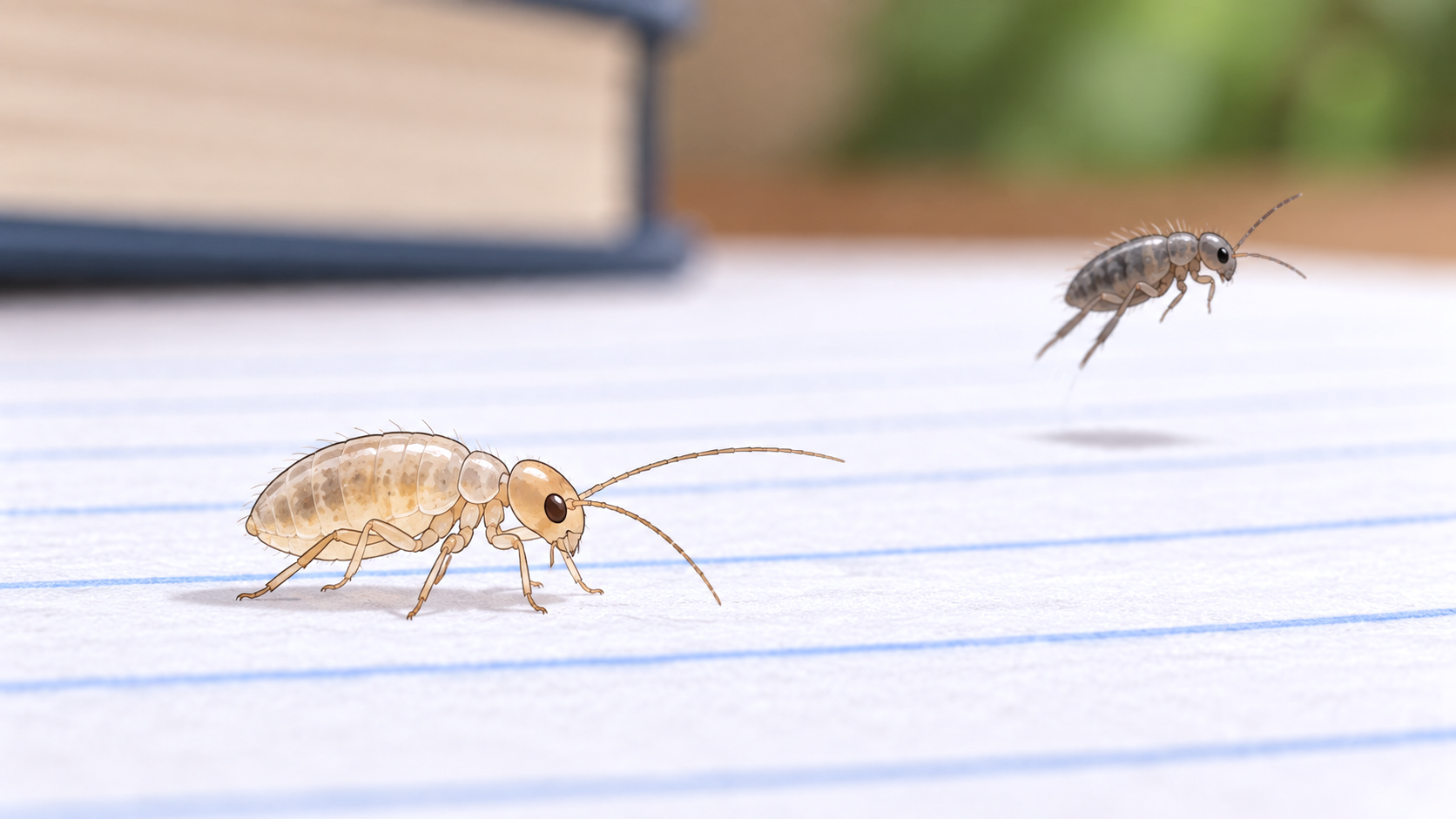
Household booklice crawl and run rather than springing through the air. Their fast, uneven movement may resemble a tiny hop when viewed without magnification. However, an insect that repeatedly launches itself from the surface when disturbed is more likely to be a springtail than a booklouse. For a pest barely longer than a printed period, movement can reveal more than color. Pale booklice disappear against paper, while darker ones blend into wood or mold spotting. Watching the route they take gives you an identification clue that does not depend on seeing every body part.
Booklice Stay on the Surface When They Move
The booklice most often found indoors belong to the family Liposcelididae. They are small, soft-bodied, wingless insects with flattened bodies suited to narrow gaps. Instead of using a springing organ, they travel on six legs. A disturbed specimen may run into a paper seam, beneath a food package, or behind loose wallpaper.
That short dash can look like a jump because the insect is so small. Your eye loses it for a fraction of a second and picks it up farther along the same surface. Magnification usually resolves the confusion. The insect remains in contact with the material as it runs, which matches the broader observation that psocids escape by running or flying rather than using the springtail’s catapult-like movement.
Body shape supplies the next check. A booklouse has a relatively large head, threadlike antennae, and a soft abdomen. Indoor species often look flattened from above. The photographs and proportions in our booklice appearance guide are more reliable than judging a moving speck by color alone.
A Real Jump Strongly Suggests a Springtail
Springtails are commonly found in the same damp rooms as booklice. Their shared preference for moisture creates the confusion, but their movement separates them quickly. A springtail has a forked appendage called a furcula folded beneath its body. When released, it strikes the surface and throws the animal into the air. That is why springtails are defined by their jumping escape.
Place a clear container over the specimen rather than poking it repeatedly. A springtail may strike the wall or lid after launching. A booklouse will continue across the base or hurry toward an edge. One accidental fall proves little, so look for the same response more than once.
This movement test is especially valuable around bathrooms, sinks, basements, new plaster, and houseplants. Both animals may be present there, and both can indicate excess moisture. The detailed differences in booklice versus springtails help confirm what the jump test suggests. Springtails are also described as tiny jumping creatures associated with moist areas, while indoor booklice are linked to damp materials that support fungi.
Do Not Identify Every Tiny Jumper as a Booklouse
Fleas, some small beetles, and other arthropods can also jump. Location narrows the possibilities. Fleas are laterally flattened and usually occur where people or animals spend time. Springtails gather around damp soil, drains, wet foundations, and condensation. Booklice are more closely associated with microscopic fungi on paper, cardboard, stored food, wall coverings, and similar materials.
Humidity should be part of the inspection regardless of which moisture pest you find. Booklice develop where dampness supports mold, and their presence may expose a leak or condensation problem before obvious water damage appears. The same room can support springtails for related environmental reasons.
Capture a specimen on clear tape if its movement remains ambiguous. A hand lens can reveal the broad head of a booklouse or the different body form of a springtail. Comparing it with other insects mistaken for booklice is safer than choosing a pesticide from one uncertain sighting.
What to Do After the Movement Test
Trace the insect back to the dampest nearby material. Inspect pipe joints, window frames, cardboard, wallpaper, plant saucers, and stored dry food. Fix the water source and lower humidity before considering chemical control. Indoor booklice usually decline when the environment can no longer support fungal growth, and moisture correction is the primary control measure.
Do not let the movement test become the entire diagnosis. A clear jump is powerful evidence against a typical household booklouse, but body structure and habitat should support the final identification.
Other Questions About How Booklice Move
Can booklice fly away when disturbed?
Common indoor booklice are wingless. The wider psocid group includes winged outdoor species, so a flying insect may still be a psocid without being the household booklouse you expected. Booklouse wing development explains that difference.
Can booklice crawl on walls and ceilings?
Yes. Their legs allow them to cross firm surfaces, including walls, shelving, window frames, and ceilings. A specimen may fall after losing its grip, but falling is not jumping.
Do booklouse nymphs jump?
No. Nymphs resemble smaller, paler adults and move on their legs. Their size makes their path difficult to follow, so magnification helps when examining baby booklice.
Can a booklouse move fast enough to disappear?
It can leave the visible area quickly by entering a seam or crack. On a patterned surface, losing sight of the insect may feel instantaneous even though it never left the surface.