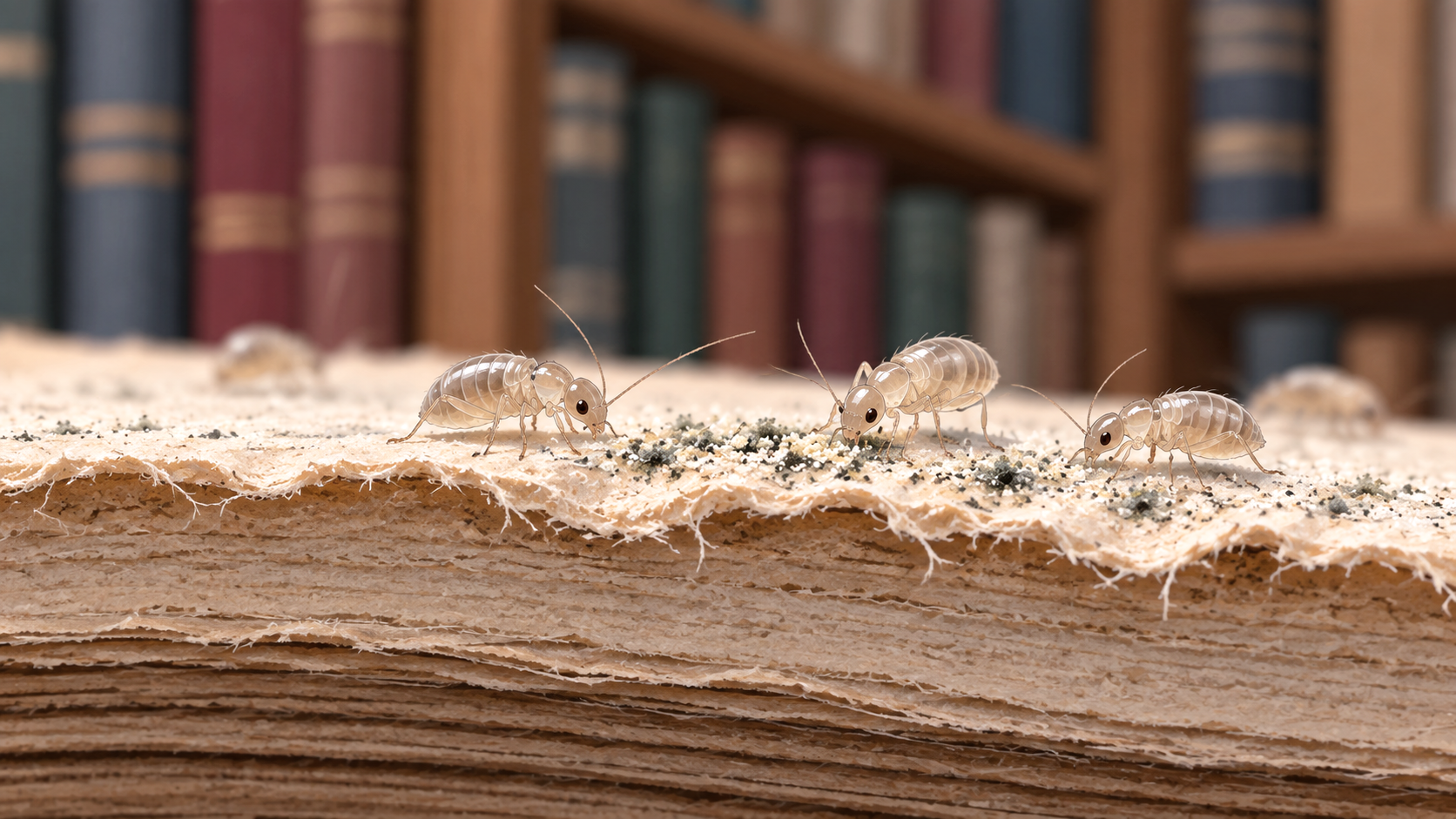
Finding tiny booklice crawling between pages or along a bookshelf makes it reasonable to wonder whether they are actually eating your books. The answer is more nuanced than their name suggests. Booklice are strongly associated with books and paper, but common household species primarily feed on microscopic mold and fungi growing on damp materials rather than consuming ordinary paper as their main food.
Booklice generally do not eat plain paper itself. They are commonly found on books because damp paper and bindings can support microscopic mold and fungi, which booklice eat. Some can also feed on starchy materials associated with books, including certain binding glues and starch sizing, so prolonged infestations can sometimes contribute to limited damage. This distinction matters because seeing booklice on a book does not automatically mean the pages are being eaten. In many homes, their presence says more about the moisture surrounding the books than about the paper itself.
Why Are They Called Booklice If They Do Not Normally Eat Paper?
The name comes from where these insects are frequently found, not from a requirement to eat books. Booklice are small psocids that commonly occur around books, papers, cardboard, stored foods, and other materials kept under humid conditions. Their tiny size allows them to move into bindings, between stored papers, and around narrow spaces on bookshelves.
Books can become particularly suitable when they absorb moisture. Damp conditions encourage microscopic fungi to grow on paper, bindings, adhesives, and accumulated organic material. Booklice then have both a protected habitat and a source of food.
That is why indoor booklice are commonly associated with paper, books, bookbindings and wallpaper where mold is growing. Their presence on those materials does not mean cellulose is necessarily what they are eating.
The name is misleading in another way too. Booklice are not parasitic lice. They belong to a broader group of psocids, and many common indoor forms belong to Liposcelis. Understanding what booklice actually are helps explain why their common name can cause so much confusion.
What Are Booklice Eating on a Book?
Often, they are eating fungi.
Household booklice feed heavily on microscopic molds and other fungal growth. A book stored in a humid basement, garage, storage room, archive, or poorly ventilated cupboard can absorb moisture and develop fungal growth long before obvious patches of mold appear.
This means a book can look perfectly normal while still providing microscopic food. Booklice can exploit fungal growth that you would never notice by casually looking at the pages.
This relationship is particularly important because booklice themselves thrive in humid environments. Dampness helps support the insects while also encouraging their food to grow. Their strong connection with mold and fungal spores explains why reducing moisture is usually much more useful than treating the books with insecticide.
The same relationship is explored more closely in why booklice eat mold. Books are simply one of many household materials on which that food can occur.
Can Booklice Eat Bookbinding Glue?
Some booklice can feed on starchy materials associated with books, including certain bookbinding glues. Household psocids are documented feeding on starchy material including glue from bookbindings.
That does not mean every adhesive used in every book is edible to booklice. Book manufacturing has changed considerably, and “bookbinding glue” can refer to adhesives with very different compositions. It would therefore be inaccurate to assume that booklice can digest any modern adhesive simply because it is holding a book together.
Older books and bindings containing suitable starch-based materials can offer more potential food. Moisture can make the situation worse by simultaneously encouraging fungal growth.
This gives booklice more reason to remain around a damp binding than around a clean, dry sheet of modern paper.
Can Booklice Eat the Edges of Pages?
There is some evidence that booklice can damage particular paper-related materials, so saying they categorically never damage books would go too far.
Booklice can feed on starch sizing associated with bindings and page edges. Guidance on booklice and silverfish notes that book damage can sometimes involve starch sizing in bindings and along page edges. This provides an important exception to the broader rule that household booklice are primarily fungal feeders.
However, this should not be confused with booklice consuming ordinary sheets of paper as their principal food. The type of material on or within the paper matters.
If the only evidence is several booklice walking across a page, there is no reason to conclude that they are eating through it.
Do Booklice Damage Books?
They can contribute to limited damage under suitable conditions, but major physical destruction is not typical of a household booklice infestation.
Current guidance describes booklice as insects that do not directly damage paper products in the manner of more destructive paper pests. Another household insect reference describes psocids as rarely damaging and primarily a nuisance, although occasional damage to paper products can occur.
Those statements fit with what we know about their feeding. Mold and fungi are major foods, while certain starch-containing components of books can also be used. The book itself is therefore part habitat, part potential food source, and part surface supporting the fungi they consume.
For a valuable collection, even limited activity is worth addressing because booklice usually indicate that the storage environment is too damp. Moisture and mold may ultimately pose a greater threat to the collection than the insects themselves.
Booklice Damage Looks Different From Silverfish Damage
If pages have obvious holes, irregular chewed areas, scraped surfaces, or extensive missing material, do not automatically blame booklice just because tiny insects are nearby.
Silverfish are much more strongly associated with direct feeding damage to paper and starch-rich materials. They can feed on paper products, wallpaper, adhesives, and other materials containing carbohydrates and starches. They are also dramatically larger than booklice and have an elongated, tapered body with three conspicuous tail-like appendages.
Booklice are tiny, broad-headed insects without those three long rear filaments. The differences between silverfish and booklice are usually substantial once you look closely.
This is one reason identifying the insect should come before assigning blame for damage. A pest found near damaged paper is not necessarily the pest that caused it.
Termites Can Damage Paper and Books Too
Termites provide another important comparison when the damage is extensive.
Termites consume cellulose and can feed on structural wood as well as paper and books. A serious termite problem can therefore produce physical destruction that would be completely out of proportion to a typical booklice infestation.
Booklice do not behave this way. They do not form termite-like colonies or tunnel through structural wood, and their presence does not indicate that the cellulose throughout a building is under attack.
If damaged books are accompanied by wood damage, mud tubes, swarmers, shed wings, or other suspicious structural evidence, investigate termites rather than assuming booklice explain everything. Booklice and termites may occasionally occupy damp environments, but their feeding behavior and potential consequences are very different.
Why Damp Books Are More Likely to Have Booklice
Moisture changes a book from an ordinary object into a much more suitable booklice habitat.
Booklice are highly dependent on humidity, and damp conditions encourage the fungi they eat. A book stored for years in a dry room therefore presents a very different environment from the same book stored against a damp basement wall.
The problem can become particularly noticeable when books are tightly packed. Limited airflow between books can slow drying, while shelving against a cool or damp wall can create localized humidity that differs from conditions in the middle of the room.
This helps explain why a humidity reading from across the room does not always tell you exactly what is happening inside a tightly packed bookshelf. The small spaces between books, behind shelving, or against an exterior wall can remain more favorable.
The relationship between survival and atmospheric moisture is covered in more detail in why booklice need humidity. For books, maintaining dry storage is one of the most useful preventive measures.
Can Booklice Live Inside Books?
Booklice can hide within the protected spaces a book provides, particularly around bindings, covers, and gaps between stored books.
Their flattened bodies and extremely small size allow them to use spaces that are easy for us to overlook. Eggs are also tiny and can be concealed with debris, making a light infestation difficult to detect.
However, a book is not a self-contained habitat that automatically supports booklice forever. The insects still need suitable environmental conditions and food. A collection maintained under dry conditions becomes much less favorable even if individual insects initially arrive with one of the books.
That distinction is useful when bringing secondhand books home. The possibility that a used book can transport a tiny insect is different from assuming every secondhand book represents an infestation.
Can Booklice Spread From One Book to the Rest of a Collection?
Yes, booklice can move between nearby books and other materials once they are present in a suitable environment.
A single affected book does not create an invisible barrier around itself. Adults and nymphs can crawl onto neighboring books, shelving, papers, cardboard, and other nearby surfaces. If the entire storage area is humid, several books may provide suitable habitats.
The more important question is whether the conditions that supported the original insects extend throughout the collection. If one damp box of books is moved into a dry room, the situation is different from an entire library stored against a chronically damp basement wall.
This is why inspecting the surrounding area matters. Look behind books, beneath shelving, around nearby cardboard, and along walls for condensation or other moisture. If you find repeated activity across multiple locations, the issue is no longer limited to one book.
Should You Throw Away Books With Booklice?
Not automatically.
Finding several booklice on a book does not mean the book is ruined. For ordinary books with no serious mold or physical deterioration, removing the insects and correcting the storage environment may be enough. The priority is to prevent continued moisture and fungal growth.
Books with extensive mold contamination require a different judgment because the mold itself can damage the material and may present handling concerns. Valuable, historic, rare, or irreplaceable books also deserve more conservative treatment than inexpensive replaceable paperbacks.
Avoid soaking books with household pesticides, bleach, rubbing alcohol, essential oils, or other improvised treatments. These substances can damage paper, inks, coatings, adhesives, and bindings while failing to address the humidity supporting the infestation.
For an affected collection, getting rid of booklice in books should focus on protecting the books while making their environment unsuitable for the insects.
Dry Storage Is the Best Protection for Books
The most effective way to make a book collection unattractive to booklice is to keep it dry.
Household psocids are strongly moisture-dependent and do not survive when relative humidity remains below roughly 45 to 50 percent. Lower humidity also suppresses the fungal growth that provides much of their food, so dryness works against the infestation in two ways.
This does not mean briefly lowering the room to 49 percent instantly eliminates every insect. Humidity needs to remain low enough for long enough to affect the habitat, and hidden damp areas can persist even when a room hygrometer gives a reassuring reading.
Keep books away from known leaks and chronically damp walls, avoid storing cardboard directly on wet basement floors, improve airflow where books are tightly packed, and investigate condensation or musty odors around shelving. These measures are more useful for preventing booklice than repeatedly killing individual insects while leaving the collection humid.
Questions About Booklice, Paper, and Books
Do booklice eat ordinary printer paper?
Plain paper is not the primary food associated with household booklice. They are much more strongly associated with fungi growing on damp paper and with certain starchy materials. Finding a booklouse on printer paper does not prove that it is eating the sheet.
Can booklice destroy a book collection?
Booklice are generally minor nuisance pests rather than major paper destroyers. Some feeding on starch-containing book materials can occur, but persistent moisture and mold may pose the greater threat to a collection. Obvious extensive feeding damage should also prompt identification of other paper pests.
Do booklice eat cardboard?
Booklice commonly occur around damp cardboard, where fungal growth can provide food. Their presence does not necessarily mean they are directly consuming the cardboard fibers themselves.
Why are booklice between the pages of my books?
Books provide narrow protected spaces, and damp books can support microscopic fungi. Booklice may therefore hide and feed around pages and bindings without the pages themselves being their primary food.
Can booklice survive in completely dry books?
Dry conditions are unfavorable to household booklice. Even if insects arrive with a book, maintaining sufficiently low humidity makes continued survival and reproduction much harder while also suppressing the fungal growth they commonly eat.
4 thoughts on “Do Booklice Eat Paper and Books?”