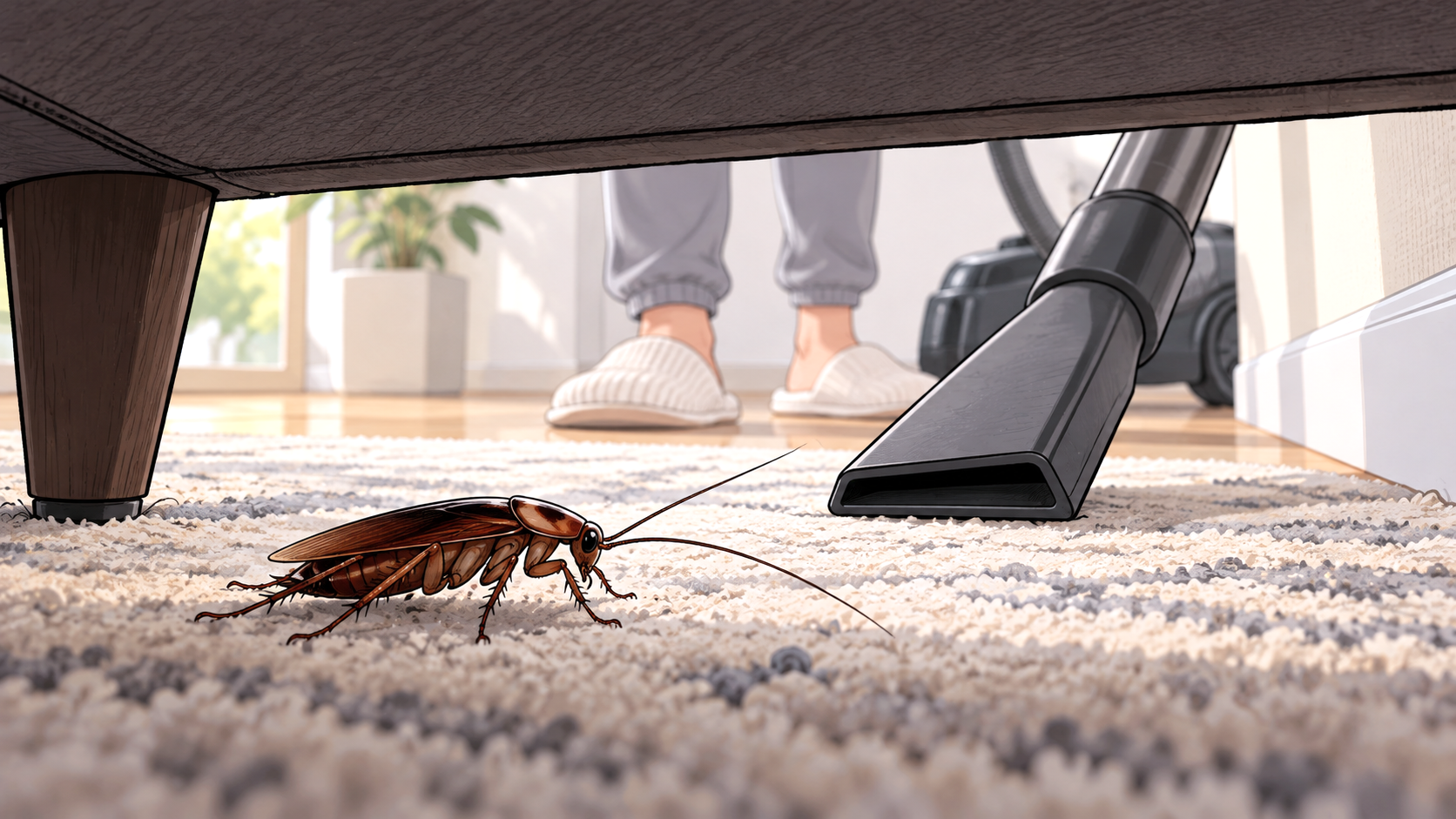
A cockroach disappearing into a vacuum hose is no longer running across your floor, but that does not necessarily mean it is dead. The insect may survive inside the dust compartment, particularly if the vacuum is emptied before the contents have been securely contained.
Yes, you can vacuum cockroaches. It is an effective way to capture live insects and remove accessible cockroach debris, but suction alone does not reliably kill them. The safest approach is to use a vacuum with effective filtration, collect the insects through a hose attachment, and promptly seal and discard the collected material.
The type of vacuum matters, especially when dealing with more than one insect or substantial accumulated debris.
Can Cockroaches Survive Inside a Vacuum Cleaner?
Cockroaches can survive being vacuumed. Although suction, collisions inside the hose, and contact with debris may injure or kill some individuals, none of those effects guarantees death.
The University of Nebraska–Lincoln’s Cockroach Management Manual explicitly identifies vacuuming as an effective removal method while noting that vacuuming itself does not kill cockroaches.
Survival depends on the vacuum’s construction, the force of collection, and conditions inside the compartment. A cockroach captured in an almost empty dust container may remain alive, while one collected with considerable dust and debris may experience greater physical stress.
If the machine has accessible gaps or the compartment is opened indoors, surviving insects may escape. The ability of cockroaches to climb surfaces makes an open collection container unsuitable for holding them.
Do not leave a vacuum containing live cockroaches sitting indoors for days. Even if the insects eventually die, the machine is not intended to function as a pest-holding container.
How to Vacuum a Live Cockroach Without Losing It
A hose with a crevice attachment allows you to approach a cockroach without placing the entire vacuum against the surface. Keep the nozzle close enough to capture the insect promptly, avoiding repeated attempts that may drive it into an inaccessible opening.
The EPA’s integrated pest management guidance identifies strong vacuums and crevice attachments as useful for collecting cockroaches from cracks, beneath furniture, and other accessible spaces.
For a cockroach on a hard floor, approach with the nozzle positioned directly in its likely path. When the insect is partly beneath furniture, use the attachment only where there is sufficient clearance to avoid damage. Do not insert a metal attachment into electrical equipment or disturb exposed wiring.
Where several cockroaches occupy the same accessible crevice, continuous suction may collect multiple insects before they disperse. The speed at which cockroaches move makes it easier to intercept them with a nearby nozzle than to chase them individually across the room.
Check that the vacuum’s collection compartment is properly installed before beginning. A damaged seal, loose hose connection, or missing filter can compromise containment.
Bagged vs. Bagless Vacuums: Which Is Better?
Both types can capture cockroaches, but their disposal arrangements differ substantially.
| Vacuum type | Advantage | Main limitation |
|---|---|---|
| Bagged vacuum | The collection bag can often be removed with relatively little contact with its contents | A bag without a secure closure may allow insects or debris to escape |
| Bagless vacuum | Captured insects may be visible through a transparent compartment | Emptying can expose the user to live insects and airborne debris |
| HEPA-filtered vacuum | Helps retain fine cockroach allergens and dust | Filtration does not kill the insects |
| Handheld vacuum | Convenient for an isolated accessible insect | Small compartments and limited filtration may complicate disposal |
| Wet/dry shop vacuum | Can provide strong suction and accommodate larger amounts of debris | Filtration and containment vary; not every model is suitable for fine allergenic dust |
A bagged vacuum with a self-sealing disposable bag offers a practical advantage when collecting live cockroaches because the contents can remain enclosed during removal. Bagless machines require greater care when the compartment is opened.
For larger amounts of cockroach debris, filtration becomes particularly important. The EPA’s indoor particulate matter guidance recommends HEPA-filtered vacuuming to reduce the redistribution of fine dust and allergens.
A vacuum advertised as having a HEPA filter is not necessarily completely sealed. The EPA’s explanation of HEPA vacuum construction distinguishes machines designed to direct all exhaust air through the filter from equipment that merely accepts a HEPA filter attachment.
For substantial contamination, choose a machine with effective whole-system filtration rather than relying on suction power alone.
How to Empty a Vacuum After Collecting Cockroaches
Dispose of the collected contents promptly, preferably outdoors, to reduce the possibility of surviving insects escaping into the house.
For a bagged vacuum, switch off and unplug the machine, remove the bag according to the manufacturer’s instructions, and place it directly into a sturdy plastic rubbish bag. Seal the outer bag securely before placing it in an outdoor waste container.
With a bagless vacuum, take the machine outdoors before opening the dust compartment. Empty the contents directly into a suitable bag, minimizing shaking and dust release. Close the bag immediately and wash the collection compartment afterward if the manufacturer permits it. Allow washable components to dry completely before reassembly.
The National Pesticide Information Center’s cockroach recommendations specifically advise promptly sealing vacuum bags after collecting cockroaches. Freezing a sealed, removable vacuum bag is another option it identifies for killing captured insects, provided the bag and its contents are suitable for freezing.
Do not place an entire vacuum cleaner or electrical assembly in a freezer. Nor should insecticide be sprayed into the hose or dust compartment to kill surviving cockroaches.
If an insect remains visible inside a transparent compartment, avoid repeatedly opening the machine to check whether it is dead. Secure containment and disposal are more dependable than waiting for the insect to stop moving.
Can Cockroaches Crawl Back Out Through the Hose?
A surviving cockroach may be capable of moving through parts of a vacuum cleaner if its internal construction permits passage. However, escape is not inevitable, and a particular insect’s ability to return through the hose depends on the machine’s design.
Some vacuums contain internal flaps, filters, or barriers that restrict movement. Others have relatively open pathways between the hose and collection chamber. An insect remaining inside a machine with an open or improperly fitted compartment presents an avoidable escape risk.
The University of Minnesota’s cockroach guidance recommends vacuuming as a useful collection method, particularly when combined with other measures, rather than treating the vacuum itself as a killing device.
Do not assume that switching off the machine permanently traps everything inside. Prompt disposal removes the uncertainty surrounding what a captured insect can do after suction stops.
Why HEPA Filtration Matters When Vacuuming Cockroaches
Vacuuming a live insect and vacuuming an accumulation of cockroach debris create different exposure concerns.
Cockroach droppings, shed skins, and body fragments contain proteins capable of triggering allergic reactions in susceptible people. A poorly filtered vacuum can stir fine particles into the surrounding air while collecting larger debris.
The EPA’s pest-management recommendations for housing managers specifically recommend HEPA-filtered vacuums when removing cockroaches and their debris because they help limit airborne allergens.
The health concerns associated with cockroach droppings become particularly relevant when dried deposits have accumulated in enclosed spaces.
Vacuuming should therefore be performed with appropriate filtration when significant contamination is present. People with asthma or substantial cockroach allergies may benefit from having someone else carry out the work while they remain away from the affected area.
Filtration also requires maintenance. A clogged filter can reduce performance, while a damaged or improperly fitted filter may allow particles to bypass the intended filtration pathway. Follow the manufacturer’s instructions for replacement and cleaning.
Can Vacuuming Spread Cockroaches Around the House?
Vacuuming generally removes cockroaches from the surface being cleaned, but careless handling of the equipment can create opportunities for dispersal.
The principal risks involve leaving captured insects inside the machine, opening the compartment indoors, or moving contaminated equipment between rooms without disposing of its contents.
For an isolated cockroach, emptying the vacuum after capture is straightforward. When collecting numerous insects from several areas, avoid leaving the machine unattended with a full compartment or repeatedly opening it in different rooms.
Cockroaches can occupy concealed spaces around furniture and building fixtures, and vacuuming those areas may remove insects that would otherwise remain inaccessible. However, suction cannot guarantee that every individual within a deep structural cavity has been collected.
A vacuum should not be used to deliberately disturb electrical components, dismantle equipment, or blow air through concealed spaces in an attempt to force cockroaches into another room.
Will Vacuuming Get Rid of an Infestation?
Vacuuming can substantially reduce the number of accessible cockroaches in a heavily affected area, making it a useful immediate removal method. It does not establish that insects concealed beyond the nozzle’s reach have been eliminated.
The EPA’s integrated pest management manual describes thorough vacuuming as especially useful for rapidly reducing large cockroach populations before other management measures are carried out.
The results also depend on which insects were collected. Removing visible adults does not necessarily remove smaller individuals occupying inaccessible cracks, and surviving females may continue reproducing.
After vacuuming, the evidence used to determine whether cockroaches are gone remains important. Repeated sticky-trap captures or fresh sightings indicate continued activity, even when the floor appears free of insects.
Vacuuming is therefore an effective capture tool, not proof of extermination. Its immediate benefit is removing accessible insects while keeping the collected material contained until disposal.