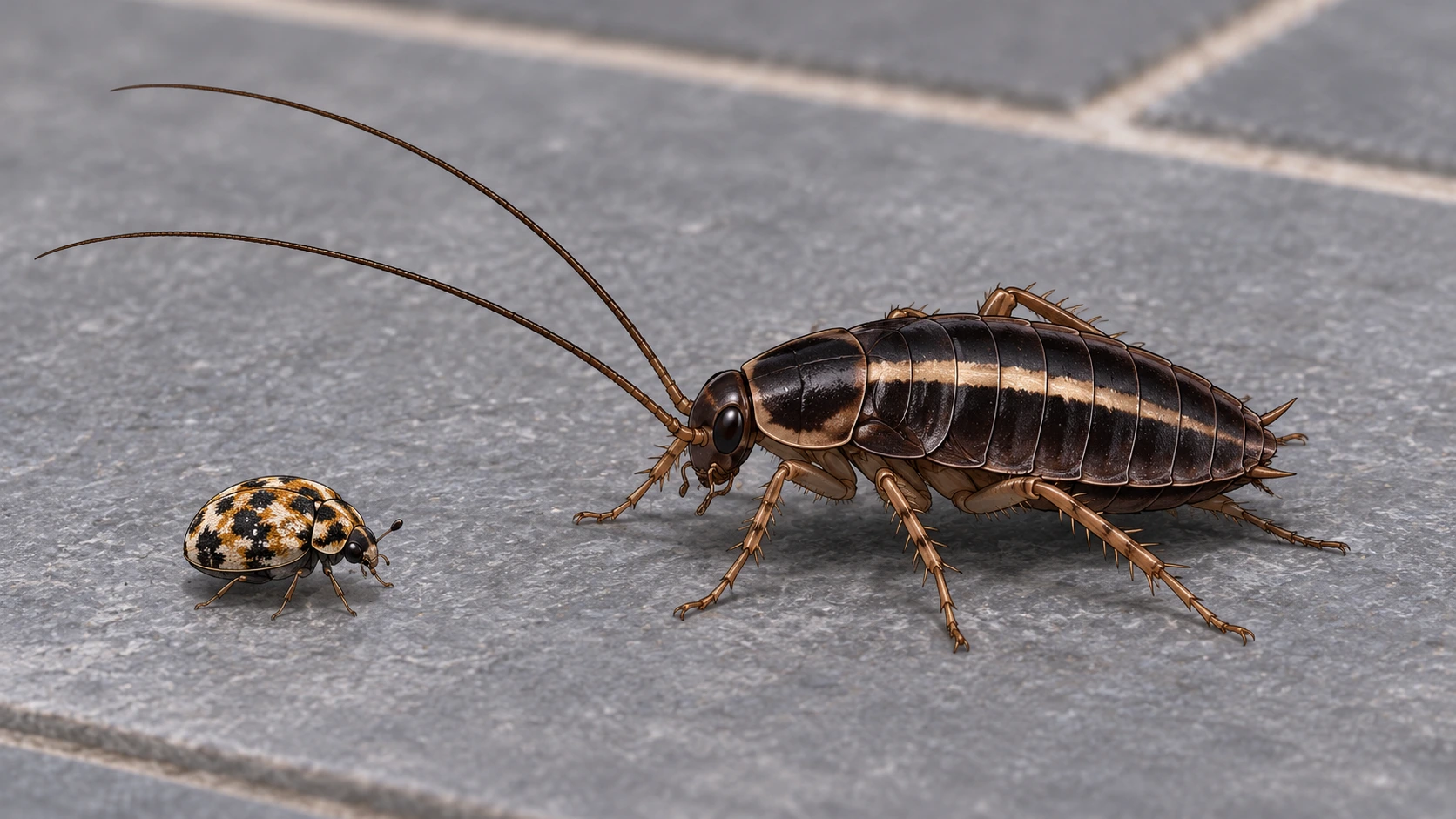
Carpet beetles are small, rounded or oval beetles with short antennae, while cockroaches have flatter bodies, long antennae, and prominent spiny legs. The difference becomes particularly important when comparing a dark carpet beetle with a baby cockroach. Young cockroaches are smaller and usually wingless, but they already have the flattened body and long appendages characteristic of roaches.
A tiny brown insect crossing a bedroom floor can be difficult to identify without a closer look. Black carpet beetles may be mistaken for young cockroaches because both can appear dark and oval. Some cockroach nymphs have pale markings that make them look patterned, while worn carpet beetles can lose the scales that normally distinguish their species.
The clearest identification comes from looking at the insect’s overall profile, antennae, legs, wing structures, and rear end. Where it was found provides supporting evidence, but a beetle in the kitchen does not become a cockroach simply because kitchens are associated with roaches.
Carpet Beetle vs. Cockroach: The Main Differences
Both insects have six legs and a recognizable head, thorax, and abdomen. Their body shapes and appendages, however, are built quite differently.
| Feature | Adult carpet beetle | Adult cockroach | Baby cockroach (nymph) |
|---|---|---|---|
| Body shape | Compact, rounded to elongated oval, usually convex | Broad, oval, and flattened | Flattened and oval, resembling a miniature adult |
| Antennae | Short, usually club-shaped | Long, thin, threadlike | Long, thin, threadlike |
| Legs | Relatively short and often partly hidden under the body | Long, conspicuous, and spiny | Spiny and well developed |
| Wings | Hardened forewings form a protective shell | Wings vary by species; usually lie flat over the back when present | Absent in young nymphs; developing wing pads may appear in older nymphs |
| Rear appendages | No pair of cockroach-style cerci | Paired cerci at the end of the abdomen | Paired cerci |
| Typical appearance from above | Rounded shell or elongated beetle outline | Flattened body with conspicuous legs and antennae | Smaller flattened roach outline |
| Development | Egg, larva, pupa, adult | Egg, nymph, adult | Nymph becomes an adult without a pupal stage |
The comparison describes the usual household carpet beetles and cockroaches. Individual roach species differ in adult size, wing development, and body markings.
For a small, unfamiliar insect, antennae and rear appendages are especially helpful. These features often remain recognizable even when color and body markings are unclear.
The Body Shape Is the First Clue
An adult carpet beetle generally looks like a tiny seed with legs underneath it. The back is rounded or gently domed, creating a noticeable convex shape when viewed from the side.
The varied carpet beetle, Anthrenus verbasci, is particularly rounded. Its body may look almost circular from above. The black carpet beetle, Attagenus unicolor, is more elongated, but still has the compact, convex profile of a beetle.
Cockroaches have a different arrangement. Their bodies are usually broad and flattened, allowing them to enter narrow spaces. From above, the abdomen and thorax form an oval outline, but the insect does not have the same compact, domed shell.
Young cockroaches maintain this general body plan. They are not round-bodied larvae that later transform into recognizable roaches. A newly hatched nymph already has the general shape of a cockroach, although its proportions and markings change as it grows.
The distinction is well established in cockroach identification guidance, which describes flattened oval bodies, long antennae, spiny legs, and wingless nymphs.
An overhead photograph can obscure the difference in height. If possible, examine the insect from the side. A distinctly domed, seedlike body favors a carpet beetle. A low, flat body with long projecting legs favors a cockroach.
Antennae Can Separate Them Even When Both Are Dark
Antennae are among the strongest features for distinguishing adult carpet beetles from baby roaches.
Carpet beetles have relatively short antennae. In the common household species, the tips are enlarged into a club-like structure. The antennae may be tucked close to the head and can be difficult to notice without magnification.
Cockroaches have long, slender antennae made of numerous segments. They are flexible, threadlike structures that project forward and frequently extend a substantial distance beyond the head.
A cockroach nymph has these long antennae even before developing wings. This is a critical feature when comparing a tiny black nymph with a dark adult beetle.
Imagine two insects of similar body length. One has antennae that barely extend beyond its rounded front. The other has thin, sweeping antennae nearly as long as its body. The second insect is much more consistent with a cockroach.
Some adult carpet beetles have species-specific differences in antennal structure, including males with unusually long terminal antennal segments. Nevertheless, their antennae do not generally resemble the long, threadlike pair characteristic of cockroaches.
The dermestid beetle identification characters include clubbed antennae and a rounded to oval body covered in fine hairs or scales.
If the antennae are missing or broken, rely on the insect’s body profile, legs, and rear appendages rather than trying to identify it by color.
Look for Two Small Appendages at the Rear of a Cockroach
Cockroaches have paired structures called cerci at the tip of the abdomen.
The cerci are sensory appendages that help cockroaches detect changes in their surroundings. Depending on the species and size of the insect, they may resemble two short, pointed projections extending from the rear.
Cockroach nymphs also have cerci, so this feature can help identify an immature roach.
Adult carpet beetles do not have an equivalent pair of conspicuous cockroach-style cerci. Their rear outline is normally formed by the hardened wing covers and underlying body.
The distinction is particularly useful when the insect’s antennae are difficult to photograph. If a specimen has a flat body, long legs, and paired rear projections, those features together strongly favor a cockroach.
Very small nymphs may require magnification before the cerci can be seen clearly. A missing or obscured cercus also should not be used by itself to rule out a cockroach.
Be careful not to confuse cerci with the tail hairs of carpet beetle larvae. A carpet beetle larva can have a conspicuous tuft of bristles at its rear, but that tuft is made of hairs rather than the paired sensory appendages of a cockroach.
Carpet Beetle Legs vs. Cockroach Legs
Cockroaches are built for running. Their legs are long, strong, and equipped with visible spines, especially along the lower leg segments.
The legs extend noticeably to either side of the flattened body. Even a small cockroach nymph often has a relatively leggy appearance when viewed from above.
Carpet beetles also have six legs, but the legs of an adult are generally shorter in relation to the body and less prominent. A rounded adult may appear to sit close to the surface with much of its legs concealed beneath the shell.
This difference is often visible before fine details such as antennal clubs or cerci can be resolved.
The legs also contribute to characteristic movement. Cockroaches are capable of very rapid running and often retreat into crevices when disturbed. Carpet beetles usually move more slowly and deliberately across household surfaces.
Movement alone is not conclusive. A cold or injured cockroach may move slowly, while a carpet beetle can become more active when disturbed.
Use movement to support identification, not replace the structural features.
A dark insect running rapidly under a refrigerator, with long antennae and spiny legs, deserves closer investigation as a cockroach. A compact, rounded beetle crawling across a windowsill is more consistent with a carpet beetle.
Can a Black Carpet Beetle Look Like a Baby Roach?
Yes. This is probably the most convincing source of confusion between the two groups.
Adult black carpet beetles are typically small, dark, and elongated oval. They lack the bright mottled scales of varied carpet beetles, so a quick glance may reveal little more than a black or dark brown insect.
An early-stage German cockroach nymph can also be dark, small, and oval. Without magnification, someone may mistake one for the other.
The difference becomes clearer when the appendages are examined.
A black carpet beetle has short antennae, a rounded upper surface, relatively short legs, and hardened wing covers. A German cockroach nymph has long antennae, conspicuous running legs, a flatter body, and no adult wings.
The two insects also have very different developmental histories. The black carpet beetle is already an adult when it has the recognizable smooth, dark beetle body. A small German cockroach nymph is immature and will grow through additional molts.
The black carpet beetle description identifies adults as small, black, oval beetles measuring approximately 3–5 mm. This overlaps the size of some young cockroach nymphs, making body length an unreliable deciding feature.
A dark, wingless-looking insect should not be called a baby roach until its antennae, legs, and body form support that identification.
What Do Baby German Cockroaches Look Like?
The German cockroach, Blattella germanica, is one of the most important indoor-infesting cockroach species. Its nymphs are a useful example because they are small enough to be confused with household beetles.
Young German cockroach nymphs are commonly dark brown to nearly black with a lighter area or stripe along the back. The pattern changes as they develop, and very young individuals may look darker overall than mature nymphs.
Adults usually have two dark, lengthwise stripes on the shield immediately behind the head, while the immature forms have different patterns extending across the back.
The nymphs lack fully developed wings, but their long antennae and spiny legs are already present.
This is why the absence of wings is not a useful way to distinguish a carpet beetle from a baby German cockroach. The correct comparison is between an adult beetle with hardened wing covers and an immature cockroach whose wings have not developed.
The German cockroach identification details describe the darker nymphs, their longitudinal markings, and the adult’s characteristic pronotal stripes.
Other cockroach species can have quite different nymph patterns. Brown-banded cockroach nymphs, for example, may show pale crosswise bands rather than the lengthwise pattern associated with German cockroaches.
Consequently, a dark nymph without a clear pale stripe is not automatically excluded from being a cockroach. Long antennae, flattened shape, cerci, and spiny legs remain more dependable than a particular color pattern.
Are Carpet Beetle Larvae Ever Mistaken for Baby Cockroaches?
They can be, but the two immature forms are structurally very different.
Carpet beetles undergo complete metamorphosis. Their life cycle includes egg, larva, pupa, and adult. The larva usually bears obvious hairs or bristles, has a segmented body, and may taper toward one end.
Cockroaches undergo incomplete metamorphosis. They develop from eggs through a series of nymphal stages before becoming adults. A cockroach nymph resembles a smaller wingless adult rather than a hairy beetle grub.
That difference can be expressed simply: a carpet beetle larva looks nothing like an adult carpet beetle, while a cockroach nymph already resembles an adult cockroach.
Carpet beetle larvae can have conspicuous rear tufts of hair. These are especially noticeable in some Attagenus species. The overall body can look banded or fuzzy.
Cockroach nymphs have a smoother-looking, flattened upper surface and visible jointed legs extending beyond the body. Their paired cerci are not tufts of fine hairs.
A larva lying among old wool fibers may be mistaken for a roach if only its size and brown color are considered. However, once the bristled body and short appendages are visible, the identification usually becomes much clearer.
The separate carpet beetle larval appearance guide addresses differences among beetle larvae. For this comparison, the main point is that a hairy grub is not the normal juvenile form of a cockroach.
Do Adult Carpet Beetles and Cockroaches Have the Same Wings?
Both groups can have wings as adults, but their wing structures differ.
Adult beetles have hardened forewings called elytra. These form protective covers over the delicate hind wings and typically meet along a straight line down the center of the back.
The elytra produce the firm, shell-like appearance of adult carpet beetles.
Cockroach wings are arranged differently. When present, the forewings are leathery rather than forming the rigid, symmetrical shell characteristic of beetles. They lie over the body, and the extent of development varies among cockroach species and sexes.
Some adult cockroaches have short wings or are effectively wingless. It is therefore incorrect to identify an insect as a nymph solely because its wings are absent.
A carpet beetle’s rounded back may make the central seam difficult to see. Patterned scales can also obscure details on the wing covers.
If a clear photograph shows hard, matching wing covers meeting along the middle of a convex body, that favors a beetle. If it shows a flat roach-shaped insect with long antennae and leathery overlapping wings, that favors an adult cockroach.
Wing structure is most useful for distinguishing adults. A wingless cockroach nymph must be identified using the other features.
Why Color Is a Poor Identification Method
Carpet beetles can be black, brown, or mottled with white, yellow, orange, and darker scales. Cockroaches can be tan, reddish brown, nearly black, or patterned with pale bands and stripes.
That creates substantial overlap.
A worn varied carpet beetle may have lost many of its pale scales and appear much darker than a freshly emerged individual. A small cockroach nymph may carry pale markings that superficially resemble patterned beetle scales.
Lighting also changes how the insects appear. A glossy dark shell can look brown under warm artificial light and almost black in daylight.
Even the color of a cockroach can change temporarily after molting. Newly molted nymphs may appear pale before their outer covering darkens and hardens.
A white or unusually pale roach is not necessarily a different species. Nor does a dark beetle automatically belong to the black carpet beetle species.
The more useful question is whether the insect has short clubbed antennae and a convex beetle body or long threadlike antennae and a flattened roach body.
For identification among carpet beetle species themselves, the varied-versus-black carpet beetle comparison examines differences that should not be confused with the broader beetle-versus-cockroach distinction.
Does Where You Found the Insect Help?
Location can provide supporting evidence, especially when the specimen is too small for easy identification.
Adult carpet beetles are frequently noticed near windows. Many are attracted to light, and adults of several common species feed on pollen or nectar outdoors.
Their larvae may be found near stored wool, animal-derived materials, accumulated hair, lint, or dead insects.
Indoor pest cockroaches are more commonly associated with sheltered locations that provide food, water, and hiding places. Kitchens and bathrooms are important environments for some species, particularly German cockroaches.
However, both insects can be encountered outside their most familiar locations.
A carpet beetle can appear in a kitchen, and a cockroach can move into a bedroom or living room. A roach near a window is still a roach if its anatomy identifies it as one.
The location therefore changes the list of plausible explanations, but it cannot override the insect’s physical features.
Consider two discoveries. A tiny round beetle with short antennae on a sunny windowsill is consistent with a carpet beetle. A flattened, long-antennaed nymph beneath a kitchen sink is consistent with a cockroach.
If those locations were reversed, the structural evidence would remain more important than the room.
Does Finding One Mean You Have an Infestation?
The meaning of one sighting differs between the two groups.
An individual adult carpet beetle may have entered from outdoors. Finding one by a window does not establish that larvae are developing inside the home.
A single cockroach can also enter accidentally, depending on the species. However, identifying a German cockroach nymph indoors is more concerning because nymphs do not fly and are generally associated with nearby breeding and hiding areas.
One nymph does not establish the exact size or extent of an infestation. It does provide a stronger reason to inspect for additional cockroaches than an isolated adult carpet beetle near a window provides for assuming an established carpet beetle population.
Carpet beetle evidence becomes more compelling when live larvae, repeated cast skins, and fresh damage occur in suitable materials.
Cockroach activity may be supported by multiple nymphs, characteristic droppings, egg cases, or repeated sightings in sheltered areas. These signs should be interpreted together rather than treated as conclusive when found individually.
The question addressed in found one carpet beetle: what it actually means is particularly relevant when the insect is a confirmed adult beetle rather than a cockroach nymph.
Correct identification changes what evidence should be sought next.
Carpet Beetle Shed Skin vs. a Baby Roach
An empty carpet beetle larval skin can look surprisingly like a living insect. It retains much of the original segmented shape, including the hairs that made the larva recognizable.
Cockroaches also shed their outer coverings as they develop, so cast skins can occur in cockroach hiding places.
The two kinds of shed material can often be distinguished by the shapes they preserve.
A carpet beetle larval skin is generally bristly and resembles a hollow, hairy grub. A cockroach nymph’s cast skin resembles a pale, flattened, leggy cockroach, including its antennae and other appendages when those remain intact.
That is a structural difference, not simply a color difference.
A small brown object found near a baseboard may also be an insect fragment, debris, or another arthropod. It should not be identified from size alone.
The distinction between live larvae and their discarded coverings is explained in carpet beetle shed skins and casings.
An old shed skin confirms previous development by the insect that produced it, but not necessarily current activity. A live nymph is stronger evidence of a cockroach’s present developmental stage.
How to Confirm a Tiny Insect Without Guessing
The most useful identification photograph is usually taken from directly above, with the insect in focus and enough detail to see the body outline and antennae.
A second photograph from the side can reveal whether the body is convex or flattened. A rear view may help show cockroach cerci, and a close photograph of the legs may reveal spines.
Place a ruler beside the container or photograph a known scale separately. Size can support identification, although it cannot establish the insect group on its own.
If the insect is moving too quickly, a clear container may make observation easier. Avoid picking it up with bare hands or crushing it before examining its distinguishing features.
For a difficult specimen, work through four questions:
-
Are the antennae short and clubbed, or long and threadlike?
-
Is the upper body rounded and shell-like, or noticeably flattened?
-
Are the legs short and tucked beneath the body, or long and conspicuously spiny?
-
Are there paired cerci at the rear, or the ordinary rounded end of a beetle?
The more features that agree, the more reliable the identification.
No single clue should be interpreted in isolation. An insect may have damaged antennae, missing legs, or worn surface markings.
If the specimen remains uncertain, a local extension service, entomologist, or qualified pest identification professional may be able to examine photographs or the insect itself.
Why Misidentifying Them Matters
Carpet beetles and cockroaches present different household concerns.
Carpet beetle larvae can damage susceptible animal-derived materials, including wool, fur, and feathers. The adult beetles themselves are not responsible for most household fabric damage.
Cockroaches are more strongly associated with food contamination and indoor allergens. Their presence is particularly important where they are breeding around food preparation or storage areas.
Neither animal should be identified solely from a possible skin reaction. Cockroach allergens and carpet beetle larval hairs can affect people differently, and a rash by itself does not establish which insect is present.
Their preferred hiding places and evidence of breeding also differ. Using a treatment strategy designed for carpet beetle larvae when the insect is actually a cockroach nymph may fail to address the real problem.
The first useful action is therefore identification, followed by inspection appropriate to the confirmed insect. There is no advantage in applying a general household pesticide before establishing what is present.
If carpet beetles are confirmed, the signs of a carpet beetle infestation help distinguish an occasional visitor from active larval development. If cockroaches are confirmed, the inspection should instead focus on evidence of roach activity and the environments relevant to the identified species.
The Bottom Line: Carpet Beetle or Baby Roach?
A small carpet beetle is compact, convex, and equipped with short, usually clubbed antennae. A baby cockroach is flatter, has long threadlike antennae, conspicuous spiny legs, and paired rear cerci. Those features remain useful even when both insects are dark brown or black and similar in size.
A cockroach nymph is not a larva in the beetle sense. It already resembles a wingless adult cockroach. A carpet beetle larva is a separate, usually hairy and elongated stage that later develops into a pupa and then a beetle.
Start with body shape and appendages, then use markings, movement, and discovery location as supporting evidence. A tiny insect can look alarming without being a baby roach, but a genuine cockroach nymph should not be dismissed as a harmless carpet beetle just because it is small.