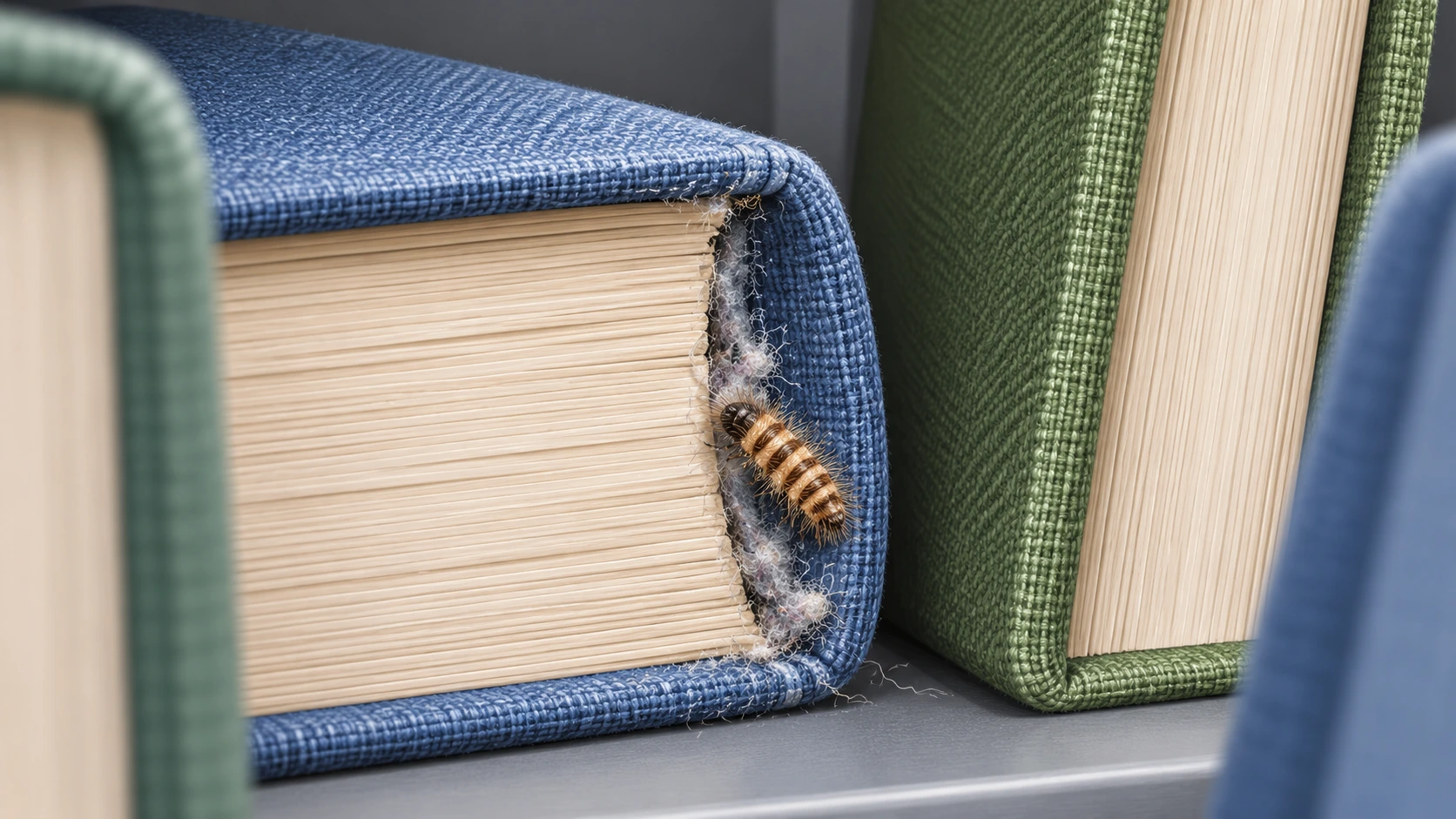
Carpet beetles can damage books, particularly bindings made with animal glue and other protein-rich materials, but ordinary paper is not their preferred food. The larvae are responsible for most of this damage. They can feed on susceptible book components while leaving the pages largely untouched, although some references also recognize occasional feeding associated with paper and other plant-derived materials.
A carpet beetle crawling across a book does not prove that it has been eating the pages. Likewise, a hole through an old book does not automatically mean carpet beetles caused it. Silverfish, certain other beetles, and several additional pests can damage books in different ways.
The best way to assess the risk is to examine what the book is made from. A modern paperback with a synthetic adhesive binding presents a different feeding opportunity from an antique volume containing animal glue, parchment, and wool-covered boards.
Which Parts of a Book Can Carpet Beetles Eat?
Books contain more than paper. Their covers, binding materials, decorative finishes, and protective cases can contain substances that attract carpet beetle larvae.
Animal-derived components are the clearest concern. Traditional bookbinding materials may contain collagen-based glue, parchment, animal skins, or other protein-rich substances. These materials can provide food for insects that would have little reason to consume a clean sheet of modern printing paper.
Carpet beetles are among the documented pests of animal-glue bindings and protein-rich archival materials. Their larvae can damage the material holding a book together even when the printed pages remain substantially intact.
A book can therefore suffer genuine carpet beetle damage without showing the characteristic page scraping associated with silverfish.
The following comparison brings together the material-specific distinctions found in archival and museum pest guidance.
| Book component | Susceptibility to carpet beetle larvae | Main consideration |
|---|---|---|
| Ordinary clean paper pages | Generally low | Paper cellulose is not their principal food |
| Animal-glue binding | Documented susceptibility | Protein-rich adhesive can provide food |
| Parchment or animal-skin components | Potentially susceptible | Animal-derived material can attract dermestid pests |
| Wool felt or wool-covered book parts | Susceptible | Wool can support larval feeding |
| Leather binding | Variable | Some dermestids damage leather, but not every carpet beetle species regularly attacks finished leather |
| Starch-based paste | Not a primary carpet beetle food | Silverfish and other pests are often more relevant |
| Synthetic binding adhesive | No basis for assuming it is edible | Formulation and surrounding materials matter |
| Protective case lined with wool felt | Susceptible | Larvae may feed on the lining rather than the enclosed book |
This is a susceptibility comparison, not a promise that every material will be attacked. Processing, finishes, species differences, and the presence of alternative food all affect what happens.
An old leather-bound volume, for example, may contain several distinct substances. The animal glue inside its spine may be more attractive to carpet beetle larvae than the finished leather covering.
Do Carpet Beetles Eat the Actual Paper Pages?
Carpet beetle larvae are not major cellulose-feeding pests in the way that silverfish and some other book-damaging insects can be.
Plain paper is largely made from cellulose, a plant-derived material. The best-known household carpet beetle larvae are particularly associated with animal-derived proteins and other suitable organic food sources.
That is why conservation guidance separates pests of paper surfaces from pests of protein-rich materials.
In a material-by-material classification of collection pests, silverfish, cockroaches, and booklice are associated with paper-surface damage. Carpet beetles and related dermestids are associated especially with materials such as wool, hair, animal skins, and collagen-based bindings.
However, it would go too far to claim that carpet beetles never feed on paper-associated materials. Carpet beetles vary by species, and some can consume plant-derived substances. The National Pesticide Information Center includes books among possible plant materials associated with carpet beetle feeding.
Those statements can be reconciled without treating all books as equally vulnerable. A book is a combination of materials, and occasional feeding associated with books does not establish that clean paper is a preferred food for every carpet beetle species.
If several pages have been scraped thin or their surfaces appear grazed, we would investigate other paper pests before attributing the damage to carpet beetles.
If damage is concentrated around an animal-glue binding and live carpet beetle larvae are present, the case for carpet beetle feeding becomes stronger.
Why Animal Glue Makes Some Book Bindings Vulnerable
Traditional bookbinding adhesives sometimes contain gelatin or other materials derived from animal collagen.
Collagen is a structural protein found in animal connective tissues. When processed into glue, it can remain a nutrient source for certain insects capable of feeding on animal-derived materials.
This creates a particular vulnerability in older books.
A book may have perfectly ordinary paper pages but a spine reinforced with animal glue. Carpet beetle larvae that encounter that glue may damage the binding without needing to eat the paper itself.
Over time, feeding can weaken an already fragile spine or contribute to separation of binding components. The damage may appear more serious than the amount of material consumed because a small area of glue can be responsible for holding several parts together.
The problem is especially relevant to historic books and archival collections, where original binding materials are often preserved rather than replaced with modern substitutes.
Carpet beetle larvae are documented among insects that feed on collagen-containing materials, including glue joints and book bindings.
There are limits to this risk. Not every traditional book contains animal glue, and not every adhesive sold as bookbinding glue has the same composition.
Modern adhesives may be synthetic, plant-derived, animal-derived, or formulated from several ingredients. The name glue alone does not tell us whether carpet beetle larvae can use it as food.
For an ordinary modern paperback, a suspected infestation should be assessed from actual evidence rather than an assumption that anything sticky in a book attracts carpet beetles.
Can Carpet Beetles Damage Leather-Bound Books?
They can be associated with damage to animal-derived binding materials, but leather requires a more careful answer.
Leather is processed animal skin. Its physical and chemical properties can differ substantially depending on tanning, finishing, age, condition, and the type of leather.
Some dermestid beetles are capable of damaging leather bindings. However, that does not mean every household carpet beetle regularly feeds on every finished leather cover.
Library preservation guidance recognizes that dermestid beetles can damage leather-bound books. It also distinguishes species that may feed inside binding materials or bore into book blocks during development.
A different conservation source cautions that leather is not generally a favored material for carpet beetle larvae in the same way that wool felt and other protein-rich collection materials are.
Both observations are useful. They show why the broader word dermestid should not be treated as proof that a particular carpet beetle larva is consuming a finished leather cover.
We would pay particular attention to the binding’s structure. Animal glue beneath the leather, exposed animal-skin components, deteriorated seams, and adjacent wool-based materials may present different feeding opportunities.
A damaged leather spine with no living insects or fresh larval skins does not provide enough evidence to identify carpet beetles as the cause.
For antique or valuable books, identifying the actual material being lost is often as important as identifying the insect.
What About Wool, Felt, and Fabric-Covered Books?
Wool-containing book components can be considerably more attractive to carpet beetle larvae than ordinary paper.
Some books and manuscripts are stored in protective boxes lined with wool felt. Older bindings and decorative covers may also include susceptible animal-derived fibers.
The larvae can feed on these materials while the enclosed pages remain unaffected.
This is a documented concern in library and archival collections. Carpet beetle larvae can consume wool felt used in protective book boxes and collection displays.
Consider an antique manuscript stored in a fitted case lined with wool felt. Finding larvae inside that case does not establish that they are eating the manuscript. The lining may be the actual food source.
That distinction changes the response. Replacing or professionally treating the infested lining may address the problem while avoiding unnecessary treatment of the manuscript.
The same reasoning applies to a fabric-covered book. The fabric’s composition matters. A wool covering and a cotton covering do not have the same susceptibility to ordinary carpet beetle feeding.
Where the covering is synthetic, check for adjacent animal-derived materials or accumulated debris before assuming that the artificial fabric itself is being eaten.
Why Finding Carpet Beetles on a Bookshelf Doesn’t Prove Book Damage
Bookshelves can provide sheltered places for carpet beetles without necessarily providing their main food.
A crowded shelf may collect dust, pet hair, lint, dead insects, and other organic debris behind books or along the rear panel. These materials can support carpet beetle larvae even when the books themselves contain no attractive binding components.
Adult carpet beetles may also be found near windows or resting on books without having fed on either the pages or the covers.
The larvae are the stage responsible for most material damage. Finding one adult on an open book establishes very little about what the insect has eaten or whether it developed inside the room.
Cast larval skins can be more informative, especially when found repeatedly among susceptible materials. Even then, an old skin does not prove that feeding is continuing.
For example, suppose you find a hairy larva behind a row of paperback novels. Before blaming the books, inspect the shelf cavity for a dead insect, trapped pet hair, or a nearby wool item.
If the paperbacks show no fresh damage, the larva may be using the shelf as a sheltered location while feeding on something else.
A systematic home inspection for carpet beetles can help establish whether the shelf is associated with active development or simply happens to be where an insect was noticed.
How Can You Tell Whether Carpet Beetles Are Damaging a Book?
A reliable assessment needs more than one clue.
First, consider the vulnerable material. An older book containing animal glue or wool felt has a more plausible carpet beetle food source than a clean, modern paperback with ordinary paper pages.
Next, examine where the damage occurs. Damage concentrated around animal-derived binding components has a different significance from shallow scraping across page surfaces.
Finally, look for physical evidence of the insect responsible, preferably at the damaged location.
The distinction can be summarized this way:
| What you find | What it may suggest | What it does not prove |
|---|---|---|
| Live carpet beetle larvae around an animal-glue spine | Potential feeding on the binding | That the larvae have eaten the printed pages |
| Larvae in a wool-lined protective case | The lining may be infested | That the book inside is damaged |
| A single adult beetle on a book | Incidental presence is possible | That an infestation exists in the book |
| Thin, grazed patches on paper | Investigate paper-feeding insects such as silverfish | That carpet beetles caused the scraping |
| Small round tunnels through pages | Investigate book-boring beetles and other causes | That a carpet beetle made the holes |
| Old larval skins beside a damaged binding | Carpet beetles have been present | That fresh feeding is still occurring |
This comparison is a starting point for investigation, not a definitive identification key.
One important complication is that different insects may have occupied the same book or storage area at different times. A carpet beetle found today may be unrelated to damage caused years earlier.
Fresh debris, active larvae, and a clear connection between the insect and the damaged material make the evidence more persuasive.
When the damage is substantial or the book is valuable, a pest identification specialist or book conservator may be needed to establish the cause without damaging the object during inspection.
Are Carpet Beetles Responsible for Small Holes Through Book Pages?
They are not the first explanation we would assume.
Small tunnels through a book block can be caused by certain book-boring beetles. The everyday word bookworm is applied to the larvae of several different beetle species, not to one particular insect.
Some beetles feed on starch-rich paper or binding materials. Others may bore into books while developing or creating a place to pupate.
A library preservation account describes how certain dermestid larvae can bore into text blocks while preparing a pupation chamber. That behavior is different from consuming pages as a regular food source.
Carpet beetle larvae are therefore not categorically incapable of being associated with physical holes in a book, but the presence of a hole does not justify identifying the insect as a carpet beetle.
The hole’s shape, position, depth, and surrounding evidence all matter.
A tunnel that passes through many pages may have a different explanation from shallow grazing along a page edge. Likewise, a damaged binding joint may reflect feeding on adhesive rather than feeding on the adjacent paper.
Historic books can retain evidence of infestations that ended decades ago. There may be no living insects left to identify.
If a book contains extensive tunneling, avoid putting it into ordinary circulation with the rest of a collection until the possibility of active infestation has been assessed.
Carpet Beetles vs. Silverfish: Which Are More Likely to Eat Paper?
Silverfish are generally the more relevant concern when the visible damage is to paper surfaces.
They can feed on starch-containing materials, certain paper coatings, adhesives, and other suitable substances. Their feeding may produce irregular patches where the surface has been scraped or thinned.
Carpet beetle larvae, by comparison, are more strongly associated with animal-derived materials and susceptible binding components.
That distinction helps narrow the investigation when a book has been damaged.
If a printed page has shallow, uneven surface loss and no evidence of larvae around the binding, silverfish become a more plausible possibility. If an old spine containing animal glue is damaged and carpet beetle larvae are present, carpet beetles deserve closer attention.
Neither inference is a substitute for finding and identifying the insect.
The differences between the animals themselves are covered in carpet beetle versus silverfish, while whether silverfish eat paper addresses the paper-feeding mechanism in more detail.
A household may also contain both pests. Finding a carpet beetle on a bookshelf does not exclude silverfish as the cause of damage to the pages.
Could Booklice Be Responsible Instead?
Booklice are frequently found among books, papers, cardboard, and stored documents, especially where humidity is elevated.
Their presence has a different significance from finding carpet beetle larvae.
Many household booklice primarily feed on microscopic fungi and mold associated with damp materials. Some can use starchy substances such as particular binding pastes.
They are not generally responsible for the same type of extensive feeding damage associated with carpet beetle larvae in animal-derived materials.
A humid bookshelf can therefore contain booklice because its surfaces support fungal growth rather than because the insects are consuming the pages as their main food.
This does not make booklice irrelevant. Their presence can indicate environmental conditions that threaten valuable paper and bindings through mold growth and other deterioration.
If tiny insects appear repeatedly along damp books, identification is worthwhile before treating the area as a carpet beetle infestation.
The distinction is explained further in do booklice eat paper and books.
How to Protect Books From Carpet Beetle Damage
The most useful protection is to reduce access to susceptible materials and remove nearby sources of larval food.
For an ordinary bookshelf, that means inspecting dusty areas behind books, cleaning shelf joints, and removing accumulations of hair, lint, or dead insects. These materials can sustain larvae without any feeding damage to the books.
For older or valuable books, examine the binding materials and protective enclosures. A wool-lined case deserves closer attention than a clean storage box made entirely from suitable inert materials.
When live larvae are found near a book, inspect the object carefully without forcing open a fragile spine or dismantling historic binding components.
An infested protective lining may be removable or replaceable. An original animal-glue binding may require conservation treatment rather than ordinary cleaning.
Avoid spraying insecticide directly onto books or manuscripts unless a qualified professional has determined that a specifically permitted treatment is suitable. Liquid formulations can stain pages, damage adhesives, affect inks, or introduce residues. A general household insecticide label does not automatically authorize treating books.
For collections containing valuable or irreplaceable material, professional conservation advice is more appropriate than experimenting with chemicals or uncontrolled heat.
Storage conditions also matter. Clean, dry, well-maintained shelving helps prevent several book pests and reduces the deterioration that can complicate insect damage.
The principles used to protect books from silverfish overlap in areas such as inspection and storage, although carpet beetles present a different feeding risk.
What If You Find Larvae Inside a Valuable Book Collection?
Do not assume that every book requires treatment.
Begin by separating books showing suspicious damage or live insect activity from unaffected material, using handling and containment methods appropriate for the collection.
The immediate goal is to prevent movement of potentially infested debris while determining where the insects are feeding.
A book conservator may need to assess an old binding before any cleaning or treatment. Animal glue, brittle leather, parchment, water-sensitive media, and historic repairs can all limit the methods that are safe to use.
Professional collection-care programs commonly rely on inspection, documentation, housekeeping, appropriate storage, and treatment methods selected for the materials involved.
For suspected carpet beetles, that may mean addressing an infested wool lining or adjacent storage material rather than treating every page of every volume.
Do not attempt to freeze, heat, or chemically treat a rare book without considering its construction and condition. A method that kills insects may also damage inks, adhesives, bindings, or moisture-sensitive components.
If the insects remain unidentified, a clear photograph or safely collected specimen can help a specialist distinguish carpet beetle larvae from other book-associated pests.
Once the affected source has been addressed, continued monitoring can help establish whether new activity remains. Our guide to how to tell if carpet beetles are gone explains why old larval skins and historic damage should not be mistaken for proof of ongoing feeding.
Do Modern Books Have the Same Risk as Antique Books?
No. Their construction can create different feeding opportunities.
An antique volume may contain traditional animal glue, parchment, leather, textile reinforcement, and decorative materials. Some of those components are susceptible to carpet beetle larvae.
A modern paperback may consist mainly of paper, printing inks, a manufactured cover, and a synthetic adhesive binding. That combination is generally less attractive to carpet beetle larvae, although the exact materials vary.
The distinction is not absolute. A modern artist’s book could contain wool or other animal-derived components, while an older volume might contain relatively little susceptible material.
Surrounding conditions also change the risk. Even a modern book can be stored beside an infested wool blanket or in a shelf cavity containing accumulated dead insects.
That is why the setting matters alongside the book’s age.
A bookshelf filled with modern paperbacks is not automatically a significant carpet beetle food source. A protective case lined with wool felt may be vulnerable even when the rare book inside contains very little suitable food.
The actual construction of the book and its enclosure offers a more reliable assessment than its publication date alone.
The Bottom Line
Carpet beetle larvae can damage books, but their main targets are susceptible binding materials and other animal-derived components rather than ordinary paper pages. Animal glue, parchment, certain animal-skin materials, and wool felt can create feeding opportunities that do not exist in a plain sheet of paper.
Paper damage requires a careful assessment. Silverfish and other book-associated insects may be more plausible causes of surface grazing, while tunnels through pages can have several explanations. A carpet beetle found on a book is not enough to establish that it caused the damage.
For modern books, the risk is usually lower when they contain few susceptible materials and are stored in clean conditions. For older bindings and valuable collections, checking the materials used in the spine, cover, and protective case is more informative.
If live larvae are present, investigate the binding and surrounding organic debris before treating the book itself. Protecting the object begins with confirming what the insects are actually eating.
One thought on “Do Carpet Beetles Eat Books and Paper?”