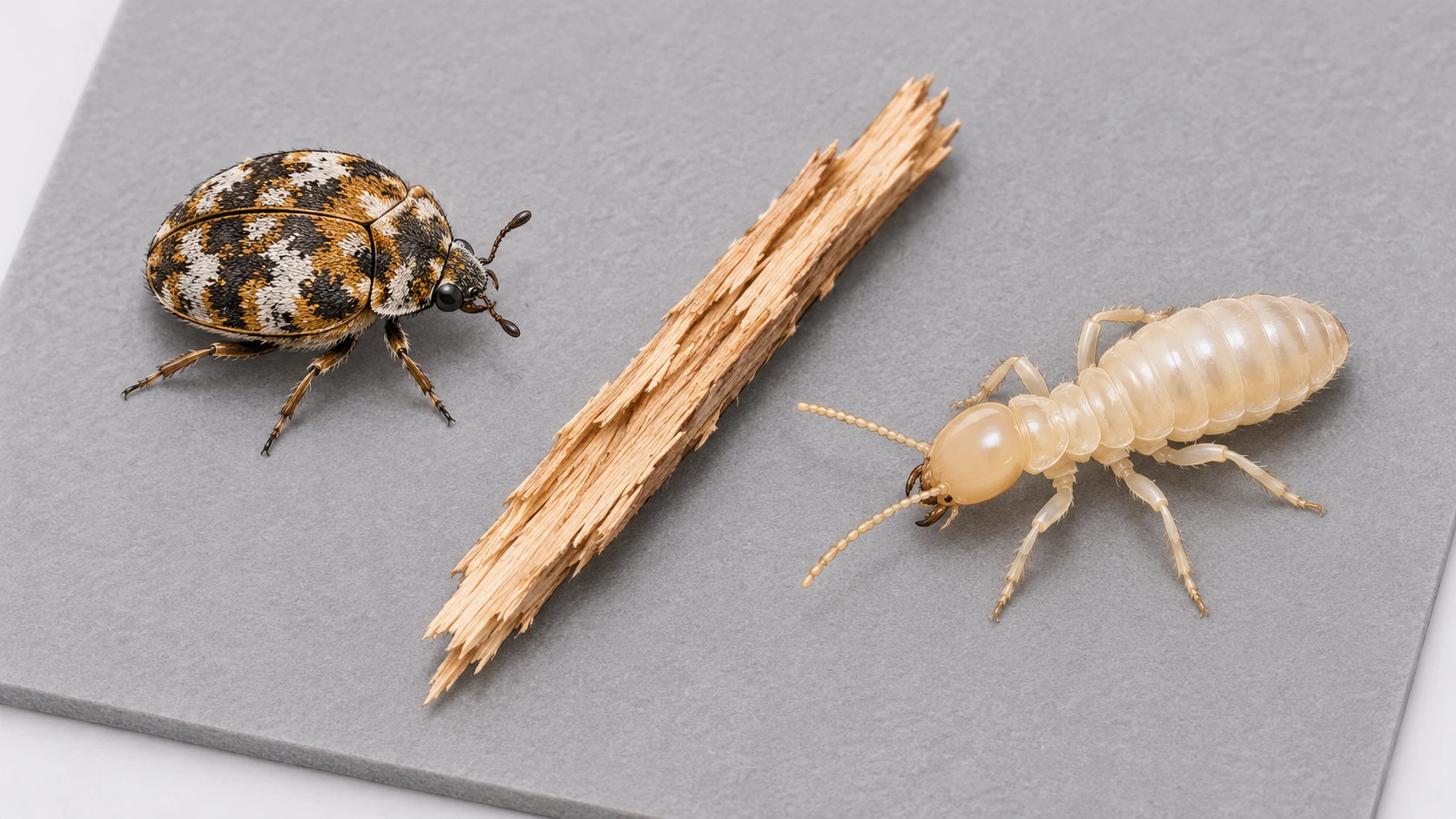
Carpet beetles and termites are different insects that damage different household materials. Adult carpet beetles are small, hard-backed beetles, while carpet beetle larvae are usually brown and covered in hairs or bristles. Termite workers are typically pale, soft-bodied insects with straight, beadlike antennae, and termite swarmers have long, similarly sized wings. Termites also have the potential to damage structural wood, while carpet beetles are mainly associated with fabric and other susceptible organic materials.
The two can be confused when someone discovers an unfamiliar insect near a baseboard, sees small brown particles beneath furniture, or notices damage to a rug beside a wooden floor.
A hairy carpet beetle larva crawling across a wooden shelf does not establish that the shelf is being eaten. Likewise, a tiny dark insect near a window is not automatically a termite swarmer.
The most dependable way to separate these pests is to examine the insect’s body and then look for evidence associated with the material being damaged. Their appearance, feeding activity, and typical traces are different enough that a close inspection can often narrow the possibilities.
Carpet Beetle vs. Termite: The Main Differences
The comparison changes depending on which developmental stage you find. Carpet beetle larvae look nothing like the adults, and termite workers look quite different from winged reproductive termites.
| Feature | Carpet beetle | Termite |
|---|---|---|
| Insect group | Beetle, family Dermestidae | Termite, infraorder Isoptera within Blattodea |
| Typical visible adult | Small, rounded or oval, with hardened wing covers | Winged reproductive with elongated body and long wings |
| Immature or worker appearance | Larvae usually brown, segmented, and hairy | Workers often creamy white, soft-bodied, and wingless |
| Antennae | Adult carpet beetles generally have short, clubbed antennae | Straight, beadlike antennae |
| Wings | Adult beetles have hardened forewing covers called elytra | Swarmers have two pairs of similarly sized membranous wings |
| Main damage concern | Feeding by larvae on susceptible fibers and organic materials | Feeding on wood and other cellulose-containing materials |
| Common evidence | Bristly shed larval skins, damaged wool or other susceptible items | Wood galleries, mud tubes in subterranean species, or distinctive pellets in drywood species |
| Common discovery setting | Windowsills, wool rugs, clothing storage, lint and dead insects | Infested wood, protected tunnels, foundations, or swarming locations |
These are broad distinctions rather than a complete identification key for every species.
An adult black carpet beetle can be dark and elongated, while termite swarmers may also be dark. Conversely, a newly hatched carpet beetle larva may be quite pale, while a winged termite can be brown or black.
Body structure and associated evidence provide a more dependable identification than color alone.
Adult Carpet Beetles Have a Hard Shell That Termites Lack
An adult carpet beetle has the characteristic body covering of a beetle. Its hardened forewings, called elytra, meet along the back and protect the folded flight wings underneath.
This gives the insect a compact, shell-like appearance.
The varied carpet beetle, Anthrenus verbasci, is particularly rounded and usually has mottled patches of white, brown, and yellowish scales. The black carpet beetle, Attagenus unicolor, is more elongated and generally dark brown or black.
Adult carpet beetles are usually small. Common household species often measure approximately 2–5 millimetres long, although the exact size varies.
The adult characteristics of household carpet beetles include a convex, seedlike body and a surface that may be patterned with colored scales or hairs.
Termites do not have hardened beetle wing covers.
Winged reproductive termites have a more elongated body, with two pairs of membranous wings extending beyond the abdomen. Their wings overlap when folded over the back, but they do not create the rigid shell seen on a beetle.
Worker termites are wingless and soft-bodied. They look different from both adult carpet beetles and termite swarmers.
If an insect has a rounded, hard-looking back with two wing covers meeting along the middle, it is much more consistent with an adult beetle than a termite.
Carpet Beetle Larvae Look Different From Termite Workers
Confusion becomes more understandable when comparing a carpet beetle larva with a termite worker.
Neither looks like a typical winged adult insect, and both can be found in hidden parts of a building.
However, their bodies are noticeably different.
Carpet beetle larvae are segmented and usually have conspicuous hairs or bristles. Their bodies may be tan, golden brown, reddish brown, or almost black. Some species have a broader rear end, while others taper toward a tuft of longer hairs.
A black carpet beetle larva, for example, is elongated and has a distinctive tuft of hair at its rear.
Termite workers are generally much paler. The workers of common subterranean termite species have creamy-white bodies, relatively soft outer coverings, and no long, dense covering of carpet beetle-style hairs.
They also have straight, beadlike antennae and a clearly recognizable head. Their legs are relatively short.
The description of eastern subterranean termite workers identifies them as creamy-white insects that typically remain concealed in soil, wood, or protective tubes.
A brown, bristly larva moving along a carpet edge is much more consistent with a carpet beetle than a subterranean termite worker.
A cluster of pale, soft-bodied insects uncovered within damaged wood or a soil-lined tunnel is considerably more concerning for termites.
One specimen may still be difficult to identify, particularly if it is tiny, damaged, or photographed poorly. The surrounding evidence helps determine whether the apparent identification fits.
Termite Antennae and Beetle Antennae Are Different
Antennae can help when body color and size are misleading.
Adult carpet beetles generally have short antennae with enlarged terminal segments, often forming a club. The antennae may be partly tucked beneath the front of the body.
Termites have straight antennae composed of many beadlike segments. Their antennae do not end in the same typical club found on carpet beetles.
The difference is especially useful when an adult black carpet beetle and a dark termite swarmer appear superficially similar.
A carpet beetle will have its hardened wing covers and relatively short antennae. A termite swarmer will have a different wing arrangement and straight, beadlike antennae.
Antennae alone may be difficult to inspect without magnification. If the insect has lost an antenna, the body and wings become more useful.
For a suspected termite swarmer, the wing arrangement is often easier to evaluate than tiny antennal segments.
A Flying Carpet Beetle Is Not the Same as a Termite Swarmer
Both insects can appear near windows, which is one reason they may be confused.
Adult carpet beetles commonly fly and are attracted to light. They may collect on windowsills or window glass, particularly during warmer periods.
A single adult beetle near a window does not necessarily indicate that larvae are developing inside the house.
Termite swarmers are reproductive adults that leave an established colony to disperse and potentially start new colonies. Their appearance can be an important warning sign, especially when a swarm emerges from within a building.
The wings provide a useful distinction.
Termite swarmers have two pairs of membranous wings that are approximately equal in length. These wings are relatively long compared with the termite’s body and may be shed after swarming.
Carpet beetles have hardened elytra covering their flight wings. When resting, their backs look like beetle shells rather than pairs of long, overlapping transparent wings.
The differences between termite and other winged insect structures are central to distinguishing swarmers from lookalikes.
If you find several long, similarly sized detached wings around a window or door, preserve a sample and investigate. Carpet beetles do not normally leave piles of termite-like shed wings after flying.
However, wings alone do not establish that a building contains an active termite colony. Swarmers can arrive from nearby locations, and other insects may leave wings or fragments. Identification and inspection are still necessary.
Carpet Beetle Damage and Termite Damage Usually Occur in Different Materials
The clearest practical difference is what each insect uses as food.
Carpet beetle larvae are particularly associated with animal-derived materials. Wool, fur, feathers, hair, preserved animal specimens, and certain other organic substances can support their development.
The larvae may leave thin patches or irregular feeding damage in susceptible materials. They can also leave bristly cast skins, which provide useful evidence of their presence.
Termites use cellulose-rich materials as food. Wood is especially important in buildings, although termites can also consume materials such as paper and certain plant-based fibers.
Their damage may develop inside wooden components, leaving galleries or hollowed areas that are not immediately visible from the surface.
That difference can be summarized through the material showing injury.
| Evidence or damaged material | More consistent with | Important qualification |
|---|---|---|
| Bristly larval skins beside damaged wool | Carpet beetles | Confirm the insect and whether damage is recent |
| Irregular feeding damage in fur or feathers | Carpet beetle larvae or another suitable fabric pest | Damage alone does not prove the species |
| Mud-covered tunnels across a foundation | Subterranean termites | Needs proper confirmation of activity and cause |
| Galleries inside timber containing soil-like material | Subterranean termites | Other wood pests and old damage may require evaluation |
| Uniform, hard, six-sided fecal pellets beneath wood | Drywood termites | Requires identification; not all termites produce visible pellet piles |
| Damaged cotton rug backing near infested wood | Termites are possible | Some other insects or physical deterioration can also affect backing |
| A beetle resting on a wooden window frame | Neither type of damage is established | The insect may simply be passing through |
This table is a comparison of evidence, not a method for declaring that an infestation is present from one observation.
The feeding damage associated with carpet beetle larvae is strongly linked to wool and other susceptible organic materials, while termite management references identify wood and cellulose as the primary concerns.
An additional complication is that termites can sometimes damage textile components. That is why the context surrounding a damaged rug matters.
Can Termites Damage a Carpet or Rug?
Yes, in certain circumstances. Termites can feed on cellulose-containing materials, including cotton or other suitable plant-fiber components of rugs.
This is an important exception when comparing the two insects.
An older wool rug may contain a backing or binding made from a different material. The wool pile itself and the backing are not necessarily equally attractive to the same insect.
Carpet beetle larvae can damage the wool, while termites may attack certain cellulose-rich backing components under suitable conditions.
Historical fabric-pest damage guidance specifically describes termite damage involving the cotton or hemp binding of a wool rug while the wool itself remains intact.
That pattern would differ from typical carpet beetle feeding in the wool pile, but it does not mean every damaged rug binding is evidence of termites.
The relationship to the building also matters. A rug located over an area of confirmed termite activity deserves a different assessment from a wool sweater stored in a clean closet.
If the insect evidence includes soil-lined galleries, mud tubes, or recognizable termite workers, the possibility of termite involvement becomes more substantial.
If the evidence consists mainly of bristly beetle skins among wool fibers, carpet beetles become more plausible.
The specific fabric patterns are considered in carpet beetle damage to rugs, carpet, and furniture. The main comparison here is that one household item can contain different materials that support different pests.
Mud Tubes Are a Termite Clue, Not a Carpet Beetle Clue
Subterranean termites often move through protected tunnels made from soil and other materials.
These structures, commonly called mud tubes or shelter tubes, help termites travel between their colony and food while maintaining the humid conditions they need.
They may appear along foundation walls, masonry, wooden posts, or other structural surfaces.
Carpet beetles do not construct these soil-based shelter tubes.
Their larvae may hide beneath carpets, along baseboards, or among accumulated lint and debris, but they do not build the protected earthen passageways characteristic of subterranean termites.
The formation of termite shelter tubes is linked to the insects’ need to travel without drying out.
An apparent mud tube should be documented and assessed rather than immediately dismissed as ordinary dirt.
However, mud tubes are not a universal sign of every termite species. Drywood termites live within wood and do not normally construct the same soil-based tunnels.
The absence of visible tubes therefore does not establish that a building is termite-free.
What Do the Droppings and Shed Material Look Like?
Small particles found beneath damaged material can be confusing because both types of insect leave traces.
Carpet beetle larvae shed their outer coverings as they develop. These discarded skins are often brown, segmented, and covered in hairs, sometimes resembling a hollow larva.
They can also leave small fecal particles near feeding areas.
Termite evidence varies by type.
Drywood termites produce distinctive hard fecal pellets, often relatively uniform in size and with a characteristic six-sided form. The pellets may accumulate beneath small openings through which the insects eject them.
Subterranean termites generally keep fecal material within their galleries and shelter structures rather than producing the characteristic dry pellet piles associated with drywood termites.
The distinctive signs left by different termite groups include pellet accumulations, shelter tubes, and concealed wood damage.
Finding brown grains on a windowsill is not enough to identify either insect. Dirt, sawdust, insect droppings, and fragments of old material can look similar without magnification.
A bristly shed skin is a much more direct clue toward carpet beetle larval activity than a pile of unidentified dust.
Our carpet beetle shed skins and casings guide examines what those coverings mean, including why an old skin does not necessarily establish that living larvae are still present.
Why a Carpet Beetle on a Wooden Floor Doesn’t Prove Wood Damage
A carpet beetle found on a wooden surface may simply be moving through the room.
Adult carpet beetles can crawl across window frames, furniture, and flooring without feeding on those materials. Larvae may also move across wood while searching for shelter or food.
Some carpet beetle food sources occur very close to wood. Hair, lint, dead insects, old nests, and natural-fiber materials can accumulate beside baseboards and within sheltered furniture spaces.
This creates an apparent association between the insect and the wooden structure even when its food is something nearby.
Termite-related wood damage requires its own supporting evidence. An insect found on a board and a soft or damaged section of wood do not necessarily share a cause.
Wood may deteriorate through moisture, fungal decay, physical wear, or another insect. Termites are one important possibility, but not the only one.
The detailed question of whether carpet beetles eat wood is separate from identifying termites. For this comparison, a beetle’s presence on timber should not be used to diagnose what caused a structural defect.
The Discovery Location Helps, but It Cannot Identify the Insect Alone
Carpet beetles and termites are associated with different environments, yet both may be discovered in hidden areas of a house.
Adult carpet beetles often appear on windowsills, especially during spring or warmer periods. Their larvae may remain concealed in stored textiles, beneath furniture, or around accumulations of organic debris.
Subterranean termite workers usually avoid open air and light. They are commonly found when infested wood, soil galleries, or shelter tubes are exposed.
Winged termites are more conspicuous during swarming periods. Like carpet beetles, they may appear near windows because of their attraction to light.
Consequently, a dark insect on a windowsill could be an adult carpet beetle, a termite swarmer, or something else.
The shape of the insect resolves more than its location.
If it has hard wing covers and a compact, rounded body, a beetle identification is more plausible. If it has long, similarly sized transparent wings and straight beadlike antennae, termite swarmer identification becomes more plausible.
The same principle applies near the floor.
A hairy brown larva beside a wool rug is very different from a group of pale termite workers inside a soil-lined tunnel.
Use the room and material as supporting context after examining the insect itself.
How to Separate the Evidence When Both Fabric and Wood Are Damaged
Consider a room with a damaged wool rug, a wooden baseboard, and a few small insects.
There are several possible explanations, and it would be premature to assume that a single pest caused every problem.
If the rug contains bristly beetle skins and live carpet beetle larvae, that evidence supports carpet beetle development around the fabric.
If the baseboard contains hollow internal galleries with soil-like material, that finding requires a separate investigation for wood-destroying insects.
The two forms of damage may be unrelated, even though they occur within inches of one another.
A practical assessment can distinguish three situations:
| What is confirmed | What it supports | What remains unresolved |
|---|---|---|
| Carpet beetle larvae and feeding damage in wool | Active or previous carpet beetle activity | Whether nearby wood damage has a separate cause |
| Termite workers or confirmed termite galleries in timber | Termite activity associated with the wood | Whether damaged fabrics were affected by those termites or another pest |
| Unidentified brown insects and damaged materials | Neither species is confirmed | Identification of the specimens and cause of damage |
This framework helps prevent a common diagnostic error: identifying one insect correctly and then attributing all nearby damage to it.
It also protects against unnecessary reassurance. Finding a harmless adult carpet beetle on a damaged window frame does not explain away evidence that independently suggests termites.
If structural evidence is concerning, the building should be evaluated on that evidence even when carpet beetles are also present.
Does One Tiny Insect Mean Your House Has Termites?
No. A single ambiguous insect is insufficient to diagnose a structural termite infestation.
Even a confirmed termite swarmer does not always establish that the colony originated inside the building. Winged termites can disperse from outdoors or nearby structures.
Nevertheless, a confirmed indoor swarm, termite workers in wood, active shelter tubes, or characteristic termite damage can justify prompt professional inspection.
The distinction is important because termites may remain concealed while wood damage progresses.
An adult carpet beetle alone provides a different level of concern. Adult beetles can enter from outdoors, and finding one does not necessarily mean larvae are feeding on belongings inside.
The meaning of finding one carpet beetle indoors depends on whether there is additional evidence of breeding or damage.
For a suspected termite, document the specimen and its exact location. Photographs of the insect, wings, galleries, or shelter-like material may help a qualified inspector assess what has been found.
Avoid covering or repairing suspicious wood damage before it has been documented if an inspection is being arranged. Do not deliberately weaken wood or open potentially important structural components to search for insects yourself.
What to Do If the Evidence Points Toward Termites
Where there is credible evidence of termite activity, the priority is proper identification and assessment of the affected structure.
A qualified termite inspector or licensed pest management professional can investigate the relevant wood, building conditions, and signs of activity.
The urgency is greater when structural components appear significantly damaged, particularly if floors, supports, or framing may be affected. A building professional may also be necessary where the strength of a component is uncertain.
Do not assume that a household carpet beetle spray is suitable for termite treatment. Pesticide products have distinct authorized uses, and treating an unidentified pest with an unrelated spray can leave the actual problem unresolved.
Likewise, finding termite evidence does not mean every nearby textile must be treated for carpet beetles.
When bristly larvae or characteristic beetle skins are found, the affected fabrics and organic materials should be assessed separately. The signs of carpet beetle infestation provide useful context for determining whether those insects are actively developing indoors.
This article does not replace a professional structural inspection. It provides the identification distinctions needed to avoid confusing textile-associated carpet beetles with wood-destroying termites.
The Bottom Line: Carpet Beetle or Termite?
A compact, hard-backed beetle or a brown, bristly larva points toward carpet beetles. A pale, soft-bodied worker or a dark swarmer with long, equally sized wings points toward termites. Antennae, body covering, and wing structure are more dependable than color alone.
The evidence around the insect matters just as much. Carpet beetle larvae are mainly associated with susceptible animal-derived materials and bristly shed skins. Termites are associated with cellulose feeding, concealed wood galleries, and, depending on the termite group, mud tubes or characteristic dry fecal pellets.
Fabric damage and wood damage can occur together without having the same cause. A carpet beetle resting on timber does not establish termite activity, and finding a carpet beetle does not rule out an independent wood-destroying pest.
Where the evidence suggests termites, arrange an appropriate structural inspection rather than relying on an uncertain photograph or treating the area as a routine carpet beetle problem.