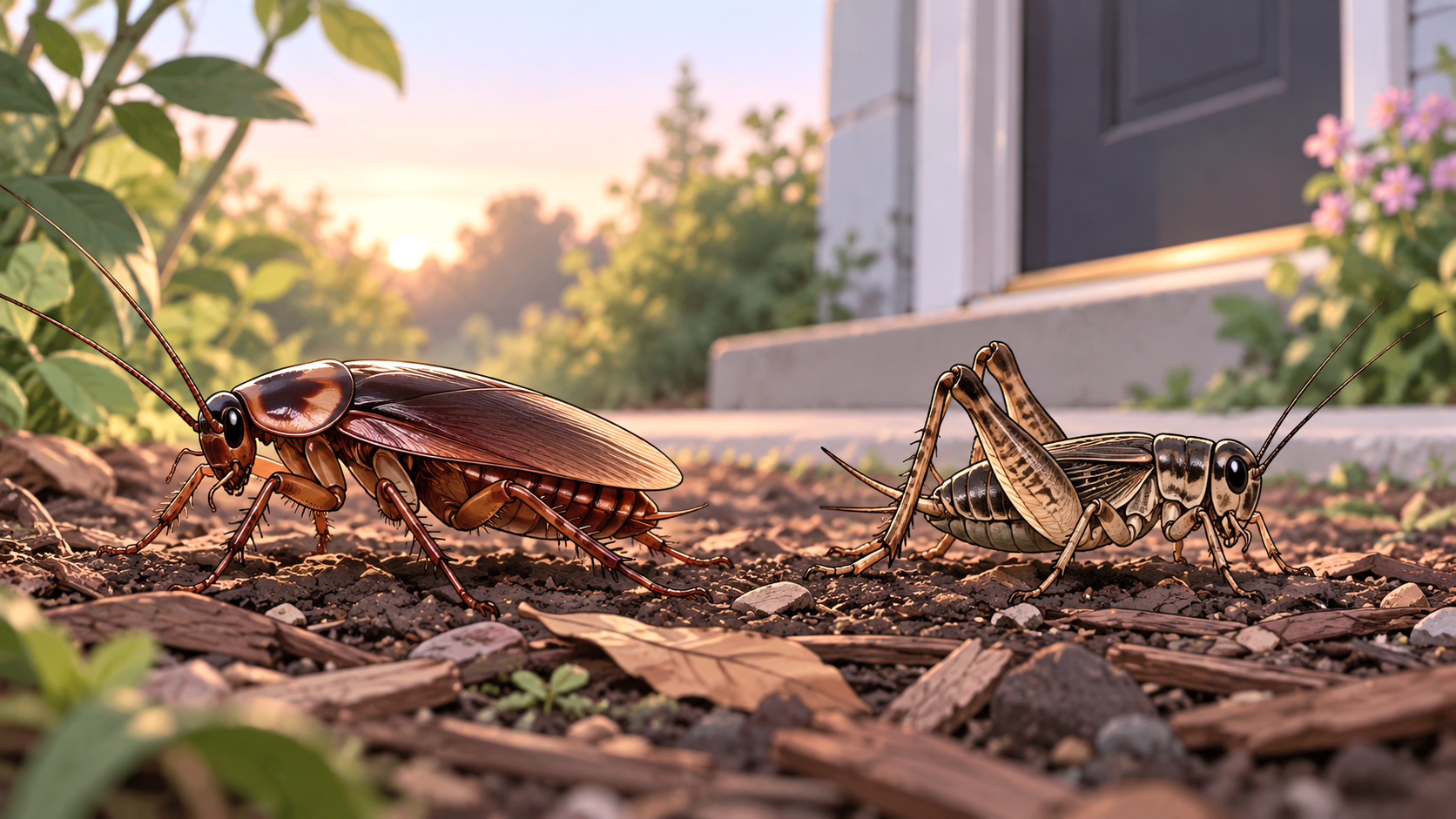
Long antennae, a brown or black body, nighttime activity, and a sudden dash across the floor can make a cricket surprisingly easy to mistake for a cockroach. The resemblance weakens considerably once you can see the legs. Crickets have enlarged, muscular hind legs built for jumping, while cockroaches have six running legs without one dramatically enlarged pair. A cricket also tends to have a more cylindrical or upright body. Cockroaches are generally flatter, with the head partly concealed beneath a shield-like pronotum. Female crickets can provide another giveaway: a long ovipositor projecting from the rear.
Start With the Back Legs
The hind legs provide the most useful visual shortcut because cricket anatomy is strongly adapted for jumping. The femur, the thick upper section of each rear leg, is noticeably enlarged compared with the front and middle legs. Crickets consequently have a rear-heavy outline even when standing still. Their enlarged hind legs allow them to jump or hop, sometimes covering enough distance that the insect seems to disappear when disturbed.
Cockroaches are built differently. Their six legs are arranged as three running pairs, and although the hind pair can be longer than the front pair, it does not have the swollen cricket-like femur. Cockroach legs also carry conspicuous spines. When a dark insect has long antennae and the body is difficult to see, the proportions of the hind legs can be more informative than its color.
A Cricket Sits Higher Off the Surface
Cockroaches have a distinctly flattened profile. The body is usually broad and oval when viewed from above, while the pronotum partly covers the head. Their low profile helps them move into narrow spaces, and the legs spread outward around the body.
House and field crickets look less compressed. Their enlarged hind legs hold the rear portion of the body differently, producing a more elevated appearance. Camel crickets make the contrast even stronger because their bodies are noticeably arched or hump-backed. Cockroach species vary substantially in size and coloration, so body height and leg proportions remain useful when different cockroach types do not match the familiar small tan roach.
Long Antennae Do Not Settle the Identification
Antennae are one of the weaker ways to choose between these insects. Cockroaches are known for long, slender antennae, but crickets have them too. House crickets can have antennae longer than their bodies, making a quick front-end comparison surprisingly unhelpful.
Other structures around those antennae provide better evidence. A cockroach’s head is directed downward and can be difficult to see from above because of the broad pronotum. A cricket’s head is more exposed and visually distinct from the thorax. If a photograph shows little more than two extremely long feelers, wait for a clearer view of the body and legs before identifying the insect.
A Long Spike at the Rear May Be an Ovipositor
Female house and field crickets have a long, narrow ovipositor extending from the end of the abdomen. It is an egg-laying structure rather than a stinger. Depending on the viewing angle, it can look like a straight needle projecting backward between smaller paired appendages. Female crickets use this conspicuous structure for egg laying.
Cockroaches do not have a comparable sword-like projection. Their rear anatomy includes short sensory cerci, and female cockroaches generally package their eggs inside an ootheca rather than inserting them into a substrate with a cricket-style ovipositor. The cockroach egg case may sometimes protrude temporarily from a female, but its capsule-like form looks nothing like the thin appendage of a female cricket.
Movement May Reveal What a Blurry Photograph Cannot
Cockroaches are exceptionally capable runners. Their long, spiny legs support rapid movement across surfaces, and their flattened bodies can vanish into narrow gaps. The combination of an oval body, long antennae and cursorial legs produces a movement pattern dominated by running rather than jumping.
A cricket may run as well, so seeing an insect travel along the floor does not identify it. A strong jump is much more revealing. If the insect launches itself when approached, enlarged cricket hind legs should be visible once it lands. A cockroach suddenly disappearing beneath an appliance may look as though it jumped during a split-second encounter, which is one reason behavior should be paired with anatomy rather than reconstructed from a brief glimpse.
Chirping Strongly Favors a Cricket
Sound provides evidence that appearance cannot. Male house and field crickets produce their familiar calls by rubbing specialized parts of their forewings together, a form of stridulation. The process involves a scraper and file-like structure on opposing wings, rather than the hind legs producing the familiar house-cricket chirp. Each wing movement contributes to the cricket’s calling song.
Cockroaches do not produce the repetitive household chirping associated with house and field crickets. Hearing persistent chirps from a basement, garage, wall edge, or another concealed area therefore points strongly toward a cricket even when you cannot see the insect. Silence proves little, however. Female crickets do not make the male calling song, and camel crickets do not produce the familiar chirping of house and field crickets.
Color Can Send the Identification in the Wrong Direction
Field crickets are often dark brown or black, while house crickets can be yellowish brown. Those colors overlap enough with cockroaches to make color a poor first test. A shiny black field cricket, for example, can easily be mistaken for a dark cockroach during a brief nighttime sighting.
Size overlaps too. Common house-invading crickets can fall within roughly the same general size range as several household cockroaches. A dark insect measuring around an inch long could fit either group before its structure is considered. Enlarged jumping legs, an exposed head, and a female’s ovipositor favor a cricket; a flattened oval profile, spiny running legs, and a head tucked beneath the pronotum favor a cockroach. Similar ambiguity occurs with several other insects mistaken for cockroaches.
Less Obvious Clues When the Insect Is Hard to See
Can both crickets and cockroaches have wings?
Yes. Adult house and field crickets can be winged, and many adult cockroaches also develop wings. Some winged cockroaches rarely fly, so simply seeing wings or watching an insect remain on the ground does not resolve the identification.
Could a small wingless cricket be confused with a baby cockroach?
Yes. Cricket nymphs resemble smaller wingless versions of adults, while cockroach nymphs also lack developed adult wings. The cricket’s increasingly enlarged hind legs provide a more useful clue than the absence of wings.
Do camel crickets look like cockroaches?
Usually not once seen clearly. Their very long legs, enlarged hind legs, arched body, and lack of wings produce a distinctive appearance. A fleeting encounter in a dark basement or crawl space can still cause confusion.
Does a cricket indoors indicate the same kind of problem as a cockroach sighting?
Not necessarily. Field and camel crickets frequently originate outdoors and enter structures, while some cockroach species are closely associated with indoor infestations. The significance of finding a cockroach indoors therefore cannot be transferred automatically to a cricket sighting.