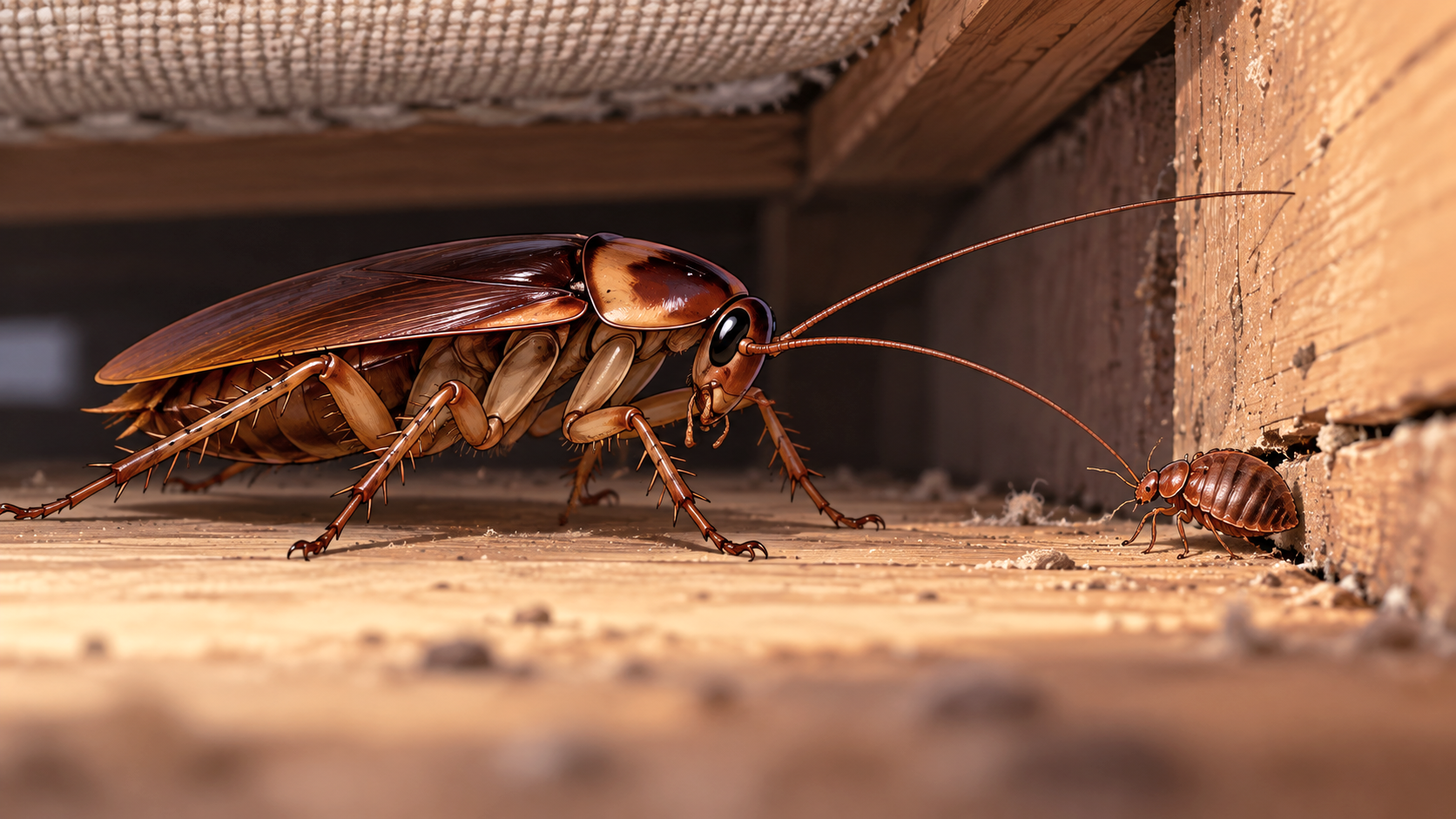
Cockroaches can eat bed bugs, including living ones whenever they have the opportunity to. This behavior has been documented in American cockroaches (Periplaneta americana), which have been observed consuming young, recently fed bed bugs. However, cockroaches are opportunistic feeders rather than specialized bed bug hunters, and there is no convincing evidence that their predation can reliably eliminate a bed bug infestation.
Both pests can occupy the same building, but their presence together does not mean cockroaches are controlling the bed bug population. Even when one insect consumes another, the number eaten may be too small to affect an established infestation.
What Experiments Reveal About Cockroaches Eating Bed Bugs
One of the most direct investigations appeared in Nature in June 1930, when researcher A. N. Gulati examined whether cockroaches actually consumed living bed bugs.
The investigation followed observations in Bombay, now Mumbai, where cockroaches frequently visited bed bug-infested bedsteads. In one instance, large numbers of cockroaches were observed on an infested cot, followed by the disappearance of bed bugs after the cot was no longer used.
Rather than assume predation explained the disappearance, Gulati conducted feeding experiments. Individual cockroaches were confined in glass containers with living bed bugs to establish whether consumption occurred.
The results confirmed that American cockroaches could eat living bed bugs, particularly young individuals whose abdomens were soft and swollen with blood. Adults with comparatively harder body coverings were sometimes rejected.
In the most successful observation, one cockroach consumed three of twelve available bed bugs over 48 hours. During the following 24 hours, it did not consume additional bed bugs despite continued food deprivation.
The original experimental report published in Nature remains particularly relevant because it documents actual feeding rather than merely assuming that a cockroach would eat bed bugs because both insects occupy the same environment.
The results nevertheless have important limitations. The experiments involved confined insects, a small number of observations, and one confirmed cockroach species. They did not measure predation rates inside occupied homes or establish how many bed bugs cockroaches might consume under natural conditions.
Are Baby Bed Bugs Easier for Cockroaches to Eat?
The historical experiment suggests that bed bug developmental stage and physical condition can influence whether a cockroach consumes one.
Young bed bugs have smaller bodies and generally less developed outer coverings than mature individuals. Immediately after feeding, their abdomens become distended, potentially making them easier for another insect to damage.
The CDC’s description of bed bug development explains that bed bugs pass through five nymphal stages before adulthood, with each immature stage requiring a blood meal before molting.
Gulati’s observations specifically favored young bed bugs with soft, blood-filled abdomens. This does not establish that all newly hatched nymphs are preferred prey or that unfed nymphs are attacked at the same rate.
Cockroach size may also influence encounters. A large American cockroach is physically capable of handling prey that might be unsuitable for a smaller insect. The substantial differences in cockroach body size mean that feeding observations involving American cockroaches cannot automatically be applied to German or brown-banded cockroaches.
There is insufficient experimental evidence to assign dependable bed bug consumption rates to these other household species.
Why Cockroaches Rarely Encounter Hidden Bed Bugs
An important limitation on natural predation is that cockroaches and bed bugs do not necessarily occupy the same spaces, even when both infest a room.
Bed bugs commonly shelter in mattress seams, bed frames, furniture joints, and other narrow gaps close to sleeping hosts. Their flattened bodies allow them to remain concealed between feeding periods.
The University of California’s overview of bed bug biology describes their flattened shape and specialized blood-feeding habits, features that distinguish them from generalist scavenging insects.
Cockroaches may travel through bedrooms and encounter exposed bed bugs, but they are not known to systematically search all bed bug harborages. A cockroach passing beneath a bed might never encounter the insects concealed inside its joints.
Even when the two species occupy the same furniture, access depends on the dimensions of individual crevices and whether the bed bugs are exposed. The situation differs from a controlled experiment in which predator and prey are confined together. In an occupied bedroom, both insects can retreat into separate refuges, greatly reducing opportunities for direct contact.
Do Cockroaches Hunt Bed Bugs or Just Eat Them Opportunistically?
The evidence supports opportunistic feeding more strongly than specialized hunting.
A cockroach encountering a vulnerable bed bug may consume it, but there is no established evidence that common household cockroaches actively track bed bug populations, pursue them consistently, or preferentially seek them over other available foods.
The 1930 experiment is informative here: even when living bed bugs remained available, the cockroach with the highest recorded consumption stopped feeding after eating three.
This observation cannot establish why feeding stopped. However, it does not support the idea that cockroaches continuously consume bed bugs whenever they are available.
A review of bed bug resurgence and natural enemies identifies cockroaches among reported bed bug predators but emphasizes that such natural enemies have not been successfully used to control bed bug infestations.
Consumption of a prey species is not the same as meaningful population suppression. A predator must encounter and remove enough individuals, consistently enough, to reduce the population despite continued reproduction.
For cockroaches, that level of impact on bed bugs has not been demonstrated.
Can Cockroaches and Bed Bugs Live in the Same Home?
Yes. There is no biological incompatibility preventing the two pests from occupying the same dwelling.
A study published in the Journal of Integrated Pest Management examined building-wide management of German cockroaches and bed bugs in a high-rise apartment building. The investigation illustrates that both pests can require management within the same residential environment.
Their environmental requirements overlap in some respects, including access to sheltered resting locations, but their feeding habits are fundamentally different.
Cockroaches obtain resources from a broad range of organic materials. Bed bugs require blood meals from suitable hosts. Their ability to coexist does not depend on one species serving as food for the other.
The tendency of cockroaches to occupy shared shelters concerns interactions among cockroaches themselves, not an organized relationship with bed bugs.
Likewise, finding cockroaches near an infested bed does not establish that they have been eating bed bugs. They may simply be using the same furniture or traveling through the room independently.
Could Cockroaches Eliminate a Bed Bug Infestation Naturally?
There is no reliable evidence that cockroaches can eradicate an established bed bug population.
Several biological limitations prevent them from functioning as dependable control agents. Their encounters with bed bugs are unpredictable, they do not specialize in locating concealed bed bugs, and the few direct feeding observations available do not demonstrate sustained consumption at a rate sufficient to control an infestation.
Bed bug reproduction further complicates the situation. A female can deposit eggs in sheltered locations, and young insects emerge over time. The CDC’s bed bug life-cycle information documents their reproductive development and dependence on blood meals.
Even if a cockroach occasionally consumes an exposed nymph, other bed bugs may remain protected in inaccessible locations.
The ecological relationship also provides no reason to tolerate an additional household pest. Cockroaches can contaminate surfaces and contribute to indoor allergens, so deliberately introducing or retaining them would exchange one pest problem for another.
The EPA’s guidance on bed bug management recommends coordinated inspection, monitoring, and appropriate control methods rather than reliance on natural predators.
Should You Leave Cockroaches Alone if You Have Bed Bugs?
No. Allowing cockroaches to remain in a bed bug-infested bedroom offers no demonstrated control benefit.
The occasional consumption of a bed bug does not compensate for the risks associated with maintaining a cockroach population indoors. Both infestations should be assessed independently rather than assuming one will suppress the other.
The presence of cockroaches also complicates interpretation of sightings. Small cockroach nymphs can sometimes be mistaken for bed bugs, particularly when insects are seen briefly or under poor lighting. Correct identification is essential before drawing conclusions about which pests are present.
The EPA recommends confirming bed bug identification before beginning control, since other household insects can resemble them. Although cockroaches have numerous natural enemies, their own capacity to consume bed bugs is limited evidence for biological control. A household containing both insects should be treated as having two separate pest concerns, not a self-correcting predator-prey relationship.