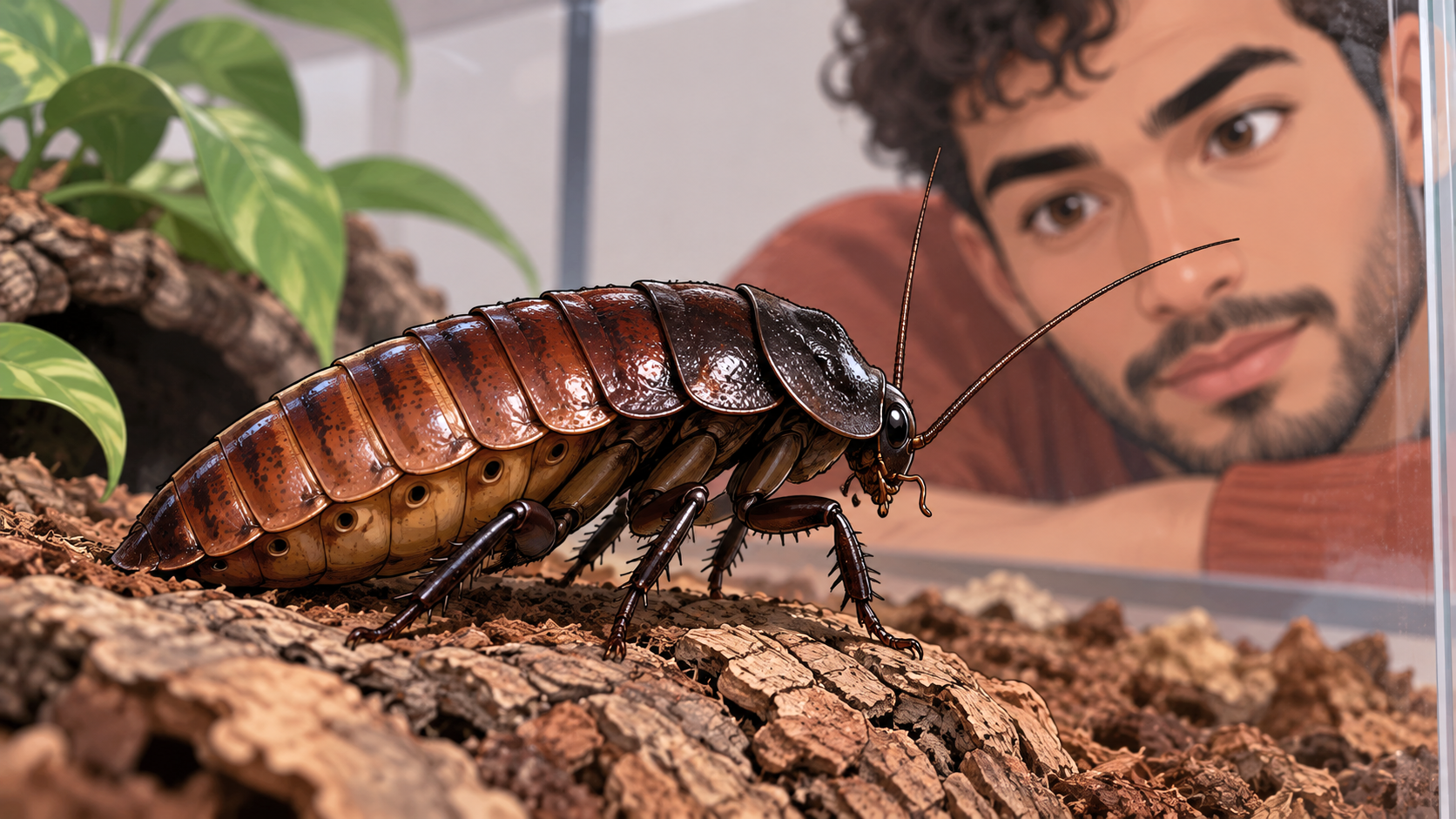
Cockroaches can produce sounds, but most common household species are nearly silent. German, American, and Oriental cockroaches may create faint rustling, scratching, or scuttling noises as they move across surfaces or through loose materials. They do not normally produce the loud, deliberate hisses associated with Madagascar hissing cockroaches.
Some less familiar species have specialized sound-producing structures. Madagascar hissing cockroaches force air through modified openings in their bodies, while others rub hardened body parts together to produce chirps or scraping sounds. Consequently, hearing a noise does not necessarily mean cockroaches are present, and a silent room does not rule out an infestation.
What Do Cockroaches Sound Like?
The sounds attributed to cockroaches fall into two categories: incidental noise generated by movement and deliberate sounds produced through specialized anatomical structures.
| Sound | Likely explanation | Examples |
|---|---|---|
| Faint rustling | Movement through paper, packaging, or debris | Common household cockroaches |
| Light scratching or scuttling | Legs contacting a surface or loose material | German, American, and other household species |
| Brief buzzing | Wing movement during flight | Some winged cockroach species |
| Audible hissing | Air expelled through specialized spiracles | Madagascar hissing cockroaches |
| Chirping or rasping | Body parts rubbing against one another | Certain sound-producing cockroach species |
The distinction between incidental noise and deliberate signaling is supported by research on several cockroach species. An account of cockroach sounds in household environments describes ordinary indoor noises as predominantly movement-related, whereas research in the Journal of Experimental Biology documents specialized sound production in particular species.
The volume of incidental noise depends partly on what the insect touches. A cockroach walking across smooth tile may be virtually inaudible, while one moving through a paper bag could produce noticeable rustling. The same insect can therefore sound different without changing its behavior.
Madagascar Hissing Cockroaches Produce Several Distinct Sounds
Madagascar hissing cockroaches (Gromphadorhina portentosa) are famous for producing audible bursts of air that resemble a hiss or forceful exhalation. Unlike crickets, which create many familiar insect sounds by rubbing body structures together, these cockroaches use modified respiratory openings called spiracles.
Both sexes can hiss when disturbed. Adult males also produce specialized hisses during aggressive encounters and courtship. The sounds differ in duration, intensity, and pattern according to the situation.
Research published in Behavioral Ecology and Sociobiology demonstrated that Madagascar hissing cockroaches use acoustically distinct signals during social interactions. Courtship sounds can influence female receptivity, while aggressive hisses accompany competition between males.
The Oklahoma State University account of Madagascar hissing cockroaches identifies their modified abdominal spiracles as the structures responsible for hissing. The noise can be produced when an insect is disturbed, even without another cockroach nearby.
A 2025 study published in Sensors used fiber-optic acoustic equipment to record individual hissing cockroaches. Researchers captured both the characteristic hiss and mechanical vibrations caused by the insect’s movements, demonstrating that these are distinguishable components of its acoustic activity.
Madagascar hissing cockroaches are primarily known outside their native habitat as display animals, educational specimens, or pets. Their loud sounds should not be treated as representative of German cockroaches living behind kitchen cabinets.
Some Cockroaches Chirp by Rubbing Body Parts Together
Hissing is not the only form of deliberate sound production among cockroaches. Certain species use stridulation, a process in which specialized surfaces rub together to generate sound.
An Australian cockroach, Megazosteria patula, produces a disturbance sound through a structure involving small projections beneath its thoracic segments. The projections scrape against a ridge on an adjoining segment when the insect moves the relevant body parts.
A 2017 paper in Zootaxa documented the stridulatory mechanism of Megazosteria patula, establishing that its sound differs mechanically from the air-powered hiss of Madagascar cockroaches.
Another species, Nauphoeta cinerea, produces chirping sounds during courtship. Researchers described males rubbing the margins of the pronotum against specialized regions of the forewings, generating patterned acoustic signals that may continue during prolonged courtship interactions.
The original study of stridulation in Nauphoeta cinerea documented sequences of pulses and chirps rather than a simple continuous hiss.
Sound production has also been studied in Henschoutedenia epilamproides, an African cockroach that produces distinct chirps when disturbed. The 1966 experimental investigation identified a stridulatory apparatus and recorded sounds with frequency components around 4.5–5 kilohertz.
These mechanisms are species-specific adaptations, not structures possessed by every cockroach. An unfamiliar chirping insect should not automatically be identified as a cockroach merely because some cockroaches are capable of chirping.
Can You Hear German or American Cockroaches Moving?
German cockroaches are small and relatively light, so individual movements are rarely audible under ordinary household conditions. Their legs may make contact with hard surfaces, but the resulting sounds are usually too faint to distinguish from background noise. Rustling becomes more noticeable when insects disturb lightweight materials such as paper, dry leaves, or loose packaging.
American cockroaches are larger and may produce more noticeable movement sounds, particularly when several individuals are active in an enclosed space. Their body size increases the potential for audible contact with surrounding objects, although size alone does not establish how loud an insect will be.
A rapid series of taps or scratches might coincide with a cockroach running across a rough surface. However, cockroaches can run extremely quickly, making brief movements difficult to associate with a particular sound unless the insect is visible.
Wing movement introduces another possibility. Some cockroaches produce a buzzing or fluttering noise when airborne, although its loudness varies with species and circumstances. Cockroach flight ability differs considerably among common household species, and a fluttering noise alone cannot establish which insect produced it.
Do Cockroaches Make Clicking or Ticking Sounds?
An occasional click or tick near a suspected cockroach hiding place is not a recognized diagnostic sound of ordinary household cockroaches. Such noises can arise when an insect contacts a hard object, packaging shifts, or building materials move.
Certain sound-producing cockroaches generate pulses that might be perceived as clicks, but these behaviors cannot be generalized to German, American, or Oriental cockroaches.
For example, a study published in Bioacoustics examined different defensive signals in the flat-horned hissing cockroach. Researchers distinguished whistles, whistle-hisses, and hisses, illustrating the variety of acoustic signals found among specialized species.
Repeated clicking inside a wall could originate from many sources, including mechanical equipment, expanding materials, or other animals. Without observing an insect producing the noise, assigning it to cockroaches would be speculative.
Can You Hear Cockroaches Inside Walls or Cabinets?
A cabinet containing numerous cockroaches might occasionally produce faint rustling, particularly if the insects move through loose material. Sounds arising from an enclosed wall cavity are much harder to interpret.
German cockroaches can occupy narrow gaps that conceal their movements almost completely. Even a heavily used cockroach harborage may produce no recognizable noise.
Louder scratching, repeated impacts, or prolonged movement sounds should not automatically be attributed to cockroaches. Rodents, other insects, plumbing, ventilation equipment, and structural movement may produce similar noises. The physical source must be established before the sound can be interpreted reliably.
Sound alone also provides no dependable estimate of population size. Several insects moving through paper could be more noticeable than a much larger group resting inside a narrow, solid-walled gap.
Can You Detect a Cockroach Infestation by Listening?
Listening is not a reliable method for confirming or ruling out a household cockroach infestation. Most pest species do not produce distinctive, easily recognized calls, and their incidental movement sounds are difficult to separate from other sources.
Professional acoustic systems can detect certain insect-generated signals under controlled conditions. The 2025 fiber-optic study involving Madagascar hissing cockroaches, for example, demonstrated that specialized equipment could record a single insect’s hiss and movements. However, the experiment used a conspicuously sound-producing species and an instrumented laboratory arrangement, not ordinary listening through household walls.
For indoor inspections, visible evidence is substantially more useful. Cockroach droppings, shed skins, live insects, and captures on sticky monitors can provide evidence that a noise cannot.
The University of California’s cockroach monitoring guidance recommends placing sticky traps near suspected activity and using catches to determine where insects are concentrated. This approach can confirm cockroach presence even when the insects remain silent and concealed.
If rustling is repeatedly heard from a particular cabinet, examining accessible gaps and nearby monitoring traps may establish whether cockroaches are responsible. A sound recording can document the noise, but without corresponding visual evidence, it generally cannot identify the source.