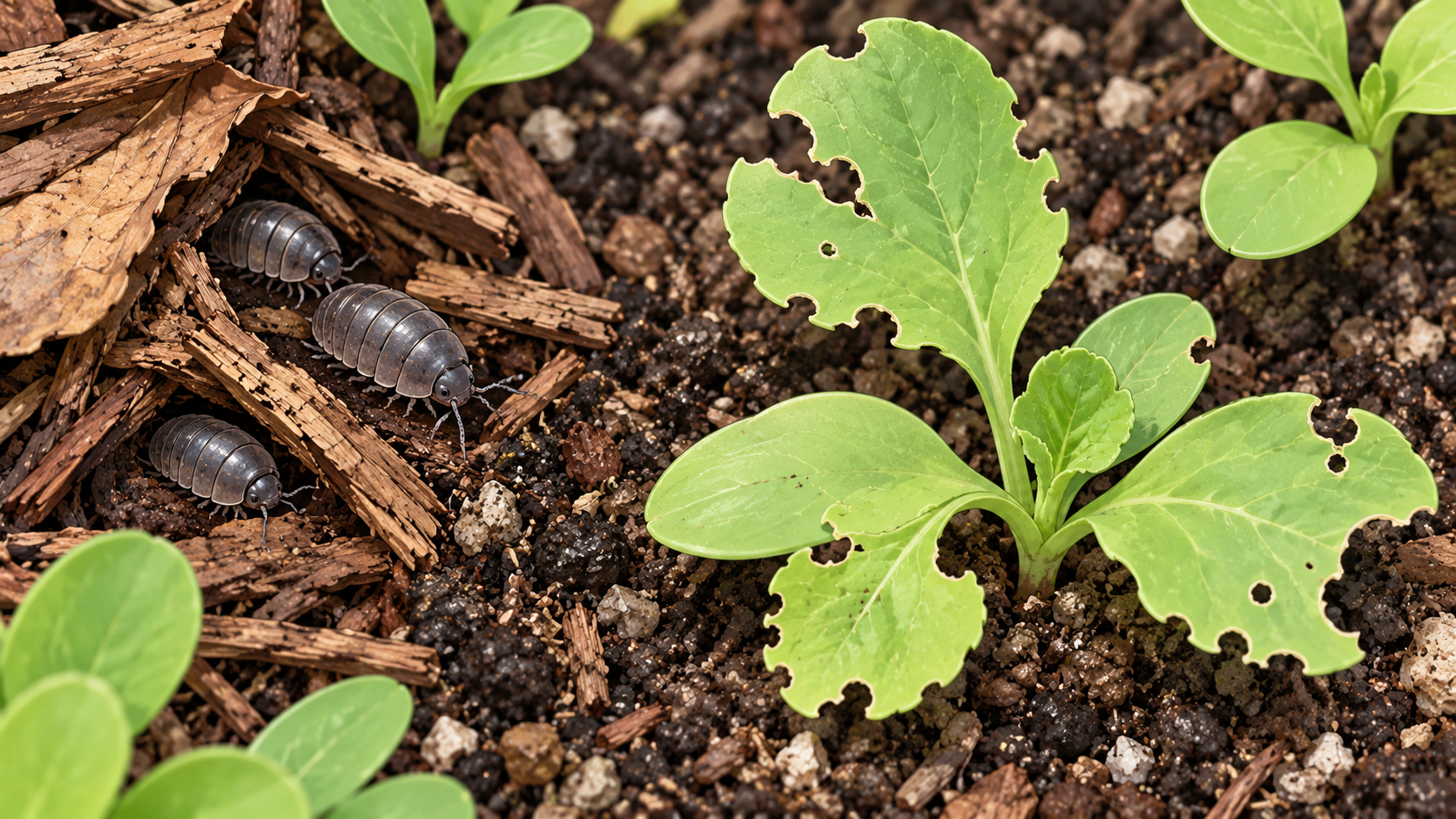
Roly-poly damage usually appears as irregular chewing on tender plant tissue close to the soil, including damaged cotyledons, scraped or chewed seedlings, injured young stems, roots, and holes in low-growing fruit. Confirmation requires finding roly-polies actively feeding because slugs, snails, earwigs, cutworms and other garden pests can leave similar damage.
The strongest diagnosis combines three things: susceptible plant tissue, feeding at a height roly-polies can readily reach, and direct evidence of the animals at the damaged area. Simply finding them beneath nearby mulch is weak evidence because their normal food includes abundant dead and decomposing organic material.
Seedlings Can Be Chewed Before They Have Much Chance to Grow
Newly emerged plants are particularly vulnerable because their stems and cotyledons are soft and close to the ground. Controlled feeding trials have demonstrated that Armadillidium vulgare can damage emerging seedlings across pulses, legumes, cereals and oilseeds, although susceptibility differs substantially among crops. Damage may involve eaten cotyledons, irregularly rasped tissue, chewed stems or seedlings reduced to short stumps. Agricultural observations also record ringbarking around young stems and branches under damaging infestations.
Soybeans provide a well-documented example of what severe feeding can look like. A. vulgare can attack the succulent hypocotyl just below the cotyledons soon after emergence. Enough tissue may be removed to separate the cotyledons from the developing seedling, killing the plant and leaving gaps in the stand. Similar-looking losses in a vegetable bed still require confirmation because several unrelated pests can cut or consume seedlings near soil level.
Plant age helps narrow the diagnosis. Pillbugs can feed on older plants, but significant injury is more often associated with tender new growth. Greenhouse populations can also become more damaging than ordinary outdoor populations; pillbugs and sowbugs are generally minor pests but can seriously injure seedlings under favorable greenhouse conditions. A mature plant with extensive damage high in the canopy is consequently a poorer match than fresh chewing concentrated around newly emerged tissue near the ground.
Strawberry Damage Usually Begins Where Fruit Is Accessible From the Ground
Strawberries are vulnerable because ripe fruit can sit directly against damp soil, mulch or debris where terrestrial isopods already shelter. Pillbugs and sowbugs are documented feeding on fruits and vegetables that contact the soil, along with seedlings, new roots and lower leaves. Damage to a strawberry can appear as irregular cavities or chewed areas rather than the small punctures associated with sap-feeding pests.
Position provides useful evidence. Injury on the underside of a berry touching damp mulch is more consistent with a ground-dwelling chewing animal than equivalent damage appearing only on elevated fruit. Roly-polies also favor humid refuges beneath ground-level cover, making low fruit particularly accessible where dense shelter extends directly beneath the plant.
A roly-poly sitting inside an existing hole still does not prove it created the opening. Soft, overripe or previously damaged fruit can become accessible to opportunistic feeders after the original injury. Strawberries have numerous potential invertebrate pests, including earwigs, slugs, snails, beetles and caterpillars, as reflected in comprehensive strawberry pest monitoring guidance. Fruit position, the shape of the injury and direct observation of feeding together provide stronger evidence than finding one animal on a damaged berry.
Damage to Roots and Lower Leaves Needs the Same Caution
Roly-polies occasionally feed on roots, lower foliage and other tender tissue. Reports for A. vulgare include injury to tomato, radish, lettuce, mustard, pea and bean, while Armadillidium nasatum has been reported feeding on cucumber plants and fruit. The broader record confirms that living plant feeding occurs in several pillbug species, but it remains secondary to their usual detritivorous feeding.
Root injury is particularly difficult to attribute from appearance alone. Beetle larvae, root-feeding insects, diseases, water stress and other soil problems can produce declining plants without leaving a unique roly-poly signature. On strawberries, for example, root beetle larvae can consume small roots and damage larger ones until plants become stunted, wilt or die. Roly-polies found in the same soil may simply be exploiting the damp organic environment.
Lower-leaf damage presents a similar problem. Irregular chewing near the soil is compatible with pillbug feeding, but location and appearance are not enough for a confident identification. The more useful question is whether roly-polies can be caught feeding on fresh injury rather than merely resting nearby.
Check the Plant When Roly-Polies Are Actually Likely to Be Feeding
Direct observation provides the clearest confirmation. Roly-polies often remain under cover during brighter, drier periods and conduct much of their exposed movement under darker conditions. Checking susceptible plants after dark or during cool, humid conditions increases the chance of seeing roly-polies during their active period rather than discovering only their daytime shelters.
Inspect the exact injury, not just the surrounding bed. A roly-poly underneath a nearby stone demonstrates that the garden supports roly-polies; one repeatedly observed chewing the edge of a damaged cotyledon provides much stronger evidence. Their compact, segmented bodies and ability to roll tightly into a ball when disturbed can also help confirm that the animal at the feeding site is a pillbug rather than another soil-dwelling arthropod.
Temporary monitoring shelters can help establish whether substantial numbers are gathering beside affected plants. Terrestrial isopods readily occupy protected objects placed against the soil, but a shelter count still measures local activity rather than proving plant damage. Even agricultural field studies have found that high A. vulgare numbers do not consistently predict crop injury. Feeding evidence remains more informative than abundance alone.
Slugs and Snails Leave One Clue Roly-Polies Do Not
Slug and snail feeding can produce irregular holes and rasped areas that resemble isopod damage, particularly on seedlings and fruit close to the soil. Their movement, however, can leave visible mucus trails on foliage, fruit, mulch or nearby hard surfaces. Finding a fresh slime trail leading to damaged tissue shifts the diagnosis toward a gastropod rather than a roly-poly.
Absence of slime is less conclusive. A trail may be difficult to see on soil, rough mulch or after weathering, so “no slime” does not prove pillbug feeding. Direct nighttime inspection remains useful when the shape of the injury overlaps.
Cutworms produce another potentially confusing seedling symptom. They can sever young plants at or near soil level, sometimes leaving a collapsed top beside the remaining stem. Pillbug injury can also destroy emerging seedlings, but documented A. vulgare feeding includes rasping, removal of cotyledon tissue and damage to succulent hypocotyls rather than a single diagnostic cut. A severed seedling should therefore prompt a search around its base and surrounding soil instead of identification from the cut alone.
Earwigs Can Reach Many of the Same Low Plants
Earwigs are also nocturnal, hide in sheltered locations during daylight and feed on a wide variety of plant and animal material. Their chewing can overlap with damage blamed on roly-polies, especially on seedlings, flowers and soft fruit.
The animal itself resolves the confusion quickly. Roly-polies have a broad, armored body made of overlapping plates and seven pairs of walking legs. Earwigs are insects with six legs and conspicuous forceps at the rear. A pillbug can also curl into the familiar defensive sphere, while an earwig cannot. When the damaged plant supports several nocturnal feeders, identifying the animal actually occupying the fresh feeding site is more reliable than interpreting holes alone.
Sap-feeding pests produce a different class of symptoms. Aphids and mites remove plant fluids rather than chewing away chunks of tissue. On strawberries, spider mite feeding produces stippling, scarring and bronzing of leaves, while aphids can cause honeydew contamination and transmit viruses. Missing tissue, scalloped edges and cavities point toward a chewing organism instead.
Confirm the Culprit Before Deciding the Damage Requires Action
A reliable roly-poly diagnosis does not automatically mean the population needs to be reduced. Minor feeding on an occasional leaf or already damaged fruit has a different significance from repeated destruction of newly emerged plants. Roly-polies normally contribute to organic-matter breakdown, so the balance between their garden benefits and plant injury depends on whether feeding is producing meaningful losses.
Repeatedly finding pillbugs on fresh damage, seeing injury progress while the animals are feeding, and finding the characteristic low-level chewing on susceptible plants together provide a much stronger case than population size alone. Once injury is confirmed and substantial enough to justify intervention, garden management for damaging roly-poly populations can be targeted to the affected area rather than applied simply because pillbugs exist in the garden.
Questions That Help Confirm Roly-Poly Damage
Can roly-polies damage seeds before seedlings emerge?
Yes. A. vulgare can consume some seeds as well as newly emerging seedlings, so missing plants are not always the result of feeding after the shoot becomes visible. Digging carefully around a failed planting can help determine whether the seed remains intact.
Do roly-polies leave slime on plants?
No. Roly-polies are crustaceans and do not produce the locomotory mucus trails associated with slugs and snails. Visible slime near fresh chewing therefore points toward another culprit.
Can roly-polies make holes in tomatoes or other fruit touching the soil?
They can feed on fruit and vegetables accessible at ground level. Existing wounds, decay and damage from other organisms can also attract opportunistic feeding, so finding a pillbug inside a hole does not establish that it initiated the damage.
Can you identify roly-poly damage from a photograph alone?
Sometimes a photograph can narrow the possibilities, but most chewing symptoms are not uniquely diagnostic. Images showing the damaged tissue, its position on the plant, nearby evidence and the animal actively feeding are considerably more useful than a close-up of the wound alone.
2 thoughts on “How to Identify Roly-Poly Damage on Plants”