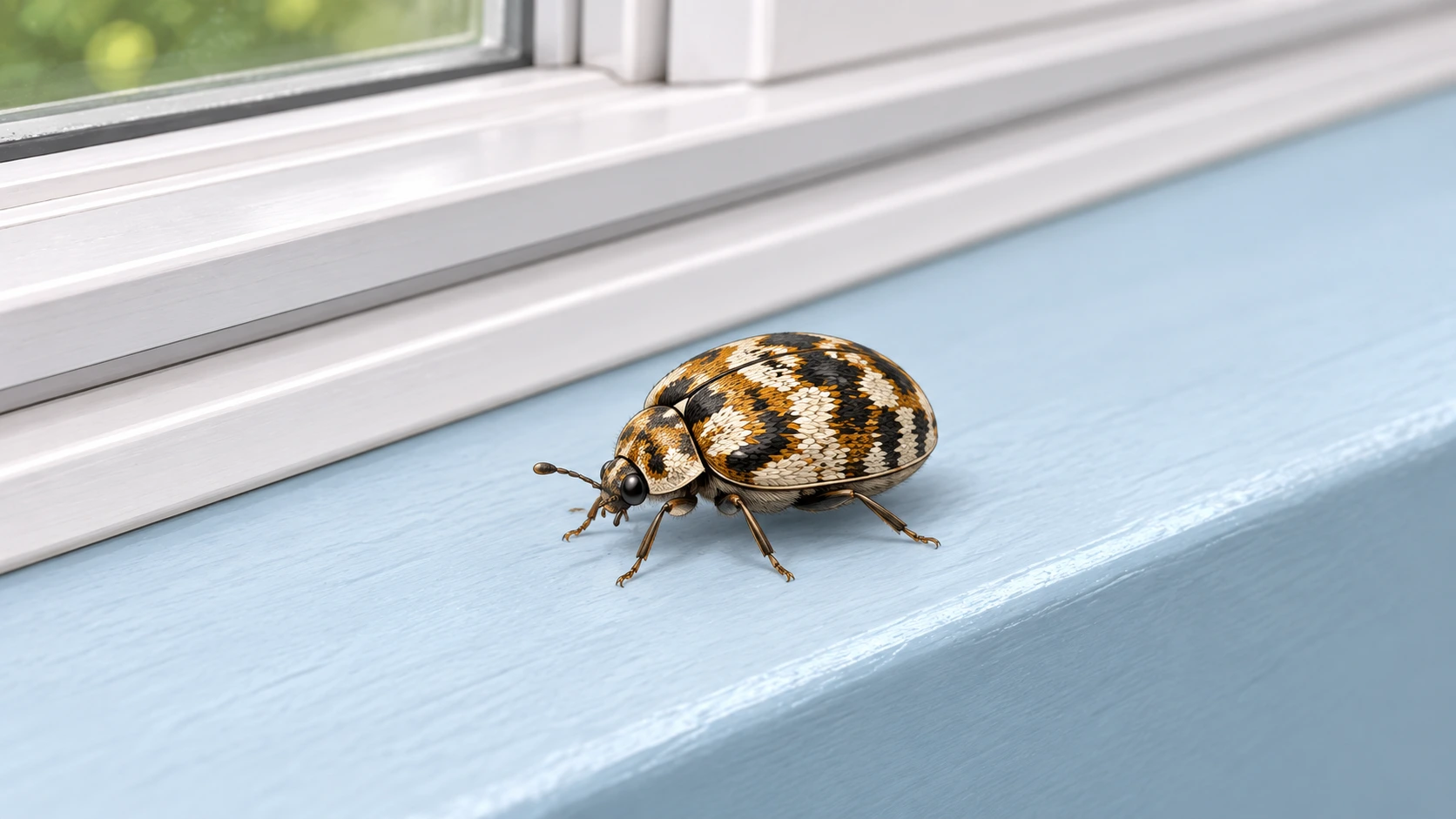
The black carpet beetle (Attagenus unicolor) and varied carpet beetle (Anthrenus verbasci) are among the most common carpet beetles found in American homes, but which one is most common depends on the region. Some North American entomology references identify the black carpet beetle as the leading species nationally. Others identify the varied carpet beetle as the most frequently encountered species in a particular state.
In the United Kingdom, the varied carpet beetle is also a familiar household pest, although two-spot and brown carpet beetles are important in certain regions and buildings. There is no reliable evidence establishing one carpet beetle species as the most common inside homes worldwide.
The distinction matters because common, widespread, and most frequently encountered are not necessarily the same thing. A species may occur across an entire country without being the beetle homeowners encounter most often in every area. Similarly, the adult beetles most frequently seen on windowsills are not necessarily the species causing the most damage inside stored clothing or furniture.
To answer the question accurately, we need to look at the location, the type of building, and what the available evidence actually measures.
Which Carpet Beetle Is Most Common in the United States?
The black carpet beetle is one of the strongest candidates for the most common carpet beetle in the United States.
This species, Attagenus unicolor, is widespread across North America and has long been recognized as an important household and stored-product pest. It can develop in animal-derived materials, including wool, feathers, fur, hair, and dried insects. Its larvae may also feed on certain stored plant products.
Some established entomology publications go further than describing it as widespread. The black carpet beetle species profile identifies it as the most common and most destructive of the five important carpet beetle species in the United States.
That statement provides a legitimate basis for naming the black carpet beetle as a leading U.S. species. It does not, however, provide a recent national count demonstrating that black carpet beetles outnumber every other species inside occupied homes.
Other regional accounts show why the distinction is important.
The varied carpet beetle, Anthrenus verbasci, is also repeatedly described as one of the most familiar household carpet beetles. Its adults are small, rounded, and covered with a mottled pattern of pale and dark scales. They are conspicuous on windowsills and other illuminated surfaces, particularly during periods of adult activity.
Both species can establish populations indoors, and both are regularly included in the major carpet beetle groups addressed by North American pest-control guidance.
The most defensible U.S. answer is therefore that the black carpet beetle is often cited as the most common nationally, while the varied carpet beetle can be the most frequently encountered species in particular regions.
A homeowner should not use either broad ranking as proof of which beetle is present in a specific room.
Why Do Some Sources Name the Varied Carpet Beetle Instead?
Different statements about the most common species may describe different geographic areas or types of observations.
Missouri provides a particularly clear example.
The black carpet beetle is described as one of the most common and widespread carpet beetles in the United States, while the varied carpet beetle is identified as the most commonly encountered carpet beetle in Missouri.
Both statements appear in the same regional carpet beetle guidance for Missouri homes. They are not necessarily contradictory because the first concerns a broad national distribution and the second concerns encounters within a particular state.
The same distinction may apply elsewhere. A species common in one locality may be less frequently reported in another because climate, available breeding materials, buildings, and surrounding habitats differ.
It is also possible for one species to be widespread but relatively inconspicuous. Another species may produce adults that are frequently noticed near windows, creating a strong impression that it dominates local household infestations.
The word encountered is especially important here. Reports of insects seen by homeowners are not identical to systematic surveys of established breeding populations.
Without comparable sampling across regions and buildings, it would be misleading to combine separate extension statements into a numerical national ranking.
Which Carpet Beetles Are Common in Different Regions?
The available references support a regional picture, but not an exact ranking for every state, province, or country.
| Region or setting | Species emphasized in reliable references | What the evidence supports |
|---|---|---|
| United States overall | Black carpet beetle, varied carpet beetle | Black carpet beetle is frequently described as a leading U.S. species; both are important household pests |
| Missouri | Varied carpet beetle | Specifically identified as the most commonly encountered carpet beetle in Missouri |
| California | Varied, furniture, and black carpet beetles | Three common species are recognized without a definitive statewide ranking |
| Northeastern United States | Black and varied carpet beetles | Both occur commonly; the black carpet beetle is especially important in some regional guidance |
| United Kingdom | Varied, two-spot, and brown carpet beetles | All are established household or collection pests, with differences by region and setting |
| Museums and heritage collections | Multiple Anthrenus and Attagenus species | Species encountered depend partly on the collection, its materials, and local insect fauna |
This comparison summarizes what the references identify as common or important. It does not represent a standardized survey in which all these regions were sampled using the same method.
California, for example, recognizes the varied carpet beetle, furniture carpet beetle, and black carpet beetle as its three commonly encountered species. That California carpet beetle guidance does not establish a single winner across every county or household.
A species-ranking article can easily become misleading when descriptions such as common throughout the state are converted into unsupported claims such as found in most homes.
Those are very different statements. A beetle can be widely distributed without being present in most buildings, and its presence in a building does not necessarily mean an established infestation exists.
What Is the Most Common Carpet Beetle in UK Homes?
The varied carpet beetle is an established and familiar pest in British homes, but naming it as the most common species across the entire United Kingdom would require more comprehensive comparative evidence.
Three species are particularly relevant in UK household guidance: the varied carpet beetle (Anthrenus verbasci), the two-spot carpet beetle (Attagenus pellio), and the brown carpet beetle (Attagenus smirnovi).
The varied carpet beetle has a long history as a domestic and museum pest in Britain. It is readily recognized by specialists and commonly associated with natural-fiber materials and stored collections.
The two-spot carpet beetle is another important British species. It is described as one of the commonest carpet beetles in the country, with its pest significance particularly associated with southern England and Wales. Larvae may occur in bird nests and can subsequently be found in buildings.
The brown carpet beetle represents a different distribution history. It is a more recent introduction than the long-established varied carpet beetle, and its importance can vary with location and building conditions.
These distinctions are documented in the UK carpet beetle identification and distribution guide.
There is no need to turn those observations into a single UK-wide numerical ranking without comparable household-survey data.
For someone in Britain, the most useful starting point is recognizing that a small patterned beetle may be Anthrenus verbasci, while other common local species may look considerably darker or differ in body shape. The complete identification belongs in a separate species guide rather than being inferred from which name appears most often online.
What About Canada?
Both black and varied carpet beetles are relevant to Canadian homes, but a definitive Canada-wide ranking would require reliable, comparable records from multiple provinces and territories.
Black carpet beetles are documented across Canada and the United States, while varied carpet beetles have a broad geographic distribution and occur in temperate regions well beyond their originally described ranges.
Those facts establish that both species are plausible household pests in Canada. They do not prove which one is most common in a particular Canadian city.
A house in southern Ontario, a building on the Prairies, and a residence on the Pacific coast may differ in surrounding vegetation, building age, stored materials, and insect activity. Such differences can influence which species are encountered.
A national species name is therefore less useful than a confirmed local identification when an infestation is suspected.
For Canadian homeowners, as elsewhere, the practical distinction is between a beetle that has merely entered the building and larvae actively developing in stored or concealed materials.
The wider question of how carpet beetles get into homes helps explain why an occasional adult does not necessarily reflect the species responsible for an established indoor infestation.
Does the Name “Common Carpet Beetle” Mean It Is the Most Common?
No. Common carpet beetle is also the established common name of a particular species, Anthrenus scrophulariae. The name does not mean that this species necessarily outnumbers every other carpet beetle.
This naming issue causes considerable confusion.
A homeowner may read about the common carpet beetle and understandably assume the article is discussing whichever species is found most often in houses. In reality, the phrase can refer to a named species rather than to carpet beetles generally.
Anthrenus scrophulariae is a recognized household and museum pest, but its relative frequency varies by region. It is reported worldwide and is especially associated with northern areas of the United States in some species accounts.
The scientific name resolves the ambiguity. When an author writes Anthrenus scrophulariae, they are identifying a specific species. When they write that black or varied carpet beetles are common, they are making a statement about how frequently those other species occur.
This distinction is one reason it helps to use scientific names when discussing prevalence. Everyday names are useful, but they do not always tell us how abundant an insect actually is.
Our guide to the different types of carpet beetles covers the principal species names in more detail.
Are Varied Carpet Beetles More Common Inside Houses Than Black Carpet Beetles?
There is no single answer that applies to all homes.
The varied carpet beetle may be more frequently noticed in some houses because its small, rounded adults appear around windows and illuminated areas. The black carpet beetle may be associated with a different set of household materials or be encountered in less conspicuous locations.
However, seeing more adults of one species does not establish that it has a larger breeding population inside the house.
Adults and larvae occupy different ecological roles. Adult carpet beetles commonly feed on pollen or nectar outdoors, while the larvae of household pest species develop on suitable organic materials. An adult entering through an open window may have developed elsewhere.
The reverse can also happen. A household may contain a concealed larval population without anyone frequently seeing adults.
That means the answer depends partly on what is being counted:
-
Adults noticed by residents.
-
Specimens submitted for identification.
-
Larvae found in actively infested materials.
-
Species recorded during systematic household inspections.
These categories are not equivalent. A study based on adult window sightings could produce a different ranking from one based on larvae collected from wool rugs or stored animal products.
Without knowing how an abundance claim was measured, its usefulness for a particular household remains limited.
For readers interested in the actual species differences, the dedicated varied carpet beetle versus black carpet beetle comparison is the appropriate place to examine their adult and larval characteristics.
Does the Most Common Species Change Between Homes and Museums?
It can, because the environment and the materials available to insects are different.
A typical home may offer wool rugs, pet hair, old clothing, feather-filled furnishings, and accumulations of dead insects. A natural history collection may contain dried insect specimens, taxidermy, animal skins, preserved feathers, and other materials that are particularly attractive to dermestid larvae.
Some carpet beetle species are well known in both settings, but the relative number of specimens encountered can differ.
A museum’s trapping records may reflect the species most active around its collections, not the species most numerous in nearby residential buildings. Likewise, a survey of textile damage in storage rooms may emphasize a different part of the population from an inspection of residential windowsills.
Even the same institution may record different species in different storage spaces. A room containing dried animal specimens creates different feeding opportunities from one containing primarily paper or synthetic materials.
This is why conclusions drawn from a museum pest survey should not automatically be converted into rankings for ordinary homes.
The species that matters in either setting is the one actually causing the damage. Its identity and the material supporting its larvae are more useful for control than its position in a general list of common pests.
Why Is There No Reliable Worldwide Winner?
The biggest problem with naming one worldwide winner is that carpet beetle prevalence has not been established through a single standardized global household survey.
Regional fact sheets identify pests of practical importance, but they do not all report comparable numbers. Some focus on damage, some on geographic distribution, and others on the insects most frequently submitted for identification.
Differences in terminology add another complication. The term carpet beetle can be used broadly for several members of the family Dermestidae, including species that are particularly associated with stored products or museum collections.
Identification practices can also affect the data. Some household reports are based on an insect’s general appearance, while specialist records may involve confirmed specimens. Small beetles can be misidentified, and closely related species may require examination of fine physical structures.
The absence of a reliable global ranking should not be mistaken for a lack of knowledge about the insects themselves.
We know that several species have broad distributions and are regularly associated with buildings. What we cannot honestly infer from those facts is a worldwide percentage assigning first, second, and third place to individual carpet beetle species.
An evidence-based account of common species therefore needs to retain its geographic boundaries.
A claim such as “black carpet beetles are among the most widespread household carpet beetles in the United States” is more defensible than “black carpet beetles are found in 70% of homes worldwide” when no supporting global survey exists.
Does the Species Ranking Matter When You Find Carpet Beetles at Home?
The regional ranking can help narrow the possibilities, but it should not substitute for identification of the actual insect.
If you find a tiny adult beetle near a window, knowing that varied and black carpet beetles are common locally can help you decide which reference photographs to examine. It does not prove the identification.
An adult beetle’s appearance, the location where it was found, and the presence of larvae or other physical evidence can all help establish which species is involved.
The general carpet beetle appearance guide explains the basic traits of the group, while the species-specific articles address finer distinctions.
The discovery context can be equally important. Adult beetles gathering near windows may be visiting insects rather than proof of a developing infestation. Larvae found repeatedly in natural-fiber materials provide stronger evidence of breeding activity.
That distinction is useful when you’ve found just one carpet beetle and are trying to decide whether further inspection is necessary.
It is also worth remembering that the damage is mainly caused by the larval stage. A common adult species is not automatically the most destructive species in a particular home, and one species can cause substantial damage even when it is uncommon in the surrounding area.
For a confirmed infestation, identifying the breeding source remains more important than learning which species leads a national ranking.
How Can You Find Out Which Species Is Common in Your Area?
Local entomology references are more useful than generalized worldwide lists.
University extension services, agricultural experiment stations, regional museums, and professional insect identification laboratories may publish information about species known to occur in their area.
The quality of a prevalence claim depends on its evidence. A reference that explicitly describes a species as frequently encountered in a named state is stronger evidence for that state than a general article that calls the insect common everywhere.
It also helps to distinguish occurrence records from actual relative abundance. A biodiversity database showing a species in several counties establishes that it has been recorded there. It does not necessarily show that it is the most common carpet beetle inside homes.
If you need to identify a specimen, collect clear photographs showing the adult’s upper surface and approximate size, or preserve a specimen for appropriate examination. Avoid relying solely on color because patterned scales can wear away.
The relevant question is not only whether a species is present in the region, but whether the specimen in the house matches that species.
If you repeatedly find larvae, inspect the affected material and nearby potential food sources. The signs of a carpet beetle infestation provide a more useful basis for assessing household activity than an unsupported assumption about the most common local species.
The Bottom Line
Black and varied carpet beetles are the principal candidates when asking about the most common carpet beetle in American homes. The black carpet beetle is widely identified as a leading U.S. species, while regional guidance specifically places the varied carpet beetle first in areas such as Missouri.
In Britain, varied carpet beetles are familiar household pests, alongside important species such as the two-spot and brown carpet beetles. Canada and other countries also have multiple species, but documented presence does not establish a national or worldwide prevalence ranking.
No reliable single species can be declared the most common in homes everywhere. Location, building type, the material being infested, and the method used to count insects all influence the answer.
For an individual household, local prevalence is a useful starting clue. Confirming the species and finding any actively developing larvae are much more informative than assuming the most frequently named carpet beetle must be the one inside your home.