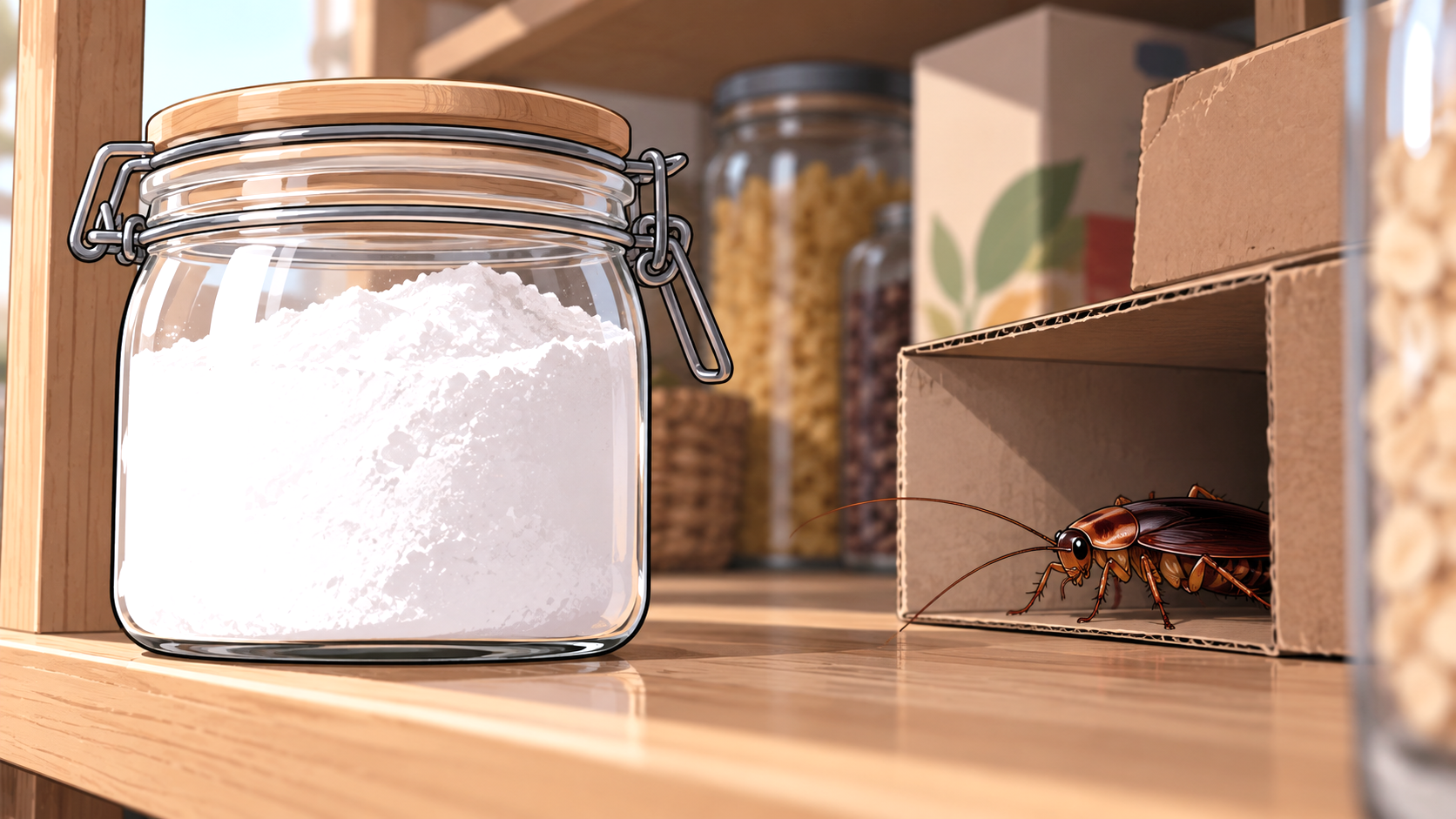
Baking soda is frequently promoted as a homemade cockroach killer, usually after being mixed with sugar or another food. It is not a reliable treatment for a cockroach infestation. Published pest-management guidance specifically notes that baking soda does little to reduce cockroach populations, while established control programs rely on sanitation, monitoring, exclusion, baits, and proven insecticides instead. The confusion is understandable because baking soda is sodium bicarbonate, a substance that has legitimate uses far beyond baking. Sodium bicarbonate even appears in registered pesticide applications, but those uses include controlling fungal diseases on plants. The existence of sodium bicarbonate as a pesticide ingredient does not establish grocery-store baking soda as an effective insecticide against cockroaches.
The Baking Soda and Sugar Remedy Has a Weak Foundation
The familiar recipe combines baking soda with sugar on the assumption that sugar attracts a cockroach, the insect eats both ingredients, and the sodium bicarbonate subsequently kills it. Variations of this remedy have circulated for years, and some government materials have even repeated it. The stronger entomological guidance is much less favorable. Baking soda and baking powder are among the home remedies described as doing little to reduce cockroach populations, while a detailed cockroach-management manual classifies baking-powder remedies among treatments that lack a scientific research basis for recommendation.
We would not build a treatment plan around the sugar mixture. A substance can injure or kill individual insects under particular circumstances without being useful for controlling a household population. For a cockroach remedy to matter in a home, enough insects must encounter it, consume an effective amount, and ultimately decline as a population. A dish of sugar and baking soda gives you no dependable way to know that any of those things are happening.
That uncertainty becomes more consequential once you have an established infestation. Cockroaches occupy protected harborages and exploit food, moisture, and shelter throughout their surroundings. Signs of a cockroach infestation can also extend beyond the adults you happen to see. Counting dead cockroaches beside a homemade mixture would therefore be a poor measure of whether the population itself is being controlled.
Baking Soda Is Not the Same Thing as Boric Acid
One source of bad DIY advice is the tendency to treat white household powders as though they are interchangeable. They are not. Baking soda is sodium bicarbonate. Boric acid is a different substance with established insecticidal uses, and boric acid products can be used against cockroaches when the product is intended for that purpose and its label directions are followed. Pest-management guidance explicitly warns that homeowners may confuse baking soda, baking powder, or borax with boric acid when choosing cockroach remedies.
Diatomaceous earth is different again. Its effectiveness depends on its physical interaction with insects rather than the supposed digestive reaction attributed to baking soda, and diatomaceous earth for cockroaches comes with its own application and safety limitations. Calling all three “powder remedies” hides the properties that determine whether each material has a legitimate role in pest control.
A Cheap Remedy Can Become Expensive in Lost Time
Baking soda looks attractive partly because most households already have it. Cost and availability, however, are poor measures of pest-control performance. Cockroach populations continue using available food, water, and shelter while an ineffective remedy sits on the floor. Waiting to see whether a baking-soda mixture eventually works can delay measures that actually address those resources and the places where the insects are living.
A more defensible cockroach control strategy begins by determining where activity is concentrated and reducing the conditions supporting it. Food and garbage should be secured, leaks repaired, clutter reduced, and accessible gaps addressed. These steps are central to integrated pest management, which combines inspection and identification with environmental changes, appropriate control measures, and follow-up rather than depending on a single remedy.
Monitoring also gives you information that a pile of baking soda cannot. Traps placed along likely cockroach travel routes can reveal where activity is greatest and whether numbers are changing over time. Cockroach traps used for monitoring therefore have value even when they are not expected to eliminate the infestation by themselves.
Where insecticidal treatment is necessary, cockroach baits and gels are specifically designed to exploit cockroach feeding behavior. Government cockroach-control guidance includes baits, traps, dusts, and other labeled pesticides among available options and stresses that pesticides must be applied according to their labels. That is a much stronger basis for choosing a treatment than a household recipe whose effectiveness against an infestation is unreliable.
Where Baking Soda Still Belongs in a Cockroach-Prone Kitchen
Throwing out the baking soda is unnecessary. It simply has a different job. Sodium bicarbonate works as a mild abrasive and is commonly used in household cleaning, including sinks and other kitchen surfaces. Keeping food residue and grease under control can remove resources that cockroaches exploit, so cleaning remains useful even though the baking soda itself should not receive credit as the insecticide.
Sanitation works best as one component rather than a standalone cure. Reducing food, water, and shelter available to pests makes the environment less supportive of cockroaches, while exclusion and targeted treatment address other parts of the infestation. If avoiding conventional products is the priority, natural cockroach-control methods still need to be judged by evidence and realistic limitations rather than by whether their ingredients happen to come from a kitchen cupboard.
Other Questions About Baking Soda and Cockroaches
Can baking soda attract cockroaches by itself?
Plain baking soda is not the attractive component in the popular DIY recipe. Sugar or another food ingredient is added to encourage feeding. Leaving edible material accessible to cockroaches is a questionable strategy when cockroach management otherwise calls for removing competing food sources.
Is baking powder the same cockroach remedy as baking soda?
No. Baking soda is sodium bicarbonate, while baking powder is a formulated leavening product that contains sodium bicarbonate along with acid ingredients and usually starch. Neither should be confused with a registered cockroach-control product simply because sodium bicarbonate is present.
Can I sprinkle baking soda everywhere because it is a household product?
There is little reason to spread it throughout the home for cockroach control when the treatment itself is unreliable. Loose powders can also create unnecessary mess and may contaminate food-preparation areas. Reserve baking soda for appropriate household uses and place actual pest-control products only where their labels permit.
What should I do if I already tried baking soda and still see cockroaches?
Stop judging progress by the homemade mixture and begin monitoring the infestation. Remove accessible food and water, inspect likely harborages, seal useful entry points, and select a treatment with established cockroach-control value. Persistent or extensive activity warrants professional assessment rather than repeated experimentation with another kitchen ingredient.