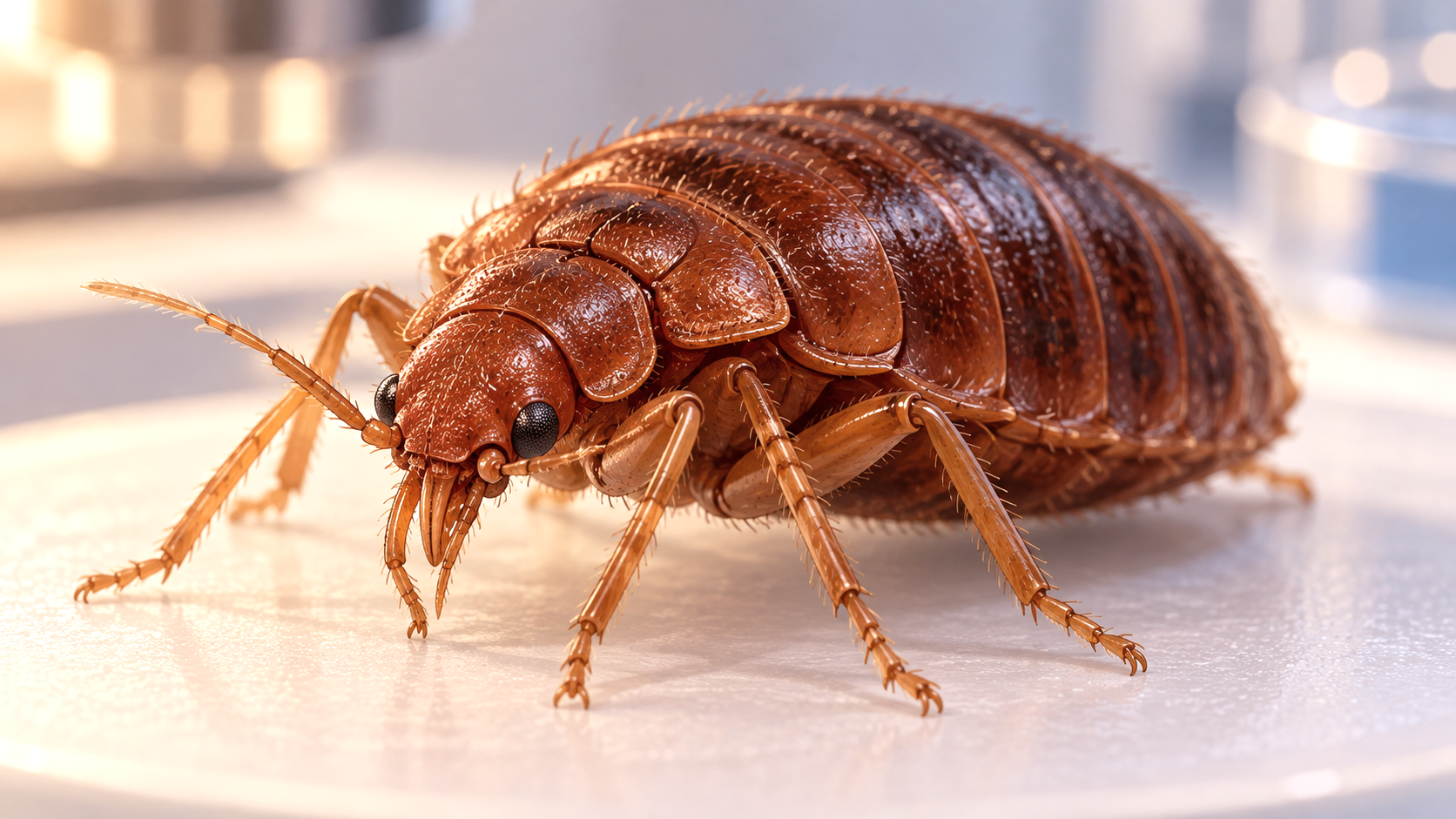
A bed bug’s body is built around feeding on blood while remaining small enough to hide in narrow crevices. Adults have compound eyes, three pairs of legs, a folding piercing-sucking mouthpart system, and a flexible external skeleton rather than a true shell. The abdomen can expand dramatically during feeding, while the flatter head and thorax change much less.
Bed Bug Eyes Are Small Compound Eyes, Not Simple Black Dots
The dark structures on either side of a bed bug’s head are compound eyes made from multiple visual units called ommatidia. A microscopic study of Cimex lectularius vision found that the eyes develop through the five nymphal stages and into adulthood, with their internal structure changing as the insect grows. CDC electron microscopy likewise shows that each compound eye contains repeating ommatidia rather than functioning as one simple lens.
Bed bugs can respond to light and visual contrast, although vision is only part of how they navigate. Research on bed bug vision and mechanoreception shows that light intensity, vertical objects, and surface texture can influence orientation. Their other sensory equipment includes four-segmented antennae, and the structure and role of bed bug antennae are distinct from the eyes themselves. The combination of these organs helps explain why the small head of a bed bug contains more sensory machinery than its simple outline suggests.
Six Legs Carry Claws Designed for Crawling and Gripping
Bed bugs are insects, so adults and nymphs have six jointed legs, one pair attached to each of the three thoracic segments. The legs are built for walking rather than jumping. Bed bugs have no enlarged hind legs like fleas, and they cannot jump or fly.
At the end of each leg are tarsi equipped with paired claws. Research in the Journal of Experimental Biology found that bed bug tarsal claws grip folds and hairs in human skin during feeding. The same gripping structures help them move over rough fabric, wood, walls, and other textured surfaces. Their claws perform less effectively on extremely smooth materials, which is one reason surface texture influences movement.
Although bed bugs can crawl efficiently for their size, their locomotion remains ordinary walking rather than specialized jumping. Their ability to travel across floors, furniture, and walls accounts for much of the movement commonly observed around an infestation. The legs also keep the body close to the surface, preserving the low profile that lets an unfed bug enter very narrow gaps.
The Visible “Beak” Is a Folding Sheath Around Piercing Stylets
Bed bugs do not bite with jaws like an ant or beetle. As members of the order Hemiptera, they possess specialized piercing-sucking mouthparts. The CDC’s bed bug identification material shows the characteristic mouthparts beneath the head, while the Natural History Museum describes them as needle-like structures used to pierce mammalian and bird skin.
The visible external structure is the labium, a segmented sheath that normally folds beneath the head and front of the body. Inside it are much finer modified mandibles and maxillae called stylets. Anatomical studies of piercing-sucking insect mouthparts show that interlocking maxillary stylets create separate channels for saliva and liquid food. During feeding, the stylets enter the skin while the labium bends away rather than being driven into the wound.
Saliva passes into the feeding site while blood travels in the opposite direction through the food canal. This arrangement allows a bed bug to take a liquid meal without chewing tissue. Every nymphal stage and adult depends on this feeding apparatus because bed bugs obtain their nutrition from blood.
A Bed Bug Has an Exoskeleton, but the Abdomen Is Built to Stretch
The brown outer covering sometimes called a bed bug’s “shell” is more accurately its cuticle or exoskeleton. Insects do not have bones supporting the body internally. Their external cuticle provides structural support and protection, with chitin and cuticular proteins forming major components of the insect exoskeleton. A modern review of insect cuticle structure describes this material as a complex matrix that protects against physical damage, dehydration, and environmental stress.
A bed bug’s exoskeleton is not equally rigid everywhere. The abdomen consists of visible segments separated by softer membranous cuticle, allowing the rear of the body to expand as blood enters the digestive system. Laboratory research found that feeding can increase bed bug body length substantially through abdominal distension. An unfed adult therefore looks broad, flat, and relatively compact, while a recently fed individual becomes longer and more swollen. The visual differences between fed and unfed bed bugs largely reflect this expansion rather than a change in the basic body plan.
The cuticle also explains why growing bed bugs must molt. CDC describes five nymphal stages, with a blood meal required before each molt, after which the insect sheds its old exoskeleton and forms a larger one. Those discarded skins can remain in harborages as evidence of an infestation. Despite the protective outer covering, bed bugs are not beetle-like insects enclosed in a rigid case, and the question of how easily bed bugs can be crushed depends partly on whether the abdomen is flat and unfed or distended with blood.
The familiar oval, flattened appearance of a bed bug results from all of these structures working together: compact compound eyes and sensory organs on the head, six clawed walking legs on the thorax, folded feeding stylets beneath the front of the body, and a segmented abdomen whose flexible exoskeleton can expand when the insect feeds.