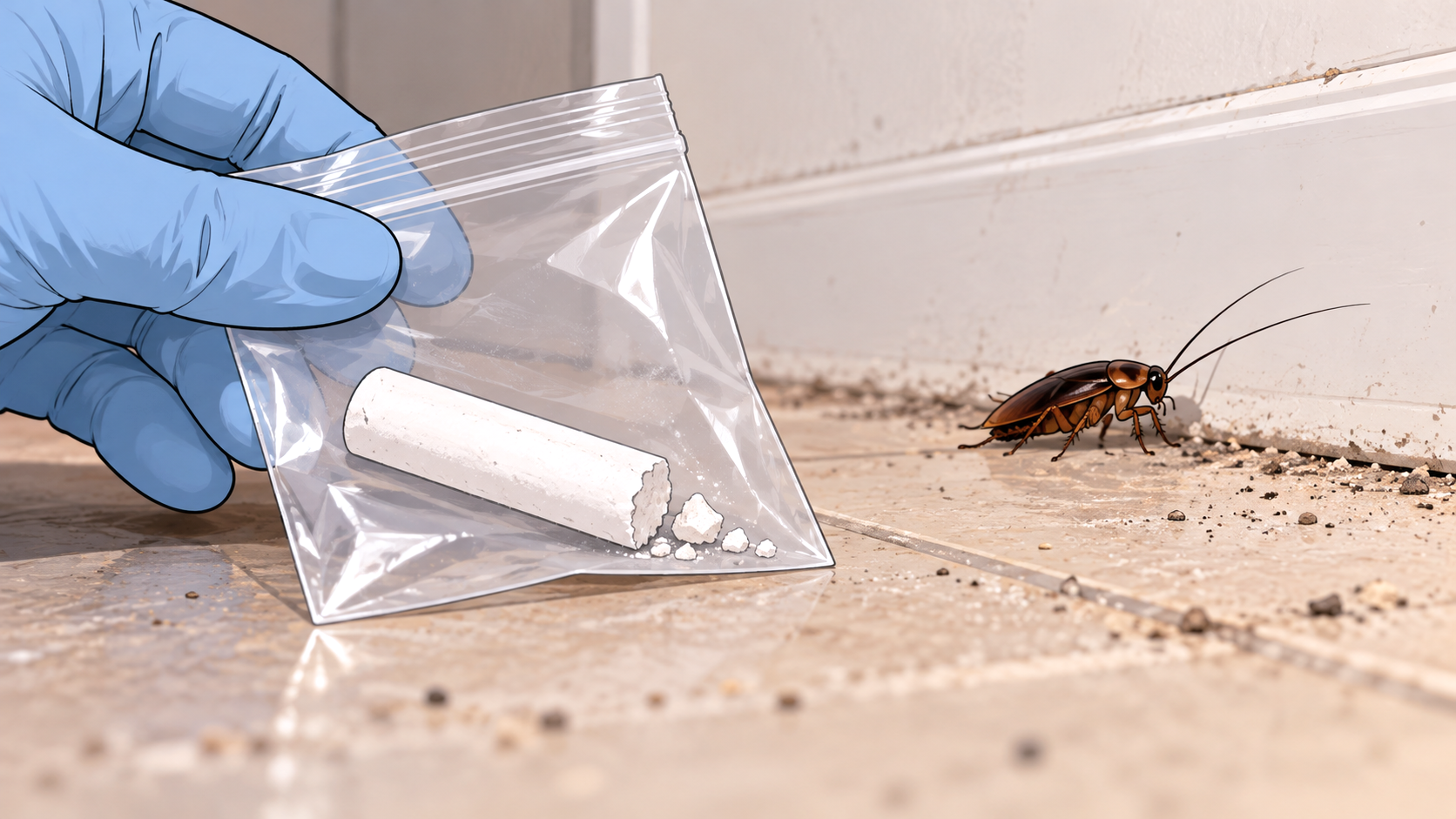
Cockroach chalk looks like an ordinary stick of writing chalk, but some products contain powerful insecticides intended to poison insects that cross the marks left behind. These products are often sold as Chinese Chalk, Miraculous Chalk, or insect-killing chalk, sometimes with claims that they are harmless to people and pets.
Cockroach chalk can kill cockroaches if it contains an effective insecticide and the insects receive sufficient exposure. However, its performance is unpredictable, and many insecticidal chalk products are illegal to sell in the United States because they lack EPA registration. Their ingredients may be undisclosed, and the powder left on household surfaces can expose children, pets, and other occupants.
Ordinary blackboard or sidewalk chalk is not an equivalent treatment. It does not contain the insecticidal ingredients responsible for the killing claims.
What Is Cockroach Chalk Made Of?
Insecticidal chalk generally consists of a solid carrier mixed with one or more insecticides. Drawing with the stick deposits powder onto a surface, creating a treated line that crawling insects may encounter.
The exact ingredients are not consistent across products. The National Pesticide Information Center’s investigation of illegal insect-killing chalk reports that laboratory testing by California pesticide regulators identified deltamethrin in some samples and cypermethrin in others. Both substances belong to the pyrethroid family of insecticides.
Pyrethroids disrupt normal insect nerve signaling. Sufficient exposure can cause uncontrolled movement, paralysis, and death. The National Pesticide Information Center’s deltamethrin assessment confirms that deltamethrin can kill insects through contact or ingestion.
Because some imported chalks do not disclose their ingredients accurately, the color, smell, or appearance of the stick cannot establish which chemical it contains. A product containing deltamethrin should not be assumed identical to one containing cypermethrin or another undisclosed pesticide.
The difference between rapid cockroach incapacitation and actual death also applies to these ingredients. An insect that becomes uncoordinated after crossing a treated line has not necessarily received a lethal dose.
How Effective Are the Chalk Lines Against Cockroaches?
Insecticidal chalk depends on cockroaches encountering enough deposited pesticide. A line on the floor does not form a physical barrier, and the insect is not required to remain within the marking.
A cockroach may cross the line, accumulate pesticide on its body, and subsequently die. Alternatively, it may encounter too little material for a lethal effect, avoid the treated area, or remain inside a hiding place without contacting the chalk.
There is no dependable body of independent product-specific testing establishing that commonly sold unregistered cockroach chalks eliminate household infestations. Claims promising death within hours or complete removal after a few days should therefore not be treated as established performance standards.
The EPA’s 2019 enforcement action against sellers of Miraculous Insecticide Chalk documented products advertised as effective cockroach killers despite lacking registration and making misleading safety claims.
A few dead insects near a chalk marking would demonstrate neither that every exposed cockroach died nor that the remaining population had been controlled. The locations cockroaches occupy while concealed often extend beyond the exposed surfaces where people can draw lines.
Why Cockroach Chalk Is Not the Same as Boric Acid or Ordinary Chalk
Three products that may look like powders or chalk can have very different properties.
Ordinary writing chalk typically consists of calcium carbonate or calcium sulfate. Its purpose is to leave a visible mark, not to deliver a toxic dose to cockroaches. Drawing a continuous white line with classroom chalk does not create a scientifically established insect barrier.
Boric acid insecticides contain a different active ingredient. Their toxic action is not interchangeable with the nerve-disrupting effects of pyrethroids. A comparison of boric acid and diatomaceous earth for cockroaches involves labeled insecticidal dusts with properties distinct from the unidentified mixtures sometimes sold as Chinese Chalk.
Commercial insecticidal chalk, meanwhile, may contain a pyrethroid without any reliable disclosure of concentration or accompanying ingredients. Its effectiveness and safety cannot be determined from its chalk-like form.
A substance being sold as chalk says nothing about whether it is harmless. The insecticide it contains and the amount a person or animal encounters determine the potential hazard.
Why Insecticidal Chalk Is Particularly Dangerous Around Children
Insecticide chalk can be mistaken for the chalk children use on blackboards or pavements. Its stick form encourages handling, while the powder left behind can transfer onto fingers, toys, clothing, and other household surfaces.
This is a documented exposure problem, not merely a theoretical warning. A study of Texas poison-center reports identified 188 exposures to Miraculous Insecticide Chalk among children aged five or younger between 2000 and 2010. Ingestion was reported in 97.3% of those cases.
The consequences depend on the chemical, dose, and route of exposure. Poison Control’s insecticide guidance identifies ingestion, inhalation, and skin or eye contact as potential exposure routes, with symptoms varying among insecticide classes.
The danger also extends to pets that walk through powder and subsequently groom themselves. The National Pesticide Information Center reports that sufficiently high deltamethrin exposure in dogs and cats can cause drooling, vomiting, poor coordination, and tremors.
If someone swallows insecticidal chalk or develops symptoms after exposure, seek immediate guidance from a poison center or medical professional. In the United States, Poison Control is available at 1-800-222-1222. Do not induce vomiting unless specifically instructed by a medical professional.
How to Check Whether Cockroach Chalk Is Legal
In the United States, insecticidal chalk making claims against cockroaches ordinarily requires EPA pesticide registration unless a specific exemption applies. A valid registered product should identify its active ingredients, carry an EPA Registration Number, and provide directions and precautions for its approved uses.
The EPA’s pesticide registration database allows consumers to check product registration. An EPA Establishment Number alone is not evidence that the pesticide itself has been registered.
Be especially cautious of products that provide no active-ingredient concentrations, manufacturer details, or meaningful safety instructions. The EPA warns specifically against Chinese Chalk and Miraculous Chalk, including packages claiming they are harmless to people and animals.
Registration requirements differ outside the United States. A product sold legally in one country is not automatically authorized in another, and sellers’ claims should not substitute for checking the relevant national pesticide regulator.
What if You’ve Already Drawn Cockroach Chalk Lines?
If the product is unregistered, unidentified, or suspected to be illegal, stop using it and prevent children and pets from contacting the marked surfaces. Retain the packaging or photograph its labeling for identification without handling the chalk unnecessarily.
Avoid dry sweeping, brushing, or using a household vacuum that might disperse pesticide dust into the air. Contact your local poison center or pesticide regulatory authority for advice about safe removal and disposal of the particular formulation. Cleaning and disposal recommendations may differ depending on the ingredients.
Do not flush leftover chalk into drains or mix it with household cleaners. If the product is unidentified, guessing how its ingredients will react with water or other chemicals is unnecessary.
For continued cockroach activity, appropriately labeled bait stations or other registered treatments provide a safer and more accountable alternative to an unknown chalk formulation. The EPA’s household pesticide precautions emphasize using products only for their intended pests and locations.
Regardless of which registered treatment is selected, monitoring for continuing cockroach activity provides more useful evidence than judging success by whether a few insects die near a treated surface.
Cockroach chalk containing genuine insecticide can produce lethal effects, but the familiar chalk-stick appearance conceals substantial uncertainties about ingredients, exposure, and effectiveness. Unregistered insecticidal chalk is not worth using when legally registered cockroach-control products are available.