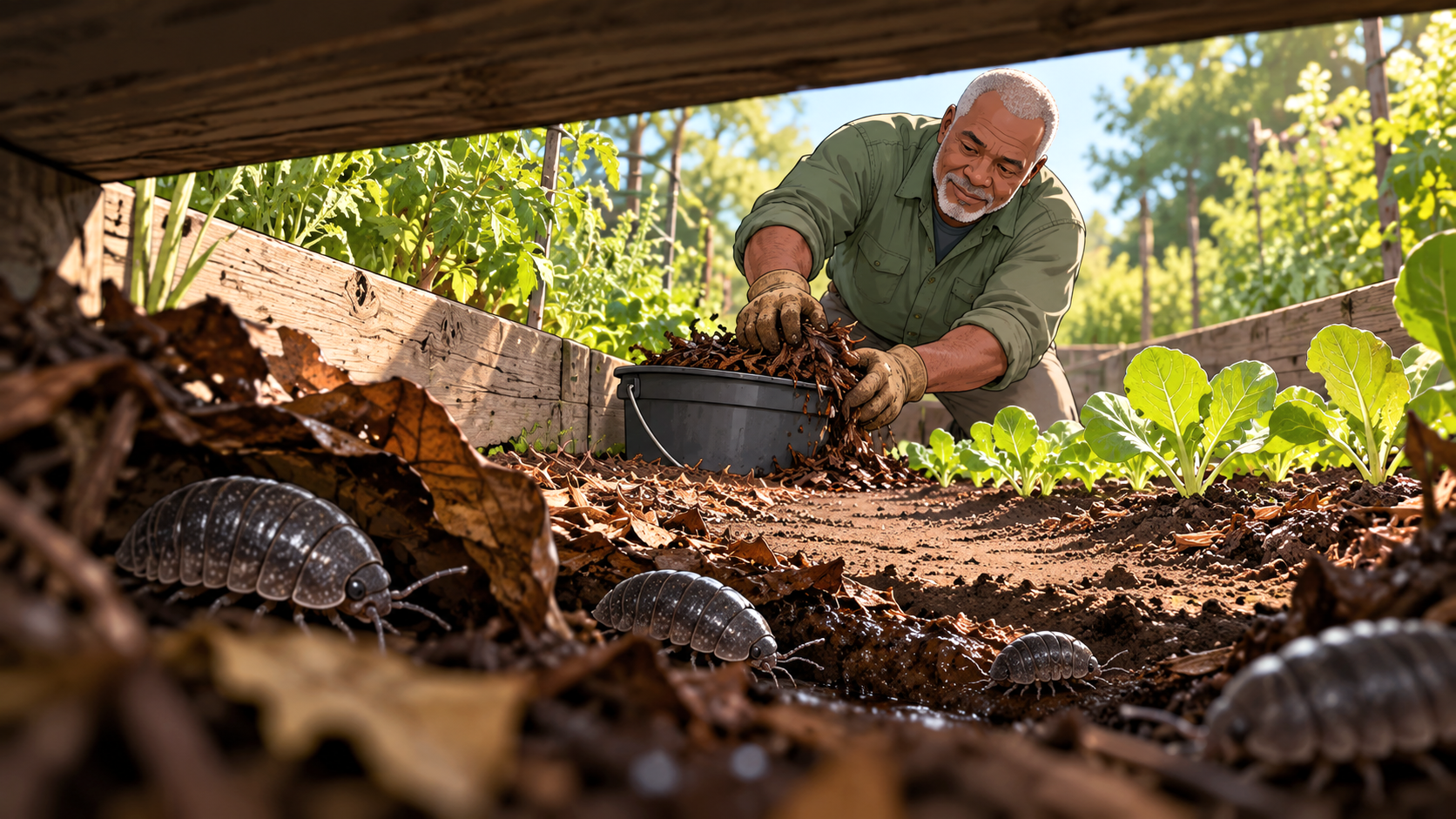
To get rid of damaging roly-polies in a garden, make the immediate area around vulnerable plants less favorable, protect seedlings and low fruit, and remove concentrated groups from their shelters. Reduce persistent surface moisture and excessive debris without drying plants excessively. Pesticides are rarely the first or most useful response to ordinary garden populations. The goal is not to eliminate every roly-poly from the landscape. They normally function as decomposers, so management is most useful where roly-polies are actually damaging plants rather than merely living beneath mulch.
Start With the Few Square Feet Where Damage Is Happening
Roly-poly management can often be much more localized than gardeners expect. Seedlings, new roots and fruits or vegetables touching damp soil are among the plant parts most vulnerable to pillbug feeding, while established plants usually tolerate their presence. Controlled feeding experiments confirm that Armadillidium vulgare can damage emerging seedlings from several crop groups, but susceptibility varies among plants. Concentrate changes around affected seedbeds, transplant rows and low fruit instead of stripping organic material from an entire garden.
High numbers alone are a poor reason for aggressive treatment. Field experiments in soybeans found no consistent relationship between A. vulgare abundance and seedling injury, and even removing crop residue by burning failed to reduce feeding damage. A cluster under a board may be feeding primarily on decomposing vegetation. The balance changes when fresh plant injury is attributable to them, which is why whether roly-polies are good or bad for a garden depends on their effect on the plants rather than a simple population count.
Let the Soil Surface Dry Between Necessary Watering
Persistent surface moisture gives terrestrial isopods the humid conditions they need. Their physiology makes them vulnerable to water loss, and dry conditions can dehydrate roly-polies rapidly. Irrigation can therefore be adjusted so plants receive adequate water without keeping the soil surface and surrounding debris continuously wet.
Water early enough that exposed surfaces can dry before evening, and avoid unnecessary overhead watering when a more targeted method suits the plants. Drip or furrow irrigation can reduce the amount of continuously wet surface compared with sprinklers, while irrigation frequency can be reduced only as far as healthy plant growth permits. These approaches are specifically recommended for problematic pillbug and sowbug populations.
Do not respond by deliberately drought-stressing the crop. Moisture management works by removing unnecessarily wet refuges, not by withholding the water roots require. Roly-polies naturally occupy humid, protected microhabitats close to the ground, so relatively small changes at the surface can make a planting area less attractive without allowing the root zone to become excessively dry.
Thin the Shelter Immediately Around Vulnerable Plants
Organic mulch has legitimate horticultural benefits and does not need to disappear from the garden. Dense, wet mulch pressed directly against tender stems and ripening fruit, however, combines shelter, moisture and decomposing food beside plant tissue susceptible to feeding. Pulling that material slightly away from affected seedlings and removing accumulations of decaying vegetation from the immediate feeding zone can reduce protected daytime refuges.
Boards, overturned pots, stones, discarded plant material and other objects resting against moist soil can serve the same function. Check beneath them around affected plants and remove unnecessary hiding places. Roly-polies spend much of their time concealed under surface cover, and their predominantly nighttime activity means daytime cleanup can expose concentrations that were otherwise difficult to notice.
Avoid indiscriminately clearing every patch of leaf litter from the landscape. Roly-polies normally consume dead and decomposing plant material, and organic residues support many useful soil processes. Management works better when it changes the microhabitat immediately around plants suffering injury instead of attempting to convert the entire garden into bare soil.
Keep Seedlings Physically Separated From Concentrated Populations
Young plants can suffer disproportionately because a small amount of chewing represents a large share of their total tissue. If a bed repeatedly loses new seedlings, starting vulnerable plants in containers or protected trays and transplanting them after they have developed more substantial stems can shorten the period when a ground-level feeder can destroy the entire plant.
Raised planting containers can also help when their construction physically separates young plants from heavily populated surface soil. The benefit depends on the design. Roly-polies can climb sufficiently rough vertical surfaces, so a raised edge made from textured wood or masonry is not automatically an exclusion barrier.
Physical barriers work only when they actually block access. Smooth-sided planting containers can be harder to climb, while leaves, mulch or objects leaning against an edge can provide a bridge. Inspect protected seedlings rather than assuming elevation alone has solved the problem.
Lift Strawberries and Other Low Produce Away From Damp Ground
Fruit touching wet mulch or soil is easy for ground-dwelling isopods to reach. Supporting strawberries and similar produce above the surface reduces direct contact with the zone where roly-polies shelter and forage. Plastic mulch can also provide a less favorable surface than thick organic debris in situations where pillbug feeding is persistent; guidance for garden pillbugs notes that black plastic mulch can discourage them more effectively than white or clear plastic in some settings.
Remove ripe produce promptly and discard fruit that has collapsed into decay. This does not mean every damaged strawberry was initially attacked by a roly-poly. They can exploit previously injured plant material, so management is more efficient after the feeding culprit has been confirmed.
Use Temporary Shelters to Concentrate Roly-Polies for Removal
A simple shelter can exploit the animal’s tendency to gather beneath dark objects resting against moist soil. Place a board, folded damp cardboard or another removable cover near the affected planting area, then check underneath it and physically collect the animals that congregate there. The method is best suited to small beds where repeated removal is practical.
This is different from assuming a trap will suppress a large outdoor population by itself. Shelter-based collection removes only the animals that enter the device, while favorable conditions elsewhere remain available. The effectiveness and limitations of different roly-poly traps therefore depend on what the trap is expected to accomplish.
Collected roly-polies can be relocated away from vulnerable plantings if practical. Their ability to roll into a ball when disturbed can make hand collection relatively simple because individuals often stop running once handled.
Treat Pesticides as a Targeted Last Step, Not the Starting Point
Most home-garden problems can be approached through moisture management, shelter reduction and plant protection before considering an insecticide. Any pesticide used around edible or ornamental plants must be specifically labeled for the intended site and use. The label determines permitted plants, application method, rate, precautions and restrictions; a product marketed broadly for crawling pests is not automatically appropriate for application in a vegetable or strawberry bed.
Applications also perform poorly when the surrounding conditions continue to provide abundant damp refuges. Pillbugs remain beneath mulch, soil debris and other protected surfaces, so indiscriminate spraying of exposed foliage can miss much of the population while unnecessarily exposing nontarget organisms. Integrated pest management instead emphasizes monitoring, accurate diagnosis and the least disruptive effective intervention before escalating treatment.
Individual products require their own evidence assessment. For example, diatomaceous earth against roly-polies is strongly affected by moisture, while claims about neem oil for roly-polies should not be inferred merely from neem’s effects on unrelated pests. Neither substance needs to be added automatically to a garden simply because pillbugs are present.
Stop Escalating Once New Plant Damage Stops
Success is better measured by the plants than by whether another roly-poly can still be found. Continue inspecting the seedlings or fruit that originally prompted action. If new feeding stops after surface moisture, shelter and plant exposure are corrected, further attempts to eliminate harmless individuals elsewhere in the garden provide little benefit.
Persistent losses despite those changes justify reassessing the diagnosis before escalating treatment. Slugs, earwigs, cutworms and other chewing pests can overlap with pillbug injury, while some plant problems are not caused by animals at all. If roly-polies remain the confirmed cause and repeated management has not protected valuable plants, professional pest control may be reasonable for an unusually severe or difficult situation.
Questions About Managing Roly-Polies Around Plants
Should you remove all mulch to get rid of roly-polies?
No. Mulch can conserve soil moisture, suppress weeds and contribute organic matter. Pulling excessive damp mulch away from repeatedly damaged seedlings or fruit can reduce nearby shelter without removing useful mulch from unaffected parts of the garden.
Will tilling the garden eliminate roly-polies?
Disturbing soil and surface debris can disrupt refuges, but intensive tillage is not justified solely as a pillbug treatment. Soil disturbance has broader effects on soil structure and organisms, and agricultural research shows that simple residue reduction does not reliably translate into less isopod damage.
Can you pick roly-polies off plants by hand?
Yes. Hand removal is practical for small beds when individuals are directly observed feeding. Checking during periods of activity or beneath nearby temporary shelters can make collection more efficient.
Should you treat a compost pile because it contains roly-polies?
Ordinarily, no. Decaying organic matter is normal food for terrestrial isopods, so their presence in compost does not by itself represent a plant-protection problem.