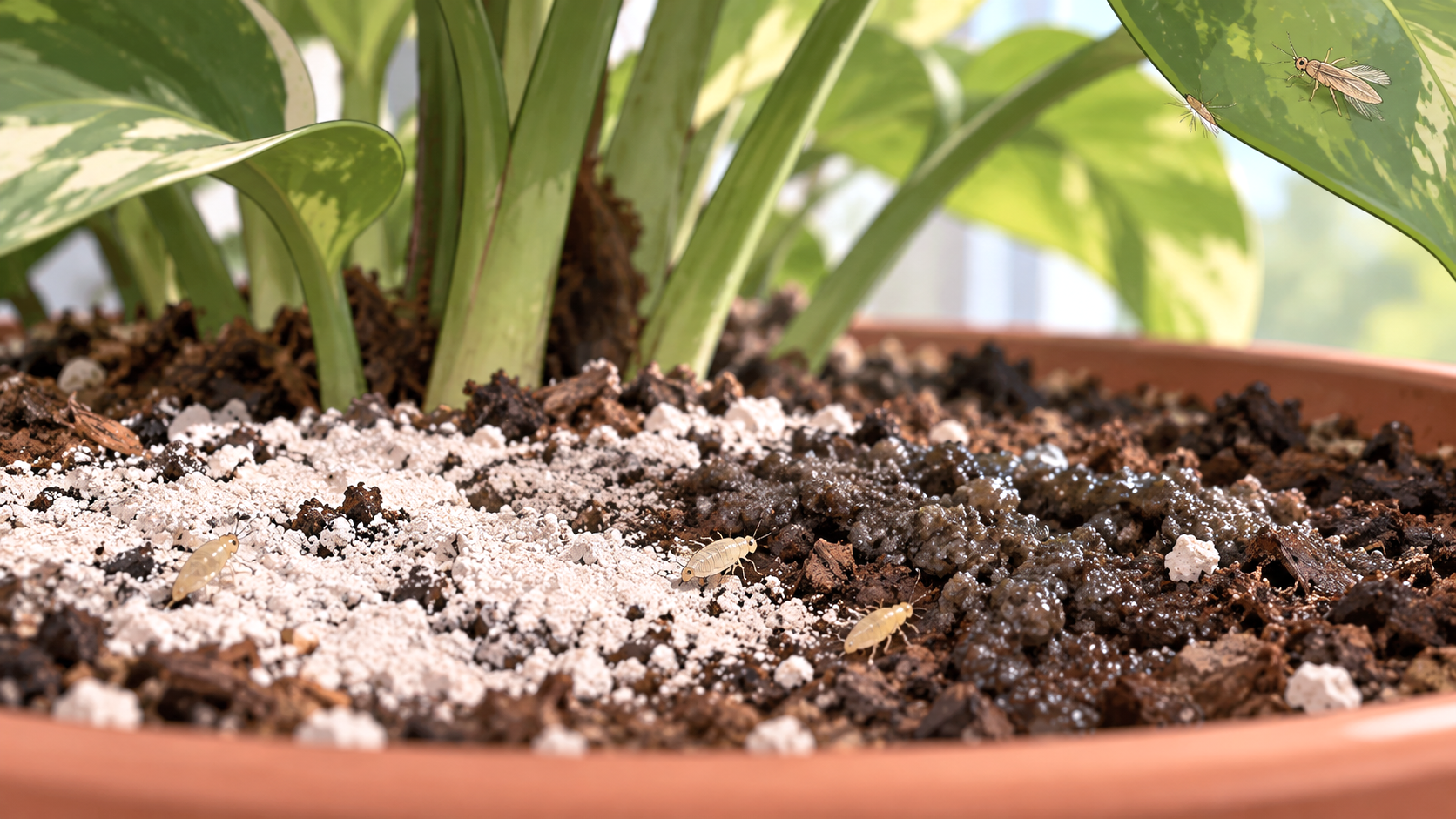
Diatomaceous earth can kill thrips that come into direct contact with the dry powder, but it is not a reliable way to eliminate an entire thrips infestation. It works as a contact insecticide by damaging the insect’s protective outer surface and absorbing moisture, causing the insect to dry out. However, thrips spend important parts of their life cycle in places where diatomaceous earth may never reach them. Diatomaceous earth can kill exposed thrips, but it usually will not get rid of a thrips infestation by itself. Thrips can hide inside buds, flowers, and other protected plant areas, while their eggs are commonly inserted into plant tissue. Diatomaceous earth is therefore better considered a supplementary control method than a complete treatment.
How Does Diatomaceous Earth Kill Thrips?
Diatomaceous earth consists largely of amorphous silicon dioxide derived from fossilized diatoms. As a contact insecticide, diatomaceous earth damages an insect’s outer surface and absorbs moisture, eventually causing dehydration. A thrips therefore needs sufficient contact with the dry material for it to work.
The limitation is that thrips are not consistently exposed. Many pest thrips feed in protected locations, including buds, shoot tips, flowers, and beneath other plant structures. Powder sitting on the soil or an exposed leaf cannot kill thrips that never contact it.
Does Diatomaceous Earth Kill Thrips in Soil?
Diatomaceous earth applied to the surface of potting mix may contact some thrips moving through that area, but it should not be expected to eliminate the infestation. Some thrips enter the soil or other protected locations during their prepupal and pupal stages, which explains why thrips can sometimes be found in soil.
Moisture is another limitation. Diatomaceous earth relies on remaining dry to provide its insecticidal action effectively. Potting mix is regularly watered, so a surface application can lose effectiveness when it becomes wet. Treating the soil alone also leaves feeding thrips and eggs associated with the plant untouched.
Why Diatomaceous Earth Usually Isn’t Enough for Thrips
Thrips have a life cycle that makes a surface powder an incomplete solution. Eggs of many species are inserted into plant tissue, feeding stages can hide in tight plant structures, and later stages may develop in soil or other protected places. Thrips are difficult to control because of their mobility, feeding behavior, and protected egg and pupal stages.
For that reason, diatomaceous earth may kill some exposed individuals without stopping the population. Washing thrips from foliage, removing heavily infested plant material, and using an appropriate treatment when necessary are more useful components of a complete thrips-control strategy.
Should You Use Diatomaceous Earth for Thrips?
Diatomaceous earth can supplement other control measures, but it should not be your main treatment for an established infestation. For houseplants, washing thrips from the plant and removing infested plant parts directly target insects on the foliage. Insecticidal soap or horticultural oil may also be appropriate when additional treatment is needed.
If you use diatomaceous earth, choose a pesticide product labeled for the intended use and follow its directions. Avoid breathing airborne dust and do not assume that applying a thick layer will provide better control.
Questions About Diatomaceous Earth and Thrips
Does diatomaceous earth kill adult thrips?
It can kill adults that have sufficient contact with the dry powder, but adults that avoid the treated area will not be affected.
Does diatomaceous earth kill thrips eggs?
It should not be relied upon to kill thrips eggs. Many thrips insert their eggs inside plant tissue, protecting them from a surface application.
Can I put diatomaceous earth on houseplant soil for thrips?
A labeled product may be used according to its directions, but treating the soil surface alone is unlikely to eliminate thrips because much of the infestation can remain on or inside the plant.