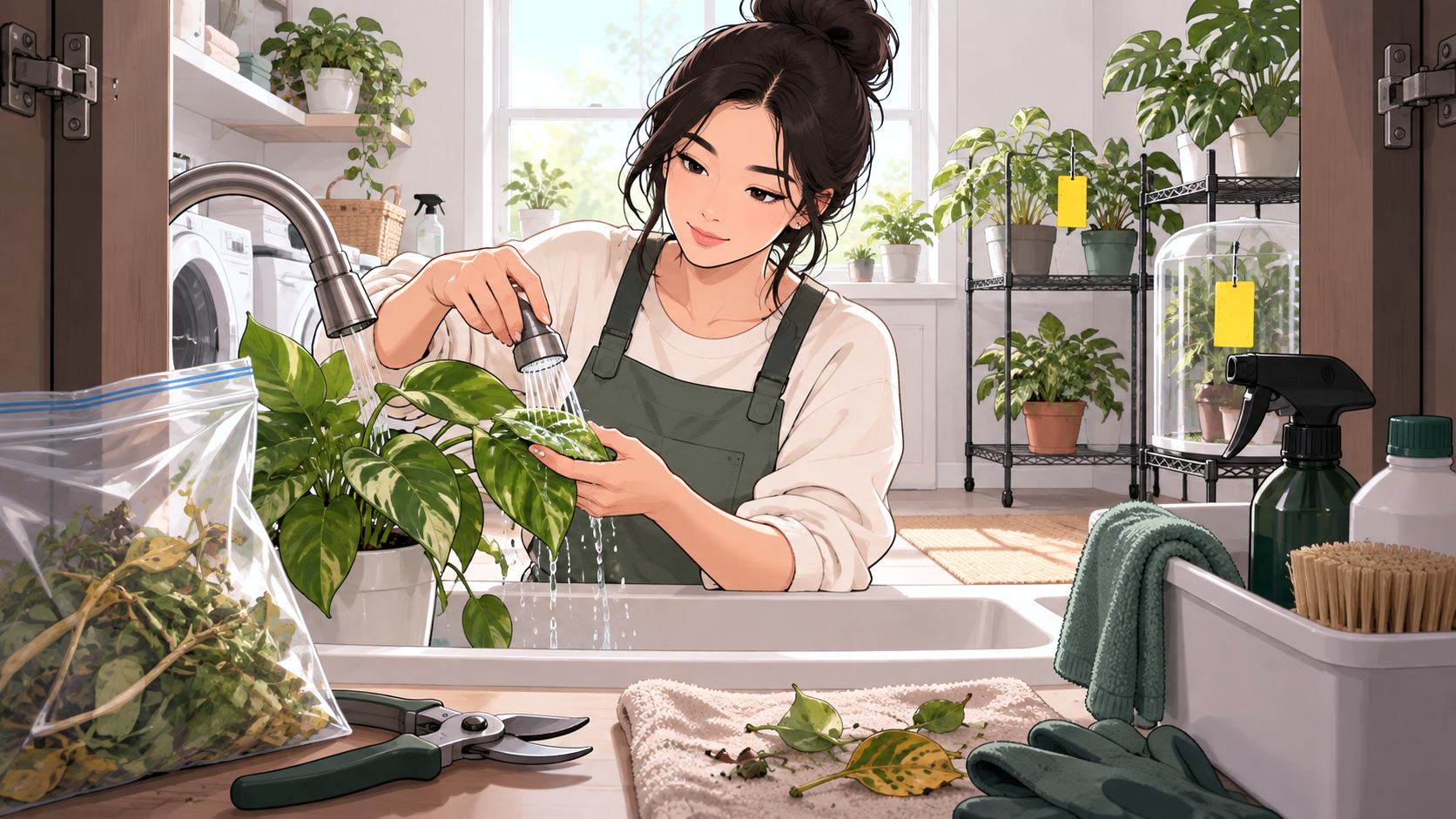
Thrips rarely disappear after one quick spray. A plant can look cleaner for several days, then fresh silvery marks appear and tiny insects start moving across the newest leaves again. The reason becomes clear once you understand where the population is hiding. Eggs can be protected inside plant tissue, larvae feed in sheltered parts of the plant, and the prepupal and pupal stages of many species develop away from exposed leaf surfaces. Getting rid of thrips therefore requires more than killing the adults you can see.
To get rid of thrips, confirm the infestation, isolate affected plants where practical, remove heavily infested material, wash exposed thrips from suitable plants, and monitor new growth. If additional control is necessary, use appropriately labeled insecticidal soap, horticultural oil, or another suitable treatment. Repeat monitoring is essential because protected eggs and pupal stages can survive an initial treatment.
Make Sure You Actually Have Thrips
Do not begin spraying solely because a leaf has silver patches. Thrips feeding can cause stippling, scarring, silvery discoloration, distorted leaves, damaged flowers, and tiny dark fecal spots, but mites, plant diseases, environmental injury, and poor growing conditions can produce some similar symptoms. Confirming that pest thrips are actually present prevents unnecessary treatments and makes it much easier to choose an effective control strategy.
Inspect the undersides of leaves, flowers, buds, shoot tips, and tightly folded new growth. Adult thrips are tiny, narrow insects with fringed wings, while immature stages are smaller and wingless. Their color can range from pale yellow or tan to brown or nearly black depending on species and developmental stage. If identification is difficult, the appearance of thrips at different life stages provides a better starting point than relying on leaf damage alone.
Tap Suspicious Leaves Over White Paper
One of the simplest ways to find hidden thrips requires nothing more than a sheet of white paper. Hold it beneath a damaged leaf, flower, or branch and gently tap or shake the plant. Tiny insects that were nearly invisible against the foliage become considerably easier to see once they fall onto the contrasting surface.
This technique is particularly useful when you can see fresh feeding damage but cannot locate the insects responsible. Gently shaking foliage or flowers over light-colored material is an established method for monitoring thrips. Examine what falls with a hand lens if possible because other small arthropods may also be present. Finding elongated insects together with characteristic feeding scars and dark fecal specks provides much stronger evidence of an active infestation.
Look for Fresh Damage Rather Than Old Scars
Old thrips damage does not disappear after the insects are gone. A silver scar remains damaged, a distorted leaf does not straighten, and a scarred flower will not return to its original appearance. Judging control by repeatedly examining old leaves can therefore make a successful treatment look like a failure.
Pay more attention to newly developing tissue. Fresh silvery streaks, new distorted leaves, additional dark fecal spots, or newly damaged flowers indicate continued feeding. If new growth remains clean while repeated inspections reveal fewer living thrips, the infestation is moving in the right direction. Understanding what thrips damage looks like on leaves makes this distinction much easier.
Isolate Infested Houseplants
When thrips are found on an indoor plant, separate it from uninfested plants if practical. Adult thrips have narrow fringed wings and can move between suitable hosts. Keeping pots close together gives an expanding population additional opportunities to spread through a plant collection.
Isolation is not a guarantee that nearby plants remain pest-free. Adults may have moved before you noticed the infestation, so inspect every plant that was previously nearby. Pay particular attention to tender growth, flowers, and leaf undersides. The adult stage is capable of flight, which means treating one visibly damaged plant while ignoring its neighbors can leave another population developing a short distance away.
Remove Heavily Infested Plant Material
Pruning can immediately remove a portion of the thrips population when insects are concentrated in badly damaged flowers, leaves, or shoots. Remove declining or heavily infested plant parts when the plant can tolerate the loss. Place the material directly into a bag or appropriate waste container instead of dropping it beside other plants.
Avoid stripping a plant merely because older leaves contain cosmetic scars. The goal is to remove tissue that is actively supporting substantial pest activity, not every leaf that shows historical damage. Pruning declining, injured, or infested plant parts can contribute to thrips management, but it works best alongside monitoring and other controls rather than as a stand-alone cure.
Wash Thrips Off the Plant
For sturdy houseplants and other plants that tolerate washing, a stream of water can physically remove exposed larvae and adults. Concentrate on the undersides of leaves and other areas where thrips have been observed. Washing will not reach eggs embedded within plant tissue or every insect hidden in a tight bud, but reducing the exposed population gives the remaining management steps less work to do.
Physical removal is particularly useful when an infestation is detected early. Washing thrips from infested houseplants can be combined with disposal of heavily infested plant parts and, when needed, appropriately labeled horticultural oils or insecticidal soaps. Keep the plant’s moisture requirements in mind so repeated washing does not leave the growing medium unnecessarily saturated.
Clean Up Fallen Leaves and Plant Debris
The area around an infested plant matters because some thrips stages occur away from exposed foliage. Remove fallen flowers, dead leaves, pruned material, weeds, and unnecessary plant debris rather than allowing them to accumulate around containers, benches, or garden beds. Sanitation also makes subsequent monitoring easier because there are fewer hiding places and fewer alternative plant hosts.
This is especially important in greenhouses and larger indoor growing areas where plant material can accumulate beneath benches. Exclusion and sanitation are central parts of greenhouse thrips management. Cleaning alone will not eliminate thrips already developing inside living plant tissue, but it removes resources that can help sustain a population.
Understand Why One Treatment Usually Is Not Enough
The thrips life cycle is one of the biggest obstacles to control. Thrips begin as eggs and pass through two actively feeding immature stages before entering the nonfeeding prepupal and pupal stages and eventually becoming adults. Females of many plant-feeding species insert their eggs into plant tissue, protecting them from treatments that only coat exposed surfaces.
The later stages can be protected as well. Prepupae and pupae of many species move into soil, leaf litter, plant crevices, or other sheltered locations. This combination of protected eggs, concealed feeding sites, mobility, and sheltered pupal stages is among the reasons insecticides alone often provide incomplete thrips control. A plant that looks clear immediately after treatment may still contain developing insects capable of restarting visible activity.
Do You Need to Treat the Soil for Thrips?
Not every thrips infestation requires a soil treatment. Many important plant-feeding thrips spend their damaging stages on foliage, flowers, buds, and shoots. However, the prepupal and pupal stages of many species can occur in soil, potting mix, or leaf litter. That is why adults can sometimes emerge after the visible insects on a houseplant have been reduced.
Finding developmental stages in potting mix does not mean thrips are normally feeding on the plant’s roots. The reason thrips can occur in plant soil is often connected to pupation rather than root feeding. Instead of automatically drenching every infested pot, manage the whole life cycle and use only soil treatments specifically labeled and appropriate for the situation.
Should You Repot a Plant With Thrips?
Repotting is not a guaranteed thrips cure. Replacing the potting medium may remove some soil-associated prepupae or pupae, but eggs can remain inside plant tissue and feeding larvae can remain aboveground. A completely repotted plant can therefore produce another generation.
Repotting makes more sense when the growing medium already needs replacement because it has deteriorated, drains poorly, or has another problem. If you do replace the mix, dispose of heavily infested old material appropriately and clean reusable containers before using them again. Do not subject a stressed plant to unnecessary root disturbance simply because thrips have been detected on its leaves.
Use Sticky Traps to Monitor Adult Thrips
Blue or bright yellow sticky cards can help reveal adult thrips moving around plants. They are especially useful for detecting changes over time. A sudden increase in trapped adults can signal continued emergence or spread, while consistently declining catches can support other evidence that the population is being suppressed.
Sticky cards should not be mistaken for a complete control method. Eggs inside plant tissue and wingless immature stages will never fly onto the traps. Sticky traps are primarily a monitoring tool for adult thrips, so continue inspecting foliage even when trap catches become low.
Blue or Yellow Sticky Traps: Which Should You Use?
Both can detect thrips. Blue traps are commonly used when monitoring thrips specifically, while bright yellow traps can capture thrips along with various other flying plant pests. The best choice depends partly on what else you are monitoring.
Place traps close enough to susceptible plants to intercept flying adults and inspect them regularly. In a greenhouse or larger collection, recording catches from individual traps can help identify hotspots rather than simply telling you that thrips exist somewhere in the growing area. Replace cards when they become covered with insects, dust, or debris.
Insecticidal Soap Can Help Control Exposed Thrips
Insecticidal soaps can suppress thrips when the spray directly contacts susceptible exposed stages. They have little residual activity, which reduces persistent effects on many beneficial organisms but also means insects missed during application can survive. Thorough coverage is therefore essential.
Direct the spray toward the parts of the plant where thrips are actually feeding, particularly leaf undersides and other accessible surfaces. Insecticidal soaps are among the lower-persistence contact options used against some thrips. Follow the exact product label because not every plant tolerates every soap formulation, and household dishwashing detergent is not a substitute for a pesticide product formulated and labeled as insecticidal soap.
Horticultural Oil Can Suppress Thrips
Narrow-range horticultural oils can also kill exposed thrips through direct contact. Like insecticidal soap, oil depends heavily on coverage. An insect hidden deep inside a bud or protected within distorted growth may escape even when the visible leaf surfaces have been thoroughly sprayed.
Plant sensitivity matters. Horticultural oils can provide temporary control of some thrips infestations, but labels contain important restrictions concerning susceptible plants, temperature, plant stress, application intervals, and combinations with other products. Do not assume that increasing the concentration will improve control. Excessive or improperly timed oil applications can injure plants.
What About Neem Oil?
Neem oil is another contact treatment used against certain thrips infestations. Its effectiveness depends on reaching the pest, so protected thrips can survive applications that fail to penetrate their hiding places. It should therefore be considered one component of an integrated strategy rather than a guaranteed cure.
Neem products can also injure sensitive plant tissue, particularly when plants are stressed or applications are poorly timed. Flowers may be especially vulnerable to oil injury. Neem oil is among the less-persistent insecticides used for some thrips situations, but the exact product must be labeled for the plant and intended use. Follow its directions rather than relying on homemade concentrations found online.
Spinosad Can Be Effective Against Thrips
Spinosad is often more effective against thrips than simple contact products because it has some translaminar activity, allowing it to move a short distance into treated plant tissue. This can help reach thrips feeding in places that a purely surface-active material might miss. However, effectiveness does not make it appropriate for every plant or every setting.
Spinosad can harm certain beneficial insects and mites, and it poses a risk to bees when they contact freshly treated material. Spinosad should not be applied to flowering plants where bees can be exposed. Product registrations and permitted uses also vary, so the label must confirm that the particular formulation can legally and safely be used on the plant you intend to treat.
Do Not Rely on Repeated Spinosad Applications
Western flower thrips and several other economically important thrips have demonstrated an ability to develop insecticide resistance. Repeated exposure to the same mode of action creates selection pressure favoring resistant individuals. Eventually, a treatment that previously suppressed the population can perform poorly.
Resistance is not merely theoretical. Repeated use of the same insecticide mode of action has produced resistance in thrips populations. In commercial situations where multiple pesticide applications are necessary, rotate among effective modes of action according to the product labels and current resistance-management guidance rather than simply switching between brand names that may contain the same type of active ingredient.
Pyrethrins Can Kill Exposed Thrips, but Consider the Tradeoffs
Pyrethrins are contact insecticides that can provide temporary suppression of exposed thrips. They can be useful in certain situations, but broad insecticidal activity means they may also affect beneficial arthropods helping to suppress the pest population.
Natural origin should not be confused with ecological selectivity. A botanical insecticide can still harm nontarget organisms. Protecting predators and parasitoids is an important part of integrated thrips management, particularly outdoors where naturally occurring enemies can contribute significantly to pest suppression.
Avoid Broad-Spectrum Spraying When It Is Not Necessary
Finding a thrips does not automatically justify spraying an entire garden. Some plants tolerate thrips feeding well, and certain thrips species are beneficial predators. Unnecessary broad-spectrum pesticide use can kill natural enemies and sometimes contribute to secondary pest outbreaks.
Assess the amount of fresh damage, the plant involved, and whether the population is increasing. A healthy established shrub with minor cosmetic injury may need no pesticide treatment, while young vegetables threatened by a thrips-transmitted virus can require a very different response. The goal is to prevent unacceptable damage, not to create a thrips-free outdoor ecosystem.
Beneficial Predators Can Control Thrips
Thrips have numerous natural enemies. Minute pirate bugs, predatory mites, lacewings, predatory thrips, and other arthropods can feed on various thrips stages. Protecting these predators is one reason persistent broad-spectrum insecticides can work against long-term pest management even when they kill thrips initially.
Commercial greenhouse and indoor-production systems can take this further by deliberately releasing beneficial organisms. Predatory mites are commonly used against young thrips larvae, while Orius species attack additional stages. Natural enemies can contribute substantially to thrips management when introduced early and protected from incompatible pesticides.
Predatory Mites Work Best Before Thrips Become Overwhelming
Several commercially available predatory mites are used against thrips in greenhouse production. They hunt small larvae on plant surfaces and can prevent low populations from developing into much larger infestations. Their effectiveness depends on predator species, temperature, humidity, crop, pest density, and how early they are introduced.
Biological control should not be approached as simply releasing predators after a severe outbreak and expecting immediate elimination. Establishing beneficial populations early generally gives them a better chance to keep pace with thrips reproduction. Pesticide compatibility must also be considered because a treatment aimed at thrips can simultaneously eliminate the predators being used to control them.
Soil Predators Can Target Another Part of the Life Cycle
When a thrips species pupates in the growing medium, soil-dwelling predators can attack stages that foliage-dwelling predators cannot reach. Predatory mites used in greenhouse production can consume thrips prepupae and pupae along with other small soil arthropods.
This demonstrates why attacking several stages of the life cycle can be more effective than repeatedly targeting adults. Aboveground predators reduce feeding larvae, while soil predators can intercept insects developing below. Commercial biological-control programs should be designed around the actual thrips species and growing system rather than adding every available beneficial organism without a plan.
Beneficial Nematodes Can Be Useful in Some Growing Systems
Entomopathogenic nematodes such as Steinernema feltiae are used in some greenhouse IPM programs against thrips. These microscopic beneficial organisms can attack susceptible pest stages under appropriate environmental conditions and can complement other biological controls.
They are living organisms rather than conventional chemical pesticides, so storage, water quality, moisture, temperature, and application method affect performance. They are most useful when incorporated deliberately into an IPM program rather than treated as a universal household remedy. Follow supplier directions closely when using biological-control organisms.
Avoid Overfertilizing With Nitrogen
Plant care can influence pest pressure. Excessive nitrogen fertilization can encourage tender growth that is attractive or suitable to some thrips populations. Applying more fertilizer because a damaged plant looks unhealthy can therefore make the situation worse rather than helping it recover.
Feed plants according to their actual nutritional requirements. Avoiding excessive nitrogen and inappropriate irrigation forms part of cultural thrips management. Good plant care cannot eliminate an established infestation by itself, but keeping plants appropriately watered and fertilized improves their ability to tolerate injury without creating unnecessarily favorable conditions for pests.
Control Weeds Around Susceptible Plants
Weeds can serve as alternative hosts for thrips and, in agricultural systems, may also contribute to the persistence of thrips-vectored plant viruses. Removing unnecessary weeds around production areas reduces potential reservoirs from which insects can move into susceptible crops.
This is particularly useful before planting or between crop cycles. Avoid allowing weeds to become heavily infested and then disturbing them immediately beside vulnerable plants, because dispersing adults may move onto the crop. Sanitation should be planned as part of prevention rather than performed only after a severe infestation has developed.
Inspect New Plants Before Bringing Them Home
One of the easiest thrips infestations to control is the one that never enters your plant collection. Examine new houseplants, cuttings, seedlings, and ornamentals carefully before placing them among established plants. Check new growth, leaf undersides, flowers, and buds for insects and feeding scars.
Keeping new plants separate temporarily provides additional time for hidden pests to reveal themselves. Eggs inserted into plant tissue may be invisible during the first inspection, so repeated checks are more informative than a single glance at the store. A small quarantine area can save considerably more work than managing thrips after adults have dispersed through dozens of plants.
Use Insect Screening and Row Covers Where Appropriate
Physical exclusion can prevent thrips from reaching susceptible plants in the first place. Fine insect screening can reduce entry into protected growing structures, while row covers can protect young outdoor plants when properly installed. Exclusion is particularly valuable when thrips-vectored viruses pose a risk because preventing the insect from reaching the crop can prevent virus transmission.
Covers must be appropriate for the crop and removed when necessary for pollination or plant development. They also work best when installed before thrips are already present beneath them. Physical exclusion is among the most effective ways to prevent thrips infestation and reduce virus transmission.
Reflective Mulch Can Reduce Thrips on Young Crops
Reflective mulches can interfere with thrips movement into young plants by altering the visual environment around the crop. They are particularly useful during early growth, before expanding foliage covers much of the reflective surface.
This technique is primarily relevant to outdoor crop production rather than ordinary houseplants. Reflective mulch can reduce thrips infestation and infection by insect-vectored viruses in young crops. Its effectiveness declines as the canopy expands and shades the mulch.
How to Get Rid of Thrips on Houseplants
Begin by isolating the affected plant and inspecting the rest of the collection. Remove heavily infested flowers or foliage where appropriate, then wash exposed thrips from sturdy plants. Continue inspecting new growth and use sticky cards to monitor adults. If physical control is insufficient, an appropriately labeled insecticidal soap or horticultural oil can be considered, with thorough coverage of the plant parts where thrips are feeding.
Do not assume one application has solved the problem. Eggs protected in plant tissue and later developmental stages in sheltered locations can produce another wave of insects. The more detailed approach to getting rid of thrips on houseplants accounts for indoor conditions, neighboring plants, potting media, and repeated monitoring.
How to Get Rid of Thrips Naturally
Physical removal, pruning, sanitation, exclusion, and biological control can substantially reduce reliance on conventional insecticides. Washing suitable plants removes exposed insects immediately, while predators can attack the survivors. Outdoors, conserving naturally occurring predators is often more practical than purchasing beneficial insects.
“Natural” should not be treated as synonymous with harmless. Neem oil, horticultural oils, insecticidal soaps, pyrethrins, and biological insecticides can all have restrictions or nontarget effects. A more detailed natural thrips control strategy should still be based on pest identification, plant sensitivity, label directions, and protection of beneficial organisms.
How to Get Rid of Thrips in a Greenhouse
Greenhouse control begins before an outbreak. Inspect incoming plant material, eliminate weeds and crop debris, use monitoring cards, scout plants directly, and maintain records of where thrips are appearing. Early detection allows biological controls to become established before pest numbers become overwhelming.
When insecticides are required, resistance management becomes especially important. Western flower thrips is notorious for developing resistance, and greenhouse management programs should combine sanitation, exclusion, natural enemies, and carefully selected insecticides. Repeatedly using one pesticide against successive generations can undermine the entire program.
How Long Does It Take to Get Rid of Thrips?
There is no reliable universal number of days. Control time depends on the thrips species, infestation size, temperature, host plant, treatment method, and whether protected life stages remain. A lightly infested houseplant caught early can improve relatively quickly, while an established greenhouse population may require sustained management.
Think in terms of breaking the life cycle rather than completing one treatment. Continue checking new growth, performing white-paper tests, and monitoring adults. Do not declare success simply because no thrips are visible the morning after spraying. Several clean inspections over time provide much stronger evidence that the population is no longer reproducing.
Why Do Thrips Keep Coming Back?
Recurring thrips usually have an identifiable explanation. Eggs may have survived inside plant tissue, pupae may have remained protected away from sprayed foliage, nearby plants may still be infested, or adults may be entering from outdoor vegetation. Poor spray coverage can also leave insects alive inside buds and other protected plant structures.
Resistance becomes another possibility when the same insecticide has been used repeatedly. Rather than increasing the concentration or spraying more frequently than the label permits, reconsider the entire management program. Check identification, inspect surrounding plants, examine the growing medium where relevant, improve sanitation, and make sure every control method is targeting the appropriate stage.
Common Thrips Control Mistakes
The most common mistake is treating symptoms without confirming the pest. Another is spraying only the upper surfaces of leaves even though thrips are feeding underneath or inside protected growth. Other failures include ignoring nearby plants, relying on sticky cards as the sole control method, assuming old scars mean treatment failed, and stopping management immediately after adult numbers decline.
Repeatedly using the same insecticide is another major mistake. So is assuming that a homemade pesticide must be safer because its ingredients came from the kitchen. Thrips management becomes much more predictable when each action has a clear purpose within an IPM program instead of continually switching between unverified remedies.
Should You Throw Away a Plant With Thrips?
Usually not at the first sign of infestation. A valuable or otherwise healthy plant can often be saved, particularly when thrips are detected early. Isolation and treatment may be worthwhile when only one or a few plants are affected.
Discarding a plant becomes more reasonable when it is severely damaged, heavily infested, inexpensive to replace, or threatening a large collection of valuable plants. A badly infested plant can continually supply adults capable of moving onto healthier hosts. If you decide to discard it, contain the plant before carrying it through areas containing other susceptible plants.
The Best Way to Get Rid of Thrips Is to Attack the Infestation From Several Directions
Begin with the insects you can physically remove, then account for the ones you cannot see. Wash or prune exposed populations where appropriate, isolate infested houseplants, remove debris, inspect neighboring plants, and monitor adults with sticky cards. Protect beneficial organisms outdoors and consider biological control in growing systems where it is practical. When pesticides are justified, choose the least disruptive effective option that is labeled for the plant and situation.
Most importantly, keep monitoring after the first apparent improvement. Thrips are difficult because different stages occupy different locations, not because they are impossible to manage. Once fresh feeding stops, new growth remains healthy, trap catches fall, and repeated plant inspections stop revealing larvae or adults, you have much stronger evidence that the life cycle has finally been interrupted.
More Questions About Getting Rid of Thrips
Can thrips go away on their own?
A very small outdoor population may be suppressed by predators, environmental conditions, or changes in the availability of suitable plant tissue. An established indoor infestation should not be expected to disappear simply because it is ignored. Continued reproduction can allow thrips to spread to additional plants.
What kills thrips instantly?
Direct contact with an appropriately labeled insecticidal soap, horticultural oil, or other effective contact insecticide can kill exposed thrips, depending on the product and pest species. Killing individual insects immediately is not the same as eliminating an infestation because eggs and protected developmental stages can survive.
Can you get rid of thrips without pesticides?
Sometimes, particularly when an infestation is caught early. Washing plants, pruning heavily infested tissue, isolation, sanitation, exclusion, and biological control can all reduce populations. Severe infestations or high-value commercial crops may require additional interventions.
Should I treat every plant if one has thrips?
Every nearby plant should be inspected, but automatically applying pesticide to every plant is not always necessary. Treatment decisions should be based on pest presence, exposure, plant susceptibility, and the product label. Isolation and close monitoring may be sufficient for plants with no evidence of infestation.
How do I know when the thrips are finally gone?
Look for a combination of evidence rather than one clean inspection. New foliage should develop without fresh feeding scars, white-paper tests should stop producing thrips, direct inspections should reveal no active larvae or adults, and sticky-card catches should remain low or absent. Old damage can remain visible long after control has succeeded.
2 thoughts on “How to Get Rid of Thrips: The Complete Guide”