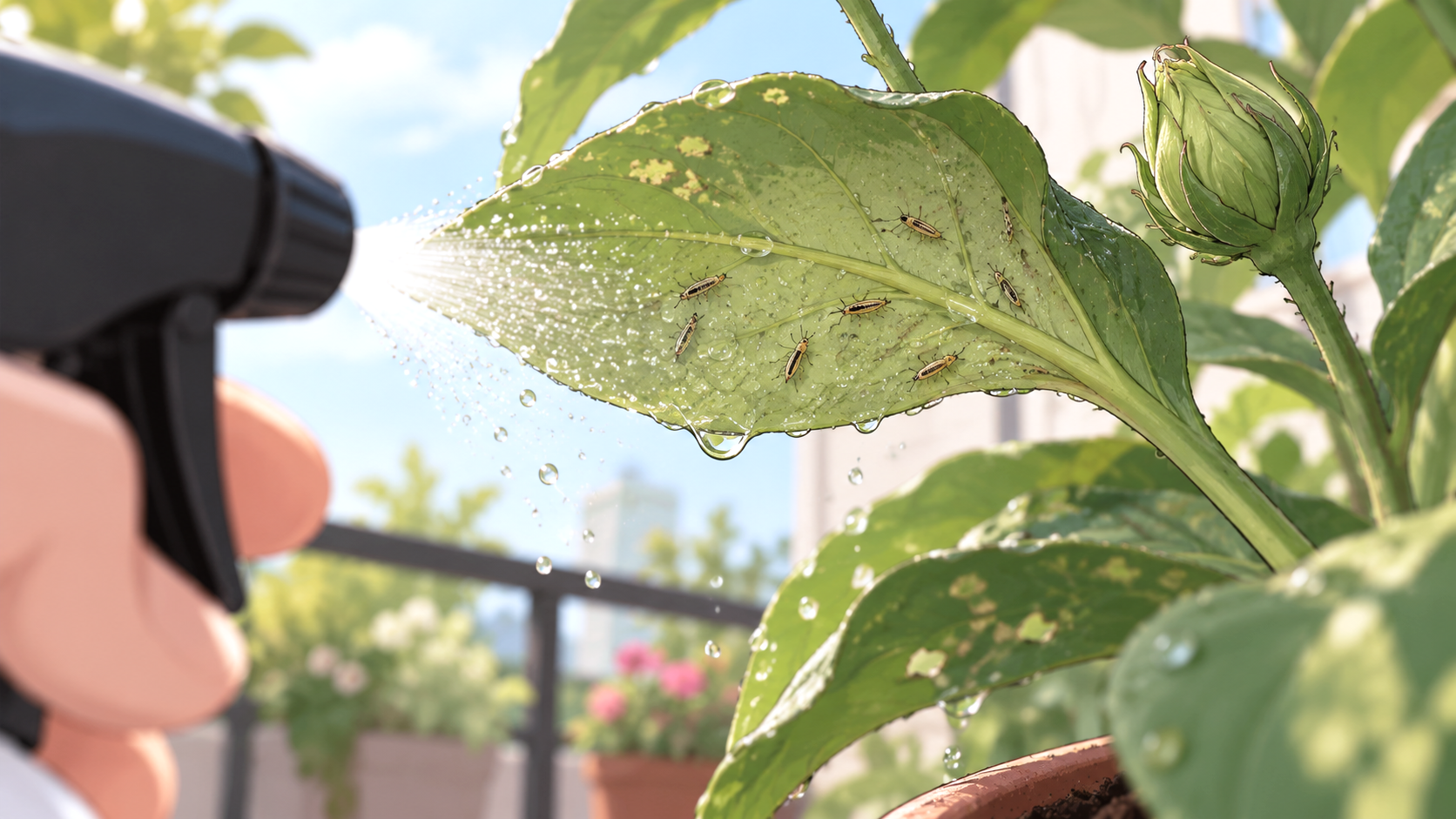
Insecticidal soap can work on thrips, particularly when the insects are exposed and the spray reaches them directly. However, it has little to no residual activity, so thrips that escape the initial spray are not killed later simply by walking across a treated leaf. This makes good coverage and follow-up monitoring important. Insecticidal soap can kill thrips that are directly contacted by the spray. However, it may not reach thrips hidden inside flowers, buds, or tight plant growth, and protected stages can survive treatment. For this reason, insecticidal soap can reduce thrips populations but may require repeat applications and other control measures.
How Does Insecticidal Soap Kill Thrips?
Insecticidal soaps are generally made with potassium salts of fatty acids. They work as contact insecticides, disrupting insect cell membranes and causing rapid dehydration. Because the soap must actually wet the insect, spraying the general area around a thrips infestation is not enough. Thorough coverage of the insects and the plant areas where they are hiding is essential.
This also explains why insecticidal soap has limited residual value. Once the spray has dried, it does not continue killing thrips for an extended period. Newly emerging or previously hidden insects may therefore survive.
Why Doesn’t Insecticidal Soap Kill All the Thrips?
Thrips frequently occupy protected parts of plants where a contact spray may not reach them. They can hide inside flowers, buds, shoot tips, folded growth, and other tight spaces. Eggs of many plant-feeding thrips are also inserted into plant tissue, making them difficult to reach with a surface treatment. These protected locations are one reason thrips can be difficult to control with insecticides.
Insecticidal soap can therefore kill many exposed thrips without eliminating the entire population. New insects may appear afterward even when the first treatment worked. This does not necessarily mean the soap was ineffective. It means some thrips were protected from direct contact.
How to Use Insecticidal Soap for Thrips
Use an insecticidal soap specifically labeled for the plant and pest you intend to treat. Apply it according to the label, concentrating on areas where thrips are present, including leaf undersides and other accessible hiding places. Insecticidal soap must contact thrips directly, so thorough coverage is important.
Continue inspecting the plant after treatment. Repeat applications may be necessary because insecticidal soap has little residual activity and protected thrips can survive the first application. Follow the interval specified on the product label rather than spraying more frequently or making the solution stronger.
Removing badly infested flowers or leaves and washing exposed thrips from the plant can also improve control. These methods reduce the number of insects the soap needs to reach and fit naturally into a broader thrips-control strategy.
Can Insecticidal Soap Damage Plants?
Yes. Some plants can be sensitive to insecticidal soap, and repeated applications can increase the risk of leaf injury. When plant sensitivity is uncertain, testing the product on a small portion of the plant before treating it extensively can help reveal phytotoxicity.
Always follow the product label, including instructions concerning concentration, temperature, plant species, and application frequency. Using a stronger solution than directed does not overcome the problem of thrips hiding where the spray cannot reach them.
Is Dish Soap the Same as Insecticidal Soap?
No. Household dishwashing liquids are not equivalent to formulated insecticidal soaps. Dish soaps can contain detergents, degreasers, fragrances, preservatives, and other ingredients that were not designed for pest control and may damage plants.
Commercial insecticidal soaps are specifically formulated and tested for use against plant pests. Homemade mixtures made from household soaps and detergents are not recommended as substitutes. Use a labeled insecticidal-soap product rather than improvising a mixture from kitchen detergent.
Is Insecticidal Soap Enough to Get Rid of Thrips?
It can be enough for some small infestations, but it should not be expected to eliminate every thrips problem by itself. Insecticidal soaps can provide temporary thrips control, while combining treatments with pruning, physical removal, and other appropriate methods generally improves control.
For houseplants, washing the foliage, removing heavily infested plant material, isolating affected plants, and applying insecticidal soap when needed can work together. The full process for getting rid of thrips on houseplants covers those steps in more detail.
Pesticide disclaimer: Insecticidal soap is a pesticide when sold for insect control. Always follow the current product label for permitted plants, application rates, intervals, precautions, and indoor or outdoor use.
Questions About Insecticidal Soap and Thrips
Does insecticidal soap kill thrips on contact?
Yes. Insecticidal soap works through direct contact, so the thrips must be thoroughly wetted for effective control.
Does insecticidal soap kill thrips eggs?
Do not rely on insecticidal soap to eliminate thrips eggs. Many thrips insert their eggs into plant tissue, where a contact spray cannot readily reach them.
Do you need to reapply insecticidal soap for thrips?
Repeat applications may be necessary because insecticidal soap has little residual activity and some thrips can remain protected during the first treatment. Follow the application interval on the product label.
Can you use insecticidal soap on houseplants with thrips?
Yes, when the particular product is labeled for the plant, pest, and intended indoor use. Check the label because some plants can be sensitive to insecticidal soap.
One thought on “Does Insecticidal Soap Work on Thrips?”