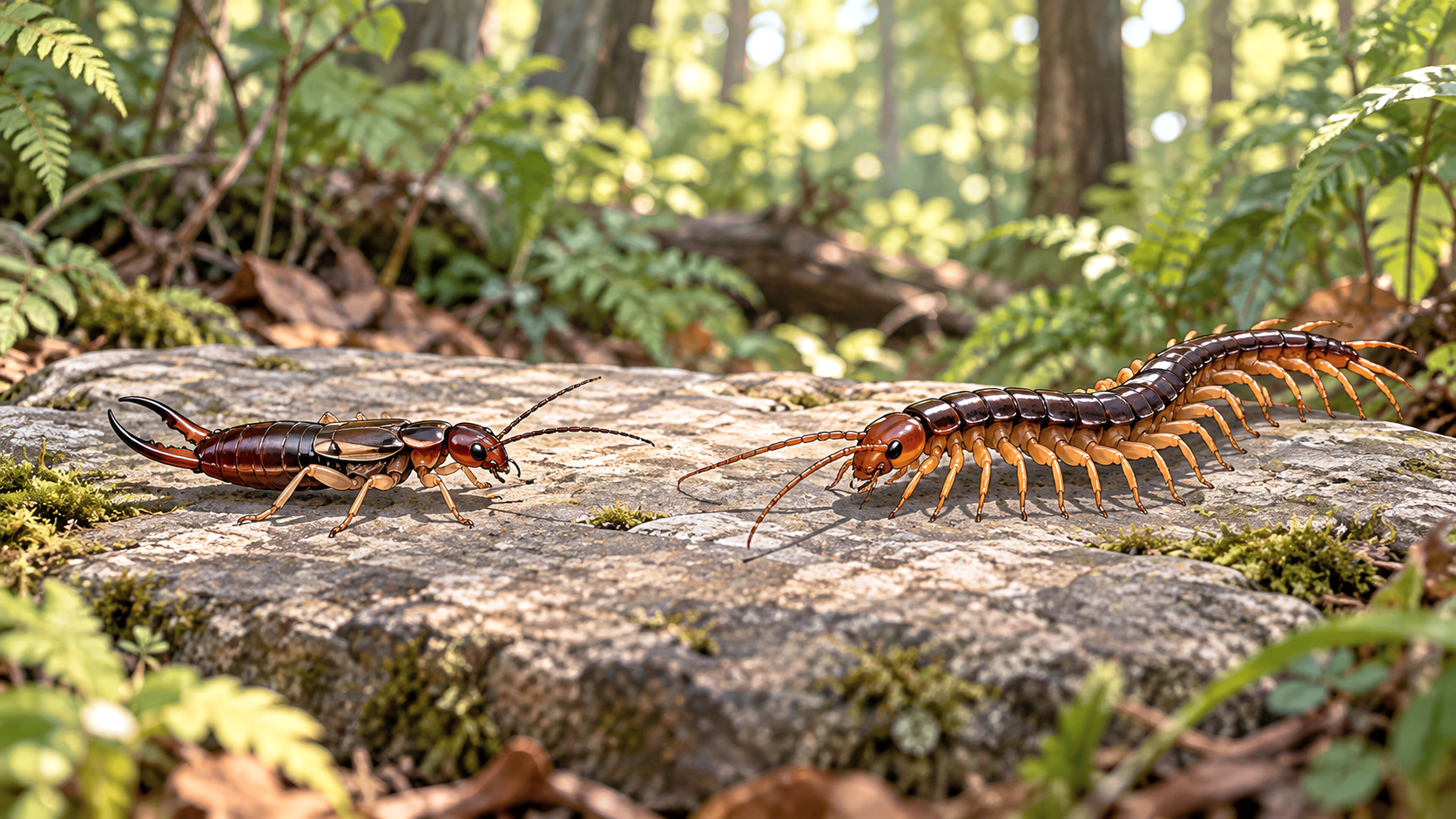
The easiest way to tell an earwig from a centipede is to count its legs and examine the end of its body. Earwigs are insects with six legs and a pair of prominent pincers on their rear end. Centipedes are many-legged arthropods with one pair of walking legs on most trunk segments and venom-delivering claws near their heads. Both have elongated bodies and often occupy dark, damp places, but they are very different animals.
An earwig is usually a small, reddish-brown insect with clearly visible antennae and a narrow abdomen. A centipede has a more segmented, many-legged appearance, with legs extending along much of its body. These differences remain useful even when the animal is moving quickly.
Earwig vs Centipede: Identification at a Glance
| Feature | Earwig | Centipede |
|---|---|---|
| Animal group | Insect, order Dermaptera | Myriapod, class Chilopoda |
| Number of legs | 6 | Many pairs; commonly 30 legs in adult house centipedes |
| Body shape | Elongated, relatively compact | Elongated and divided into numerous leg-bearing segments |
| Rear end | Two conspicuous pincers | Often an elongated final pair of legs |
| Front end | Antennae and chewing mouthparts | Antennae and venom-delivering forcipules |
| Wings | Present in some species | None |
| Movement | Runs or crawls into shelter | Often runs rapidly, particularly house centipedes |
| Feeding | Omnivorous or predatory, depending on species | Predatory |
| Human concern | Can pinch defensively | Can deliver a venomous bite-like sting, usually when handled |
The University of Maryland’s description of centipedes identifies their numerous pairs of legs, while Penn State’s European earwig identification emphasizes the distinctive abdominal forceps.
Six Legs or Many Legs: The Most Reliable Difference
An earwig has three pairs of legs attached to its thorax, the body region immediately behind the head. Its long abdomen has no walking legs, so most of the rear half of the insect appears relatively smooth apart from the pincers.
A centipede has legs distributed along a succession of body segments. In the common house centipede (Scutigera coleoptrata), an adult possesses 15 pairs, or 30 walking legs. Other centipede species have different numbers, and some possess considerably more than 100 legs.
The familiar house centipede’s legs are exceptionally long and slender, extending outward from the body. They often display alternating light and dark bands, creating a feathery or spiderlike appearance. Iowa State University’s description of house centipedes notes their yellowish-gray bodies, three dark longitudinal stripes, and conspicuously banded legs.
Not every centipede has the same appearance. Soil centipedes are typically narrower and have numerous shorter legs, giving them a more wormlike outline. Stone centipedes have sturdier bodies and shorter legs than house centipedes. Nevertheless, all remain recognizable as many-legged animals rather than six-legged insects.
A young centipede may have fewer legs than a mature individual, depending on its group. Even then, its body organization differs from the three-paired thoracic legs of an earwig.
Rear Pincers vs. Front Venom Claws
An earwig’s pincers are located at the extreme rear of the abdomen. They are modified appendages called cerci, and their appearance varies with species and sex.
In the European earwig, males commonly possess curved forceps, while females have straighter ones. Their functions include defense and interactions with other earwigs. The Illinois Extension description of earwig anatomy identifies these terminal pincers as the insect’s most recognizable feature.
Centipedes have a fundamentally different arrangement. Their venom-delivering claws, called forcipules, are positioned immediately behind the head. They evolved from a modified pair of appendages and are used to seize and immobilize prey. The Utah State University account of centipede anatomy describes these structures and their role in injecting venom.
Some centipedes also possess an enlarged or elongated final pair of legs extending backward. Viewed quickly, these appendages can resemble the rear pincers of an earwig. However, centipede terminal legs are jointed limbs rather than the hardened, forceps-shaped cerci of an earwig.
The position and appearance of these structures help avoid confusion when the animal is partially hidden. A pair of curved pincers on a six-legged insect strongly indicates an earwig. Numerous legs along the body, including an enlarged terminal pair, point toward a centipede.
How Their Movement Differs
House centipedes are exceptionally fast runners. Their long legs allow them to move rapidly across floors and walls, often disappearing before someone can examine them closely. Stone and soil centipedes may move differently because their shorter legs and body proportions are adapted to other environments.
Earwigs also run quickly, but their movements generally appear more compact because all six legs are concentrated toward the front half of the body. An earwig may abruptly reverse direction or squeeze beneath an object when disturbed. Its habit of emerging from shelter after dark means that movement is often observed briefly before the insect disappears.
Both animals can navigate narrow spaces, although their body shapes influence how they do so. Earwigs are relatively flattened, allowing them to enter shallow crevices, while many centipedes flex their segmented bodies to move through soil, leaf litter, and gaps beneath objects.
Movement alone is not a reliable identification method. A small centipede may move slowly when undisturbed, and an earwig can run rapidly enough to resemble another household arthropod. Leg arrangement remains a more dependable feature.
Where You Are Likely to Find Each One
Earwigs and centipedes overlap considerably in their preferred environments. Both can occupy damp, sheltered places beneath stones, logs, mulch, and outdoor debris. Their presence together beneath a flowerpot is therefore unsurprising.
Earwigs commonly feed on decaying organic material, plants, and other small arthropods. Their hiding places are often associated with shelter and suitable feeding opportunities. The locations where earwigs live and hide include garden debris, protected plant structures, and accessible household crevices.
Centipedes are predators that hunt insects, spiders, and other small animals. They often occupy similar surroundings because those habitats support their prey. According to the University of California’s centipede guidance, many species live under outdoor materials, while house centipedes also inhabit buildings.
Indoors, both may appear in basements, bathrooms, and other sheltered areas. However, their presence can have different implications. Most earwigs found inside are outdoor visitors, whereas house centipedes can survive and reproduce indoors when suitable prey and conditions are available.
Finding an earwig in a basement does not necessarily indicate that a breeding population is established. A house centipede repeatedly appearing in the same basement may be hunting other arthropods living there.
Is an Earwig or Centipede More Dangerous?
An earwig may pinch when handled or threatened. Its forceps can grip skin, occasionally causing temporary discomfort, but they do not inject venom. Earwig pinches are generally minor, and the insects do not actively seek people to attack.
Centipedes can deliver venom through their forcipules. These modified appendages are sometimes described as fangs, although anatomically they are modified limbs. Larger species may cause immediate pain, swelling, or redness when they puncture human skin.
House centipedes seldom bite people, and significant reactions are uncommon. Their slender forcipules are mainly used to capture small prey. The University of Wisconsin’s centipede guidance characterizes house centipedes as shy predators that rarely cause problems for people.
Larger tropical centipedes deserve greater caution because their bites can be more painful. Reactions vary with the species and individual circumstances. A person experiencing severe symptoms, breathing difficulties, or a substantial allergic reaction after a suspected bite should seek medical attention.
Neither animal is naturally aggressive toward people. Attempting to pick one up with bare hands creates a greater chance of defensive contact than simply allowing it to move away.
Can Centipedes Eat Earwigs?
Yes, a centipede can prey on an earwig if the earwig is small enough to capture and the opportunity arises. Centipedes are carnivorous and commonly consume insects and other arthropods.
A house centipede may encounter an earwig while hunting along a basement floor or beneath an object. However, an encounter does not guarantee predation. Earwigs can flee and may use their pincers defensively, while the centipede must successfully capture and immobilize its prey.
Earwigs themselves are not exclusively plant feeders. Some species consume small insects and other invertebrates, although centipedes generally have a more consistently predatory diet. The food eaten by earwigs indoors can include animal material as well as decomposing organic matter.
The presence of a centipede near earwigs should not be interpreted as proof that it is controlling their population. Both may simply occupy the same favorable habitat.
What Does Finding Either One Inside Your House Mean?
A single earwig usually represents an occasional outdoor visitor. Several house centipedes, particularly when seen repeatedly over an extended period, may indicate that the building provides enough prey and shelter to support them.
That difference can help interpret repeated sightings without assuming that every many-legged animal is an infestation. Neither earwigs nor centipedes are wood-destroying pests, and their presence alone does not establish structural damage.
Occasional earwigs appearing in apartments may enter through exterior openings or shared building spaces. House centipedes can also move between rooms, but they may remain inside for much longer than a typical wandering earwig.
For identification, concentrate on the legs before considering the location. Six legs and rear forceps indicate an earwig; numerous walking legs extending along the body indicate a centipede. If the animal has extremely long, banded legs and a striped grayish-yellow body, it is especially likely to be a house centipede.