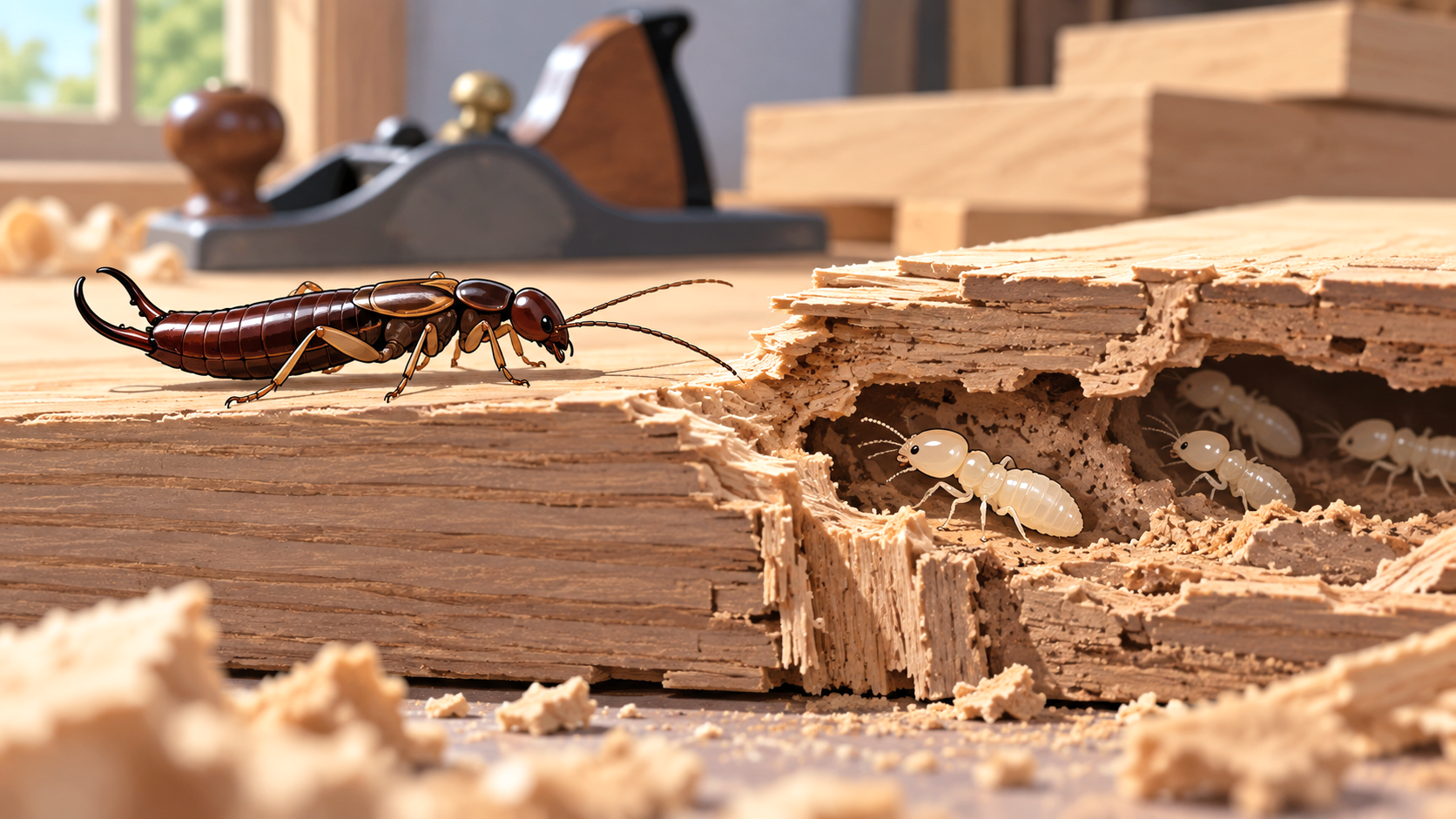
Earwigs and termites are easy to separate once you know which features matter. An adult earwig has a long, dark body with a pair of obvious forceps at the rear. Termites have no rear pincers. Depending on their caste, termites may be pale workers, large-headed soldiers, or dark winged reproductives called swarmers.
The distinction matters beyond simply naming the insect. Earwigs that enter a house are generally nuisance invaders. Termites are social insects that feed on cellulose, and some species can damage structural wood. If the insect you found might be a termite, identification deserves more attention than an ordinary household bug sighting.
Earwig vs. Termite: Check for Rear Pincers
Start at the back of the insect.
Adult earwigs have a pair of prominent forceps, technically called cerci, at the end of the abdomen. These are the feature most strongly associated with an earwig. In the European earwig (Forficula auricularia), female forceps are generally straighter while male forceps are more curved. Both sexes still have an unmistakable pair at the rear.
Termites do not have these forceps. However, a termite soldier can have a formidable pair of jaws at the front of its body. Soldiers have enlarged heads and strong mandibles used for colony defense. That difference in location is extremely useful when an insect looks like it has pincers.
Pincers at the back point to an earwig. Large jaws attached to an enlarged head can indicate a termite soldier.
Our guide to what earwig pincers are actually for explains those rear structures in more detail.
Termites Can Look Very Different From One Another
A major problem with an earwig vs. termite comparison is that there is no single termite appearance. A termite colony contains different castes, and those castes do different jobs.
Workers are the termites you are most likely to encounter after opening infested wood or breaking into a shelter tube. In subterranean termite species, workers are typically soft-bodied and pale or creamy white. For example, eastern subterranean termite (Reticulitermes flavipes) workers are about 1/4 inch long, cream-colored, and eyeless.
Soldiers look different because they have enlarged, darker heads and substantial mandibles. Their job is colony defense rather than wood consumption. Winged reproductive termites look different again. These swarmers are pigmented, have eyes, and carry two pairs of long wings.
An adult European earwig is much easier to recognize as one consistent basic shape. It is about 5/8 inch long and dark reddish brown, although the exact appearance of the forceps varies between males and females.
This variation is why we would not identify a suspected termite from color alone. A white termite worker and a dark termite swarmer can look dramatically different while belonging to the same colony.
For the other side of the comparison, our earwig identification guide covers the body shape, antennae, wings, and forceps together.
Winged Termites Look Nothing Like Winged Earwigs
Wings introduce another major difference.
Termite swarmers have two pairs of long wings that are approximately equal in length. The wings extend well beyond the abdomen. Their antennae are relatively straight, and their bodies lack the pinched waist associated with winged ants. These features are commonly used to identify termite swarmers.
Earwigs can also have wings, but the arrangement is completely different. The visible forewings are short, while the much larger hind wings are folded beneath them. Earwigs rarely fly, so many people never see those hind wings at all.
Most importantly, a winged adult earwig still has its forceps at the end of the abdomen. A termite swarmer does not.
That makes a supposed “flying earwig” much easier to check. Do not rely merely on whether it has wings. Look at the length and arrangement of those wings, then check the rear of the abdomen. Our guide to whether earwigs can fly covers their unusual wing structure separately.
Where You Find the Insect Can Provide Another Clue
Earwigs normally live outdoors. They are active at night and spend the day hiding in protected, dark, moist spaces. They can enter buildings in substantial numbers, but European earwigs are primarily outdoor insects seeking shelter.
Finding one wandering across a basement floor, bathroom, garage, or another damp part of the house can therefore fit normal earwig behavior. Our guide to why earwigs come inside goes into the conditions that encourage those indoor appearances.
Subterranean termite workers are different. They normally remain protected in soil, wood, or shelter tubes rather than wandering openly across a room. Their colonies live in the soil and forage for cellulose-containing material.
Consequently, a pale insect exposed inside damaged wood deserves much more scrutiny than a dark insect with rear forceps running across the floor.
The location is still supporting evidence rather than proof. A clear view of the insect and the surrounding signs gives you a much stronger identification.
Earwigs Do Not Cause Termite-Style Structural Damage
This is the distinction we would care about most after identifying the insect.
Earwigs can damage certain garden plants, but an earwig inside a house is not the same structural problem as a termite infestation. Termites feed on cellulose-containing materials, including structural wood. Eastern subterranean termites, for example, can damage structural timbers in buildings, with workers responsible for feeding on the wood.
Termite activity can remain concealed because the workers spend their time inside wood, soil, and protected passageways. Damaged wood may contain hollowed galleries lined with earth-like material. Subterranean termites can also build mud shelter tubes between the soil and the wood they are feeding on.
Those signs change the situation completely. Mud tubes, termite-damaged wood, and swarmers emerging from a building are important evidence of a possible termite infestation.
An earwig sighting does not carry the same implication. Seeing an earwig near a wooden wall, baseboard, or deck does not mean the insect is eating the structural wood.
That is a particularly costly identification mistake to avoid. Treating a suspected termite as though it were simply another wandering earwig could delay inspection of a wood-destroying pest.
A Termite Soldier Is the Most Convincing Earwig Look-Alike
Of the termite castes, soldiers provide the most understandable source of confusion.
A termite soldier can have two conspicuous mandibles. Seen quickly, someone unfamiliar with the insect could interpret those structures as the “pincers” they associate with an earwig.
The orientation solves the problem. A termite soldier’s mandibles are attached to its enlarged head. An earwig’s forceps project from the rear end of its abdomen.
Body shape reinforces the distinction. Subterranean termite soldiers generally have pale bodies paired with larger, darker heads. Earwigs have a more uniformly elongated insect shape, with the forceps forming the final part of the silhouette.
We think this front-versus-back test is more useful than memorizing several shades of brown. Lighting, life stage, and termite caste can all make color less dependable. The position of the appendages is much harder to misread once you know what you are looking for.
If neither description fits the specimen, other insects can resemble earwigs and are worth checking before settling on an identification.
What to Do When You Cannot Tell Whether It Is an Earwig or Termite
Do not crush the only specimen before you have a chance to examine it. A clear photograph from above can preserve useful features such as the antennae, wings, body shape, and location of any pincers or jaws.
For an apparent earwig with unmistakable rear forceps, the next step depends on how often you are seeing them. Occasional indoor earwigs can be removed, while repeated appearances may justify investigating moisture, outdoor hiding places, and entry points. Our guide to getting rid of earwigs covers that problem separately.
Suspected termites deserve a different response. Termite workers can be difficult to identify to species from appearance alone, while soldiers and swarmers provide more useful diagnostic features. If you find insects associated with damaged structural wood, mud shelter tubes, or an indoor termite swarm, arrange a professional termite inspection rather than treating the insects as earwigs.
The urgency is about getting the identification and extent of activity right, not assuming the house is about to fail. Termite damage develops over time, but determining the extent of infestation and structural damage requires a careful inspection. That is a much better basis for deciding what happens next.
Other Questions About Earwigs and Termites
Do earwigs live in termite colonies?
No. Earwigs and termites have very different social systems. Termites live in organized colonies with workers, soldiers, and reproductives. Earwigs do not form termite-style colonies.
Can an earwig be white like a termite worker?
Young earwigs can appear pale immediately after molting before their new cuticle hardens and darkens. Therefore, color alone is not enough for identification. The body structure and rear cerci provide better clues.
Are discarded wings a sign of earwigs or termites?
Piles of similar discarded wings around windows, doors, or other indoor areas can be evidence of termite swarmers. Reproductive termites shed their wings after swarming. Earwigs do not produce comparable piles of shed wings as part of their normal adult behavior.
Can termites have pincers?
Termite soldiers can have large mandibles that resemble pincers, but they are jaws at the front of the insect. Earwig forceps are located at the opposite end of the body.
Can I identify the termite species from a worker?
Usually not reliably from appearance alone. Termite workers from different species can look extremely similar. Soldiers and swarmers provide more useful features for species identification, which is another reason to preserve a specimen when professional identification may be necessary.