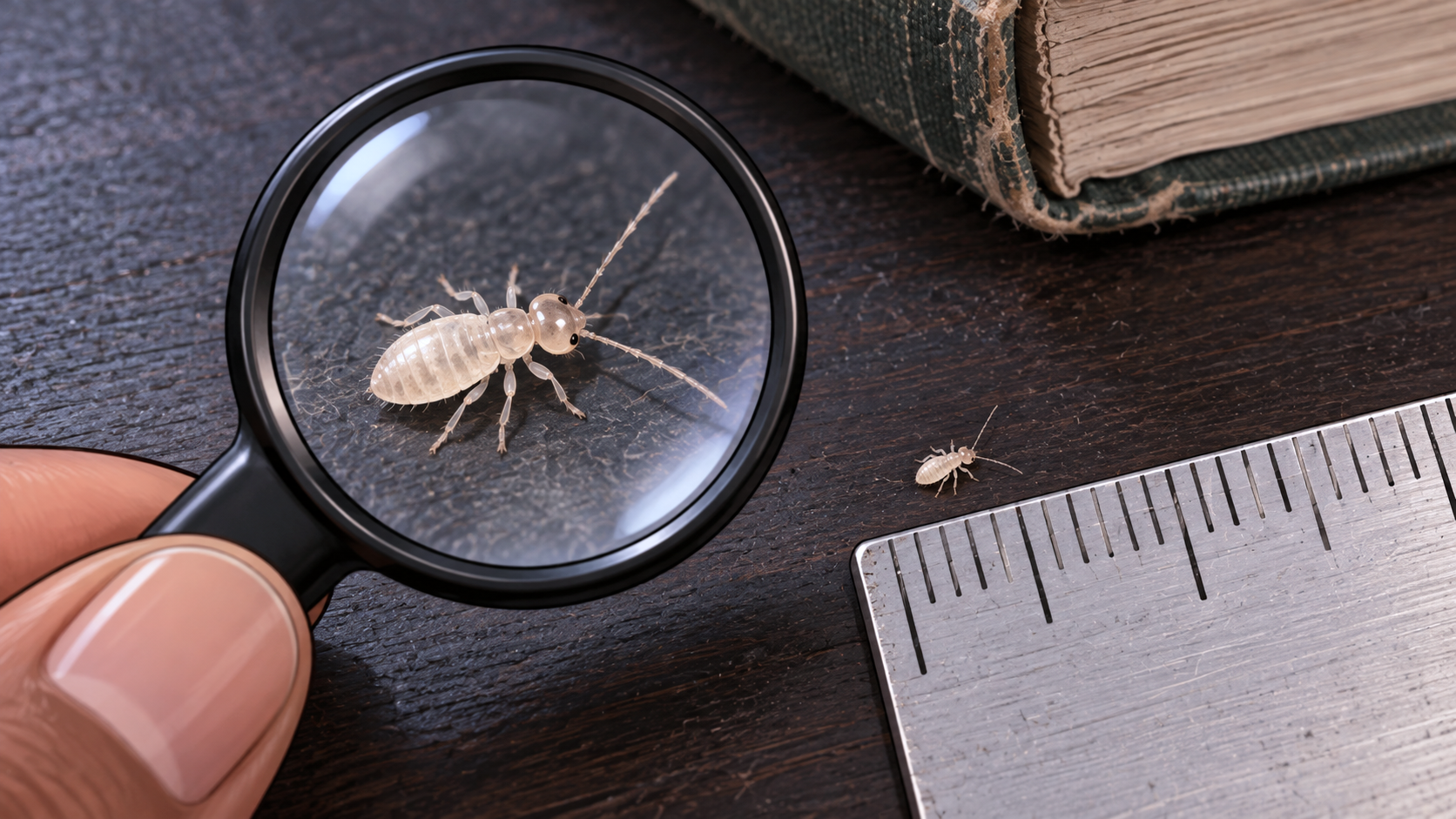
Booklice are visible to the naked eye, but they are extremely small. Common indoor booklice are usually about 1 to 2 millimeters long, so an adult may look more like a moving speck than an obvious insect from normal viewing distance. Their legs, antennae, and body shape become much easier to identify with magnification.
What Does 1 to 2 Millimeters Look Like in Real Life?
A 1-millimeter booklouse is close to the limit at which most people stop seeing useful anatomical detail and start seeing movement or a tiny dot. Household booklice in the family Liposcelididae are commonly about 1 to 2 millimeters long, while Canadian stored-product guidance describes many psocids as 1 millimeter or less, with larger pale booklice reaching about 2 millimeters. Another Canadian conservation reference places booklice associated with paper collections at roughly 1 to 1.5 millimeters. Those measurements vary because “booklice” covers multiple species rather than one insect of a fixed size.
At that scale, the insect’s presence can be easier to notice than its anatomy. A booklouse crawling across dark wood or another contrasting surface may be plainly visible, while the same pale individual can almost disappear against white paper or a light wall. The range of colors booklice can show also affects visibility because some individuals are tan or brown while others are nearly clear. We would therefore separate two questions that are often treated as the same one: you can see a booklouse without a microscope, but you may not be able to identify it confidently from what your unaided eye reveals.
You May See Movement Before You Recognize an Insect
Long antennae, six legs, a relatively broad head, and a soft flattened body are useful features once the insect is enlarged. They are much harder to resolve when a booklouse is crossing a shelf several feet away. Utah State describes indoor psocids as minute insects that often look like small specks and recommends a hand lens for identification. That matches what homeowners commonly encounter: something appears to be moving on a book, cupboard, windowsill, or damp wall, but its exact body shape is not obvious until viewed more closely.
A phone camera can help, especially if it can focus sharply at close range, although digital zoom alone may produce a large blurry shape rather than useful detail. A clear macro photograph beside a ruler or another known scale is more informative because magnified pest photographs can badly distort a person’s sense of size. The actual appearance of an adult booklouse includes features that photographs reveal far better than normal viewing distance, particularly the broad head and long slender antennae.
Nymphs Are Even Easier to Overlook
Young booklice resemble smaller versions of adults rather than passing through a wormlike larval stage. Their life cycle runs from egg to nymph to adult, and the nymphs begin smaller and often paler than mature insects. A young individual can consequently be visible as motion without being recognizable as a booklouse at all.
Pale coloration compounds the size problem. Nymphs can appear almost transparent against light surfaces, while mature individuals may develop more obvious gray, tan, brown, or orange-brown coloration. When several developmental stages occur together, you may notice larger adults first and only later realize that much smaller specks nearby are moving as well. That range in apparent size can be useful when interpreting signs of a booklice infestation, although size differences alone cannot establish the species.
Eggs present a different visibility problem. They are smaller than the already tiny adults and can resemble ordinary pale debris. Even if you can physically see a minute white speck, reliably recognizing it as an egg is difficult without magnification and supporting evidence. Adult and nymph sightings are generally much more practical clues than trying to locate every egg.
Booklice Are Tiny Enough to Be Confused With Other Pests
Size narrows the possibilities but does not complete an identification. Springtails, mites, young bed bugs, and other minute household arthropods can occupy a similar visual scale. A tiny pale insect is therefore not automatically a booklouse simply because it measures around 1 or 2 millimeters.
Bed bugs illustrate the limitation particularly well. Adult bed bugs are substantially larger than most indoor booklice, but newly hatched bed bug nymphs can overlap their size. Looking only at length can therefore create mistakes when the insect is immature. The broader comparisons among bugs that resemble booklice become useful once a specimen has been enlarged enough to compare body proportions, antennae, movement, and other structural features.
Springtails introduce another common size-based confusion because many are also tiny and moisture-associated. Their movement provides an important clue: springtails possess a specialized jumping organ, while booklice crawl. The differences between springtails and booklice are easier to see when behavior is considered alongside size rather than relying on a single measurement.
Size Questions People Commonly Have About Booklice
Are booklice smaller than a grain of rice?
Yes. A typical grain of uncooked rice is several millimeters long, while common indoor booklice are generally around 1 to 2 millimeters. A booklouse is therefore dramatically shorter and much narrower.
Do all booklice stay under 2 millimeters?
No. The familiar indoor forms are commonly around that size, but psocids are a broader group containing species of different dimensions. Minnesota guidance describes psocids generally as less than 3/16 inch long, while the very small wingless species associated with buildings tend to occupy the lower end of that range.
Can you see a booklouse’s antennae without magnification?
Sometimes at very close range and under favorable lighting, but a hand lens or sharp macro photograph makes them far easier to distinguish. Seeing the insect itself is much easier than resolving its thin antennae.
Does seeing lots of tiny dots mean you have booklice?
No. Size alone cannot identify a household pest. The dots need to be examined for movement and body features, while the surrounding conditions also provide useful context. Booklice are strongly associated with damp environments and microscopic fungal growth, and Canadian conservation guidance describes these tiny psocids as closely associated with moisture problems. If the organisms remain too small to identify confidently, a magnified specimen or photograph is more useful than guessing from size.