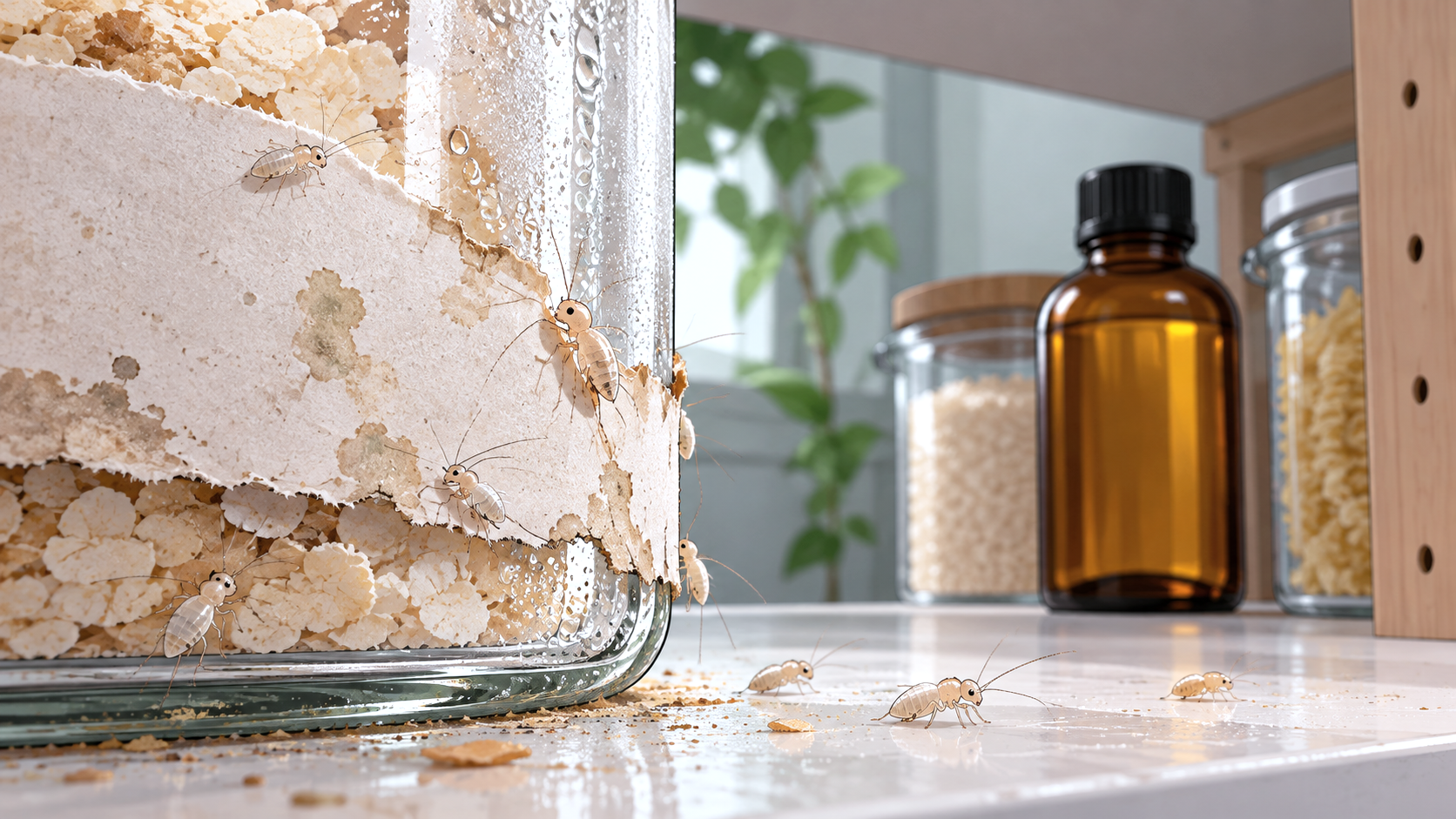
Neem oil has insecticidal and repellent properties, but there is not good direct evidence showing that ordinary neem-oil sprays reliably kill household booklice or eliminate an infestation. Azadirachtin can disrupt feeding, growth, molting, reproduction, and egg laying in susceptible insects, yet those effects cannot automatically be transferred to booklice without species-specific evidence.
Neem’s Insecticidal Reputation Comes From Other Insects
Neem oil contains numerous biologically active compounds, with azadirachtin responsible for many of its best-known insect-control effects. Depending on the insect, azadirachtin can reduce feeding, interfere with hormonal processes involved in growth and molting, suppress reproduction, and act as a repellent. Azadirachtin is the principal insect-active component of many neem products, but its performance differs greatly among insect species, life stages, concentrations, and formulations.
Much of the research supporting neem concerns agricultural pests, mosquitoes, flies, cockroaches, fleas, and other arthropods rather than household Liposcelis booklice. Reviews of neem-derived compounds across arthropod pests document a wide variety of effects but do not establish a standard neem treatment for booklice. A substance being broadly insecticidal therefore does not mean a diluted household neem spray will kill every tiny indoor insect it contacts.
Direct Evidence Against Booklice Is the Missing Piece
Booklice have been tested against numerous plant-derived substances, including several essential oils and isolated aromatic compounds. Some produced strong contact toxicity, fumigant effects, or repellency against Liposcelis bostrychophila. For example, essential oil from Illicium henryi and several of its constituents killed booklice under controlled laboratory conditions.
Comparable evidence is not established for ordinary neem oil as a household Liposcelis treatment. Research showing that neem controls aphids, caterpillars, mosquitoes, mites, or another pest cannot establish an effective booklice dose. Even among plant-derived insecticides, activity can change substantially with insect species and chemical composition. The broader evidence for essential oils against booklice demonstrates why a botanical origin alone is not enough to predict performance.
Neem Is Usually Not a Fast Contact Poison
Neem products are often misunderstood as botanical versions of fast-knockdown aerosol insecticides. Azadirachtin commonly acts through behavioral and developmental processes rather than immediate poisoning. It can interfere with feeding, molting, mating, and egg production, while clarified hydrophobic neem oil has different properties because much of the azadirachtin has been removed. Azadirachtin and clarified neem-oil extracts are distinct pesticide active ingredients.
An exposed booklouse continuing to walk after being sprayed would therefore not by itself prove that every neem formulation is inactive, but there is also no sound basis for assuming the insect will eventually die. A person seeking immediate knockdown would be better served by a product specifically labeled for the intended pest and application site. The available insecticides used for booklice should be evaluated by their labels rather than by whether an ingredient is described as natural.
Dilution Makes Homemade Neem Recipes Especially Unreliable
Commercial neem products vary in active ingredient, azadirachtin concentration, formulation, and intended use. Cold-pressed neem oil, clarified hydrophobic neem oil, purified azadirachtin products, horticultural formulations, and cosmetic neem oils are not interchangeable. Even within agricultural pest control, neem performance depends heavily on formulation and stability.
A homemade mixture containing an arbitrary number of drops per cup of water has no validated booklice dose behind it. Increasing the concentration also does not turn an untested treatment into a proven one. Concentrated oils and pesticide formulations can affect finishes, coatings, paper, adhesives, plants, skin, and other materials, while excessive spraying can add moisture to precisely the sort of environment where booklice thrive.
Spraying Neem on Books Is a Poor Experiment
Booklice often appear around books because humid paper collections can support fungal growth and provide protected crevices. Applying an oily pesticide mixture directly to pages or bindings risks staining paper, softening or altering adhesives, leaving residues, and creating odors without establishing that hidden insects or eggs received an effective dose.
The insects may not even be living in the particular book on which they were seen. They can emerge from shelving, damp cardboard, cracks, or nearby materials and then crawl over a book. Where books are involved, the association between booklice, paper, bindings, and fungal food is more useful than treating the visible page as the infestation source.
Rare, valuable, or archival materials deserve especially conservative handling. Oil-based household experiments are difficult to reverse once the material absorbs them.
Neem Will Not Dry the Habitat Supporting the Population
Indoor booklice are strongly dependent on moisture. They commonly occur where high humidity supports both the insects and microscopic fungi, and household populations decline when relative humidity remains sufficiently low. Booklice generally fail to survive prolonged humidity below roughly 45% to 50%.
Neem oil does nothing to repair a leaking pipe, dry wet cardboard, eliminate condensation, or remove moisture trapped inside a wall. The humidity requirements of booklice therefore make environmental control more consequential than whether an exposed adult reacts to a botanical spray.
Moisture also supports much of their food. Household psocids commonly feed on molds and fungi, particularly in damp, undisturbed locations, so drying the environment reduces both booklice and their fungal resources.
Neem Oil May Add Moisture Where You Do Not Want It
Most household neem sprays are oil-in-water mixtures. Repeatedly misting a bookshelf, baseboard, cabinet, cardboard box, or porous wall surface introduces additional liquid, even if much of it later evaporates. One application is unlikely to transform a dry room into a booklice habitat, but repeatedly soaking a chronically damp area is contrary to the normal goal of reducing available moisture.
A population feeding around microscopic mold and other fungi is better addressed by correcting why those materials remain damp. Neem residue does not prevent fungal food from returning if condensation, high humidity, or water intrusion continues.
Natural Does Not Mean Suitable for Every Indoor Surface
Neem is plant-derived, but neem pesticide products still require normal pesticide precautions. Exposure can occur through skin contact, eye contact, or inhalation of spray mist, and neem oil can irritate the eyes and skin. Product labels determine appropriate sites, concentrations, application methods, protective equipment, and restrictions.
Neem should not be sprayed into electronics, electrical outlets, ventilation openings, food packages, mattresses, books, or other sensitive locations merely because booklice are visible there. Natural-origin pesticides are still pesticides when used for pest control.
The natural approaches that work against booklice do not require coating household belongings in plant oils.
Physical Removal Gives a More Predictable Result on Exposed Booklice
For a few visible insects, vacuuming or wiping them from an appropriate hard surface gives an immediate, observable result. Small household populations can be physically removed, while larger infestations call for investigation of moisture rather than increasingly elaborate contact sprays. Reducing moisture is the principal household management method for psocids.
Repeated insects after cleaning indicate that the source remains active. The location and frequency of booklice infestation signs are more useful for finding that source than repeatedly testing whether neem kills individuals on contact.
Questions About Neem Oil and Booklice
Can neem oil repel booklice?
Neem and azadirachtin can repel some insect species, but reliable household repellency against booklice has not been established. Plant compounds tested directly against Liposcelis should not be assumed equivalent to neem.
Does azadirachtin kill booklice?
Azadirachtin is insect-active, but there is not enough direct evidence to give a dependable booklice concentration, exposure time, or expected mortality rate. Use a pesticide only according to its label.
Can neem oil kill booklice eggs?
There is no established household neem treatment for reliably killing booklice eggs. Eggs can respond differently from adults and may be concealed where sprays do not reach them.
Can I spray neem oil on a bookshelf?
Only if the specific product label allows the intended indoor use and the surface can tolerate it. An oily residue can stain or alter some finishes, papers, and nearby books.
Is cold-pressed neem oil better than clarified neem oil for booklice?
There is no evidence-based ranking for booklice. The two materials also differ chemically because clarified hydrophobic neem oil contains little or no azadirachtin.
Will neem oil work better if mixed with dish soap?
There is no validated neem-and-soap recipe for household booklice. Adding ingredients changes the formulation and can increase the risk of surface damage without establishing better control.
Is neem oil better than a dehumidifier for booklice?
No when excessive humidity is sustaining the infestation. A dehumidifier can directly change the environmental condition booklice require, whereas neem has no established household efficacy against them.
What should you use instead of neem oil?
Remove accessible insects, discard badly infested disposable material when appropriate, repair leaks, control condensation, and maintain sufficiently low humidity. Those measures form the most dependable strategy for getting rid of booklice because they stop the habitat from supporting continued reproduction.