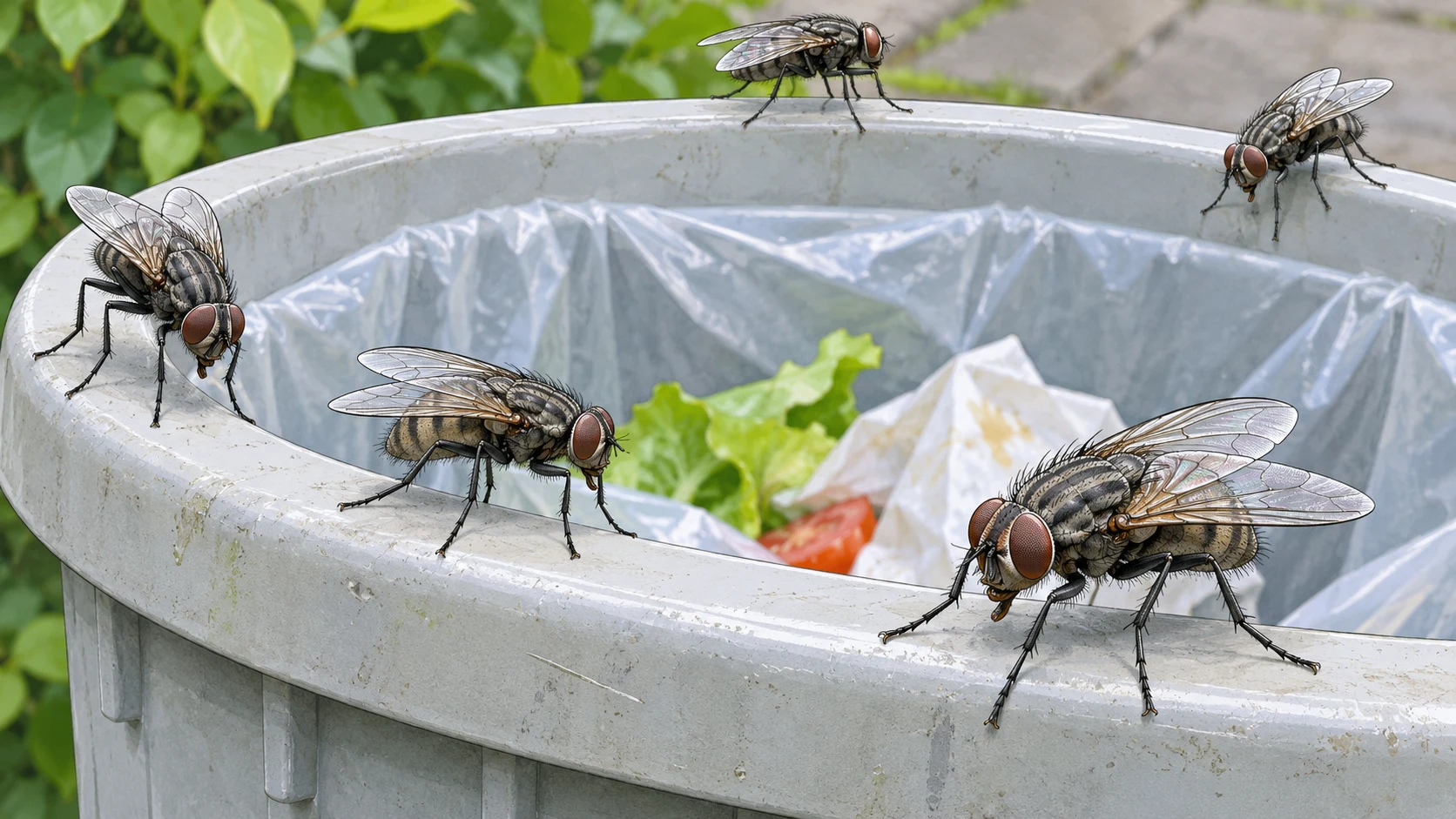
Ten house flies may not seem like many, but if several are reproductive females and suitable conditions persist, their descendants can number in the hundreds or thousands within a few weeks.
The common house fly, Musca domestica, has considerable reproductive potential. A female can produce several batches of eggs, and new adults can become reproductively active relatively soon after emerging. During warm weather, successive generations may overlap, allowing offspring to reproduce while older flies are still alive.
However, the number of eggs produced is not the same as the number of new adult flies. Some eggs fail to hatch, immature flies die before adulthood, and adults may never reproduce. Temperature, moisture, food quality, and environmental hazards can change the outcome dramatically.
To understand how quickly house flies can multiply, we need to separate their biological potential from realistic population growth.
How Fast Can a House Fly Population Increase?
Under favorable warm conditions, house flies can complete a generation in approximately two weeks, sometimes less. A generation, in this context, means the time between one female’s reproductive activity and the reproductive activity of her offspring.
This makes rapid population growth possible because new females may begin reproducing before the previous generation has disappeared.
The University of Florida’s house fly species account describes the species’ rapid development and high reproductive capacity, particularly under favorable summer conditions. The University of California Integrated Pest Management Program similarly notes that house flies can develop rapidly and produce multiple generations when suitable conditions persist.
The actual rate of increase depends on more than generation length.
A population containing 100 adult flies will not necessarily produce the same number of descendants as another population of the same size. The proportion of reproductive females, their nutritional condition, and the survival of their offspring all influence what happens next.
A useful growth estimate therefore needs assumptions about both reproduction and survival.
How One Female House Fly Could Produce Dozens of New Adults
Consider a simplified example involving one mated female house fly.
Suppose she produces 100 eggs during a reproductive period. That is within the commonly reported range for a single batch, although actual reproductive output varies.
Now assume that 20% of those eggs eventually produce surviving adults.
The calculation is:
100 eggs × 0.20 survival rate = 20 new adults
If half of those adults are female, the next generation contains approximately ten females.
Those ten females could potentially reproduce, provided they survive, mate, and obtain suitable resources.
This example does not predict what will happen in a particular home or outdoor location. The 20% survival rate is an illustrative assumption, not a universal field measurement.
It demonstrates why even substantial mortality does not necessarily prevent population growth.
A female does not need every offspring to survive for her reproductive contribution to be significant.
What Happens When Several Generations Reproduce?
The effect becomes more dramatic when the surviving daughters of one generation produce offspring of their own.
For a transparent example, assume the following conditions remain unchanged:
- Each reproductive female produces 100 eggs during the modeled generation.
- Twenty percent of eggs survive to become adults.
- Half of the surviving adults are female.
- Every surviving female successfully mates and reproduces.
- Each new generation takes approximately 14 days.
- Earlier generations are excluded from the running total to keep the calculation simple.
The calculation produces the following progression:
| Generation | Approximate time | Reproductive females |
|---|---|---|
| Starting female | Day 0 | 1 |
| First generation | Day 14 | 10 |
| Second generation | Day 28 | 100 |
| Third generation | Day 42 | 1,000 |
The third generation could theoretically contain 1,000 reproductive females under these assumptions.
That does not mean there would be exactly 1,000 flies in the area after 42 days. The calculation excludes males, earlier generations still alive, and individuals that have not yet reached reproductive maturity.
It also assumes that environmental conditions remain favorable and that every surviving female reproduces successfully.
Actual house fly populations rarely follow such a neat sequence.
How Survival Rates Change the Population-Growth Calculation
The survival rate has an enormous effect on projected population growth.
Using the same assumption of 100 eggs per female and an equal proportion of males and females, we can compare three hypothetical survival rates.
| Survival from egg to adult | New adults per female | Reproductive daughters per female |
|---|---|---|
| 5% | 5 | 2.5 |
| 20% | 20 | 10 |
| 50% | 50 | 25 |
The fractional value of 2.5 reproductive daughters is a statistical expectation, not a claim that an individual female produces half a fly.
At 5% survival, the expected number of reproductive daughters is much lower than at 50% survival.
If the model were repeated across several generations, the differences would become increasingly large.
A calculation that assumes 100% survival would produce 50 reproductive daughters from every 100 eggs under the same sex-ratio assumption. That is an extreme upper-bound scenario, not a reasonable default prediction.
The 2021 review of house fly biology in the Journal of Integrated Pest Management discusses the species’ reproductive biology and the environmental factors affecting development and survival.
Researchers studying real populations must account for mortality rather than simply multiplying the maximum number of eggs by the number of females.
Why House Flies Can Multiply So Quickly in Warm Weather
Temperature affects the speed at which new generations become capable of reproduction.
House flies are ectothermic insects, so their development and activity respond strongly to environmental conditions.
Within a suitable range, warmer temperatures generally accelerate immature development and shorten the interval before offspring can reproduce.
The University of Florida’s house fly reference reports that development can be completed in approximately seven to ten days under favorable warm conditions.
That period does not necessarily include all the additional time required before a newly emerged female begins reproducing.
The distinction is important when estimating population growth.
An egg becoming an adult does not immediately mean another batch of eggs will be produced at that moment.
A complete reproductive generation includes the time needed for the new female to reach reproductive maturity and reproduce.
Can House Flies Double Their Population Every Few Days?
A population may grow rapidly enough to double over a short interval, but there is no fixed doubling time that applies to all house fly populations.
The doubling time depends on how many reproductive females are present, how many offspring they produce, and how many survive.
For example, a population growing at a constant 20% per day would approximately double in four days.
That calculation describes a hypothetical growth rate. It does not establish that house flies normally increase by 20% every day.
Real populations do not grow at one constant rate indefinitely.
Warm weather can create opportunities for rapid multiplication, but temperature alone cannot determine the population’s doubling time.
How Food Availability Limits House Fly Population Growth
Reproduction requires resources.
Adult females need suitable nutrition to support reproductive activity, while developing offspring require organic material that can sustain growth.
A location may support a small number of immature flies but not have enough resources to support the next generation at the same rate.
As more larvae occupy the available material, competition can increase.
Competition may reduce growth, delay development, or lower survival. The outcome depends on the quantity and quality of the available resources.
The 2021 scientific review discusses the effects of larval nutrition and rearing conditions on house fly development.
In a mathematical model, every female can be assigned the same reproductive output. In an actual population, females and their offspring encounter different nutritional conditions.
A growing population may eventually exhaust or degrade the resources that initially supported rapid multiplication.
Why Moisture Can Determine Whether Population Growth Continues
House flies depend on suitable moisture conditions during immature development.
Organic material that is sufficiently damp can support developing larvae. Material that dries out excessively may no longer provide suitable conditions.
Consequently, the number of adults produced by a breeding area can change even when the amount of organic matter remains similar.
A moist accumulation during warm weather may support considerable development, while the same material after prolonged drying may support much less.
Moisture also varies within a pile of organic material.
A dry outer layer can conceal damp material underneath, creating different conditions over relatively short distances.
The University of California Integrated Pest Management Program emphasizes the importance of moist organic material in house fly breeding.
For population growth, the relevant factor is whether suitable conditions remain available across successive reproductive periods.
One favorable day does not guarantee that several generations will develop successfully.
What Happens When Too Many House Flies Develop in One Place?
Population growth eventually encounters limits.
As more immature flies occupy a finite amount of material, they compete for available nutrients and space.
High larval density can change the environment within the breeding material and affect the development of individual insects.
Some larvae may obtain fewer resources than others. Crowding can also influence their eventual size, development, and survival.
These effects are called density-dependent limitations because they become more important as the number of individuals increases relative to available resources.
A simple exponential-growth model does not include such limitations.
It assumes that every new generation has access to the same favorable conditions as the previous one.
In reality, the conditions that supported the first generation may deteriorate as the population increases.
This helps explain why a calculation predicting millions of flies from one female should not be interpreted as a realistic forecast for a single garbage container or small accumulation of waste.
Do All House Fly Eggs Become Reproducing Adults?
No. Several forms of mortality separate egg production from successful reproduction.
Some eggs may fail to develop. Others may be exposed to unfavorable temperatures or moisture conditions.
Immature flies can die before adulthood, and surviving adults may encounter predators, environmental stress, or other hazards before reproducing.
Even among surviving adults, not every individual is female.
The proportion of males and females matters because only females produce eggs.
A calculation that treats every surviving adult as an egg-producing female will exaggerate the expected growth rate.
The female proportion may also vary between populations or samples.
Using 50% females is a reasonable simplifying assumption for a hypothetical calculation, but it should not be presented as a measured ratio for every house fly population.
How Predators and Other Natural Enemies Affect Population Growth
House flies face mortality from a variety of natural enemies.
Predatory insects, spiders, birds, and other animals may consume adult flies or immature stages.
Parasitoid wasps can also affect flies developing in certain environments. Some species attack fly pupae, preventing successful adult emergence.
The USDA Agricultural Research Service has conducted research on biological control of filth flies, including the use of pupal parasitoids in livestock environments.
Natural enemies can reduce the number of offspring reaching adulthood.
Their effectiveness varies with location, environmental conditions, and the fly population involved.
Predation and parasitism should therefore be treated as potential sources of mortality rather than fixed percentages that can be inserted into every growth calculation.
A population experiencing high natural mortality may grow much more slowly than its reproductive capacity would suggest.
Why House Fly Populations Do Not Grow Exponentially Forever
Exponential growth occurs when a population increases by a constant proportional amount over successive periods.
House flies can approach this pattern temporarily when resources are abundant and environmental conditions remain favorable.
However, unlimited exponential growth is biologically unrealistic.
Food and suitable developmental material are finite. Environmental conditions change, and mortality can increase as populations become crowded.
Some adults also leave the area, while others may enter from elsewhere.
These movements complicate attempts to estimate local population growth.
A model that begins with one female and multiplies her descendants across several generations is useful for illustrating reproductive potential. It becomes misleading if it ignores all the factors that eventually slow or interrupt growth.
The difference between potential and realized growth is especially important when interpreting dramatic claims about how many flies one pair can produce.
Can One Pair of House Flies Produce Millions of Descendants?
Theoretically, a mathematical model can produce millions of descendants from one pair if it assumes sufficiently high reproduction and survival over enough generations.
However, that result depends on the assumptions.
Consider a model in which every reproductive female produces ten reproductive daughters per generation.
Starting with one female, the projected number of reproductive females would be:
| Generation | Reproductive females |
|---|---|
| 0 | 1 |
| 1 | 10 |
| 2 | 100 |
| 3 | 1,000 |
| 4 | 10,000 |
| 5 | 100,000 |
| 6 | 1,000,000 |
The result is mathematically correct under the stated assumptions.
It is not evidence that one pair will produce one million reproductive daughters in an ordinary environment.
The model assumes that all surviving females reproduce, that each generation has the same reproductive success, and that resources remain sufficient as the population expands.
It also excludes density-dependent mortality and other environmental constraints.
The million-fly figure illustrates the power of repeated multiplication, not a measured outcome from one pair of house flies.
Can House Fly Numbers Increase Even When Adults Are Dying?
Yes. A population can increase when the number of new adults entering it exceeds the number dying or leaving.
This can happen even when individual adults have relatively short lives.
Suppose an area begins with 100 adult flies.
During the next week, 60 die or leave, but 150 new adults emerge or arrive.
The population would increase to 190 adults.
The calculation is:
100 starting adults − 60 losses + 150 additions = 190 adults
This example is hypothetical, but it demonstrates an important population principle.
The number of flies present at a particular moment reflects both additions and losses.
A short adult lifespan does not necessarily prevent rapid population growth when new adults are continually entering the population.
Similarly, a temporary decline in visible adults does not establish that reproduction has stopped.
How Quickly Can House Fly Populations Decline?
House fly numbers can also decrease rapidly when reproduction and survival are no longer sufficient to replace losses.
Changes in temperature, moisture, available nutrients, and environmental conditions can reduce the number of new adults produced.
Adult mortality may continue even when relatively few offspring are surviving to replace them.
As a result, a population that expanded during favorable conditions may contract when those conditions deteriorate.
The decline does not necessarily occur at the same rate as the earlier increase.
Some immature flies may already be developing, and adults may continue moving into the area from elsewhere.
Population size therefore reflects conditions over time rather than a single day’s weather or resource availability.
Questions About House Fly Population Growth
Can ten house flies turn into hundreds?
Yes. If several are reproductive females and their offspring survive, a starting population of ten flies could contribute to hundreds of descendants. The outcome depends on reproductive success, environmental conditions, and mortality.
Can house flies multiply in one week?
House fly numbers can increase within a week when new adults emerge or arrive. However, producing a complete new reproductive generation generally requires more time than simply reaching adulthood.
Do house flies multiply faster in hot weather?
Warm temperatures within a suitable range can accelerate development and reproductive activity. Excessive heat can reduce survival, so hotter conditions do not always produce faster population growth.
Does every female house fly produce hundreds of surviving offspring?
No. A female may lay hundreds of eggs during her life, but only a proportion may survive to adulthood. The number that subsequently reproduces can be much smaller.
How House Fly Populations Grow From a Few Females
House flies can multiply quickly because reproductive females can produce numerous offspring and successive generations can follow one another within relatively short periods.
Under favorable conditions, even moderate survival rates can allow a population to increase substantially over several generations.
However, every growth estimate depends on assumptions about egg production, survival, the proportion of females, reproductive success, and generation length.
Food quality, moisture, temperature, crowding, natural enemies, and movement into or out of an area can all change the outcome.
The most useful conclusion is not that a single pair of house flies will inevitably produce millions of descendants. It is that a relatively small number of reproductive females can support rapid population growth when suitable conditions persist, even when many individual offspring fail to survive.