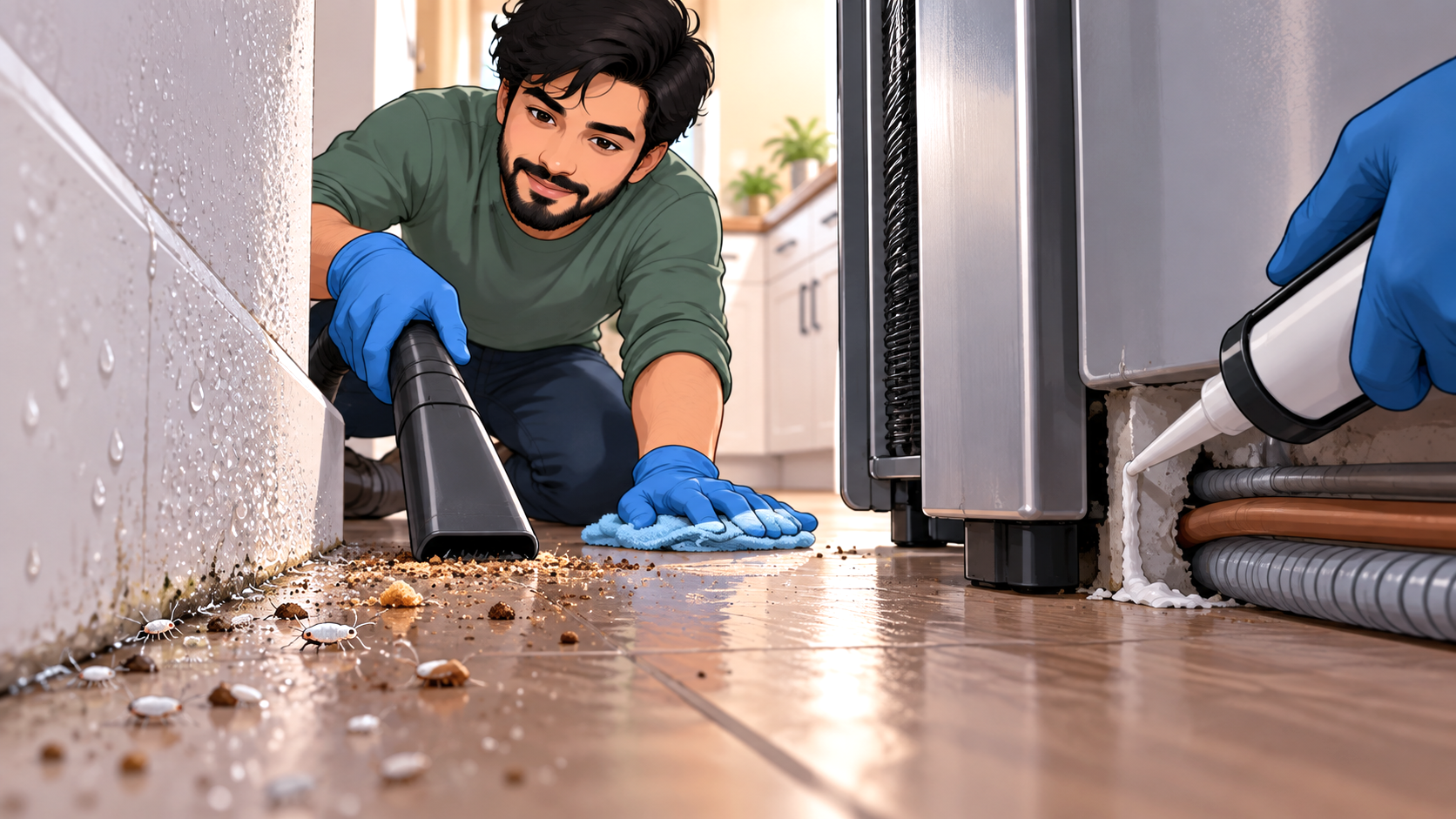
Finding springtails beside the kitchen sink creates an obvious suspicion that something in the drain is breeding them. That is not necessarily what is happening. A sink can simply be the wettest place springtails encounter after entering the kitchen, and its smooth sides can trap them there. To get rid of springtails in the kitchen, remove the ones you can see, then find and correct the moisture supporting them. Check beneath the sink, around plumbing connections, behind moisture-prone appliances, and near overwatered plants. Dry wet areas, repair leaks, reduce persistent humidity, and seal practical entry points.
Springtails need moisture, so a recurring kitchen population gives you a better clue than the countertop where you happened to notice them. They are commonly found around plumbing leaks in kitchens, while their continued presence indoors can indicate excess moisture.
Start With the Kitchen Sink, but Look Under It
Springtails in a kitchen sink are common enough to be specifically documented as an indoor nuisance. However, the insects visible inside the basin may have crawled there while searching for moisture and then become trapped.
That makes the cabinet beneath the sink more interesting than the basin itself. Empty enough of the cabinet to inspect the plumbing, cabinet floor, back corners, and places where pipes enter the wall. Look for active drips, water stains, damp material, condensation, or swollen cabinet surfaces. Springtails indoors are associated with plumbing leaks and other high-moisture conditions.
Do not stop at a quick glance. A tiny leak at a connection can keep a concealed area damp without leaving a puddle on the kitchen floor. If springtails repeatedly appear around one section of the sink cabinet, that localized pattern gives you a sensible place to concentrate the inspection.
Our guide to what attracts springtails explains the larger role moisture plays throughout a home.
Remove the Springtails You Can See
For springtails already on counters, floors, cabinet surfaces, or other dry areas, vacuuming provides straightforward physical removal. Small numbers can also be wiped or swept up. Indoor springtails can be managed this way while the underlying moisture problem is corrected.
This is one situation where we would not judge success by how many springtails you can kill in five minutes. The more useful test comes afterward. If the kitchen dries out and springtails stop reappearing, you have addressed the condition that mattered.
Repeatedly vacuuming another group from the same wet corner, on the other hand, means the investigation is not finished. Our complete guide to getting rid of springtails covers whole-home control when their activity extends beyond the kitchen.
Dry the Damp Areas That Keep Springtails Around
Once you have checked for an obvious leak, pay attention to smaller sources of persistent moisture. Water splashed around a sink should be wiped up rather than allowed to remain around seams and edges. Damp items stored beneath the sink should also be removed so the cabinet can dry properly.
For a larger moisture problem, increase airflow and correct whatever is keeping the affected area wet. A fan can speed drying, while a dehumidifier can help when excessive indoor humidity is contributing to the problem. Repairing water leaks remains more important than trying to compensate for an active leak with a dehumidifier.
Springtails generally cannot persist in a dry indoor environment. Reducing moisture is therefore the central control measure rather than an optional extra.
If high indoor humidity is the issue, our guide to using a dehumidifier for springtails covers that method in more detail.
Check Around the Dishwasher and Other Water-Using Areas
The sink is not the only place in a kitchen where water moves through plumbing. A recurring springtail problem deserves a wider inspection when the sink area is dry.
Check accessible areas around the dishwasher and any other appliance connected to a water supply. The goal is not to dismantle appliances or plumbing. Instead, look for visible leaking, damp flooring, staining, or another sign that water is escaping where it should not.
Also pay attention to where the springtails actually collect. A recurring cluster beside one cabinet or appliance is more useful diagnostically than a few scattered individuals. Signs of a springtail infestation explains how repeated location and moisture patterns can help make sense of larger numbers indoors.
Where hidden water damage is suspected but the source cannot be located safely, the moisture problem itself may require a plumber or another appropriate building professional.
Do Not Assume Springtails Are Infesting Your Food
Tiny arthropods crawling across a kitchen counter naturally raise a food-contamination concern. Springtails, however, are not stored-food pests. They feed primarily on materials such as fungi, algae, pollen, decaying roots, and other decaying organic matter rather than household food. They also do not damage food or household property.
That distinction changes where you should spend your time. Searching every cereal box and bag of flour for a springtail food source is unlikely to solve the problem. Searching for dampness is far more useful.
Normal kitchen hygiene still matters, particularly because wet organic debris can help create damp microhabitats. However, finding springtails near a pantry or food-preparation area does not turn them into pantry pests.
This is also one reason identification matters. If the tiny insects do not jump when disturbed or their appearance does not match springtails, use our guide to bugs that look like springtails before treating the problem as a springtail infestation.
Check Houseplants Kept in or Near the Kitchen
A kitchen houseplant can create a completely different springtail source from a plumbing leak. Springtails commonly inhabit overly damp potting soil, particularly mixes rich in peat, where they feed largely on fungi and decaying organic material.
Look at the soil surface and around the bottom of the pot, especially after watering. Springtails can become particularly noticeable when water disturbs them.
When the plant is the source, the treatment belongs in the pot rather than around the kitchen. Let the surface of the potting medium dry as much as the particular plant can tolerate before watering again, and do not leave drainage water standing in the saucer.
Our dedicated guide to springtails in potted plants covers that situation without confusing it with a plumbing-related kitchen problem.
Springtails in the Sink Do Not Mean You Should Pour Pesticide Down the Drain
A cluster of springtails inside a sink can make drain treatment seem like the obvious next step. Resist that shortcut. Springtails that enter a home can crawl toward moisture and become trapped in sinks, so their presence in the basin does not by itself establish the drain as the source.
Springtails already in the sink can simply be washed away. Insecticides should never be poured or sprayed down drains for springtail control.
Indoor insecticide sprays are also unnecessary for typical springtail problems. Moisture correction provides the meaningful long-term control, while indoor pesticide treatment does not fix the damp conditions allowing springtails to persist.
If the activity remains specifically concentrated at a drain after the surrounding kitchen has been inspected, our separate guide to getting rid of springtails in a drain keeps that narrower investigation in its own place.
Check the Outside of the Kitchen Wall
A dry kitchen does not automatically mean the springtails originated indoors. Outdoor springtails live in moist soil, leaf litter, organic mulch, and similar damp habitats. When outdoor conditions become unfavorable, large numbers can migrate and some may enter buildings through small openings.
When most of the springtails appear along an exterior kitchen wall, door, or window, inspect the corresponding area outdoors. Excessively wet mulch, accumulated moist leaves, poor drainage, and heavy irrigation close to the foundation can support springtail populations. Reducing excessive moisture and organic material around the foundation can make the immediate perimeter less favorable to them.
After correcting those conditions, inspect screens and obvious cracks or gaps around windows, doors, and utility penetrations. Springtails can enter through small openings, so exclusion works best alongside outdoor moisture management rather than as the only measure.
Our guides to springtails outside the house and how springtails get indoors cover those two sides of the problem in more depth.
When the Kitchen Keeps Getting Springtails
A kitchen that continues producing springtails after obvious wet areas have dried deserves another inspection rather than progressively stronger treatments. Follow where the insects are appearing.
Repeated activity under the sink points you back toward plumbing and concealed moisture. Springtails concentrated around a houseplant point toward its potting medium. Large numbers appearing along an exterior-facing window or door make outdoor migration and entry more plausible. Meanwhile, springtails turning up in bathrooms, basements, and other damp rooms suggest that the problem is broader than the kitchen.
That location-based approach is more useful than treating every springtail sighting as the same problem. The insects are small, but their distribution can tell you where to investigate next.
Make the Next Sighting Tell You Something
After drying the kitchen and removing the springtails, note exactly where the next insects appear, if they return. Under-sink activity, a plant-pot cluster, and springtails arriving along an exterior window each point the investigation in a different direction.
That is the useful part of a recurring sighting. Instead of spraying the newest group, use its location to narrow down the moisture source or entry route you have not dealt with yet. Once the kitchen no longer provides the damp conditions springtails need, repeated indoor activity should decline.
Other Questions About Springtails in the Kitchen
Why do springtails suddenly appear in my kitchen sink overnight?
Springtails can move indoors while searching for moisture and then become trapped on the smooth surface of a sink. Outdoor migrations can also occur when environmental conditions change. A sudden appearance is therefore a reason to inspect both the sink area and likely outdoor entry points rather than assuming a colony developed in the basin.
Can springtails live under a kitchen sink?
They can persist in damp indoor locations when enough moisture is available. A leaking pipe or another source of persistent dampness beneath the sink can create suitable conditions, so repeated activity there warrants a careful moisture inspection.
Are springtails in the kitchen dangerous?
Springtails do not bite or sting people, and they do not damage household property. Their importance in a kitchen is mainly as a nuisance and, when they persist, as a clue that excess moisture may be present.
Could springtails be coming from a kitchen herb pot?
Yes. Springtails can inhabit damp potting soil, and watering often makes them easier to notice. Check the soil and saucer of indoor herbs and other potted plants when springtails appear nearby.
Why are springtails still appearing after I cleaned the kitchen?
Ordinary surface cleaning does not correct a plumbing leak, overly wet potting soil, high humidity, or an outdoor population entering through gaps. When a clean kitchen still has springtails, follow the insects back toward moisture rather than simply cleaning the same surfaces again.