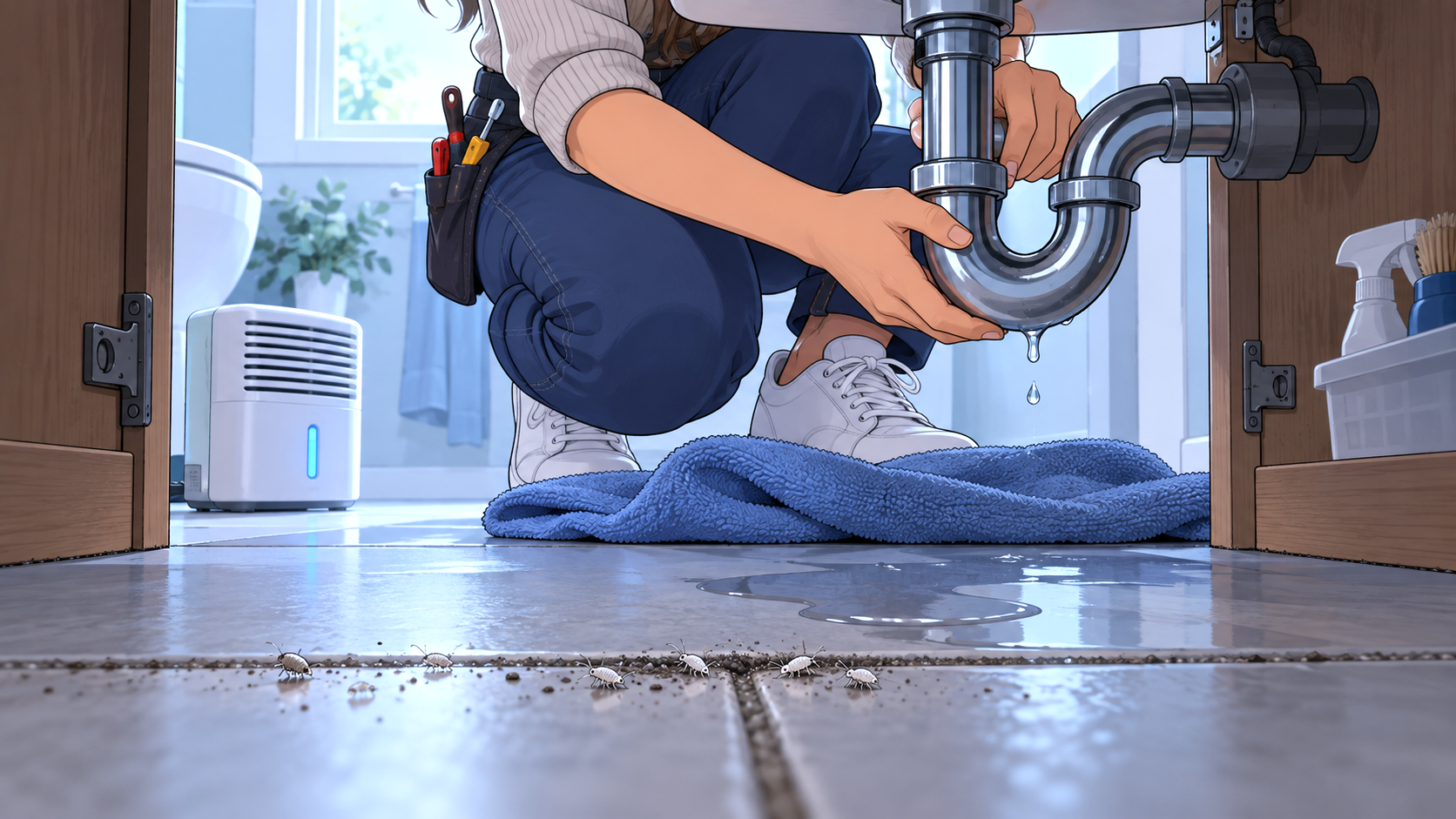
Springtails on a bathroom floor can make the drain, toilet, or shower look guilty. The more useful clue is the room itself. Bathrooms regularly provide the moisture these tiny arthropods need, and a persistent springtail problem deserves a search for damp conditions rather than automatic treatment of whichever fixture they happen to be crawling around.
**To get rid of springtails in the bathroom, remove the springtails you see, then find and correct the excess moisture supporting them. Check for plumbing leaks, condensation, damp grout or building materials, and high humidity. Improve ventilation and dry the room thoroughly. Persistent activity can point to a moisture source that has not yet been found.**That approach is less dramatic than reaching for a spray, but it gets closer to the reason springtails can persist indoors. Springtails favor moist environments, while dry indoor conditions are unfavorable to them. This is why our broader guide to getting rid of springtails puts moisture correction at the center of control.
First, Work Out Where the Bathroom Springtails Are Concentrated
Before changing anything, pay attention to where you keep finding them. A few springtails scattered across the bathroom after wandering indoors is different from repeated activity around the same damp section of the room.
Check around the toilet base, beneath the vanity, inside the sink cabinet, along tub and shower edges, and around plumbing penetrations. Also inspect baseboards and any area where flooring meets a wall. Water staining, swollen material, persistent condensation, or surfaces that remain damp long after the bathroom has been used deserve closer attention.
This does not mean every springtail marks a hidden plumbing failure. Bathrooms naturally become humid during showers, and springtails can also enter from outdoors. However, recurring concentrations in one location give you somewhere useful to start investigating.
That distinction matters because the spot where you see springtails is not necessarily where they entered. Our guide to how springtails get into a house covers their possible entry routes separately.
Remove the Springtails Already in the Bathroom
Vacuuming is a simple way to remove springtails from dry bathroom surfaces. Sweeping works too, particularly when only a small number are present. Physical removal gives you immediate cleanup without confusing the insects you killed today with the conditions that may produce another group tomorrow.
Springtails found inside homes can be vacuumed or swept up as part of nonchemical control. However, repeated cleanup should not become the entire treatment. When springtails return to the same bathroom day after day, the recurring pattern is more informative than the individual insects.
We would treat vacuuming as the cleanup step, not the solution. Once the visible springtails are gone, the bathroom becomes easier to inspect and monitor.
Dry the Bathroom More Thoroughly
A bathroom that remains humid for long periods gives springtails much better conditions than one that dries quickly after use. Improving that drying process can therefore make a noticeable difference.
Run the bathroom exhaust fan during and after showers when it vents correctly to the outdoors. Increasing airflow can also help wet surfaces dry. Where persistent indoor humidity is the larger problem, a dehumidifier can reduce moisture in the air. Moisture reduction is central to controlling springtails indoors, and populations generally decline when their damp habitat disappears.
Pay attention to surfaces as well as the air. A bathroom can feel comfortable while moisture remains beneath a sink, around a leaking fixture, or inside damaged material. Drying the visible floor while ignoring a continuing leak only deals with the easiest part of the problem.
Our guide to using a dehumidifier for springtails goes deeper into when humidity reduction can help and when it cannot replace fixing a water source.
Check the Bathroom for Plumbing Leaks
A slow leak can be much easier to miss than a dripping faucet. Water beneath a vanity, around supply connections, behind a toilet, or near a tub can keep a small area damp even when the rest of the bathroom looks dry.
Use your hand and a flashlight to inspect accessible plumbing and surrounding surfaces. Look for dampness beneath the sink and around visible pipe connections. Also watch for discoloration, peeling finishes, softened materials, or a recurring wet patch.
Indoor springtails are associated with high-moisture conditions and plumbing leaks. Consequently, fixing an active leak does more for long-term control than repeatedly killing the springtails that emerge around it.
A persistent unexplained damp area deserves attention even after the insects disappear. Springtails may be the nuisance that made you notice the moisture, but the water itself is the more important household problem.
Springtails Near a Drain Are Not Automatically Coming From It
This is one of the easiest bathroom clues to misread. Springtails found in a sink, bathtub, or shower are often described as “coming from the drain” simply because that is where they were discovered.
Their location alone does not establish the drain as their source. A smooth sink or bathtub can also trap tiny arthropods after they enter the fixture, while the surrounding bathroom provides plenty of other damp locations to investigate.
Before pouring treatments into a drain, inspect the area around the fixture. Look beneath the sink, around plumbing penetrations, along the tub or shower perimeter, and anywhere water may be escaping. If activity truly remains concentrated around the drain, our dedicated guide to getting rid of springtails in a drain keeps that narrower problem separate from general bathroom control.
This is one case where location should guide an investigation rather than settle it.
Look Beyond the Bathroom When Springtails Keep Returning
Sometimes the bathroom is simply where an infestation becomes visible. Springtails may occur indoors where moisture supports suitable conditions, including concealed damp areas.
Check what lies beside, above, and below the affected bathroom. An exterior wall may put the room next to damp foundation soil or mulch. A bathroom above a basement or crawl space may have another moisture-prone area beneath it. Plumbing also passes through walls and floors, so the visible room does not reveal every place where water can accumulate.
Springtails can become numerous in moist outdoor habitats containing decaying organic material, fungi, algae, and other food sources. If a bathroom sits beside an exterior wall, checking the outside perimeter can therefore be worthwhile. Wet mulch, excessive irrigation, leaf debris, and poor drainage near the structure may be contributing to activity around the building.
The separate guide to what attracts springtails explains why these moisture conditions matter without turning this bathroom article into a general habitat guide.
Seal Practical Entry Points Around the Bathroom
Once moisture is under control, inspect openings that could allow springtails to move into the room. Gaps around pipes are particularly relevant in a bathroom because several plumbing lines may penetrate walls, cabinets, or floors.
Check accessible openings around supply pipes and other penetrations. Exterior windows and damaged screens also deserve attention where the bathroom has them. Springtails are tiny, so exclusion should focus on obvious practical openings rather than an unrealistic attempt to make every part of the room airtight.
Sealing alone may disappoint when a large springtail population remains directly outside or a damp indoor habitat continues supporting them. Instead, exclusion works best as part of a larger moisture-control strategy.
If springtails are appearing in several rooms rather than only the bathroom, the issue has moved beyond a bathroom-specific problem. Signs of a springtail infestation can help you interpret that wider pattern.
Do Not Turn the Bathroom Into a Homemade-Chemical Experiment
Bathrooms contain plenty of products that look tempting when tiny bugs appear. Bleach and other household cleaners are useful for their labeled cleaning purposes, but killing visible springtails is not the same as correcting an infestation.
We would not make repeated surface spraying the center of bathroom control. A wet void beneath a fixture remains wet after the insects on the tile have been killed. Likewise, high humidity continues after a treated surface dries.
The same reasoning applies to vinegar and other home remedies. The dedicated guides on whether bleach kills springtails and whether vinegar kills springtails handle those individual questions. For a bathroom infestation, the priority is finding out why springtails can keep surviving there.
That is also why natural springtail control relies so heavily on moisture management, habitat correction, physical removal, and exclusion.
When the Bathroom Is Dry but Springtails Still Appear
Give the room a fresh inspection rather than assuming the treatment failed. A bathroom that looks dry at eye level can still have moisture beneath a vanity, behind damaged materials, around plumbing, or in an adjoining area.
The pattern of reappearance can help narrow the search. Springtails consistently concentrated beside one fixture point you toward a different investigation than insects appearing mostly along an exterior wall or window. Meanwhile, activity throughout several rooms suggests that the bathroom may only be one part of a larger problem.
Persistent springtails in a genuinely dry bathroom also make identification worth revisiting. Springtails are tiny and can be confused with other small arthropods. They are especially recognizable for the jumping ability found in many species. Our guide to what springtails look like can help confirm that the insects being treated are actually springtails.
Make the Bathroom a Bad Place for Springtails to Stay
Once the visible springtails are removed, watch the bathroom instead of immediately adding another treatment. The useful sign of progress is that the room stays dry and the number of new springtails falls rather than returning in the same location.
If they continue appearing, follow that pattern. Recheck plumbing, ventilation, adjoining spaces, and the exterior perimeter where relevant. A recurring springtail problem in a bathroom is much easier to solve when the search stays focused on the moisture that supports them rather than whichever surface they happened to crawl across.
Other Questions About Springtails in the Bathroom
Can springtails live in bathroom towels?
A springtail crawling onto a damp towel does not make towels a typical breeding site. However, repeatedly leaving wet textiles in a poorly ventilated bathroom adds moisture to the room. Hang towels so they dry properly and investigate the room itself when springtail activity persists.
Why do I see more springtails after taking a shower?
A shower temporarily raises bathroom humidity and wets several surfaces. Seeing springtails afterward can make existing activity easier to notice, particularly around areas that stay damp. Repeated post-shower sightings are another reason to check ventilation and drying rather than assuming the shower water created the infestation.
Can springtails come through a bathroom window?
Yes. Springtails originating outdoors can enter buildings through small openings, and a bathroom window can provide potential entry points if screens, seals, or surrounding gaps are compromised. This possibility becomes more relevant when springtails are also numerous immediately outside that side of the building.
Why are springtails only in my upstairs bathroom?
A springtail problem does not have to begin at ground level. An upstairs bathroom can provide its own moisture conditions through plumbing, condensation, damp materials, or nearby exterior entry points. Concentrating the inspection on that room and the spaces immediately around its plumbing is more useful than assuming springtails must have travelled upward from the foundation.
Should I replace bathroom caulk because I found springtails near it?
Springtails beside a caulked joint do not prove the caulk itself is the source. However, visibly failed or separated seals can allow water into places that do not dry easily. Correct deteriorated seals where needed and investigate for existing moisture rather than simply covering a wet area with new material.
2 thoughts on “How to Get Rid of Springtails in the Bathroom”