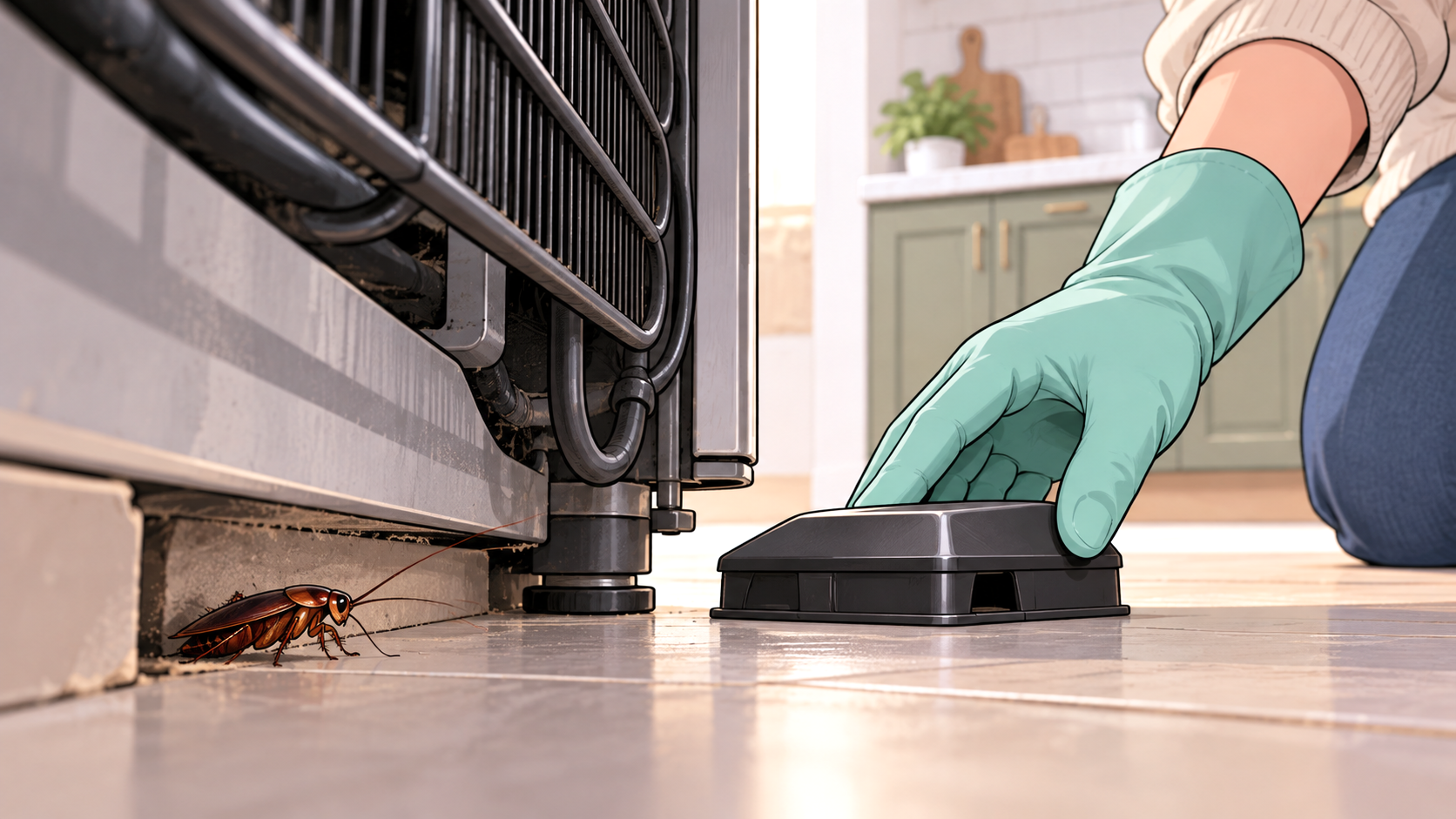
Killing the cockroaches visible on your kitchen floor will accomplish little if others remain behind cabinets, beneath the sink, or around appliances. Effective control depends on locating the areas with the greatest activity, removing accessible food and moisture, and applying treatment where the insects actually travel.
The most effective approach for an established kitchen cockroach infestation is to combine targeted cockroach baits, thorough sanitation, moisture control, sealing of hiding places, and regular monitoring. Insecticide sprays alone often produce disappointing results because they may miss concealed insects and interfere with bait-based treatments.
Before purchasing products or emptying every cupboard, establish which parts of the kitchen are affected. A German cockroach population concentrated around the stove requires a different response from an occasional outdoor cockroach entering beneath a door.
Map the Infestation Before Treating the Kitchen
Start with a flashlight and a small number of sticky cockroach monitors. Examine accessible cabinet corners, drawer runners, plumbing penetrations, gaps beneath countertops, and the junctions where cabinets meet walls. Look for living insects, egg cases, shed skins, and dark spotting concentrated around narrow openings.
Place monitors along edges near the refrigerator, stove, beneath the sink, and beside the rubbish bin. Number them and record the catches over several nights. According to Rutgers University’s German cockroach management guidance, traps are particularly useful when insect populations are too small to locate reliably through visual inspection.
A useful starting arrangement is:
| Kitchen location | What to investigate |
|---|---|
| Beneath the sink | Plumbing gaps, cabinet corners, moisture damage |
| Beside the refrigerator | Adjacent cabinet seams, floor-wall junctions |
| Near the stove | Cabinet edges, nearby gaps, accumulated debris |
| Inside lower cabinets | Rear joints, drawer runners, door hinges |
| Beside the rubbish bin | Nearby sheltered edges and recurring activity |
| Near the kitchen doorway | Movement between the kitchen and adjoining spaces |
The University of California’s cockroach management recommendations advise comparing catches from different trap locations rather than distributing pesticides indiscriminately.
Species identification is equally important. German cockroaches commonly establish breeding populations indoors, while some larger outdoor-associated species enter kitchens intermittently. The differences between household cockroach species can change whether the primary treatment should concentrate on indoor harborages or access routes.
Do not infer population size from a single nighttime sighting. Concentrated trap catches, particularly those containing adults and nymphs, provide a stronger indication of where treatment is needed.
Remove Food Residues From Places Ordinary Cleaning Misses
A visibly clean countertop is not the same as a kitchen without accessible cockroach food. Grease behind a stove, crumbs beneath lower cabinets, spilled dry goods at the back of a pantry, and residue around a rubbish bin can remain available between routine cleaning sessions.
Empty affected drawers and accessible cabinets before washing them with detergent and water. Vacuum dry debris from corners, seams, and crevices, then wipe the surfaces and allow them to dry. Remove disposable paper liners if insects or deposits have accumulated beneath them. Where droppings or cast skins are present, a vacuum fitted with a HEPA filter helps reduce the release of allergen-containing dust.
The CDC’s guidance on controlling indoor asthma triggers recommends promptly cleaning dishes, spills, and crumbs, keeping food in airtight containers, and removing materials that support cockroach activity.
Transfer opened cereals, flour, rice, and similar foods from loosely folded packages into pest-resistant containers. Empty the rubbish regularly and clean the bin itself when residue accumulates beneath the liner. Pet feeding areas need attention too, particularly when uneaten food remains accessible overnight.
Sanitation improves the effectiveness of treatment by reducing competing food sources. Cockroaches have flexible feeding habits, so removing obvious dinner scraps without addressing grease and residue in protected gaps may produce limited improvement.
Do not wash insecticidal bait placements or previously treated surfaces unless the product instructions require it. Complete routine cleaning before applying treatment wherever possible.
Correct Moisture Problems Around the Sink
Kitchen plumbing needs attention even when the infestation appears concentrated elsewhere. A leaking sink trap, condensation on a cold-water line, or damp cabinet base can maintain favorable conditions close to cockroach shelter.
Empty the sink cabinet and examine its floor, rear panel, and pipe openings for moisture. Repair leaking connections, dry the affected materials, and determine whether damaged cabinet panels need replacement. Ensure that the sink drains properly and avoid leaving standing dishwater overnight.
The EPA’s household pest-prevention recommendations identify leaking fixtures and standing water as conditions that should be corrected when managing cockroaches.
A wet cabinet can also undermine some pesticide formulations. Dusts may cake or lose effectiveness when exposed to moisture, while bait products can deteriorate under unsuitable conditions. Addressing the leak first avoids applying products into an environment where they may not perform as intended.
The limits of cockroach survival without water make moisture reduction worthwhile, although insects can obtain water from several sources. Drying one cabinet does not guarantee that every individual will die.
Use Cockroach Baits Instead of Spraying the Entire Kitchen
For established German cockroach infestations, insecticidal baits are generally more effective than repeatedly spraying visible insects. Cockroaches must encounter and feed on a suitable bait, so treatment should concentrate near confirmed activity rather than uniformly across the room.
Prefilled bait stations offer a contained formulation that can be used in locations permitted by their labels. Gel baits may be suitable for protected cracks and crevices, but they require careful application according to the specific product instructions.
The Rutgers comparison of cockroach control methods identifies gel baits and bait stations as effective options for German cockroaches and discourages reliance on ordinary aerosol sprays and total-release foggers. When treating kitchen cabinets, keep bait away from exposed food, utensils, dishes, and surfaces used directly for preparation. Do not apply gel across shelving where packaged foods are handled or allow children and pets to access pesticide deposits.
The EPA recommends baits as an early chemical-control option after preventive measures, provided they are used in accordance with the label and kept inaccessible to children and animals.
Avoid spraying repellent insecticides over or immediately around bait placements unless the product instructions specifically permit the combination. Residues may discourage cockroaches from approaching the bait or contaminate its food component.
Baits are not instantaneous. The UC Integrated Pest Management program explains that noticeable reductions may take a week or longer, depending on the infestation and treatment conditions. Applying additional products every time a cockroach appears can interfere with an otherwise effective program.
Treat Cabinet Voids and Sink Gaps Without Contaminating Food Areas
Some cockroach activity originates inside spaces that cannot be cleaned thoroughly without modifying cabinetry. These include the cavity beneath a cabinet toe-kick, gaps behind a sink unit, and openings where pipes pass through the wall.
When appropriate, insecticidal dusts may be used in enclosed, inaccessible areas, but only if the particular product is registered and labeled for those locations. Boric acid and certain desiccant dusts are used for cockroach control, yet visible piles on cabinet shelves or kitchen floors are neither necessary nor safe applications.
The EPA’s integrated pest management manual for schools describes a kitchen cockroach program that combines monitoring, vacuuming, sanitation, repairs, and carefully targeted pesticide applications in inaccessible harborages.
Do not pour boric acid into sink drains, scatter powder around food containers, or apply insecticides inside electrical fittings. Enclosed structural treatments are often better handled by a licensed professional, especially where access requires opening cabinet panels or working near electrical equipment.
The potential hazards of cockroach sprays around humans and pets also apply to unnecessary pesticide deposits on surfaces touched during food preparation.
Once activity has been controlled, seal suitable cabinet joints, gaps around plumbing penetrations, and other accessible structural openings. The EPA’s integrated pest management principles emphasize combining physical exclusion with appropriate treatment rather than using pesticides as the sole response.
Why Foggers and Repeated Surface Sprays Usually Disappoint
A cockroach visible on a counter is an easy target for aerosol spray, but most of the population may remain inside protected spaces. Broad spraying distributes pesticide over exposed surfaces without reliably reaching those insects.
Total-release foggers present an additional concern in kitchens because pesticide droplets can settle onto dishes, countertops, and other surfaces. They may also create fire hazards near ignition sources.
The EPA’s safety guidance for total-release foggers warns against using these devices in enclosed cupboards or beneath counters and explains the importance of removing exposed food and following reentry requirements.
For someone repeatedly seeing cockroaches after spraying, additional aerosol applications should not be the automatic response. Review where monitoring traps are catching insects, whether bait is being consumed, and whether accessible food or moisture remains. Some populations also exhibit resistance to commonly used cockroach insecticides, so a product that produces quick knockdown may still perform poorly against the infestation.
Keep Food-Contact Surfaces Safe Throughout Treatment
Food preparation imposes restrictions that do not apply to every other room. Remove or protect food, cutting boards, utensils, and dishes before permitted pesticide applications, following the label’s instructions. Do not assume a product approved for residential kitchens can be sprayed onto every kitchen surface.
If cockroaches have contaminated an exposed meal, discard the affected food. The appropriate response when cockroaches make direct contact with food differs from handling intact sealed packaging.
For washable countertops and utensils requiring cleaning, wash with detergent and water, rinse, and sanitize where appropriate using a product suitable for food-contact surfaces. The FDA’s kitchen hygiene guidance recommends cleaning countertops, cutting boards, dishes, and utensils before further food preparation.
Keep pesticide-treated cracks distinct from surfaces intended for food preparation. Never assume ordinary cleaning will make an incorrectly applied pesticide acceptable; the product label or pesticide manufacturer may specify particular remediation steps.
Check Whether the Kitchen Population Is Declining
Keep monitoring in the same locations after treatment begins so that catches can be compared meaningfully. A declining number of cockroaches over successive inspection periods is more informative than seeing several dead insects on the floor.
Remove and replace heavily contaminated monitors as directed. Record live captures, their approximate sizes, and the locations where activity remains concentrated. If catches stay high near the sink but fall beside the stove, direct further investigation toward the sink cabinet rather than treating the entire kitchen again.
The Rutgers German cockroach factsheet recommends continued monitoring to evaluate control and detect persistent activity. Its approach combines population assessment with sanitation and targeted chemical treatment.
Repeated captures of small nymphs deserve attention because developing cockroaches may remain after some adults have been eliminated. The time required for cockroach eggs to hatch also means that results cannot always be assessed immediately after the first treatment.
If catches remain substantial despite appropriate bait use, sanitation, and moisture repairs, professional assessment is warranted. In multifamily housing, adjoining units or shared structural spaces may require coordinated management. The EPA’s guidance for housing managers emphasizes that successful cockroach control can require cooperation between residents, maintenance staff, and pest-management professionals.
Once catches have declined, continue periodic monitoring and maintain the kitchen improvements. Removing the conditions that supported the population is what prevents another small introduction from developing into a persistent infestation.