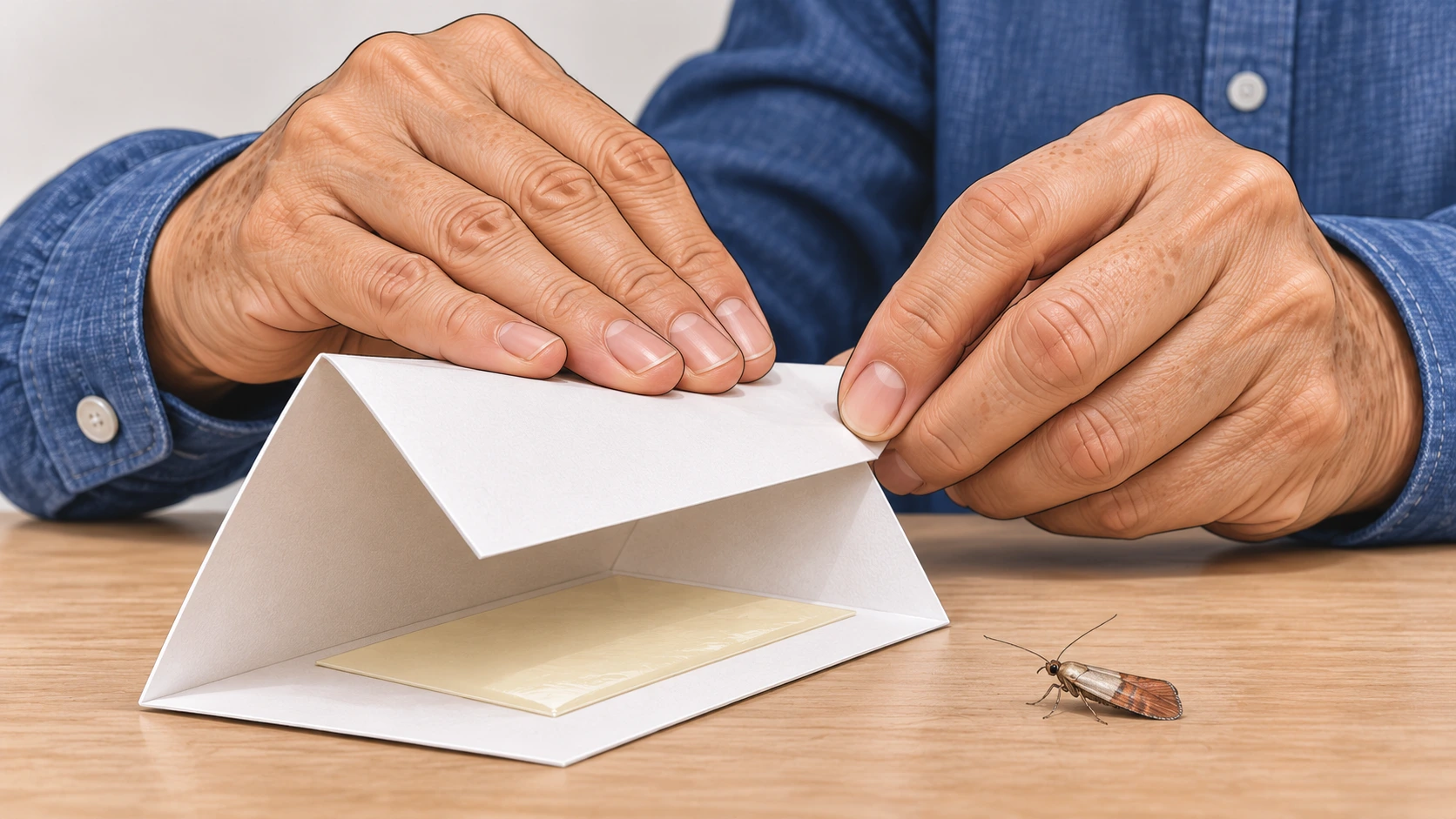
You can make a homemade Indian meal moth trap using a small piece of cardboard and double-sided adhesive tape, but it will catch moths mainly when they contact the sticky surface. For more reliable attraction, the homemade trap needs a compatible Indian meal moth pheromone lure. Vinegar, honey, and sugar water are not proven substitutes for that lure.
A homemade trap can be useful when you want to catch an occasional moth or set up a temporary monitoring point with materials already available. The important limitation is that most DIY designs are better at physically trapping insects than attracting them. A moth flying around a pantry has no particular reason to enter a cardboard structure just because you have made it sticky.
Indian meal moths (Plodia interpunctella) are stored-food pests whose larvae develop in products such as cereal, flour, grains, nuts, dried fruit, and other dry foods. Their adults may fly around kitchen cabinets or nearby rooms, making them easy to notice but difficult to trace to a particular package.
A homemade trap can collect some adults. It cannot remove eggs, larvae, or pupae concealed in food. The most useful approach is to build a trap that is safe to handle, easy to inspect, and realistic about what it can accomplish.
The Simplest Homemade Indian Meal Moth Trap
A folded cardboard sticky trap is the easiest practical design because it requires no liquid bait, heating, sharp tools, or homemade chemical mixture.
You can make one from ordinary household materials, although its performance will be limited without a species-appropriate pheromone lure.
Materials You Will Need
One piece of stiff, clean cardboard, approximately 4 × 6 inches (10 × 15 cm)
Wide double-sided adhesive tape
Scissors
A small binder clip or ordinary tape to hold the structure in shape
A pen for recording the installation date
Optional: a commercially manufactured Indian meal moth pheromone lure that is supplied for use with a compatible trap
Use adhesive tape with enough exposed surface to hold a small moth. Ordinary narrow office tape may provide very little capture area, while tape that loses its tack quickly will be even less useful.
Avoid applying homemade glue mixtures, honey, or sugar syrup to cardboard. These materials can run, collect dust, or attract other insects without establishing that they will lure Indian meal moths.
Step 1: Prepare the Cardboard
Cut a clean, dry piece of cardboard to approximately 4 × 6 inches. This is a convenient DIY size, not a scientifically established optimum for Indian meal moth capture.
Fold it gently across the middle of its longer side so it can stand like a small tent. The two sides should form an inverted V, leaving an open entrance at each end.
A tent design is useful because the adhesive will be sheltered inside rather than exposed where it can touch hands, containers, or pets.
Make sure the cardboard can stand without collapsing. If necessary, use a small binder clip or a strip of tape along the outside to stabilize its shape.
Step 2: Add the Sticky Surface
Open the folded cardboard and attach strips of double-sided tape to the inside surfaces. Cover a reasonable portion of each side while leaving the fold and edges manageable.
The adhesive should face inward when the cardboard is folded. Do not put sticky material on the outside where it could attach to food packaging or other household objects.
Remove the tape’s protective backing immediately before placing the trap.
Check that the tape remains attached to the cardboard. Some products adhere poorly to dusty or heavily textured surfaces, and a strip that falls away will provide little trapping value.
Step 3: Fold the Trap Into a Tent
Bring the two cardboard sides together to form an inverted V with the sticky surfaces facing one another.
Leave both ends open so a flying moth can enter or contact the adhesive. The trap should remain stable on a flat surface without the tape touching the shelf beneath it.
Do not close the ends completely or build a narrow entrance that prevents insects from reaching the adhesive.
At this stage, you have made an unbaited contact trap. It can catch a moth that flies into or lands on the adhesive, but it does not actively attract Indian meal moths from across the room.
Step 4: Add a Pheromone Lure Only if It Is Compatible
If you have a separately sold Indian meal moth pheromone lure, check its instructions before combining it with the homemade housing.
Some lures are designed for specific trap types, placements, or adhesives. Others are integrated into complete commercial sticky traps and are not intended to be separated.
Use a loose lure in your homemade trap only when its manufacturer permits that arrangement. Follow its instructions for handling, positioning, storage, and replacement.
Do not open a sealed lure packet unless the instructions require it, and do not coat the lure in glue or household oils.
A compatible lure changes the function of the trap considerably. Instead of depending only on chance contact, it can attract adult male Indian meal moths toward the adhesive.
That difference is supported by experimental comparisons of baited and unbaited Indian meal moth traps, which found that unbaited designs caught few insects.
A purchased pheromone component does mean the finished device is not entirely homemade. The housing and capture surface are DIY, while the active attractant is manufactured.
Step 5: Place the Trap Near Moth Activity
Set the trap on an accessible, dry shelf near the area where adult Indian meal moths have been observed.
Choose a position where it will not contact food, dishes, utensils, or food-preparation surfaces. Keep it beyond the reach of children and pets.
Avoid setting an unbaited trap behind several containers where moths are unlikely to contact it. It is more useful in an accessible location where moths have actually been flying or resting.
If using a commercial lure, follow its placement directions. The housing may be homemade, but the lure’s intended use still matters.
Write the installation date on the outside of the cardboard so you can track how long it has been in place.
Will a Homemade Sticky Trap Actually Catch Indian Meal Moths?
It can, but there is a major difference between a trap’s ability to hold a moth and its ability to attract one.
Double-sided tape can retain a moth that makes sufficient contact with the exposed adhesive. The uncertain part is whether moths will enter or land on the trap often enough for the device to be useful.
Indian meal moth adults do not normally search for bare adhesive or unbaited cardboard. An unbaited DIY trap therefore depends heavily on its position and the insects’ movements.
In controlled tests, unbaited Indian meal moth traps captured few individuals. That makes a homemade adhesive device a reasonable temporary collector, but a weak substitute for an actively baited monitoring trap.
Why the Pheromone Makes Such a Difference
Female Indian meal moths produce a sex pheromone that attracts males. A properly formulated commercial lure imitates that signal, encouraging males to approach the trap.
The pheromone does not need a strong odor that humans can smell. Its usefulness depends on the moth’s response to the chemical signal.
A pheromone-baited trap can therefore attract moths that might never have contacted an ordinary sticky surface.
Even then, the trap mainly targets adult males. It does not directly capture feeding larvae, eggs, pupae, or most females.
This is why pheromone traps are primarily useful for monitoring pantry moth activity, not for proving that an entire infestation has disappeared.
Can You Make a Homemade Moth Trap With Apple Cider Vinegar?
You can place apple cider vinegar in a jar, add a little dish soap, and cover it with plastic wrap. The physical construction is simple. The problem is that this familiar recipe is designed mainly around the attraction of certain small flies, not Indian meal moths.
Fruit flies respond to odors associated with fermenting food. Indian meal moth adults have a different biology and are not established household targets for an ordinary vinegar-and-soap bait.
In fact, adult Indian meal moths generally do not feed. Their larval stage is responsible for consuming stored food, while adult activity centers on reproduction.
That difference matters when considering claims that a sweet or fermented liquid will automatically attract the adults.
A vinegar-and-soap trap described for fruit flies should not be assumed to have the same attraction for Indian meal moths.
Some online guides present cider vinegar jars as highly effective pantry moth traps without distinguishing the insect species. That claim goes beyond the evidence available for reliable Indian meal moth monitoring.
What Happens if You Try a Vinegar Jar Anyway?
You may catch fruit flies, other small insects, or an occasional moth that enters by chance. Such a catch does not establish that vinegar is an effective Indian meal moth lure.
An empty vinegar jar is equally uninformative. Indian meal moths could be active nearby without approaching it.
Open liquid traps also create opportunities for spills, accidental contact, and unpleasant odors. In a food-storage area, those drawbacks are difficult to justify when the bait has no dependable attraction advantage.
If your purpose is identifying and monitoring Indian meal moth activity, a properly labeled pheromone lure is more suitable than vinegar.
Do Honey, Sugar Water, or Molasses Attract Indian Meal Moths?
There is insufficient evidence to recommend these common kitchen ingredients as dependable DIY attractants for adult Indian meal moths.
Honey and sugar syrups are sticky, which sometimes leads to the assumption that they function as both lure and adhesive. But a substance being sticky does not mean the insect is attracted to it.
Likewise, molasses may be used in traps designed for certain other moths or insects, but that does not establish its value against Plodia interpunctella.
The issue is not whether an individual moth could become stuck in syrup. It is whether the mixture attracts enough Indian meal moths to function as a useful trap.
For this species, the evidence is much stronger for a sex pheromone than for ordinary household sweeteners.
Comparison of Popular Homemade Baits
| DIY bait or material | Can it capture a moth? | Evidence of reliable attraction | Practical assessment |
|---|---|---|---|
| Double-sided adhesive tape | Yes, following contact | None by itself | Useful for incidental capture |
| Compatible commercial sex pheromone | Yes, when paired with adhesive | Established attraction of adult males | Best-supported attractant |
| Apple cider vinegar | An insect may enter or drown | Not established as a dependable Indian meal moth lure | Not recommended as the primary bait |
| Honey or sugar syrup | May physically trap an insect | Insufficient evidence for this species | Messy and unreliable |
| Molasses | May retain an insect in some trap designs | No dependable household Indian meal moth evidence | Do not assume effectiveness |
| Light near a sticky surface | A moth may approach or contact it | Not a validated substitute for a sex pheromone | Unreliable as a dedicated trap |
This comparison concerns Indian meal moths specifically. Attraction claims for fruit flies, outdoor moths, or other stored-food insects should not be transferred to this species without supporting evidence.
For a wider discussion of natural substances and pest-control claims, see natural and home remedies for Indian meal moths.
Can You Use a Homemade Funnel or Bottle Trap?
A funnel can make it harder for some insects to escape after they enter a container. But that does not solve the main difficulty with Indian meal moths: getting adults to enter in the first place.
A paper funnel inserted into a jar is commonly used with fermented fruit or vinegar when trapping certain flies. Without a lure that attracts Indian meal moths, adapting that design does not make it an effective moth monitor.
You could construct a reusable funnel housing and place a suitable commercial moth lure inside if the lure’s instructions permit that configuration. However, the capture mechanism then needs to be considered carefully. A dry jar with a wide opening may allow moths to leave, while an improvised liquid reservoir introduces spills and handling concerns.
A simple adhesive tent is easier to inspect and dispose of than a homemade liquid trap with uncertain retention.
There is also no practical benefit to adding an attractive food source, such as open cereal or flour, to a DIY trap. That could create accessible material for egg laying or larval development rather than providing controlled moth capture.
Where Should You Place a Homemade Indian Meal Moth Trap?
Place the homemade trap near observed adult activity and relevant dry-food storage, but not directly against unpackaged food.
For example, a small adhesive tent may be positioned on a clear, accessible shelf next to a cabinet where moths repeatedly appear. If the moths are mainly seen around a different storage area, place the trap nearer that location instead.
Avoid hidden, damp, dusty, or frequently disturbed spots. The adhesive can lose effectiveness when covered with crumbs or household dust.
Keep the trap away from food preparation, pet bowls, and locations where children or animals can touch the glue.
Should You Put a DIY Trap Inside a Food Cabinet?
You can place a dry adhesive trap on an accessible shelf if the adhesive is protected from accidental contact and the placement does not interfere with food handling.
A folded cardboard tent is more practical than exposed strips of sticky tape attached directly to cabinet surfaces. The tent allows you to remove the entire trapping device without leaving adhesive on shelves.
Do not place a trap inside a bag of food. Doing so risks contaminating the product and does not provide a useful way to measure adult moth activity.
If you use a commercially purchased lure, its directions may specify a preferred placement. Follow those instructions even when the trap housing is homemade.
How Many Homemade Traps Do You Need?
Start with one near the most relevant area of activity. For separate storage locations, an additional monitoring point may be useful.
There is no validated household spacing formula for unbaited homemade Indian meal moth traps. Placing ten cardboard traps throughout a small pantry will not necessarily improve capture or help identify the source.
When a pheromone lure is involved, use the manufacturer’s recommended spacing and quantity. Several lures crowded together can complicate monitoring and may not improve capture proportionately.
How Often Should You Check and Replace a Homemade Trap?
Check the trap at least weekly, and sooner if you know moths are active nearby.
Look for captured moths, dust, food particles, and adhesive that is becoming covered or ineffective. Count newly captured insects if possible and record the date of each check.
For a homemade trap using ordinary double-sided tape, there is no universal replacement interval. Replace the adhesive whenever it becomes dirty, loose, crowded, or insufficiently sticky.
If you add a manufactured lure, the lure has its own service life. Replace it according to its instructions rather than assuming the tape and pheromone remain effective for the same length of time.
The recommendation to check pantry pest monitoring traps weekly is a useful model for keeping records.
What Can You Learn From the Number of Moths Caught?
A homemade trap can show that a moth contacted its adhesive. It cannot reliably measure how many Indian meal moths are present.
For an unbaited trap, catching zero moths may simply mean none encountered the sticky surface. A zero catch therefore provides little reassurance.
A pheromone-baited homemade trap can provide more meaningful monitoring, but catches still depend on placement, lure condition, and adult male behavior.
An illustrative record might look like this:
| Weekly check | New moths captured | Useful interpretation |
|---|---|---|
| Week 1 | 3 | Some adult activity was captured |
| Week 2 | 1 | Fewer moths contacted the trap |
| Week 3 | 0 | No catch this week, but infestation status remains uncertain |
| Week 4 | 2 | New activity warrants checking nearby stored products |
These are hypothetical numbers, not results from a test of the homemade design.
They illustrate why trap catches should be treated as observations rather than proof of elimination. A moth caught one week could have developed in a package several shelves away.
Does a Homemade Moth Trap Get Rid of the Infestation?
No homemade adhesive trap should be expected to remove an Indian meal moth infestation by itself.
Adult Indian meal moths are the visible flying stage, but the feeding larvae develop within stored products. A cardboard trap cannot reach insects concealed in grains, flour, cereal, nuts, or other susceptible materials.
Even a properly baited pheromone trap is unlikely to capture every male before mating, and it does not directly attract all females.
A trap full of moths may demonstrate ongoing adult activity while the breeding source continues producing more insects.
The most important distinction is between catching a moth and eliminating the food that supports its development.
If you find larvae, webbing, or insect debris in dry food, that evidence requires attention regardless of whether your trap catches anything. The complete response is explained in how to get rid of Indian meal moths step by step.
For cleanup restricted to food cupboards and shelves, the dedicated guide to removing Indian meal moths from a kitchen or pantry provides the location-specific procedure.
Common Homemade Trap Mistakes
The most common mistake is expecting a homemade sweet bait to behave like a species-specific pheromone. A jar of vinegar can be effective for certain flies without reliably attracting Indian meal moths.
Another mistake is placing exposed glue where it contacts food, hands, or pets. The trap should have a protected capture surface and should be easy to remove without spreading adhesive.
Replacing a homemade trap only when it is full is also a problem. Dust can make the adhesive less effective long before the surface is covered with moths.
A final mistake is interpreting an empty trap as proof that the infestation has ended. That conclusion is particularly weak for a homemade design without a pheromone.
If you need dependable monitoring rather than an inexpensive temporary collector, review the differences between pheromone and plain sticky Indian meal moth traps before relying on DIY catches.
Frequently Asked Questions
What Is the Easiest Homemade Indian Meal Moth Trap?
A folded piece of cardboard lined with double-sided adhesive tape is one of the simplest options. It can catch moths that touch the adhesive, but without a suitable pheromone it has little ability to attract them deliberately.
Can Apple Cider Vinegar and Dish Soap Catch Pantry Moths?
A moth might enter a vinegar trap by chance, but apple cider vinegar and dish soap are not established as dependable attractants for Indian meal moths. The familiar recipe is better supported for certain small flies than for this stored-food moth.
Can You Make Indian Meal Moth Pheromone at Home?
There is no practical, reliable household recipe for reproducing a species-appropriate synthetic Indian meal moth sex pheromone. Using honey, vinegar, sugar, or essential oils is not equivalent to producing the chemical signal used in commercial moth lures.
Does a DIY Sticky Trap Need Bait?
It can capture an insect without bait if the insect makes contact with the adhesive. However, a compatible manufactured pheromone lure makes the device more useful for attracting adult male Indian meal moths.
Will a Homemade Trap Catch Indian Meal Moth Larvae?
Not reliably. Larvae feed inside stored products, and ordinary homemade adult traps are not designed to attract them. A caterpillar may contact exposed glue accidentally, but trapping larvae this way is not an appropriate substitute for addressing infested food.
Are Homemade Moth Traps Safe Around Pets?
A dry cardboard-and-adhesive trap avoids open bait liquids, but its glue can stick to fur or skin, and small parts may be chewed or swallowed. Keep it inaccessible to pets and children. Seek veterinary advice if a pet ingests part of a trap or lure.
How Long Should You Leave a Homemade Trap Out?
You can use it while monitoring activity, checking it at least weekly. Replace contaminated or ineffective adhesive promptly. A manufactured pheromone lure must be replaced according to its own instructions, and no fixed trap duration guarantees that an infestation has ended.
A Homemade Trap Is a Catching Tool, Not a Cure
A homemade Indian meal moth trap can be assembled in minutes from cardboard and double-sided tape. It offers a simple way to catch individual moths that contact the adhesive, especially when you need a temporary device and do not have a commercial trap available.
Its major limitation is attraction. Vinegar, honey, sugar syrup, and other common homemade baits are not dependable substitutes for an Indian meal moth sex pheromone. Adding an appropriate manufactured lure can improve the design, but it also changes the trap from a fully homemade device into a DIY housing with a commercial attractant.
Use a homemade trap to collect or observe adult moths, not to decide whether an infestation has disappeared. If larvae and webbing remain inside stored food, the problem continues regardless of how many flying moths the trap catches.