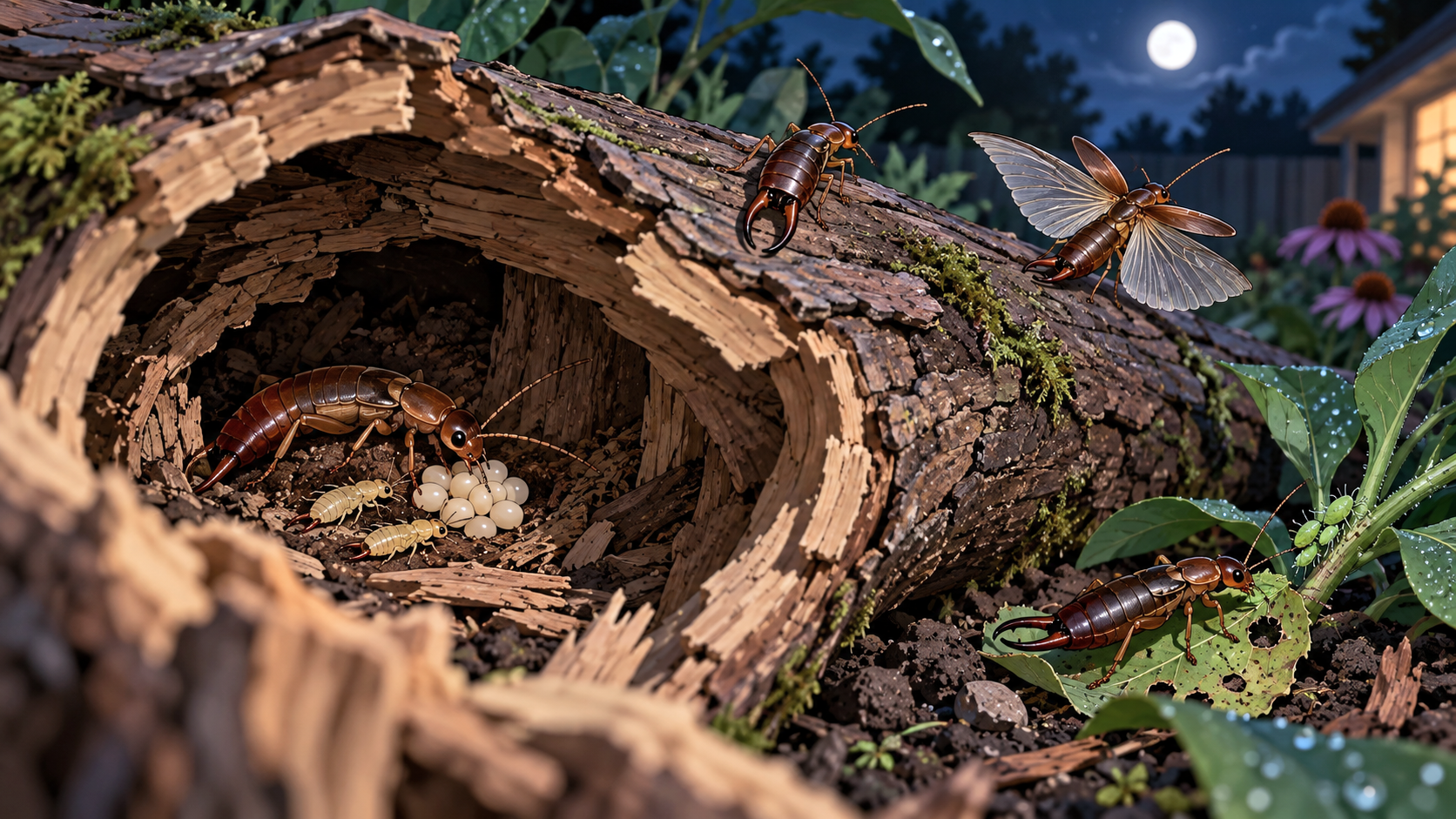
Earwigs are much stranger than the pincers on their rear suggest. They can have wings yet rarely fly, mothers actively care for their eggs and young, and some species release foul-smelling defensive secretions. They can also switch roles in a garden, damaging plants in one situation while helping control other pests in another.
Most of the familiar facts about household earwigs refer to the European earwig, Forficula auricularia. It has become widespread well beyond its original range and is one of the species people most often encounter around homes and gardens. However, earwigs form an entire insect order, so not every species behaves exactly the same way.
Earwig Facts That Explain Their Strange Appearance
The most recognizable earwig feature is the pair of forceps at the end of the abdomen. These structures are modified cerci rather than stingers. Earwigs use their forceps for defense and to grasp prey, while their role can extend to courtship and mating. They also provide one of the clearest ways to distinguish adult males from females because male European earwigs usually have more strongly curved forceps. Female forceps are straighter. The details are easier to compare in our guide to what earwig pincers are actually for.
Their name is more dramatic than their actual behavior. “Earwig” developed from an old superstition that the insects crawled into sleeping people’s ears and eventually bored into the brain. That story is false. The myth became so persistent that it survived in the insect’s common name, even though earwigs do not normally seek out human ears. The history behind that name is covered separately in why earwigs are called earwigs.
Their scientific order has an interesting name too. Earwigs belong to Dermaptera, a name referring to their leathery wings. Adults typically have short, somewhat hardened forewings with membranous hind wings folded beneath them. So although an earwig may look wingless at first glance, most species actually have wings but seldom fly. European earwigs in particular rely much more heavily on crawling than flight. That contrast between hidden wings and their mostly ground-based lifestyle makes earwig flight more interesting than their appearance initially suggests.
Earwig Mothers Are Remarkably Attentive
Parental care is one of the most striking parts of earwig biology. Female European earwigs do not simply lay eggs and disappear. After laying a clutch in a soil nest, the mother gathers the eggs together and guards them. She stays with the developing brood during a period when the eggs are especially vulnerable.
The care is active rather than passive. Mothers remove mold and other hazards from their eggs, helping maintain the clutch until hatching. Once the young emerge, maternal protection continues through the earliest nymphal stage. Some young remain associated with the nest until later molts begin moving them toward independent foraging.
That behavior is easy to underestimate if you know earwigs only as insects hiding beneath flowerpots. We think it is probably the single most surprising fact about them. The same insect known for intimidating pincers can spend a substantial part of its reproductive period tending a brood underground. Our article on how earwigs take care of their young follows that relationship in more detail.
Earwigs Can Be Pests and Beneficial Insects at the Same Time
Calling an earwig simply “good” or “bad” misses an important part of its biology. European earwigs are omnivores. They can consume plant material, fungi, decaying organic matter, and other insects, which means their effect changes with what food is available.
In gardens, that creates an unusual tradeoff. Earwigs can damage seedlings, flowers, soft fruits, and other tender plant tissue. At the same time, they can prey on aphids and other small insects. They also consume decaying material. A modest population can therefore participate in biological control and decomposition even though larger numbers may become destructive around susceptible plants.
This is one reason we would not judge every earwig sighting as a garden emergency. Their value depends on what they are eating and whether visible plant damage is occurring. The question is explored more fully in whether earwigs are good or bad for the garden, where their pest and predator roles can be weighed without oversimplifying either side.
Earwigs Communicate by Gathering Around Chemical Cues
Earwigs are frequently discovered packed together beneath boards, pots, bark, or other tight shelters. That clustering is not just a coincidence caused by several insects independently finding the same dark space.
European earwigs can use chemical cues associated with one another. Compounds associated with their exoskeletons and pheromones connected with their feces help attract other earwigs to aggregations. As a result, a hiding place already occupied by earwigs can become attractive to additional individuals.
However, congregation does not make them a colony-forming insect in the same sense as ants or termites. There is no queen-centered worker society running the group. Instead, individuals can simply gather in suitable shelters, particularly places that are dark, tight, and moist. That distinction matters when understanding whether earwigs live in colonies.
Some Earwigs Can Make Themselves Smell Terrible
The pincers are not an earwig’s only defensive option. European earwigs can release a foul-smelling yellow-brown liquid from scent glands. Other earwig species can also produce unpleasant odors, and crushing one may make the smell particularly noticeable.
This helps explain why people occasionally report a distinctive odor after handling or killing earwigs. The smell is not proof that something in the house is rotting, nor does it mean the insect is venomous. It comes from defensive chemistry associated with the insect itself.
The ability fits a broader pattern in earwig defense. An individual can hide in very narrow spaces, use its rear forceps when threatened, and employ chemical defenses as another deterrent. Our guide to why earwigs can smell when killed deals specifically with that unpleasant surprise.
Earwigs Are Built for Life in Tight, Dark Spaces
Earwigs are strongly nocturnal. They spend much of the daylight period concealed in dark, tight, damp shelters and become active after dark. Typical hiding sites include mulch, debris, cracks, spaces beneath pots, and areas where plant material creates a narrow protected gap.
Their body shape suits that lifestyle remarkably well. An earwig is relatively flat and elongated, allowing it to move into crevices that appear too narrow for an insect of its length. That preference for close-fitting shelter also explains why several earwigs can suddenly tumble out when a pot, board, or mat is lifted during the day.
Night activity does not mean they disappear completely in daylight, but it changes when you are most likely to catch them moving around. When you’re trying to confirm that earwigs are responsible for garden damage, nighttime inspection can be far more revealing. Their daily activity pattern is covered separately in whether earwigs are nocturnal.
The European Earwig Is an Immigrant to North America
The European earwig is not native to North America. It originated in Europe and surrounding regions before becoming established on this side of the Atlantic. It was recorded in Seattle in 1907 and subsequently spread across large portions of the continent.
Humans likely helped that expansion. European earwigs hide readily in transported materials, and records describe movement through items such as luggage, cut flowers, automobiles, and bundled materials. An insect that naturally seeks tight hiding spaces is especially well suited to accidental transportation.
Today, the European earwig is so familiar around North American homes that its introduced status is easy to forget. It is also only one member of a much larger group, and identifying every pincer-bearing insect as the European species can lead to mistakes. Starting with what an earwig actually is makes more sense when species identity matters.
Earwigs Grow Without Ever Becoming a Pupa
Earwigs undergo incomplete metamorphosis. A newly hatched earwig is therefore a nymph that already resembles a small version of the adult rather than a completely different larva. European earwigs pass through four nymphal instars, becoming larger and darker as development proceeds.
There is no pupal stage between the nymph and adult. Instead, each molt moves the insect closer to its mature form. By the later nymphal stages, the resemblance to an adult becomes strong enough that an immature earwig can be mistaken for a small mature one.
That gradual transformation differs sharply from insects such as butterflies or beetles, where a larva enters a pupal stage before emerging as a radically different adult. The complete progression is easier to see in the earwig life cycle rather than compressing every developmental detail into a general facts article.
Other Interesting Questions About Earwigs
How many species of earwigs are found in the United States?
At least 22 earwig species have been recorded in the United States, and 12 of those are introduced species. Only a small number commonly become household pests, so the earwig you find around a home represents only a fraction of the group’s diversity.
Do earwigs have stingers?
No. The structures at the rear are cerci, commonly called forceps or pincers. They are mechanical appendages rather than venom-delivering stingers.
Are all earwigs brown?
No. Color differs among species and developmental stages. Even within European earwigs, younger nymphs can appear much lighter than adults. Our guide to earwig colors deals with those variations specifically.
Can earwigs climb?
Yes. Earwigs can climb many surfaces and vegetation, which helps them reach flowers, fruit, foliage, and sheltered hiding sites. How well they handle particularly smooth surfaces is a separate question from their normal climbing ability.
Can an earwig survive for several years?
That is not the normal lifespan of the European earwig. Its life cycle is approximately annual, although seasonal timing and generation patterns vary by climate and population. The distinction between adult survival and the complete lifespan is explained in how long earwigs live.
What These Facts Tell You When You Find an Earwig
The most useful lesson from these facts is that earwigs are more complicated than their pest reputation suggests. A pincer-bearing insect under a flowerpot might be a plant feeder, a predator of other insects, a member of a temporary aggregation, or simply an individual hiding from daylight. Seeing one does not tell you the whole story.
When earwigs are repeatedly appearing around your home or damaging plants, identify what they are actually doing before reacting to the insect itself. That prevents a beneficial or harmless population from being treated as though any earwig automatically represents an infestation.