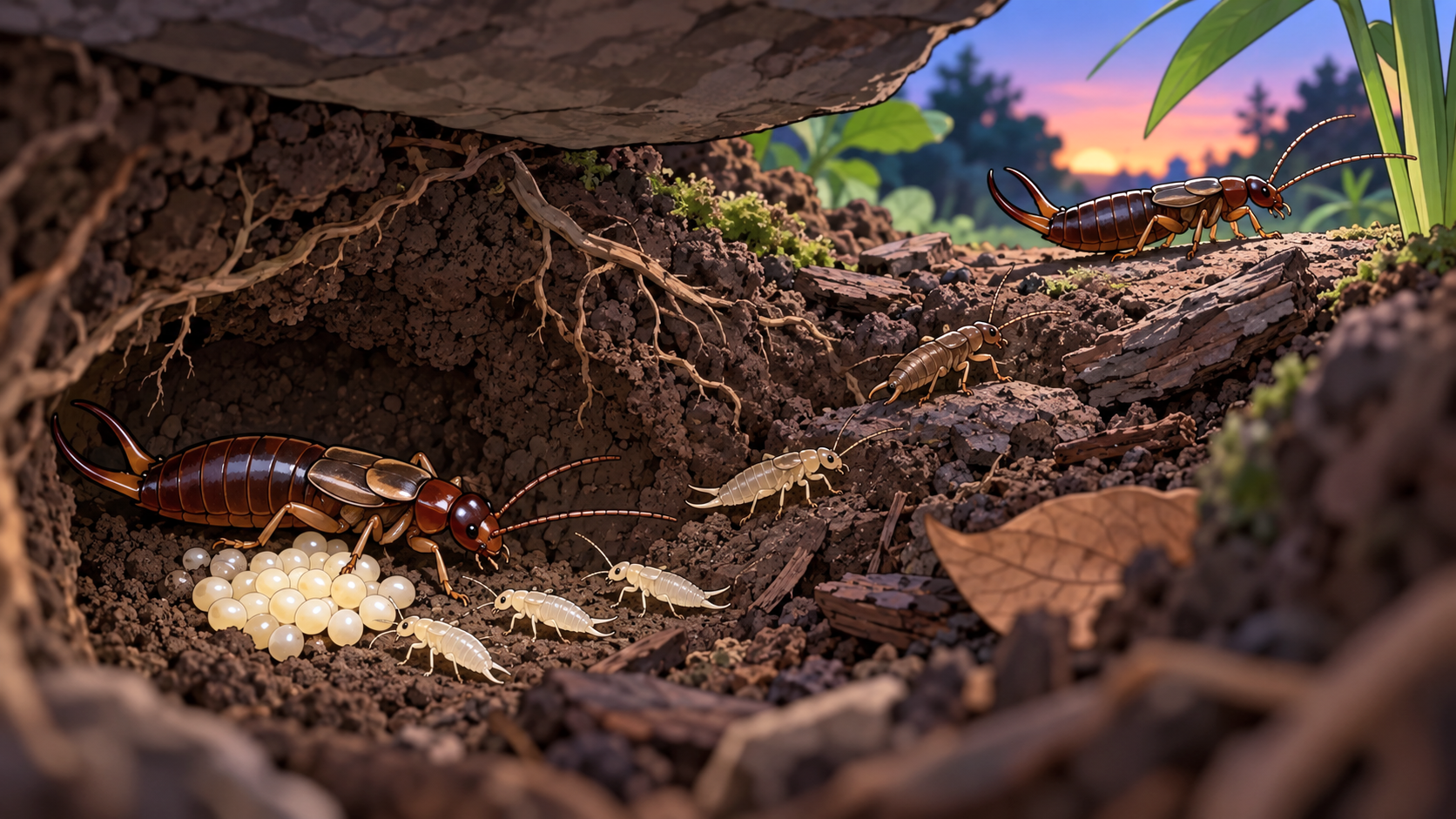
The earwig life cycle has three main forms: egg, nymph, and adult. European earwigs develop through gradual metamorphosis, so there is no caterpillar-like larva or pupal stage. After hatching, a young earwig passes through four nymphal instars, molting between each one, before developing into a sexually mature adult.
What makes the cycle especially unusual is what happens at the beginning. Female European earwigs do not simply deposit their eggs and leave. They stay with the clutch, guard it, tend the eggs, and continue caring for the youngest nymphs. That maternal behavior makes the first part of an earwig’s life very different from what many people expect from a household insect.
The Earwig Life Cycle Starts With Mating
For the European earwig, Forficula auricularia, reproduction begins before the eggs appear. Adults mate in late summer and early fall, after which pairs can establish underground nests. Adults are also the overwintering stage, although the exact seasonal pattern varies with climate and population.
That geographic variation matters. European earwigs do not follow an identical calendar everywhere they occur. Populations in different parts of the United States have documented differences in their seasonal biology, including the number of generations produced in a year. Western populations can produce two or more generations, while other populations commonly follow a single annual generation.
For a homeowner, the useful point is that the sequence stays the same even when the calendar shifts. An earwig still moves from egg to nymph to adult. Temperature, location, and the timing of reproduction determine when those stages appear.
Stage 1: Female Earwigs Lay Their Eggs in a Nest
A female European earwig lays her eggs in a small nest in the soil rather than scattering them across plants or household surfaces. A typical clutch contains about 30 to 50 eggs, although clutch size varies and a female can produce more than one clutch under suitable conditions.
The eggs themselves are tiny. European earwig eggs are about 1 millimeter long, elliptical, and pearly white when first laid. As development progresses, the eggs become larger and darker before they hatch. Our guide to what earwig eggs look like covers their appearance separately.
One mistake is assuming that finding adult earwigs indoors means they must also be laying eggs throughout the house. European earwigs normally reproduce in protected soil nests. Indoor sightings are much more often connected with earwigs wandering in or seeking shelter than with a complete indoor breeding cycle.
The Mother Stays With the Eggs
The egg stage contains one of the most distinctive parts of the entire earwig life cycle. The female remains with her clutch rather than abandoning it after laying. She guards the eggs and tends the nest, protecting them during development.
Maternal care includes keeping the clutch together and maintaining the eggs. Female European earwigs can remove mold and other hazards from the nest, which helps protect the developing embryos. The mother continues guarding the nest until after the young hatch.
We think this is the part of earwig biology that most changes how people see the insect. The adult with enormous-looking rear forceps seems built around aggression, yet the female spends a significant part of reproduction carefully tending a cluster of tiny eggs. Our article on how earwigs care for their young goes deeper into that parental behavior.
How Long Do Earwig Eggs Take to Hatch?
There is no useful single hatch time that applies to every European earwig clutch. Development depends strongly on temperature and on when the eggs were laid. In cooler conditions, development can take considerably longer than it does later in warmer weather.
For example, first-brood eggs in cooler spring conditions can take about 70 days to hatch, while eggs laid later in warmer conditions can hatch in about 20 days. Local seasonal timing therefore matters more than memorizing one universal number.
That temperature effect also explains why published earwig calendars can look different between regions. A northern Utah population, for example, begins egg hatch around mid-May in the local degree-day model. A calendar date from one state should not be treated as a nationwide hatch date.
Stage 2: The First-Instar Nymphs Hatch
When an earwig hatches, it does not emerge as a grub or caterpillar. Instead, it comes out looking like a miniature, less-developed version of the adult. These immature earwigs are called nymphs.
European earwigs have four nymphal instars. An instar is the period between molts. The nymph grows during one instar, sheds its old outer covering, and enters the next. It repeats that process until the fourth nymphal stage finally gives way to adulthood.
Young nymphs are generally lighter than adults and have less-developed adult features. Their rear cerci are slender and relatively straight, which can make a young male difficult to distinguish from a female if age is ignored. The differences are easier to see in our guide to what baby earwigs look like.
The First Nymphs Stay Close to Their Mother
Hatching does not immediately end maternal care. First-instar European earwigs remain in or around the nest with the female, and some second-instar nymphs can remain there as well. The mother continues protecting the young during this early period.
That creates a brief family stage in a life cycle that soon becomes much more independent. First instars remain primarily within the nest, where they are sheltered while still very small. After further development, the nymphs begin moving away to find food for themselves.
This distinction helps make sense of where different life stages are found. The youngest nymphs are closely tied to the nest, whereas older nymphs become increasingly visible in the same outdoor habitats used by adults.
Stages 3 to 5: Four Nymphal Instars Lead to Adulthood
The four nymphal instars form most of the visible growth between hatching and adulthood. During each stage, the young earwig becomes larger and more adult-like. European earwig nymphs range from about 4 to 11 millimeters as they develop, so the difference between an early nymph and a nearly mature one can be substantial.
By the second instar, nymphs begin venturing from the nest to forage at night. Third- and fourth-instar nymphs become fully free-foraging insects that live above the soil surface rather than depending on the maternal nest. Their behavior now looks much more like the behavior people associate with adult earwigs.
There is still no pupal stage hiding between the nymph and adult forms. Earwigs undergo incomplete, or gradual, metamorphosis. Each molt moves the nymph another step toward the adult body plan instead of producing a completely different intermediate form.
What Changes as an Earwig Nymph Grows?
Size is the most obvious change, but it isn’t the only one. Nymphs start smaller and lighter than adults, and their adult wings are not yet fully developed. The body gradually takes on the mature form as the insect progresses through successive molts.
The cerci also become more informative with maturity. Juvenile cerci are comparatively straight, whereas adult male European earwigs develop the strongly curved forceps characteristic of their sex. Females retain straighter forceps. That is why attempting to determine whether an earwig is male or female works much better with adults than with small nymphs.
By the final nymphal stage, an earwig can already look remarkably adult-like at first glance. Developmental stage therefore matters whenever size, wings, or pincer shape are being used for identification.
Stage 6: The Final Molt Produces an Adult Earwig
After the fourth nymphal instar, the earwig molts into its adult form. It has now completed the immature portion of the life cycle and has the mature structures associated with an adult European earwig.
Adults are also the reproductive stage. As the season progresses, mature males and females eventually pair, mate, and begin the cycle again. In populations following a single-generation annual pattern, both early and later broods can reach adulthood by late summer, followed by pairing as the season moves toward fall.
An adult no longer grows through additional nymphal instars. From this point onward, the important biological changes involve reproduction, overwintering, and eventually the end of the insect’s lifespan rather than another transformation into a new body form.
Why Earwig Generations Differ Between Regions
A neat January-to-December calendar is tempting, but it would make the earwig life cycle look more universal than it is. Climate and geographic population differences change when mating, egg laying, hatching, nymphal development, and adulthood occur.
That variation becomes particularly clear in the western United States. Western European earwig populations can have two or more generations per year, and their numbers can peak during mid- to late summer. Meanwhile, other documented populations primarily complete one generation annually.
For identification, the exact number of yearly generations matters less than the developmental sequence. Whether a region produces one brood cycle or several, each individual still has to pass through the egg and four nymphal stages before becoming an adult.
What the Life Cycle Tells You About Earwigs Around Your Home
Life stage can explain why the earwigs you find don’t all look identical. A small, pale earwig with straight cerci may simply be an immature nymph rather than a separate species. Likewise, a larger individual with fully developed adult features has already completed its four nymphal molts.
Season also provides context. Numbers often rise as young earwigs leave their protected nests and begin foraging. Later, more adults become visible as nymphs finish development. That doesn’t mean every cluster of differently sized earwigs represents several species.
When you’re trying to identify what you’ve found, first decide whether you’re looking at a nymph or an adult. From there, size, pincer shape, coloration, and other features become much easier to interpret without confusing normal development for a different kind of insect.
More Questions About the Earwig Life Cycle
Do earwigs have a larval stage?
No. Earwigs develop through incomplete metamorphosis, so they hatch as nymphs rather than larvae. The nymph already resembles the basic adult body form and becomes progressively more adult-like through successive molts.
Do earwigs have a pupal stage?
No. There is no cocoon or pupa between the nymph and adult stages. The fourth-instar nymph molts directly into an adult.
Can different earwig life stages be present at the same time?
Yes. Clutches do not all hatch on the same day or necessarily belong to the same brood. As a result, eggs, different nymphal instars, and adults can overlap during parts of the season.
Do adult earwigs survive winter?
European earwigs can overwinter as adults, either in underground nests or protected aggregations above ground. Their overwintering behavior is part of what allows mating adults to bridge one growing season into the reproductive period that begins the next generation.
4 thoughts on “The Earwig Life Cycle: Egg to Adult”