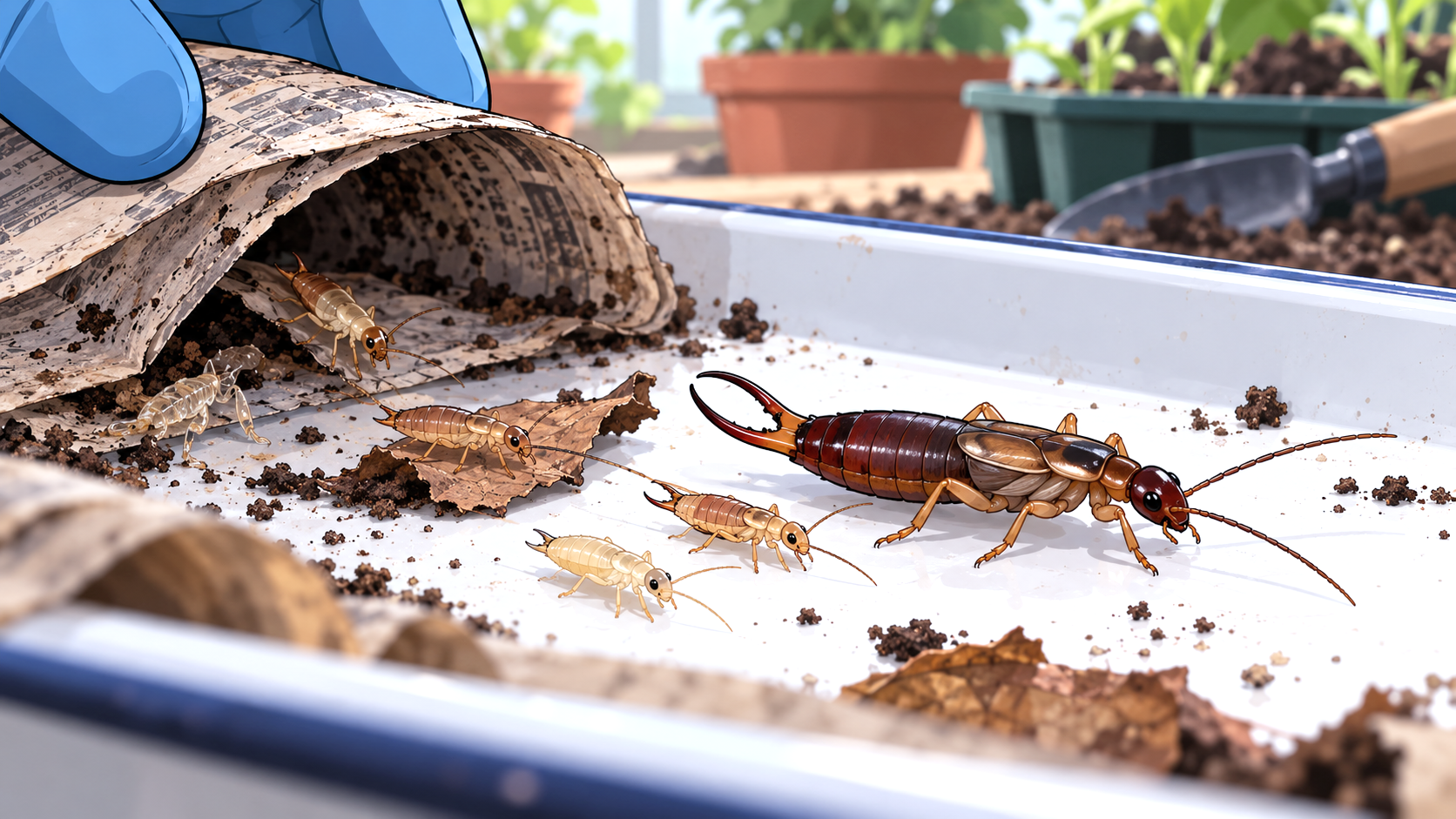
Baby earwigs, called nymphs, look like smaller and usually lighter versions of adult earwigs. They have elongated bodies, six legs, long antennae, and a pair of cerci at the rear. Unlike adults, young nymphs lack developed wings. European earwig nymphs range from gray to light brown and measure about 4 to 11 millimeters as they grow.
That miniature-adult appearance is the easiest way to recognize them. A newly hatched earwig does not look like a worm, grub, or caterpillar. Instead, it already has the basic earwig body shape. The differences become less obvious as the nymph grows, which is why an older baby earwig can easily be mistaken for a small adult.
What Does a Baby Earwig Look Like Up Close?
European earwig (Forficula auricularia) nymphs are gray to light brown and similar in appearance to adults. Their bodies are elongated rather than round, with three pairs of legs and long antennae extending from the head. At the opposite end are the cerci, the paired rear appendages that eventually become the prominent forceps associated with adult earwigs.
Young earwigs are generally lighter than adults. However, color changes as they develop. The earliest nymphs can be very pale, while later stages become darker and increasingly resemble mature earwigs. This makes body shape more dependable than looking for one exact shade of brown. If the insect already has the familiar elongated earwig outline but seems unusually small, pale, and underdeveloped, a nymph is a strong possibility.
How Small Are Baby Earwigs?
European earwig nymphs measure approximately 4 to 11 millimeters long across their four immature stages. That range is fairly broad because “baby earwig” can describe anything from a recently hatched first instar to a fourth instar that is approaching adulthood.
This size difference explains why photographs of earwig nymphs can appear inconsistent. An early nymph may be only a fraction of the size of an adult, while an older nymph can look much closer to adult size. For comparison, adult European earwigs are about 12 to 16 millimeters long. Our guide to how big earwigs get covers adult measurements and the effect the rear forceps can have on perceived size.
We would therefore avoid using small size alone to identify a nymph. The better approach is to combine size with color, wing development, and the shape of the rear cerci.
Newly Hatched Earwigs Can Look Almost White
The youngest earwig nymphs are considerably paler than the dark reddish-brown adults people usually recognize. First-instar European earwigs can appear whitish when they first emerge and remain associated with the soil nest during this earliest stage. After their first molt, they darken and begin looking more like the small gray or light-brown earwigs commonly pictured as nymphs.
That pale appearance can cause confusion if you expect every earwig to be brown. A tiny whitish insect beside a female earwig or near a recently hatched nest does not need adult coloration to be an earwig. Development changes the color considerably.
At the same time, pale color by itself is weak evidence because many tiny arthropods are white or translucent. The elongated body, antennae, legs, cerci, and surrounding context still need to fit. If you found pale oval objects rather than mobile miniature insects, compare them with what earwig eggs look like instead.
Baby Earwigs Have Pincers, but They Look Different
Nymphs already have cerci at the end of the abdomen, so the rear appendages are not something that suddenly appears only when an earwig becomes an adult. However, immature earwigs have slender, relatively straight cerci. The dramatic curved forceps seen on adult males develop with maturity.
This creates one of the easiest identification mistakes to make. An older nymph with straight cerci can resemble an adult female, since female European earwigs also have much straighter forceps than males. Size and wing development become useful supporting clues when the pincer shape alone does not settle the question.
The distinction also explains why you should be careful about trying to determine the sex of a very young earwig. The pronounced adult differences haven’t developed yet. Our male vs. female earwig comparison is most useful once the insect has reached adulthood.
Baby Earwigs Don’t Have Adult Wings Yet
Wing development gives you another way to separate nymphs from adults. Immature earwigs resemble small, wingless adults, while mature earwigs can have wings folded beneath short wing covers. Young European earwigs therefore lack the fully developed wing structures of an adult.
This difference is not always obvious from a quick glance because adult earwig wings are already easy to miss. The visible forewings are short, and the larger hind wings remain folded underneath when not in use. As a result, the absence of obvious large wings does not automatically make an earwig a nymph.
Instead, use wing development alongside the rest of the insect. A very small, light-colored earwig with immature-looking cerci is a much stronger nymph identification than an adult-sized insect that simply doesn’t appear to have wings. Our guide to whether earwigs have wings and can fly covers the adult structures in more detail.
Baby Earwigs Change Through Four Nymphal Stages
European earwigs pass through four nymphal stages, called instars. An instar is the period between two molts. Each time a nymph sheds its outer cuticle, it enters the next stage and moves closer to its adult appearance.
The visual difference between a first instar and a fourth instar can be substantial. Early nymphs are small and pale, whereas later nymphs are larger and darker. Third- and fourth-instar nymphs also live more independently, foraging away from the maternal nest instead of remaining closely associated with their mother.
This gradual change is why there is no single appearance that represents every baby earwig. The nymph develops progressively rather than undergoing one dramatic transformation. If you want the complete sequence rather than identification alone, the earwig life cycle from egg to adult follows all four instars through maturity.
Where You Are Likely to See Earwig Nymphs
The youngest nymphs are closely associated with their mother’s underground nest. First instars remain there through the earliest part of development, while some second instars may still return to the nest. By the third and fourth stages, nymphs forage independently on the soil surface and are much more likely to appear in the places where people encounter ordinary earwig activity.
Like adults, older nymphs seek protected areas and become active outside their hiding places at night. That means you may find several sizes of earwig in the same general outdoor area. Seeing tiny ones beside larger individuals does not automatically mean you have discovered several different species.
Finding nymphs indoors needs similar context. Earwigs can wander into buildings, and a small specimen can do the same. A single nymph inside is not proof that earwigs are reproducing throughout the house.
How to Tell a Baby Earwig From a Small Adult
Start with the combination of size, color, cerci, and wing development. A European earwig nymph is smaller than a mature adult, generally lighter in color, and has slender cerci rather than the fully developed forceps of an adult male. It also lacks mature wings.
The closer a nymph gets to its final molt, the less dramatic some of those differences become. A late-stage nymph can already have the elongated brownish body and unmistakable rear appendages that make you immediately think “earwig.” That is normal because earwigs undergo gradual metamorphosis rather than passing through a completely different larval form.
We would be especially cautious with photographs that show only the back of the insect. Cerci are an excellent clue, but they make more sense when you can also judge body size and development. A clear overhead photograph showing the entire insect gives you a much better chance of distinguishing a late nymph from an adult.
What to Check When You Find a Tiny Earwig
When you find what appears to be a baby earwig, look at the entire body before focusing on one feature. The strongest match is a small, elongated insect with six legs, long antennae, and paired cerci at the rear. Younger individuals will usually be paler, while older nymphs become darker and more adult-like.
Where you found it can provide another clue. Very young nymphs associated with soil and a female earwig fit the early nesting stage particularly well. Larger nymphs wandering independently are further along in development and may turn up wherever adult earwigs forage and hide.
Most importantly, don’t assume every tiny brown insect with projections at one end is a baby earwig. Several small household arthropods can look confusing at a glance. When the basic body plan does not match, our guide to bugs that look like earwigs is a better place to continue the identification.
Other Questions About Baby Earwigs
Are baby earwigs called larvae?
No. Baby earwigs are nymphs, not larvae. Earwigs undergo incomplete metamorphosis, so the immature insect already resembles the adult body form. Insects with complete metamorphosis pass through a distinct larval stage before pupating, but earwigs do not.
Do baby earwigs stay with their mother?
The youngest European earwig nymphs do. First instars remain in the nest under maternal care, and some second instars maintain an association with it. Later nymphs become independent and forage away from the nest.
Do baby earwigs shed their skin?
Yes. A nymph must molt as it moves from one instar to the next. European earwigs have four nymphal instars, with a molt separating successive stages before the insect reaches adulthood.
Can baby earwigs feed themselves?
Yes, although independence increases as they develop. Second-instar nymphs begin leaving the nest to forage, while third- and fourth-instar nymphs are free-foraging. European earwigs eat both plant and animal material, including small invertebrates and decaying organic matter.
8 thoughts on “What Do Baby Earwigs (Nymphs) Look Like?”