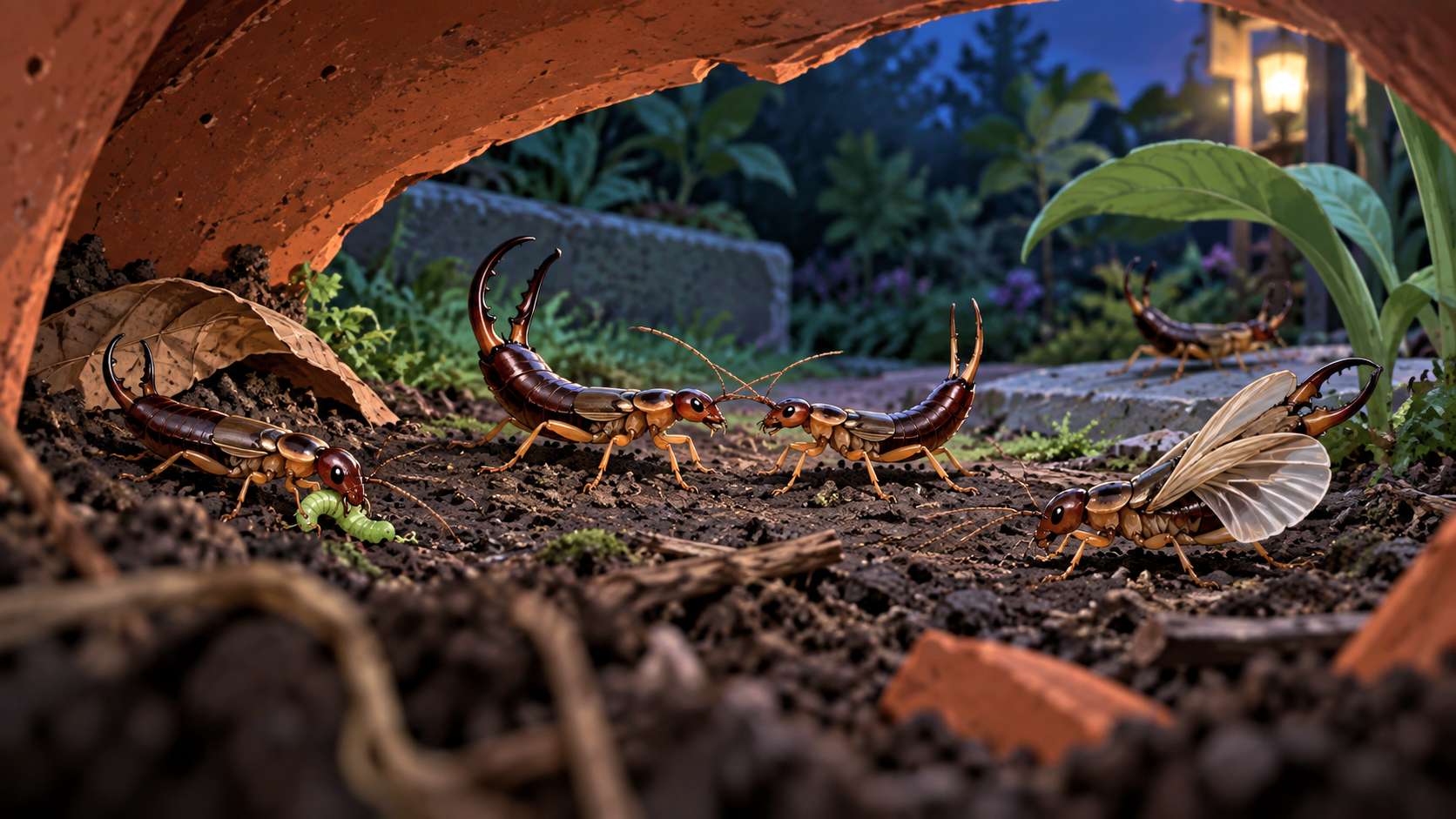
Earwig pincers are multipurpose structures used for defense, catching and holding prey, mating, and competition. Their proper name is cerci, and they sit at the rear of the abdomen rather than near the mouth. Male European earwigs also use their more strongly curved cerci to grasp females during mating and fight rival males.
The pincers may be the most intimidating part of an earwig, but thinking of them simply as weapons misses much of their purpose. They function more like a versatile pair of tools. What an earwig does with them depends on whether it is defending itself, feeding, mating, or interacting with another earwig.
Earwig Pincers Are Actually Called Cerci
The paired structures at the back of an earwig are called cerci. Cerci occur in several groups of insects, but earwigs have one of the most distinctive versions. Their cerci have developed into the forceps-like appendages that make the insect immediately recognizable. They project from the end of the abdomen, which is why describing them as mouthparts would be incorrect.
An earwig’s actual chewing mouthparts are at its head. The cerci are therefore separate structures performing separate jobs at the opposite end of the body. That distinction is useful when identifying an unfamiliar insect because a pair of obvious rear forceps is one of the strongest features covered in our guide to what earwigs look like.
Cerci themselves aren’t unique to earwigs. Other insects have them too, although they can look dramatically different. In earwigs, the modified forceps form is distinctive enough that the structures have become one of the defining visual features of the group.
Earwigs Use Their Pincers to Defend Themselves
Defense is one of the clearest functions of earwig pincers. Earwigs use their forceps as protective weapons, and a threatened insect can curve its abdomen so the forceps face whatever is disturbing it. From the wrong angle, the posture can make the rear of the animal look almost like the business end of a tiny scorpion.
The comparison stops at appearance. Earwig cerci aren’t stingers, and they don’t deliver venom. Their defensive value comes from physically gripping or pinching rather than injecting anything. That difference is worth knowing because the dramatic rear forceps are largely responsible for earwigs looking more dangerous than their anatomy actually makes them.
The behavior also explains why an earwig may suddenly raise or twist its abdomen when disturbed. It isn’t positioning its mouth to attack. It’s bringing its defensive equipment into a useful position.
The Pincers Help Earwigs Catch and Hold Prey
Earwigs don’t use their cerci only when something threatens them. The forceps can also help with feeding. Their cerci are used to grab and hold prey, while the chewing mouthparts at the head handle the actual eating.
That division of labor makes more sense once you remember that earwigs eat more than plant material. They can consume other small organisms and weakened or dead insects, in addition to scavenging and feeding on vegetation. Holding a small food item with the rear forceps gives the earwig another way to control something while feeding.
We think this is one of the more useful details to know about the pincers because it changes how you interpret them. They’re not simply something an earwig deploys in an emergency. They participate in ordinary behaviors that have nothing to do with humans.
Their predatory feeding is also part of the reason earwigs can have a mixed role outdoors. Whether their presence is helpful or damaging depends on what they’re eating, which we cover separately when looking at whether earwigs are good or bad for the garden.
Male Earwigs Use Their Pincers During Mating
For male European earwigs, the cerci also have a reproductive function. Their strongly curved forceps are used to grasp females during mating. This is one reason adult male and female European earwigs can have strikingly different-looking rear ends despite belonging to the same species.
Male forceps are generally thicker and more strongly curved, while female cerci are comparatively straight. Those differences make the pincers one of the easiest features to use when distinguishing adult sexes. Our male vs. female earwig guide covers those identification differences in more detail rather than duplicating them here.
The mating role is also a good reminder that exaggerated-looking insect structures aren’t necessarily built around interactions with predators or humans. Much of their importance may exist entirely within relationships between members of the same species.
Male Earwigs Use Their Pincers in Fights Too
Competition adds another job to the list. Male European earwigs can use their cerci when fighting rival males, so the forceps serve both reproductive and competitive functions.
That behavior gives the larger, more curved male cerci additional purpose beyond grasping a female. Two males confronting each other can use their rear forceps as physical weapons during the encounter. Earwigs can also employ them against other insects.
Male cerci can vary noticeably in form, so we wouldn’t identify an earwig species solely by how large or dramatic its pincers look. The forceps are an excellent identification clue, but body shape, coloration, antennae, wings, and other features should still agree with the identification.
Do Earwigs Use Their Pincers to Hurt People?
People aren’t the reason earwig pincers exist. Cerci function in the insect’s normal life through defense, feeding, mating, and competition. An earwig may use them defensively when restrained or threatened, but that is different from an insect actively seeking people out to attack.
The structures also shouldn’t be confused with venomous equipment. Earwigs don’t have a scorpion-like stinger hidden between the pincers, and the cerci themselves don’t inject venom. When physical contact with the forceps occurs, it is a pinch, not a sting.
That distinction is where this article should stop rather than turning into a second article about human reactions. If you’re specifically concerned about contact with one, whether earwigs bite or pinch explains the behavior, while whether an earwig pinch hurts deals with the separate question of what the experience can feel like.
Why Male and Female Earwig Pincers Look So Different
The contrast between the sexes makes more sense once you understand what the structures do. Both males and females need functional cerci, but male European earwigs also use theirs in reproductive interactions and competition between males. As a result, adult male forceps can be conspicuously curved.
Females retain slimmer, straighter cerci that remain useful for functions such as defense and handling prey. Young earwigs have straighter cerci as well, so a specimen’s rear forceps can provide information about both sex and developmental stage when combined with other features.
This is why “big pincers” shouldn’t automatically be translated as “more dangerous earwig.” Pincer form has much more to do with the insect’s biology than with how threatening it is to a person standing nearby.
What the Pincers Tell You When Identifying an Earwig
Few earwig features are as useful for quick identification as the forceps. A flattened, elongated insect with long antennae and a conspicuous pair of cerci at the rear fits the basic earwig body plan remarkably well. The pincers are therefore worth checking before getting distracted by color or size.
Still, rear projections alone don’t settle an identification. Other insects have appendages extending from the abdomen, and a distant photograph can make unrelated structures look more pincer-like than they really are. Comparing the complete insect against bugs that look like earwigs is safer than identifying something solely because its rear end looks unusual.
So when you see those forceps, don’t think of them as decorative spikes or miniature stingers. They are working structures that help an earwig defend itself, handle food, reproduce, and compete with other earwigs. For such a small insect, that’s a lot of jobs for one pair of appendages.
Other Questions About Earwig Pincers
Do baby earwigs have pincers?
Yes. Earwig nymphs already have cerci and resemble smaller versions of adults, although their bodies and rear structures continue developing as they mature. You can compare the immature stages in our guide to what baby earwigs look like.
Are earwig pincers sharp?
Earwig cerci taper toward their ends and can grip another object or animal. They shouldn’t be thought of as needles, however. Their function depends on closing around or against something rather than piercing it to inject a substance.
Can an earwig move both pincers?
Yes. The paired cerci are movable structures rather than fixed projections on the abdomen. That mobility allows them to function during activities such as grasping prey, defense, mating, and interactions with other earwigs.
Do other insects have cerci?
Yes. Cerci occur in several insect groups, including cockroaches and crickets, but their shape and function differ between groups. Earwigs are distinctive because their cerci form the obvious forceps at the rear of the abdomen.
9 thoughts on “What Are Earwig Pincers Actually For?”