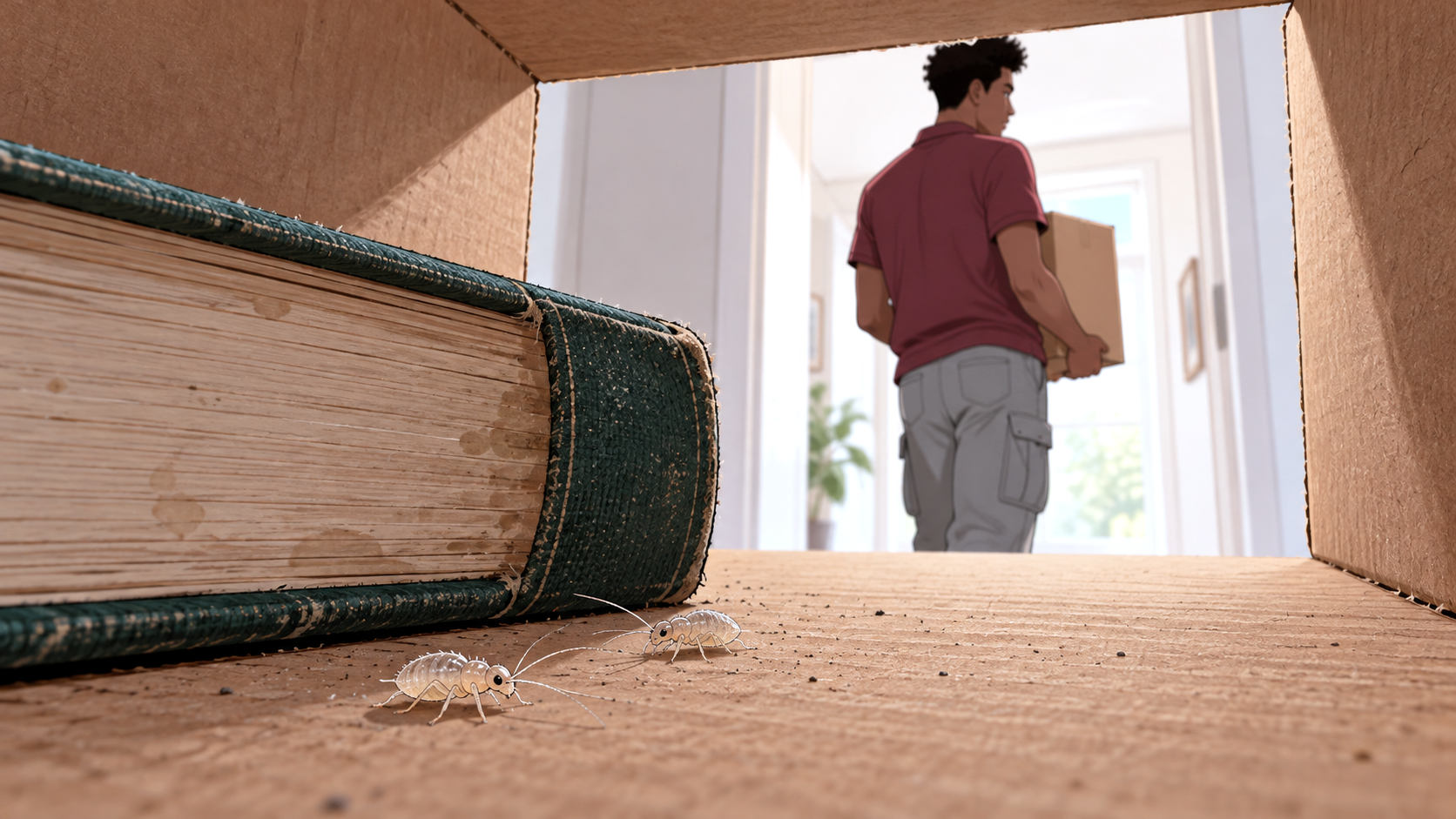
Booklice spread between rooms mainly by crawling through connected parts of a building and being carried on infested objects. Common household booklice are usually wingless, so they do not need to fly from one room to another. Boxes, books, stored foods, shelving contents, wall gaps, plumbing routes, and other connected spaces can all move them beyond the original source.
A Population Can Expand Through the Building Without a Long Journey
Booklice are only about 1 to 2 millimeters long and can use cracks that would be insignificant to larger insects. Once a population develops around a damp cabinet, wall cavity, stack of boxes, or pantry, individuals can crawl beyond that immediate patch and appear along adjoining surfaces. Indoor psocids are commonly found in cracks, crevices, warm cupboards, and other humid protected spaces, so movement does not have to occur across an exposed floor where it would be easy to notice.
A sighting in the next room may therefore represent gradual expansion from an adjacent harborage. Shared baseboards, gaps beneath trim, cabinet voids, flooring edges, and openings around pipes can connect areas that look completely separate from the occupied side of the wall. Their small, flattened body shape makes concealed travel through these narrow routes much more plausible than it would be for a larger pest.
Shared Wall Voids Can Make Two Rooms Part of One Infestation
Rooms divided by drywall are not biologically isolated spaces. Plumbing, electrical boxes, framing cavities, gaps around penetrations, and unfinished openings can create continuous routes behind the visible surfaces. Booklice can reproduce in wall voids when moisture becomes trapped there, and damp cavities can support development until the material itself dries.
This pattern can produce sightings on opposite sides of the same wall. A bathroom and bedroom may share plumbing or framing; a kitchen cabinet may back onto another room; several outlets may open into the same cavity. What looks like an insect repeatedly invading separate rooms may actually be one population emerging from connected concealed space.
Persistent activity around outlets, baseboards, plumbing penetrations, or one section of wall becomes more informative when compared with the usual signs of a booklice infestation. Random insects scattered across unrelated dry rooms suggest a different pattern from repeated sightings along a common structural boundary.
Moving Possessions Can Relocate Booklice Instantly
Human activity can spread booklice farther and faster than crawling. A cardboard box moved from a humid basement to a bedroom can carry insects, nymphs, or eggs in its folds. Books transferred between shelves, paperwork moved from storage, baskets of packaged food, furniture, and other belongings can transport a small population directly into another room.
Cardboard is particularly effective because damp boxes provide both shelter and a surface capable of supporting fungal growth. Household psocids can become troublesome when stored cardboard becomes wet, while the folds and corrugations give tiny insects concealed spaces that are rarely inspected.
Eggs can travel with those items as well. Females place booklice eggs on suitable substrates, so an object does not need to have visibly crawling adults at the moment it is moved to carry a developing population. This makes relocation of infested possessions different from insects independently crossing the entire house.
Pantry Goods Can Carry Them Beyond the Kitchen
Some Liposcelis species are stored-product pests. They occur in grain, packaged foods, warehouses, processing facilities, and households, especially where moisture is elevated. Grain-associated psocids can become abundant in high-moisture stored products and food environments.
An infested package moved from a pantry to another cupboard, utility room, pet-feeding area, or storage space can therefore move booklice with it. Flour, cereals, grains, powdered products, pet food, and packaging are more relevant than the distance between rooms. Once relocated, survival depends on whether the new area supplies suitable humidity and food.
The association between booklice and stored food also means insects found in several kitchen locations should not automatically be interpreted as a population crawling outward from one crack. More than one package or storage point may be involved.
Repeated Sightings in New Rooms Do Not Always Mean the Insects Traveled There
A house can contain several suitable moisture pockets at the same time. A humid bathroom, condensation-prone window, damp basement, and leaking kitchen cabinet may independently support booklice once insects are present in the building. Their strong dependence on elevated humidity determines where a population can persist after movement occurs.
That can make an infestation appear to be advancing room by room when several sites simply became favorable at roughly the same time. New construction provides a clear example. Moisture retained in multiple walls or building materials can allow booklice to appear across different parts of a property without requiring every insect to originate from one visible room. The tendency for booklice to appear in newly built homes often reflects moisture distributed through the structure rather than a single nest expanding outward.
Comparing the timing and location of sightings can help distinguish these patterns. Activity appearing sequentially along adjoining walls favors local movement, while populations emerging in distant humid areas may have separate harborages or may have been transported on belongings.
Common Household Booklice Do Not Need to Fly Between Rooms
Many people assume an insect appearing upstairs or across a hallway must have flown there. Common indoor booklice, particularly Liposcelis species, are typically wingless. Their movement within houses relies much more on crawling and accidental transport.
The broader psocid group does contain winged species, especially outdoor barklice, so whether a particular booklouse has wings depends on the species. Canadian conservation guidance separates the commonly indoor wingless forms from winged psocids that usually live outdoors. A normal household Liposcelis infestation does not require flight to spread through a building.
They also do not jump from room to room. Booklice cannot jump, which further narrows ordinary household spread to crawling, concealed structural movement, and transport with objects.
Dry Rooms Can Interrupt the Spread
Reaching another room does not mean booklice can establish there. Indoor psocids reproduce most successfully under humid conditions, and populations collapse when moisture remains sufficiently low. Humidity below roughly 45% to 50% is generally unfavorable to household psocids, while high humidity supports both the insects and the fungi they commonly consume.
This creates an uneven pattern through a house. Booklice may crawl through a dry hallway but fail to build a population there, then become noticeable again in a humid bathroom or cupboard. Their apparent distribution is therefore shaped by habitat quality rather than distance alone.
Preventing repeated establishment involves removing those favorable pockets. The same moisture-focused measures used to keep booklice from returning to a home also reduce the number of new locations capable of supporting insects that have already dispersed.
Questions About Booklice Spreading Through a House
Can booklice spread through air vents?
They can enter small gaps around ductwork or vents, but common indoor booklice are not strong airborne dispersers. A vent sighting may indicate a nearby humid cavity or structural opening rather than insects being blown systematically through the HVAC system.
Can you carry booklice on your clothes?
An individual booklouse could accidentally ride on clothing after contact with an infested object, but people are not hosts and clothing is not their normal habitat. Boxes, books, papers, food packages, and other materials that provide crevices are more plausible transport vehicles.
Can booklice move upstairs?
Yes. Stairs are not a barrier to such small insects, and possessions, wall cavities, pipe routes, and other building connections can move them between floors. Establishment upstairs still requires suitable conditions.
Does finding booklice in two rooms mean the whole house is infested?
No. Two rooms can share one concealed source, contain separate moisture problems, or have received insects on moved belongings. A whole-house infestation should not be assumed from room count alone.
Can vacuuming one room make booklice spread elsewhere?
Normal vacuuming is more likely to remove exposed insects than drive a population through the house. Spread is better explained by surviving harborages, transported items, connected structural spaces, and favorable humidity elsewhere.
How can you tell which room the spread started from?
The original room is not always recoverable. The most useful clues are the highest insect numbers, presence of adults and baby booklice developing together, damp materials, contaminated food, and structural connections between repeated hotspots.