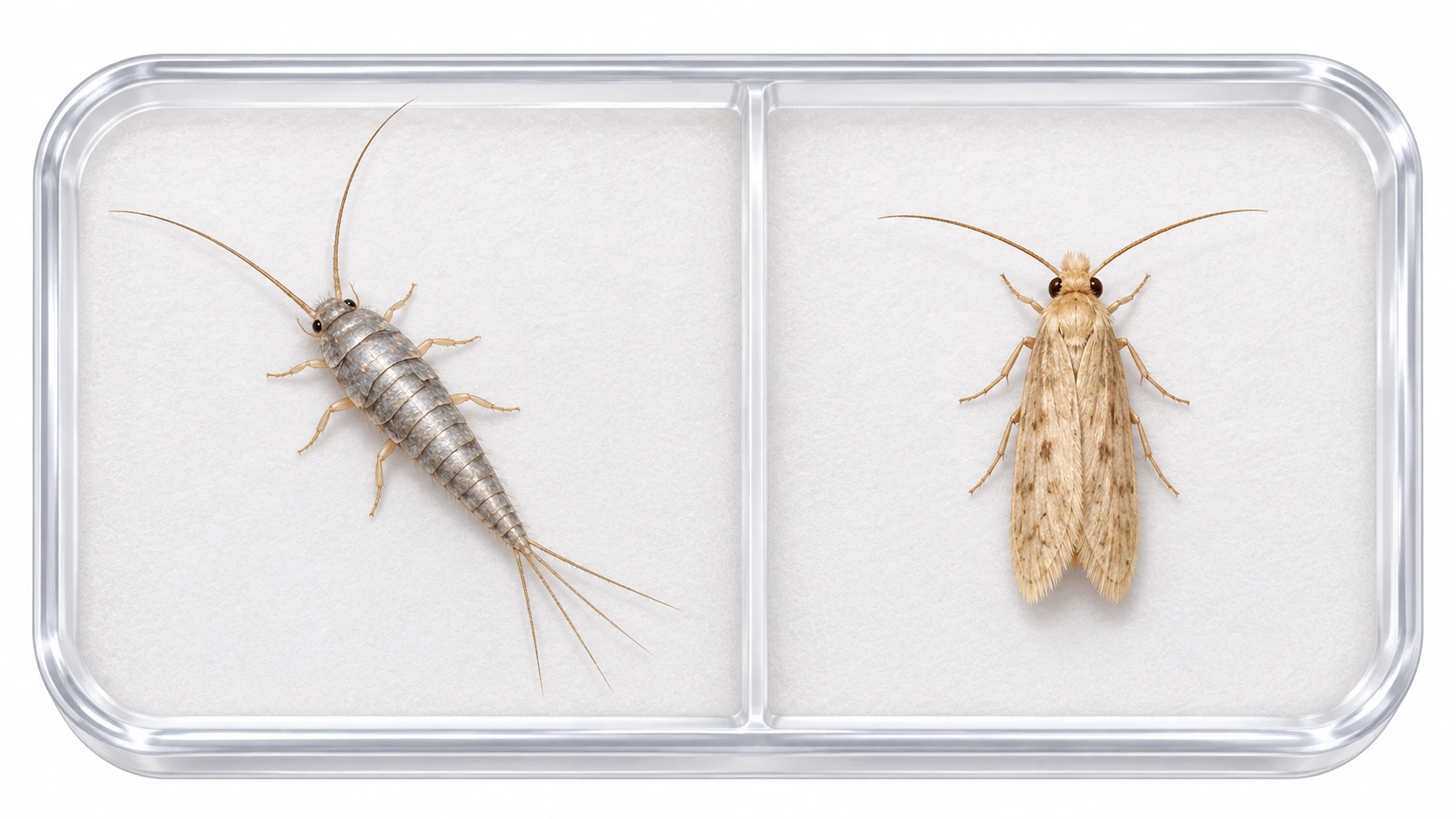
Silverfish and clothes moths can both be found around closets, bookshelves, stored clothing, and other household belongings, but they look completely different when examined closely. Adult silverfish are wingless, elongated insects with three long tail appendages, while adult clothes moths have narrow wings covered in fine scales. Their young are also different: silverfish nymphs resemble tiny wingless adults, whereas clothes moth larvae are pale caterpillars with distinct brown heads.
Silk provides another useful clue. Clothes moth larvae produce silken feeding structures or portable cases, depending on the species. Silverfish do not spin these structures, so webbing or a fabric-covered larval case around damaged clothing points toward moth activity rather than silverfish.
Silverfish vs. Clothes Moths: The Main Differences
The quickest way to distinguish these insects is to examine their wings, body shape, rear appendages, and the evidence left around susceptible materials.
| Identification feature | Silverfish | Clothes moth |
|---|---|---|
| Scientific classification | Order Zygentoma | Order Lepidoptera |
| Adult wings | Completely wingless | Two pairs of wings |
| Adult body shape | Flattened, elongated, carrot-shaped | Small, narrow moth body |
| Adult coloration | Silver, gray, or sometimes darker depending on species | Usually golden, buff, or brownish |
| Antennae | Long and threadlike | Threadlike |
| Rear appendages | Three long tail filaments | No three-pronged silverfish-like tail |
| Young | Small versions of adults | Pale caterpillar-like larvae |
| Larval head | No prominent hard brown caterpillar head capsule | Distinct hardened brown head capsule |
| Silk production | Does not spin feeding webs or portable cases | Larvae produce silk and may construct cases |
| Movement | Runs rapidly and wiggles | Adults flutter; larvae crawl |
| Main textile clue | Insect activity without moth-style silk cases | Larvae, silk, feeding tubes, or portable cases |
The differences are especially clear when an actual insect is available. A silverfish has a recognizable tapered outline and three rear filaments, while a clothes moth has wings and a different body structure.
The Australian Museum’s silverfish identification reference describes the elongated body, long antennae, and three rear filaments that characterize silverfish. The Natural History Museum’s clothes moth identification guide documents the wing and larval differences between the two common household clothes moths.
How to Identify an Adult Silverfish
An adult silverfish is wingless and has a flattened body that gradually narrows toward its rear.
Its body is usually covered in tiny scales that produce a silver or gray sheen. Long antennae extend from the front of its head, while three slender appendages extend from the back.
Those rear appendages consist of two side filaments and a central terminal filament. Together, they give the insect its characteristic three-pronged appearance.
Silverfish are generally around ½ to ¾ inch long as adults, although size varies by species. Their bodies are relatively uniform along their length, tapering toward the rear without the narrow waist or wing structure associated with a moth.
When disturbed, silverfish usually run quickly toward a dark opening or sheltered space. Their movements can appear like a rapid sideways or wiggling motion.
The physical appearance of silverfish provides additional information about their body proportions, coloration, and appendages.
How to Identify an Adult Clothes Moth
Adult clothes moths are small, winged insects with narrow wings held over or along the body when resting.
The webbing clothes moth (Tineola bisselliella) is typically golden or buff-colored. It has reddish-golden hairs around the head and fringed wings.
The case-bearing clothes moth (Tinea pellionella) is another household species. Its wings are generally more brownish and can have small dark markings.
Both are much different in shape from a silverfish. A clothes moth has wings that cover much of its body, while a silverfish has an exposed, elongated abdomen and no wings at any developmental stage.
Adult clothes moths also behave differently. They are relatively weak fliers and often remain near the materials where their larvae are developing. They tend to flutter rather than move rapidly across a floor like a silverfish.
A moth resting on a wall or closet surface can therefore provide an early indication of clothes-moth activity, particularly when larvae or silk are found nearby.
Silverfish Nymphs vs. Clothes Moth Larvae
The immature stages are particularly useful when trying to identify damage inside wardrobes and storage areas.
A young silverfish already resembles the adult form. It has an elongated body, antennae, six legs, and three rear appendages, although its appendages and overall size are smaller.
Very young silverfish may look paler and lack the well-developed scales seen on larger individuals. As they grow, they acquire the more familiar appearance of adult silverfish.
Clothes moth larvae look considerably different. They are soft-bodied, pale caterpillars with segmented bodies and a hardened brown head capsule.
They also have legs adapted for crawling through fabrics and other feeding materials. Their appearance is much closer to a small caterpillar than to a miniature silverfish.
| Feature | Silverfish nymph | Clothes moth larva |
|---|---|---|
| Body shape | Flattened and elongated | Soft, cylindrical, caterpillar-like |
| Head | No distinct dark caterpillar head capsule | Clearly defined brown head capsule |
| Rear end | Three developing tail filaments | No three silverfish-like tail filaments |
| Legs | Six short legs | Thoracic legs and abdominal prolegs |
| Appearance | Smaller version of an adult silverfish | Pale larva with a segmented body |
| Silk | Does not construct feeding tubes or cases | Produces silk for feeding structures or cases |
The strongest clue is the body structure. A silverfish nymph has the same basic outline as its adult, while a clothes moth larva has a distinct caterpillar form.
The Silk Clue: Why Clothes Moth Larvae Leave Webbing Behind
Silk is one of the most useful ways to distinguish clothes moth activity from silverfish activity around textiles.
Clothes moth larvae produce silk as they feed and develop. The exact structure depends on the species.
Webbing clothes moth larvae create silken tunnels or patches on the material they are feeding on. These structures can collect fabric fibers, insect waste, and other debris.
Case-bearing clothes moth larvae construct a portable case from silk and surrounding materials. They carry the case with them as they move and enlarge it while growing.
The case can take on the color of the fibers used in its construction. This can make it difficult to recognize when the surrounding material is already damaged or discolored.
Silverfish do not produce these silken structures. They do not construct portable cases or leave feeding tunnels made from silk.
The UC Integrated Pest Management clothes moth reference describes the differences between webbing and case-bearing clothes moth larvae, including their feeding structures and portable cases.
A small amount of fine webbing around a wool garment should therefore prompt closer inspection for moth larvae, particularly when the material also contains feeding damage.
What Do Silverfish and Clothes Moth Signs Look Like Around Clothing?
The evidence around the insects can be more informative than seeing one adult.
Silverfish and clothes moth larvae can both be associated with stored clothing and textiles, but their characteristic signs differ.
Silverfish-associated evidence may include small feeding marks, discarded scales, shed skins, and damaged material without silken feeding tunnels or portable cases.
Clothes moth-associated evidence may include silken mats, feeding tubes, larvae, attached cases, and small pellets mixed with fabric debris.
Clothes moth larvae can leave irregular holes or surface grazing on susceptible material. They may also produce silk that remains attached to the feeding area.
The presence of one small hole does not automatically confirm either pest. Fabric damage can have several causes, including ordinary wear, other textile pests, and mechanical damage.
The distinguishing signs of silverfish activity are more convincing when several clues occur together rather than when identification relies on one unexplained mark.
Which Insect Is Actually Responsible for Clothing Damage?
Both silverfish and clothes moths can damage susceptible household materials, but the evidence and responsible life stages differ.
For clothes moths, the larvae are responsible for feeding damage. Adult moths do not eat clothing or fabrics.
The larvae feed on materials containing keratin, particularly susceptible animal-derived fibers. Wool, fur, feathers, and certain animal-based materials can support their development.
Silverfish can also feed on susceptible textile materials, particularly when starches, body residues, or other food sources are present. However, their association with clothing does not automatically mean that they are responsible for every hole found in a garment.
A larva, moth case, or silk feeding structure found directly beside damaged fabric is stronger evidence of clothes moth activity than an adult moth seen elsewhere in the room.
Silverfish identification also requires actual insect evidence. A damaged garment alone cannot establish the presence of silverfish.
The separate silverfish and clothing damage assessment examines the materials they can affect and the evidence needed to distinguish feeding from simple hiding.
Where Are Silverfish and Clothes Moths Usually Found?
Both insects can be found around stored household belongings, but their preferred locations and supporting conditions are not identical.
Silverfish occupy a broad range of sheltered indoor spaces. Common silverfish often favor cool, damp locations, while other species, including long-tailed silverfish, can tolerate drier indoor conditions.
They may occur around bathrooms, basements, cupboards, stored paper, and concealed spaces near food sources.
Clothes moth activity is more closely associated with susceptible textiles and materials containing animal fibers. The larvae tend to remain concealed within or close to the material they are feeding on.
Dark, undisturbed storage locations can therefore support clothes moth activity, especially where woolens, fur, or other susceptible possessions remain stored for long periods.
The silverfish hiding-place reference helps explain why discovering one in a closet does not automatically mean that the insect is feeding on clothing.
Can You Tell the Difference From a Single Insect Sighting?
A clear adult specimen usually provides enough physical evidence to distinguish a silverfish from a clothes moth.
A wingless insect with a tapered body, long antennae, and three rear filaments is consistent with a silverfish. A small winged moth with narrow, fringed wings is consistent with an adult moth, although its species may still require closer examination.
Immature insects can be harder to identify from poor photographs. A pale larva without visible head or leg details should not be identified solely from its color.
Likewise, a small moth around a closet does not by itself establish a clothes moth infestation. Other moth species can enter rooms and may be confused with textile moths.
When identification is uncertain, photograph the insect from above and beside a scale reference. A close view of the head, wings, and rear body can provide useful information.
The guide to insects that resemble silverfish is useful when the specimen does not clearly match either pest.
The Features That Set Silverfish and Clothes Moths Apart
The most dependable identification clues are body structure and the presence or absence of silk.
A silverfish remains wingless throughout its development. Its young resemble smaller versions of the adult, and its rear three appendages are visible as it grows.
Clothes moths develop through a caterpillar-like larval stage before becoming winged adults. Their larvae can leave silken feeding structures or carry protective cases made from silk and surrounding fibers.
When you find a pale larva near damaged clothing, look for the brown head capsule, caterpillar shape, and silk before deciding what it is. When you find an elongated wingless insect with three tail filaments, the evidence points toward silverfish.
Those physical clues provide a much more dependable identification than the room where the insect was discovered or the presence of an unexplained hole in clothing.