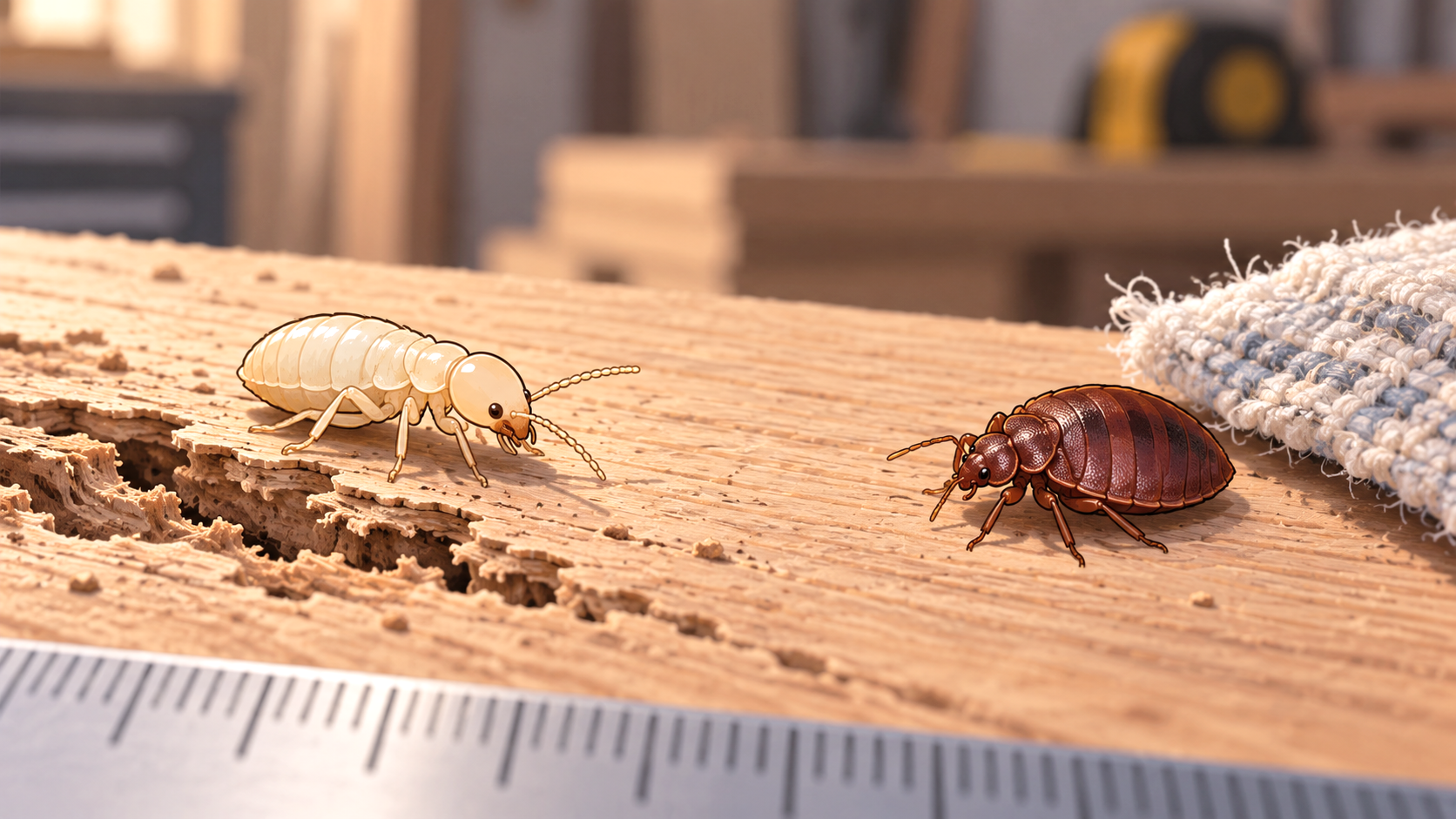
A pile of gritty pellets below a piece of wood and a cluster of black spots along a mattress seam point toward completely different pests. Termites and bed bugs can both remain hidden inside a home, but the evidence they leave behind barely overlaps.
Termites vs bed bugs are easiest to distinguish by what they damage and the signs they leave. Termites consume cellulose and can damage structural wood, while bed bugs feed on blood and do not eat wood. Drywood termite frass forms hard, six-sided pellets, whereas bed bug fecal marks usually appear as dark spots or stains rather than piles of pellets.
Termite Frass and Bed Bug Fecal Spots Look Completely Different
One of the strongest clues appears before you find either insect.
Drywood termites remove waste from their galleries through small openings in infested wood. The resulting frass consists of tiny, hard pellets that can accumulate beneath trim, furniture, windows, doors, or other wooden components.
Under magnification, drywood termite pellets are about 1/32 inch long and have six sides with longitudinal dimples or flutes. Their color can vary with the wood being consumed.
They are sometimes mistaken for sawdust or coarse debris, but actual pellets retain their shape. Another useful clue is texture: drywood termite frass feels gritty when rolled between the fingers.
Bed bug feces do not form comparable piles of hard pellets. They consist largely of digested blood. On mattresses and bed frames, bed bug fecal evidence commonly appears as black spots, while marks deposited on absorbent fabric can soak into the fibers.
So if the mystery material is a collection of tiny, uniform, gritty pellets below wood, drywood termites deserve attention. If you’re finding dark spotting around mattress seams or a bed frame, check for the other signs that confirm bed bugs instead.
Shed Wings Point Toward Termites, Not Bed Bugs
A windowsill covered with loose translucent wings provides a different clue.
Mature termite colonies produce winged reproductive termites called swarmers or alates. After dispersal, these insects shed their wings, so homeowners may discover the wings even when the termites themselves are no longer visible.
With drywood termites, shed wings and termite bodies may turn up around windowsills, light fixtures, and cobwebs. Finding multiple wings indoors warrants closer inspection, particularly when they appear alongside frass or damaged wood.
Bed bugs cannot leave anything comparable because they are wingless throughout their lives. An insect that you actually saw flying is not a bed bug.
A pile of wings alone does not automatically tell you which termite species produced them, either. Termite identification still matters because drywood and subterranean termites differ in where they live and the evidence their colonies produce.
Termites Damage Wood While Bed Bugs Feed on Blood
The most consequential difference is what each insect is doing inside the building.
Termite workers consume cellulose-containing material, including wood. Depending on the termite species, an infestation can damage structural lumber, trim, flooring, furniture, and other wooden components. For example, drywood termites excavate galleries inside sound wood, while subterranean termites typically reach wood from colonies associated with the soil.
Bed bugs have an entirely different food source. They are blood-feeding insects that normally stay close to places where a host remains still long enough for them to feed. They do not consume wood, fabric, mattresses, or the structure itself.
That means a chewed, hollowed, blistered, or internally excavated piece of wood is not bed bug damage. Conversely, recurring bites and the characteristic signs around a sleeping area do not fit a termite infestation.
Termites are also not blood-feeding insects. Soldier termites possess mandibles used to defend their colonies, but termites do not seek people as hosts or produce the recurring nighttime feeding pattern associated with bed bugs.
The Insects Themselves Are Hard to Confuse Once You See Them Clearly
Adult bed bugs are small, flattened, oval insects with six legs and no functional wings. Unfed adults are generally reddish brown, while recently fed individuals become more elongated and swollen.
Termites look very different, but there is no single appearance that describes every termite because colonies contain different castes.
Workers are generally pale, soft-bodied insects. Soldiers are also wingless but have specialized heads and mandibles for colony defense. Reproductive swarmers have wings and are the termites homeowners are most likely to notice around windows or lights during a swarm.
The contrast becomes particularly obvious if wings are present. A winged insect cannot be a bed bug. If the specimen is wingless, however, use several features rather than identifying it from color alone. Our broader bed bug identification guide covers the physical signs that help confirm the insect.
Termite Damage Requires a Different Inspection
Finding suspected termite evidence shifts the inspection away from mattresses and toward the building or wooden item involved.
With drywood termites, piles of six-sided pellets, kick-out holes, shed wings, and damaged wood are useful evidence. Advanced infestations can also leave wood blistered or warped where galleries run beneath the surface.
Subterranean termites leave different signs, particularly shelter tubes constructed between soil and aboveground food sources. That distinction is another reason not to treat every unexplained piece of wood damage as the same termite problem.
We would take suspected structural termite activity seriously rather than trying to identify the full extent of a colony from one pile of debris. Termites live in concealed locations, and determining the extent of drywood termite activity can require an experienced inspection.
A bed bug inspection goes in almost the opposite direction. The initial focus belongs around beds, mattresses, bed frames, upholstered furniture, and nearby cracks and crevices where the insects hide between blood meals.
Finding Frass Doesn’t Necessarily Prove the Colony Is Still Active
This is one of the more useful distinctions in the entire comparison.
Six-sided drywood termite pellets are strong evidence that drywood termites have been present in the wood, but an existing pile does not necessarily establish that the colony is active today. Pellets from a previously treated infestation can remain inside galleries and fall out later when the wood is disturbed or the structure vibrates.
After existing pellets have been removed, new pellets appearing beneath a kick-out hole can indicate continuing activity. Live termites provide stronger confirmation.
That is different from bed bug identification, where fecal spots are only one clue among several. Dark marks alone should prompt an inspection for live bugs, eggs, shed skins, and other evidence rather than being treated as proof by themselves.
Questions About Termites and Bed Bugs
Can termites and bed bugs infest the same home at the same time?
Yes. One infestation does not prevent the other because the pests use completely different resources. A home could have termites feeding on wood while bed bugs occupy a sleeping area.
Can bed bugs leave sawdust around furniture?
No. Bed bugs do not chew or consume wood, so they do not create sawdust. Debris around wooden furniture should be investigated for another cause.
Are all termite droppings six-sided pellets?
No. The distinctive hard, six-sided pellets discussed here are associated with drywood termites. Other termite groups leave different evidence, so the absence of a pellet pile does not rule out termites.
Could old termite frass remain after successful treatment?
Yes. Pellets can remain in galleries and later fall from previously infested wood. New pellets appearing after an area has been cleaned are more informative about possible continuing activity than an undated pile found once.
One thought on “Termites vs. Bed Bugs”