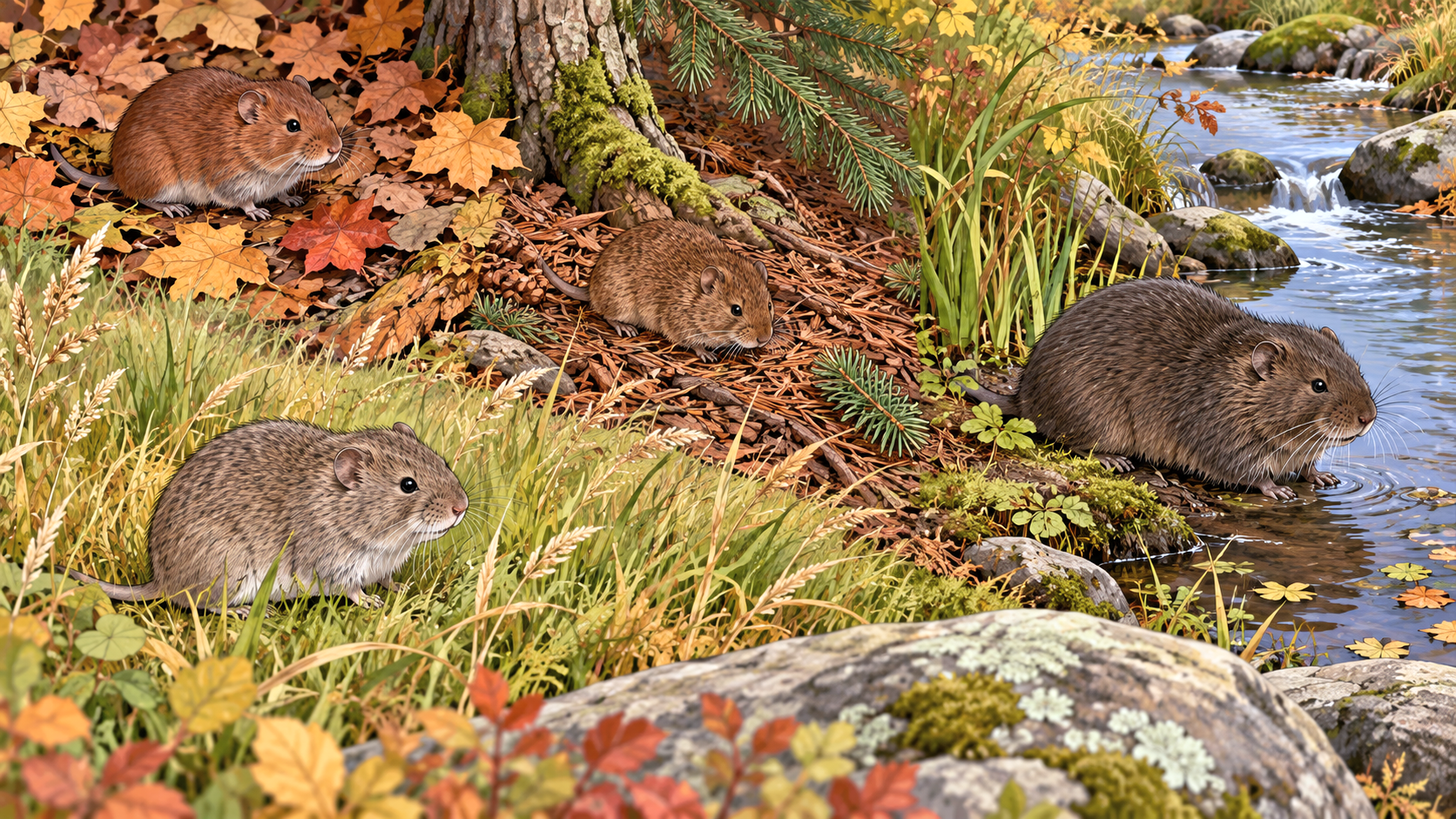
The different types of voles include meadow voles, pine voles, prairie voles, montane voles, California voles, red-backed voles, and water voles. These small rodents occupy grasslands, forests, mountain meadows, wetlands, and agricultural landscapes across North America, Europe, and Asia. Although many resemble one another, their geographic ranges and preferred habitats offer useful clues about which species you might encounter.
The name vole applies to animals belonging to several genera within the subfamily Arvicolinae. The genus Microtus contains many familiar North American species, while red-backed voles and Eurasian water voles belong to other genera. Common names also overlap. A pine vole is the same species as a woodland vole, but the North American water vole and Eurasian water vole are different animals.
Common Voles in North American Yards and Fields
1. Meadow Vole (Microtus pennsylvanicus)
Meadow voles are widespread across northern North America, occurring throughout much of Canada and the northern United States. They occupy grassy fields, pastures, marshes, roadside vegetation, and residential areas with substantial ground cover. Their fur is generally brownish with gray undertones, while their relatively short tails and compact bodies give them the familiar appearance associated with voles.
The species frequently travels through narrow pathways beneath vegetation. Its preference for dense grass means vole runways and trails are particularly relevant when identifying activity in lawns. The meadow vole’s documented geographic range includes extensive northern grasslands and wetlands, although the species also occupies agricultural land and disturbed habitats.
Meadow voles are among the first candidates to consider when a vole appears in a northern yard, but the species’ broad distribution does not eliminate the possibility of other local voles.
2. Woodland Vole or Pine Vole (Microtus pinetorum)
Pine vole and woodland vole are alternative common names for Microtus pinetorum. The species occurs primarily in eastern North America, from parts of the central United States toward the Atlantic coast. Deciduous forests, orchards, gardens, and areas with loose soil provide suitable environments.
Woodland voles are small, with short tails and brown fur that can carry reddish or chestnut tones. Unlike voles strongly associated with surface grass trails, they spend substantial time beneath the soil. Their underground feeding activity makes them especially relevant to orchards, where roots and the lower portions of trees can be damaged.
The woodland vole’s documented habitat and distribution establish its association with eastern forests and shallow underground burrows. Because these animals can occupy some of the same cultivated environments as meadow voles, the differences between pine and meadow voles are particularly relevant where both species occur.
3. Prairie Vole (Microtus ochrogaster)
Prairie voles inhabit central North America, including portions of southern Canada, the Great Plains, and the central United States. They favor grasslands, pastures, fields, and other environments containing protective vegetation, often occupying somewhat drier sites than meadow voles.
Their coats are generally grizzled brown, sometimes with yellowish or tan underparts. The scientific name ochrogaster refers to the yellowish belly associated with the species. Prairie voles also differ from many other voles in their social organization, frequently forming breeding pairs and extended family groups rather than relying entirely on solitary territories.
The prairie vole’s geographic distribution overlaps that of meadow voles in parts of central North America. Their differing habitat preferences and external features make meadow voles and prairie voles a particularly relevant identification comparison in those regions.
4. California Vole (Microtus californicus)
California voles occur along the Pacific coast from central Oregon through California into northern Baja California, Mexico. Their habitats include grasslands, oak woodlands, chaparral, coastal wetlands, and agricultural areas. They are capable of occupying both damp lowland vegetation and relatively dry grassy hillsides.
Coat coloration varies across their range, from grayish-brown and buff to darker brown. Some coastal populations appear particularly dark, while individuals in drier inland environments can have reddish tones. California voles also vary geographically in body size.
The California vole’s distribution and habitat preferences make it an important species to consider in western coastal landscapes. However, California supports other vole species, including montane and long-tailed voles, so finding a vole within the state does not establish that it belongs to M. californicus.
Voles Found in Mountains and the Pacific Northwest
5. Montane Vole (Microtus montanus)
Montane voles occupy much of western North America’s interior mountain regions, including southern British Columbia, the Rocky Mountains, and portions of the Great Basin and southwestern United States. The name reflects their association with mountainous environments, but they also inhabit grassy valleys, agricultural fields, sagebrush communities, and wet meadows.
These voles generally have brownish or grayish fur, with geographic variation in coloration and body dimensions. Their range overlaps with several other western species, particularly in areas where mountain meadows transition into lower-elevation grasslands.
The montane vole’s recognized distribution extends into Arizona and New Mexico, demonstrating that the species is not restricted to northern alpine habitats. Elevation provides useful context, but it is insufficient for identification without geographical and physical evidence.
6. Long-Tailed Vole (Microtus longicaudus)
Long-tailed voles are distributed across western North America, from Alaska and western Canada south through mountainous regions of the United States. They occupy forest edges, shrublands, grassy clearings, streamside vegetation, and mountain meadows.
Their distinguishing characteristic is the relatively long tail, which accounts for a greater proportion of total length than in many other members of Microtus. Their coats are typically grayish-brown, with lighter fur underneath.
The species can occur in both moist and relatively dry environments, so its presence should not be associated exclusively with streambanks. When encountered alongside other western voles, its tail proportions provide useful identification context, although a reliable species identification requires more than one visible characteristic.
7. Townsend’s Vole (Microtus townsendii)
Townsend’s voles inhabit the Pacific Northwest, particularly western British Columbia, Washington, Oregon, and northwestern California. They are associated with moist grasslands, freshwater marshes, coastal wetlands, and other environments supporting dense herbaceous vegetation.
This is one of the larger familiar North American Microtus species. Its fur is typically dark brown, and its comparatively substantial body can help distinguish it from smaller voles found within the same geographic region.
The Townsend’s vole’s coastal distribution is considerably more restricted than that of the meadow vole. A vole found in a wet field near the Pacific coast might belong to either species where their ranges overlap, making precise location and additional characteristics important.
8. Creeping Vole or Oregon Vole (Microtus oregoni)
The creeping vole, also called the Oregon vole, inhabits western North America, particularly forests and forest openings along the Pacific Northwest coast. Its small size and inconspicuous habits make it less familiar to homeowners than meadow or prairie voles.
Its coat is generally dark brown or grayish-brown. Creeping voles often occupy concealed spaces beneath vegetation, forest litter, and fallen woody material, moving through sheltered areas rather than regularly exposing themselves in open grass.
Despite the alternative name Oregon vole, the species is not confined to Oregon. Other voles also inhabit that state, so the geographic name should never be treated as a definitive identification.
Red-Backed Voles of Northern Forests
9. Southern Red-Backed Vole (Clethrionomys gapperi)
The southern red-backed vole occurs throughout substantial portions of Canada’s forests and the northern United States. It inhabits coniferous and mixed woodlands, particularly environments containing fallen logs, moss, roots, and deep leaf litter.
Its characteristic feature is a reddish or chestnut-colored stripe extending along the back, contrasting with grayer fur along the sides. It frequently uses sheltered areas close to the forest floor, including spaces beneath woody debris.
Older publications and many wildlife references identify the species as Myodes gapperi, while current treatments may use Clethrionomys gapperi. These names reflect changes in scientific classification rather than two separate species. The American Society of Mammalogists’ taxonomic database provides a reference for current mammalian names and their taxonomic relationships.
10. Northern Red-Backed Vole (Clethrionomys rutilus)
Northern red-backed voles occur across northern Eurasia, Alaska, and northern Canada. Their habitats include boreal forests, shrublands, and parts of the tundra where protective vegetation is available.
Their grayish coats have a prominent reddish or rusty area across the back. The species shares this general coloration with other red-backed voles, but its distribution reaches farther into northern environments than that of many temperate forest species.
The northern red-backed vole has also been widely listed as Myodes rutilus. Scientific-name differences in older wildlife guides should therefore be interpreted alongside the animal’s geographic range rather than automatically treated as evidence of a different species.
Water Voles in North America and Europe
11. North American Water Vole (Microtus richardsoni)
The North American water vole, also called Richardson’s water vole, inhabits mountainous areas of western North America. Its range includes portions of British Columbia, Alberta, and the western United States, where it occupies streambanks, wet mountain meadows, and habitats associated with flowing water.
This species is larger than many familiar grassland voles and has a strong association with aquatic environments. Its distribution is comparatively localized, making it a less likely identification for a small rodent discovered in an ordinary suburban lawn.
The name water vole introduces potential confusion because the North American species belongs to Microtus, while the familiar European water vole belongs to Arvicola. They are separate animals despite sharing similar common names and waterside habitats.
12. Eurasian Water Vole (Arvicola amphibius)
Eurasian water voles occur across parts of Europe and Asia, including Great Britain. They inhabit rivers, streams, drainage ditches, ponds, marshes, and other wetland environments. Their relatively large bodies, rounded faces, and dense fur distinguish them from many smaller grassland voles.
The species is particularly familiar in Britain, where it is often associated with vegetated riverbanks. Its fur commonly ranges from brown to chestnut, while some individuals, particularly in Scotland, have much darker coats.
The Eurasian water vole’s documented appearance and habitat establish it as a distinct species from its North American namesake. Its waterside habits also create confusion with rats, although the differences between water voles and rats extend beyond their shared use of riverbanks.
Common Voles Found in Britain and Europe
13. Field Vole (Microtus agrestis)
The field vole, also known as the short-tailed vole, is widespread across much of northern and central Europe. In Britain, it commonly inhabits grasslands, heathlands, moorlands, agricultural fields, and grassy woodland edges.
Its fur is usually grayish-brown above and paler underneath. The coat is relatively shaggy compared with that of the bank vole, and the tail is short in proportion to the body.
The European field vole’s habitat and physical characteristics are well documented in British wildlife records. Although it resembles North American meadow voles in both appearance and habitat, Microtus agrestis and Microtus pennsylvanicus are different species.
The alternative name short-tailed vole can also create confusion when used without geographical context. Scientific names provide a more dependable way to identify which animal a wildlife reference describes.
14. Bank Vole (Clethrionomys glareolus)
Bank voles occur across much of Europe, including Britain, where they inhabit woodlands, hedgerows, parks, and gardens. Their coats are generally chestnut-brown with pale underparts, and they have longer tails relative to their bodies than European field voles.
These animals are often encountered around shrubs, fallen vegetation, and woodland edges. They also climb readily and may visit bird-feeding areas, unlike species that spend nearly all their activity close to the ground.
The bank vole’s appearance and habitat make it one of Britain’s more recognizable woodland rodents. The species is also commonly listed under the scientific name Myodes glareolus, reflecting the same taxonomic naming issue found among other red-backed voles.
The differences between field voles and bank voles become particularly useful in British gardens where both species can occur. Their shared presence in vegetated landscapes should not obscure the fact that they occupy different ecological niches and belong to separate genera.
How Vole Common Names Can Mislead Identification
Several vole names suggest a preferred environment without accurately describing the full range of habitats occupied by the species. Pine voles are not restricted to pine forests, montane voles occur outside high mountain meadows, and California voles inhabit several environments beyond ordinary grassland.
Some names are also regional synonyms. Pine vole and woodland vole refer to the same species, while Oregon vole and creeping vole describe another single species. Water vole, by contrast, can refer to different species depending on whether the animal occurs in Europe or North America.
Scientific naming adds a separate complication because classifications change as researchers examine evolutionary relationships. Names such as Myodes and Clethrionomys may appear in different treatments of red-backed voles. A change in genus does not necessarily represent the discovery of another animal.
Readers comparing species should therefore use the scientific name, geographical region, and physical characteristics together. The size differences among vole species and their variations in fur coloration can provide supporting information, but neither measurement nor color is sufficient on its own.
Which Type of Vole Might Be Living on Your Property?
Geography offers the most useful starting point. A vole in a Manitoba grassland has a different set of plausible identities from one found in a California coastal marsh or a British garden. Local mammal records narrow the possibilities before external characteristics are considered.
The surrounding environment provides a second filter. Dense grass favors several species associated with surface runways, while forest litter and fallen logs are characteristic habitats for red-backed voles. Shallow underground activity near orchard trees may indicate woodland voles in eastern North America. The habitat preferences of voles can help narrow the candidate species when the animal’s location is known.
A clear photograph showing the animal’s full body, together with a record of the location, offers a useful basis for identification. Some closely related voles require examination of skull or dental characteristics for dependable species-level identification. Avoid assigning a species solely because a vole appears brown, occupies a particular type of vegetation, or matches a familiar common name.