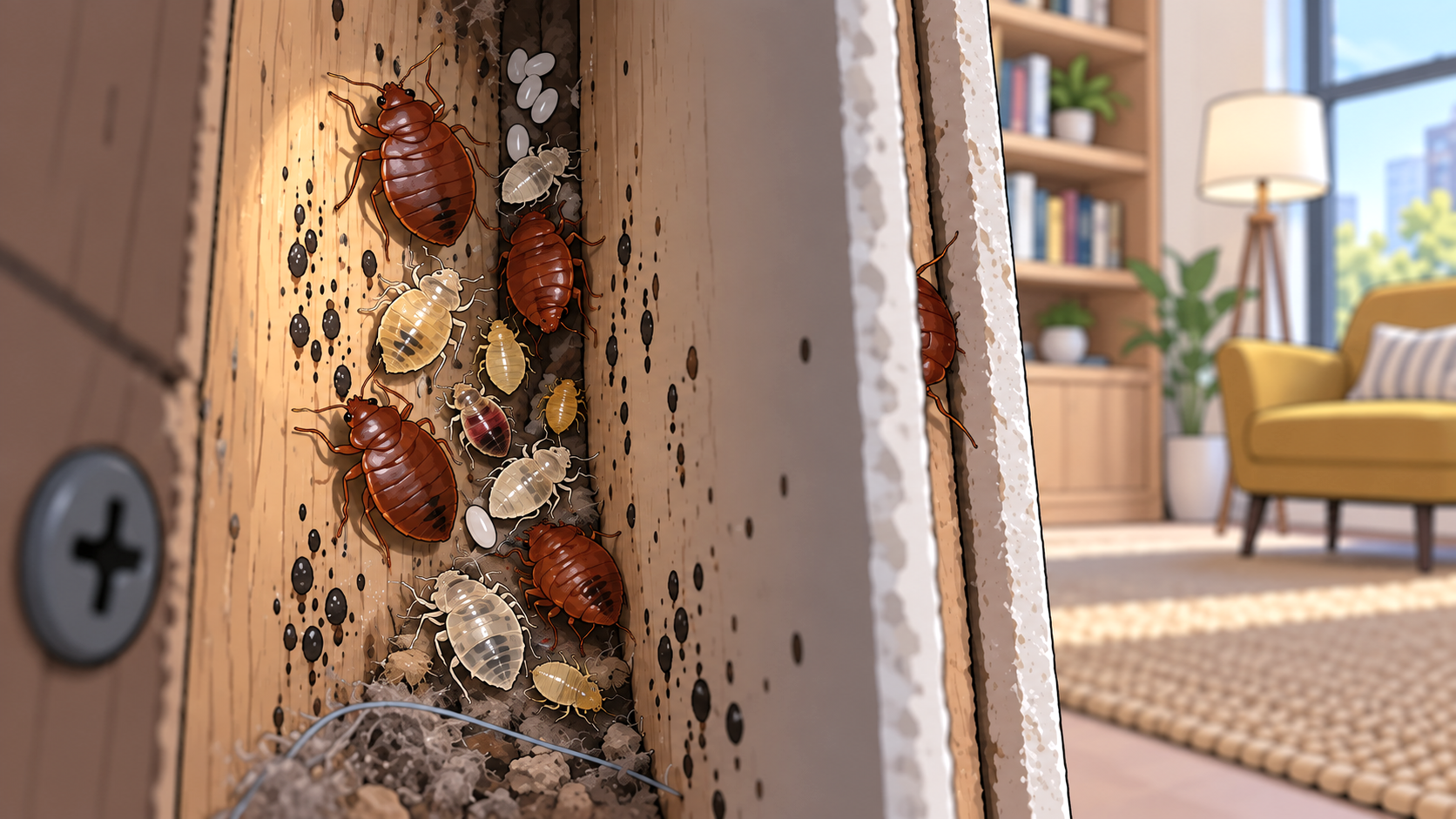
Bed bugs don’t build nests. There is no woven structure, mound, tunnel, or collection of material assembled into a home. What people commonly call a bed bug nest is actually a harborage, an existing crack, seam, crevice, or other protected space where multiple bed bugs gather.
A bed bug “nest” usually looks like a concentrated hiding spot containing live bed bugs, pale eggs, translucent shed skins, and dark fecal spots. Bed bugs don’t construct the site themselves. They settle into existing spaces, often around a mattress, box spring, bed frame, or headboard, and evidence accumulates there as the infestation develops. A heavily used harborage can look messy and unmistakable. A newer one may be nothing more than a narrow furniture joint containing a few bugs and dark spots.
Bed Bugs Have Harborages, Not Nests
The distinction is more than terminology. Bed bugs don’t collect materials or modify their surroundings to construct a nest. Instead, they take advantage of spaces that already exist.
The University of Florida describes bed bugs as concentrating in harborages, including cracks and crevices in walls and furniture, behind wallpaper and wood paneling, and beneath carpeting. A mattress seam can become a harborage. So can a screw hole in a bed frame, a joint behind a headboard, a gap under a baseboard, or a narrow opening inside upholstered furniture. The hiding place itself existed before the bed bugs arrived.
Why Bed Bugs Gather Together
Bed bugs aren’t simply ending up in the same crack by coincidence.
They exhibit aggregation behavior, and chemical cues help them gather and remain in suitable refuges. Research examining bed bug aggregation pheromones has identified multiple chemicals associated with bed bug-exposed harborages that influence this behavior.
That helps explain why an infestation can produce dense pockets of bugs rather than distributing every individual evenly throughout a room.
A suitable harborage also gives them what their flattened bodies are well adapted to use: a narrow, protected space close enough to a host for regular feeding.
What a Bed Bug Harborage Actually Looks Like
The insects themselves are only part of what you may find.
An established harborage can contain adult bed bugs and nymphs of different sizes alongside eggs. Bed bug eggs are tiny, pale, and attached to surfaces rather than gathered inside a constructed egg chamber.
As nymphs grow, they molt five times before adulthood. Their empty shed skins can remain behind in the same protected spaces. Then there are fecal spots. These typically appear as small dark brown to black marks on mattresses, fabric, unfinished wood, and other surfaces around active hiding places.
The EPA’s examples of bed bug hiding places show exactly this kind of accumulation: adults, cast skins, fecal material, and eggs occupying an existing box-spring harborage. Nothing in that collection has been assembled into a structure. It is evidence left behind because many bed bugs have repeatedly used the same hiding place.
Most Bed Bugs Are Usually Found Close to the Bed
If you’re searching for what looks like a bed bug nest, the bed and surrounding furniture deserve the closest attention first.
Current research cited by UC IPM indicates that about 85% of bed bugs are found in or near the bed. Initial inspection should therefore concentrate on the mattress, box spring, bed frame, and headboard.
Check mattress piping, seams, labels, folds, box-spring construction, joints in the bed frame, screw holes, cracks behind the headboard, and nearby furniture.
That 85% figure does not mean bed bugs are restricted to the bed. As an infestation expands, they can occupy increasingly distant harborages. The University of Florida lists hiding places ranging from furniture and mattress seams to baseboards, wall voids, flooring, and electrical outlet covers.
The practical point is to start where the concentration is most likely rather than searching the entire room equally.
A Bed Bug “Nest” Can Be Surprisingly Easy to Miss
A harborage doesn’t have to contain a conspicuous cluster of hundreds of bugs.
Early in an infestation, it may consist of a few insects tucked deep inside a narrow seam or furniture joint. The opening can look completely ordinary from the outside.
This is one reason searching specifically for a “nest” can be misleading. Someone expecting an obvious structure may overlook the actual evidence because there is nothing nest-like about it.
Look instead for the combination of signs associated with bed bug activity: live bugs, eggs, pale shed skins, and dark fecal spotting.
For a broader inspection, checking your home for bed bugs room by room helps narrow the search to the places bed bugs actually use rather than looking for a structure they never build.
Finding One Harborage Doesn’t Mean You’ve Found Them All
A visible concentration of bed bugs may be an important part of an infestation without being its only hiding place.
Bed bugs can occupy multiple cracks and crevices around the same sleeping area. As populations increase, some bugs can disperse into additional furniture, structural gaps, and other protected spaces.
That makes destroying one visible cluster different from eliminating the infestation.
Vacuuming or physically removing bugs from an exposed harborage can reduce the population in that spot, but surrounding areas still need to be inspected. Eggs or bugs hidden deeper inside inaccessible spaces may also remain.
A conspicuous bed bug “nest” is therefore evidence of where part of the population is concentrated, not proof that every bug in the room is sitting in that one location.
Questions About Bed Bug Nests and Harborages
Do bed bugs use webs or silk to make a nest?
No. Bed bugs don’t produce silk or build webs. Any webbing found around suspected bed bug activity came from something else.
Can a bed bug harborage be completely hidden?
Yes. Bed bugs can occupy furniture joints, gaps behind baseboards, spaces behind wall coverings, and other openings that are difficult to inspect directly. You may see evidence around the entrance without being able to see every bug inside.
Can there be several bed bug harborages in one bedroom?
Yes. An infestation does not have to revolve around one central hiding place. Multiple harborages can develop around the bed and elsewhere in the room, particularly as the population increases.
Does finding eggs mean you’ve found the main harborage?
Not necessarily. Eggs attached inside a crack or seam are strong evidence of bed bug activity there, but females can deposit eggs in more than one location. The surrounding bed and furniture still need to be inspected.