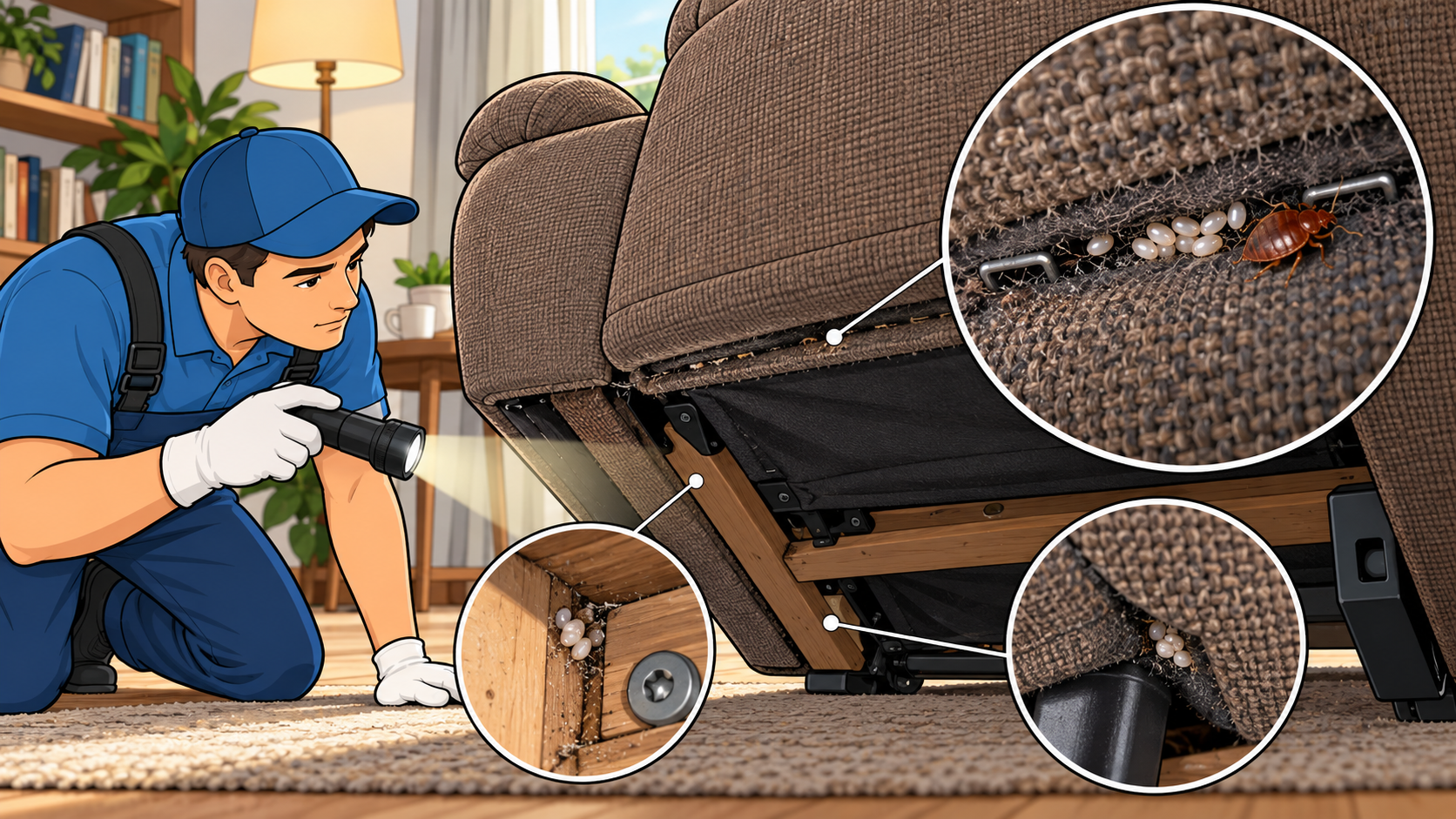
Bed bug eggs are usually found in sheltered cracks and crevices where bed bugs spend time between blood meals. That puts mattress seams, box springs, bed frames, headboards, baseboards, and nearby furniture high on the list. Eggs are not restricted to the bed, though, and a female can lay them in other protected locations if bed bugs establish a harborage there.
Bed bugs usually lay their eggs in protected hiding places close to where people sleep or rest. Common locations include mattress seams, box springs, bed-frame joints, headboards, cracks, and spaces beneath or behind baseboards. The eggs are attached to surfaces rather than simply scattered loose around the room.
If you’re trying to identify what you’ve found rather than locate more of them, what bed bug eggs look like is covered separately.
Bed Bug Eggs Usually Share the Same Hiding Places as the Bugs
Female bed bugs do not need a special nest for their eggs. Instead, they deposit them in sheltered locations that bed bugs already use as harborages.
The CDC lists mattress seams, crevices in box springs, and spaces under baseboards among the sheltered locations where females lay eggs. Those locations make sense because bed bugs generally remain close to hosts while staying concealed between feeding periods.
A bed is therefore an obvious starting point, but not because bed bugs specifically need mattresses for reproduction. The useful features are proximity to a host and access to narrow, protected hiding places.
That distinction matters. A wooden headboard joint, screw hole, furniture seam, or baseboard gap can provide a suitable egg-laying site without involving the mattress at all.
Existing Bed Bug Harborages Carry Chemical Cues
There is another reason bed bugs repeatedly gather in established hiding places.
Bed bugs use an aggregation pheromone that helps draw both adults and nymphs toward shelters. Research identified five volatile compounds that attract bed bugs toward suitable shelters, while histamine acts as a contact arrestant.
Histamine is also present in bed bug feces. Research has found that bed bugs excrete histamine after feeding, with excretion occurring across feeding life stages.
These chemical cues help explain why bed bugs repeatedly occupy established harborages rather than distributing themselves evenly throughout a room.
We would not take the research one step further and say that a female deliberately chooses the location with the strongest pheromone concentration for egg laying. The available studies demonstrate aggregation and sheltering behavior, not a direct ranking of oviposition sites by pheromone strength.
What they do show is that the places where eggs are commonly found overlap strongly with the protected harborages where bed bugs aggregate.
Feeding Changes Which Odors Bed Bugs Follow
Recent research adds an interesting piece to that movement between host and harborage.
A study first published online in 2025 found that fed and unfed bed bugs responded differently to host and aggregation odors. Aggregation odor attracted both groups, but unfed bed bugs showed a stronger preference for host odor when choosing between host and aggregation cues. Recently fed bed bugs, meanwhile, were attracted to aggregation odor and repelled by host odor under several experimental conditions.
That helps explain how bed bugs switch between finding a blood meal and returning to shelter after feeding.
There is an important limitation, however. These experiments used male bed bugs. They provide useful evidence about how feeding status changes orientation toward hosts and harborages, but they did not test where females choose to deposit eggs.
For finding eggs, the practical lesson remains simpler: start with established harborages close to where people regularly sleep or rest.
Start With Mattress Seams, Box Springs and the Bed Frame
The highest-value places to inspect are the narrow protected spaces around the bed.
Mattress seams and piping deserve attention, but the box spring can provide even more concealed spaces around staples, fabric folds, joints, and the internal frame. Headboards and bed frames add screw holes, joints, cracks, and gaps where insects and eggs can remain difficult to see.
These are not the only possibilities. Rutgers Cooperative Extension also lists sofa and chair seams, carpet edges, wall cracks, wood moldings, loose wallpaper, picture frames, switch plates, and other concealed spaces among places bed bugs can hide.
So finding no eggs on the mattress does not rule out an infestation. The mattress is one part of a much larger hiding environment.
If you’re inspecting specifically for evidence around the bed, the signs of bed bugs on a mattress can help distinguish eggs from fecal spotting, shed skins, and live insects.
Eggs Can Be Found Farther From the Bed
As an infestation spreads, bed bugs can occupy harborages beyond the immediate bed area.
That can put eggs behind baseboards, in nearby furniture, along carpet edges, behind wall-mounted objects, or in other protected crevices. Where people routinely sleep somewhere other than a bed, such as a sofa or recliner, harborages can also develop around that resting location.
An isolated female can create another situation entirely. Bed bugs are readily transported in belongings, furniture, luggage, and other objects. A mated female carried into a new location does not need access to the original harborage before she can deposit eggs.
For that reason, the absence of a large aggregation beside a group of eggs does not prove that the eggs are unrelated to bed bugs.
Don’t Stop Searching After You Find the First Egg Cluster
Finding eggs tells you where at least some reproductive activity has occurred, but it does not establish the boundaries of the infestation. Inspect the surrounding cracks, seams, joints, and furniture for live bugs, additional eggs, fecal spotting, and shed skins or casings. Several types of evidence together are much more informative than an isolated egg.
A broader inspection becomes especially important when evidence appears in more than one part of a room. The room-by-room bed bug inspection process covers where to expand the search once you’ve moved beyond the obvious mattress and bed-frame hiding places.
Questions About Where Bed Bugs Lay Eggs
Do bed bugs lay eggs directly on people?
No. Female bed bugs deposit their eggs on surfaces in the environment rather than laying them on a human host. Bed bugs approach people to feed and then return to sheltered locations.
Can bed bugs lay eggs on clothing?
They can potentially deposit eggs on clothing or other belongings if those items remain undisturbed in an infested area, but clothing is not required for egg laying. Protected cracks and crevices around established harborages are more characteristic locations.
Are bed bug eggs loose or attached to the surface?
Bed bug eggs are attached to the substrate with a cement-like material produced by the female. That is why they may remain in seams and crevices instead of simply rolling away when an object is moved.
Can bed bug eggs be behind baseboards?
Yes. The CDC specifically includes spaces under baseboards among sheltered locations where females may lay eggs, so an inspection should not be limited to bedding once there is evidence elsewhere in the room.