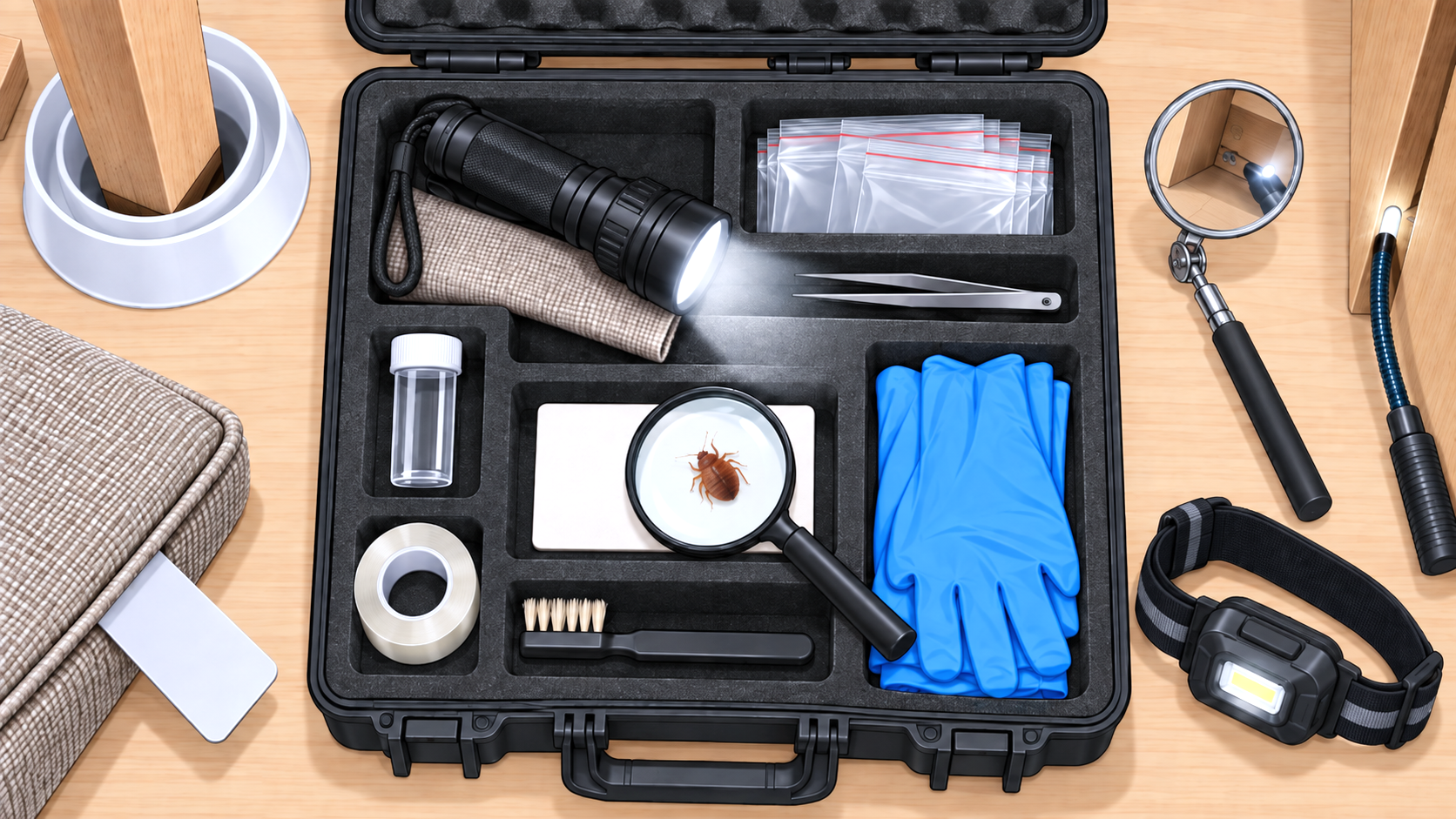
You don’t need expensive equipment to inspect for bed bugs. A flashlight and magnifying glass cover most hands-on inspection needs, while inexpensive interceptor traps can improve your chances of detecting low-level activity over time. More specialized tools, including active monitors and detection dogs, can have legitimate uses, but they aren’t automatically better simply because they cost more.
Flashlight
A bright flashlight is the most useful basic inspection tool because bed bugs commonly hide in dark seams, cracks, joints, folds, and other areas that are difficult to see clearly.
The EPA recommends using a flashlight when inspecting for bed bugs, particularly around mattresses, headboards, and luggage racks. At home, concentrate on mattress piping and seams, the box spring, bed frame, headboard, upholstered furniture, and nearby cracks.
You don’t need a flashlight marketed specifically for pest control. A compact light bright enough to illuminate narrow crevices is sufficient. Using a flashlight during a bed bug inspection is primarily about seeing concealed areas clearly, not buying a specialized type of light.
Magnifying Glass
A hand magnifier is useful when you find something too small to identify confidently with the naked eye.
Bed bug eggs are only about 1 millimeter long, and young nymphs are small and lightly colored. Magnification can help you examine suspicious insects, eggs, shed skins, and other material more closely.
It isn’t essential for every inspection. The EPA notes that adults, nymphs, and eggs can be visible to the naked eye, but a magnifying glass makes examining tiny evidence easier.
A flashlight and magnifier together therefore make a simple, inexpensive inspection kit.
Interceptor Traps
Interceptor traps are particularly useful when visual inspection hasn’t found anything conclusive or when you want to monitor activity over several days.
These pitfall-style devices are normally placed beneath the legs of beds and upholstered furniture. Bed bugs attempting to climb between the furniture and surrounding room can become trapped inside.
Their usefulness is supported by field research. A Rutgers study found that interceptors operated for seven days caught similar numbers of bed bugs as a dry-ice active monitor operated for one day in lightly infested apartments. The interceptors were also more effective than visual inspection at detecting small numbers of bed bugs under the study conditions.
Rutgers Extension consequently describes pitfall-style traps as among the most cost-effective bed bug monitoring tools.
They must be positioned correctly to work as intended. Bed bug interceptor cups are monitoring devices rather than complete treatments for an infestation.
Active Bed Bug Monitors
Active monitors use attractants such as carbon dioxide, heat, chemical lures, or combinations of these cues to draw bed bugs toward a trap.
There is genuine research behind some designs, but performance varies considerably. In the 2011 Rutgers field comparison, a dry-ice CO₂ trap performed better than the two commercial active monitors tested. A later study found that trap design, chemical lures, CO₂ release rate, and the source of CO₂ can all influence monitor performance.
That makes it difficult to judge an active monitor simply by seeing “CO₂” or “bed bug lure” on its packaging. The complete device and how it has been tested matter.
For a homeowner choosing between products, independent performance evidence is more useful than the number of attractants advertised. The same principle applies to at-home bed bug test kits.
UV and Black Lights
A UV flashlight isn’t necessary for a standard bed bug inspection.
The EPA’s inspection guidance focuses on looking for live bugs, eggs and eggshells, shed skins, fecal spots, and reddish stains. It doesn’t recommend ultraviolet fluorescence as a standard method for identifying bed bugs.
A normal flashlight also lets you see the actual colors and physical characteristics of suspicious evidence. If you’re considering a UV device specifically because it claims to reveal otherwise invisible bed bugs, black lights aren’t an established replacement for conventional bed bug inspection.
Professional Bed Bug Detection Dogs
Detection dogs are different from the other tools because you’re hiring a trained dog-and-handler team rather than purchasing an inspection device.
Results can vary substantially between teams. A Rutgers field study evaluated 11 canine teams in naturally infested apartments and found an average detection rate of 44% and an average false-positive rate of 15%. Individual teams varied widely.
Those results don’t mean every canine inspection performs poorly. Controlled studies have produced much higher accuracy under particular conditions. They do show why a dog’s alert shouldn’t automatically be treated as unquestionable proof.
If you’re considering this service, bed bug detection dogs are best understood by looking at both controlled and real-world accuracy research.
What Bed Bug Inspection Tools Do You Actually Need?
For a normal home inspection, start with a bright flashlight. Add a magnifying glass if you want help examining very small evidence. If the initial inspection is inconclusive or you want to monitor for activity over time, properly installed interceptor traps are a well-supported next step.
Active monitors can be useful, but their performance depends on the specific design rather than simply whether they contain CO₂, heat, or a chemical lure. UV lights aren’t necessary for a conventional inspection, while canine detection is a professional service whose accuracy depends on the team and circumstances.
Whatever tools you use, the objective remains the same: find identifiable physical evidence. Live bugs, eggs, shed skins, fecal spotting, and other signs matter more than the price or sophistication of the device used to find them.
Questions About Bed Bug Inspection Tools
Do I need a magnifying glass to see bed bugs?
No. Adult bed bugs and many other signs are visible without magnification. A magnifying glass simply makes small eggs, young nymphs, and questionable specimens easier to examine.
Are bed bug interceptor traps worth using?
Yes, particularly for monitoring low-level activity. Field research supports properly positioned pitfall-style interceptors as useful detection tools.
Should I buy an expensive bed bug detector?
Not necessarily. Some active monitors have research supporting their designs, but higher price doesn’t guarantee better detection. For many homes, a flashlight, careful inspection, and interceptor traps provide a practical starting point.