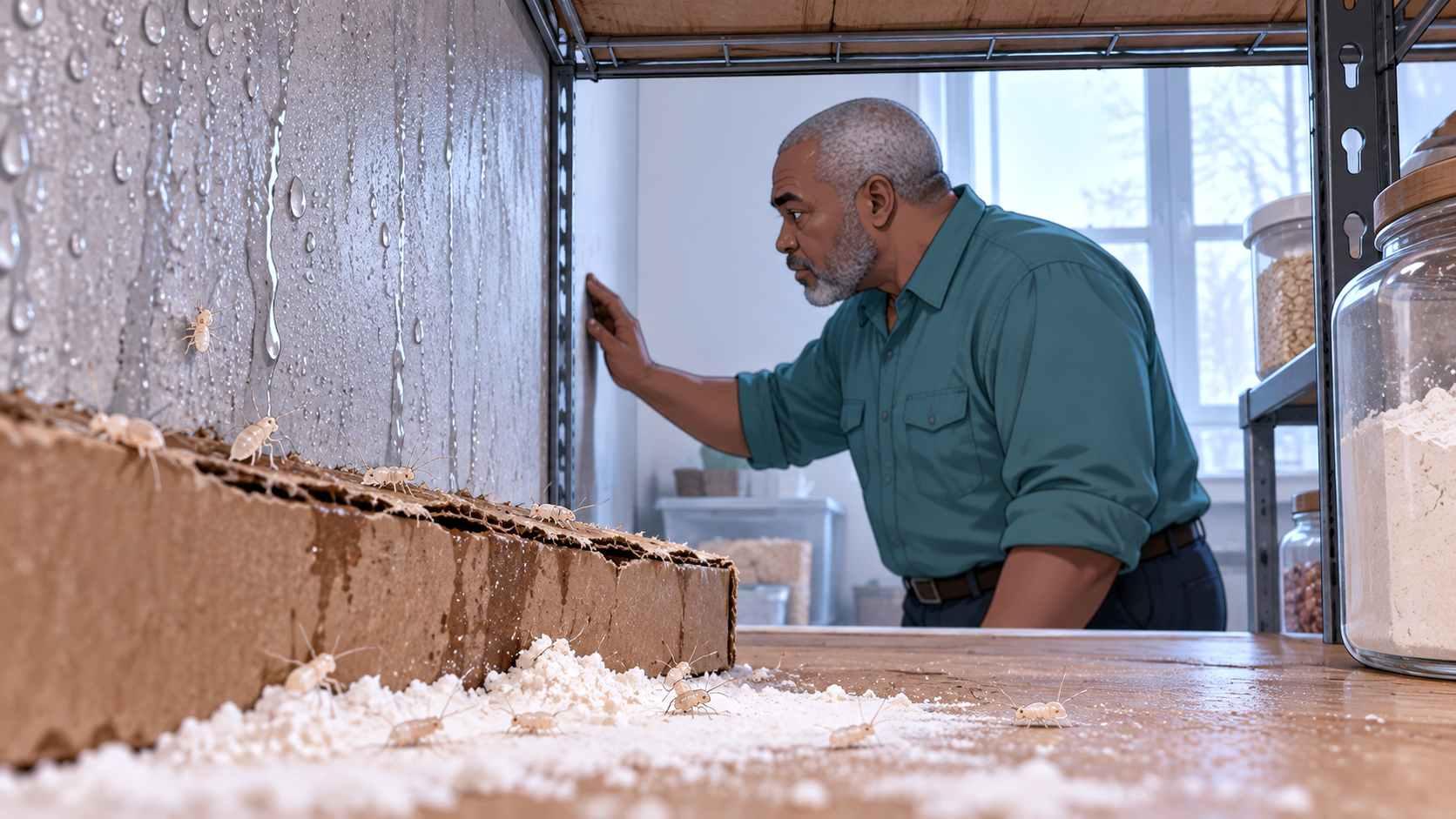
Booklice are not drawn to houses by people, light, blood, or the presence of books alone. A house becomes attractive to booklice when it provides sustained moisture, microscopic fungal food, and protected places where they can survive and reproduce. Damp cardboard, condensation, leaks, humid storage, wet building materials, and moisture-affected foods can all create suitable pockets indoors.
A House Does Not Have to “Attract” Booklice From Outdoors
An indoor infestation often develops because booklice arrive accidentally and then encounter conditions that allow them to remain. Their extremely small size gives them several ordinary ways to reach a property, including infested stored products, cardboard, paper, furnishings, or other transported materials. Some psocids can also move in from outdoors. The separate issue of how booklice get into a house explains the introduction routes, but entry and establishment are not the same event.
A booklouse entering a dry building may disappear without ever creating a noticeable population. The same insect arriving in a warm, damp storage area can encounter enough water and food to reproduce. Household psocids occur especially in damp, warm, undisturbed areas where fungi are growing, and lowering humidity is effective precisely because their ability to persist indoors depends so heavily on moisture. The conditions inside the property determine whether an introduction becomes an infestation.
Persistent Moisture Creates the Most Favorable Houses
Booklice lose water readily and perform poorly in dry environments. Common household species flourish where relative humidity remains high, which is why their dependence on humidity sits at the center of most indoor infestations. Household populations generally cannot persist once humidity remains below roughly 45% to 50%, while damp microhabitats may stay favorable even when a humidity reading taken elsewhere in the room appears acceptable.
The moisture does not need to come from a major flood. Long showers, cooking, indoor clothes drying, poor ventilation, plumbing seepage, roof leaks, wet foundations, and condensation can all add water to a building. Indoor humidity should generally remain below 60%, ideally around 30% to 50% to reduce the likelihood of condensation and fungal growth. A cold exterior wall behind a cabinet, the underside of a windowsill, or a cupboard beside a leaking pipe can consequently support booklice while the visible center of the room feels perfectly normal.
Localized dampness deserves particular attention. A wet wall cavity, condensation behind furniture, moisture beneath vinyl flooring, or a stack of boxes touching a basement floor can create a tiny climate that is much wetter than the surrounding air. Booklice only need the immediate habitat around them to remain suitable.
Dampness Also Produces Much of Their Food
Water benefits booklice twice. It provides the humid environment their bodies require while encouraging fungi to grow on nearby materials. Booklice commonly consume molds and fungal spores, so fungal growth can provide a substantial food source even when there is no thick patch of visible mold.
Microscopic fungi can develop on cardboard, paper, wood, plaster, stored foods, wall surfaces, and other organic materials. Mold spores are already widespread in indoor and outdoor air, and they can begin growing after landing on a sufficiently damp surface. Controlling moisture is therefore the primary way to control indoor mold growth.
A house does not need to look moldy to support booklice. Fungal growth may be microscopic, concealed behind materials, or concentrated in a small moisture pocket. Repeated sightings around one bookshelf, cabinet, window, baseboard, or storage box can reveal such a habitat long before visible mold becomes dramatic.
Cardboard, Paper, and Stored Belongings Become Attractive When They Stay Damp
The association between booklice and books sometimes creates the impression that paper automatically attracts them. Dry paper sitting in a dry room is not especially favorable. Paper products become much more useful to booklice after they absorb moisture, support fungi, or contain suitable starchy materials. Wet cardboard is particularly effective at combining moisture, shelter, and fungal food in one compact space.
Boxes stored directly on basement or garage floors are vulnerable because cardboard readily absorbs surrounding moisture. Closely packed papers, books, and stored belongings can also restrict airflow, allowing localized dampness to linger. The ordinary foods available to booklice extend beyond fungi to certain grains, starches, insect fragments, and other organic material, but those resources become much more useful when the surrounding humidity also permits the insects to survive.
Storage conditions therefore explain why two identical boxes can have completely different outcomes. A box kept dry on raised shelving may remain free of booklice, while one stored against a damp basement wall can develop fungal growth and support a population.
Stored Food Can Create Its Own Booklice Habitat
Flour, cereal, grain, powdered foods, and other dry products can support some booklice species, particularly when moisture increases within the product or packaging. Stored-product psocids are associated with fungi as well as damaged grains and exposed food material, and infestations become more likely in high-moisture commodities with fungal contamination.
A pantry does not attract booklice simply because food exists there. Dry products in intact, tightly closed containers present a very different habitat from damp flour in damaged paper packaging or grain stored under humid conditions. Water intrusion beneath a sink, condensation on pipes, and poorly ventilated cabinets can turn an otherwise ordinary pantry into a suitable environment.
Finding insects inside food also deserves more attention than seeing a stray specimen on a shelf. Booklice can contaminate stored products with insects and waste, so affected food should not be treated as merely a surface moisture problem.
New Houses Can Be Attractive Before the Materials Finish Drying
A recently completed home may provide excellent conditions even when no plumbing leak exists. Concrete, plaster, drywall compound, lumber, paint, and other construction materials can introduce or retain considerable moisture. Closing a building before those materials dry fully can leave humid wall voids and concealed surfaces where fungi develop.
Retained construction moisture is one of the main reasons booklice can suddenly become numerous in newly built homes. Booklice associated with damp buildings may persist until the materials dry, and severely moisture-trapped wall voids may require additional drying rather than repeated insect treatment. Indoor booklice are considered indicators of high humidity or moisture, which makes the building’s drying history especially relevant when infestations begin soon after construction or renovation.
A similar situation can follow water damage. Wallboard, insulation, timber, or flooring may remain damp after the visible surface appears dry. Booklice can continue exploiting those concealed conditions until the affected materials themselves lose enough moisture.
Cleanliness Is Not What Determines Whether Booklice Stay
A meticulously cleaned house can still develop booklice if moisture remains high. Dust and general household dirt are not required for an infestation, and vacuuming more frequently cannot correct condensation inside a wall or fungal growth behind a cabinet.
Likewise, ordinary lighting does not explain a persistent indoor population. Individual insects may end up near windows or visible surfaces, but a house is not being selected because its lights are particularly attractive. People and pets are not attractants either. Booklice do not use humans as hosts, do not feed on blood, and do not establish themselves in hair or animal fur.
A useful inspection instead follows the conditions behind repeated booklice sightings: condensation, leaks, humid rooms, damp cardboard, wet building materials, mold-prone storage, and moisture-affected foods. Those factors explain an established population far better than housekeeping standards.
Questions About What Attracts Booklice
Do houseplants attract booklice?
A healthy plant is not automatically attractive to booklice. Constantly wet potting media, condensation around the pot, decaying organic material, or fungal growth can create a favorable humid pocket around a houseplant, however. The surrounding moisture is more important than the plant itself.
Are booklice attracted to light at night?
Household booklice are not comparable to moths that routinely fly toward lights. Common indoor Liposcelis species are wingless, so lighting does not explain why a population establishes inside a house.
Does keeping lots of books attract booklice?
Not by itself. A dry collection stored under suitable conditions may never support booklice. Books become much more favorable when high humidity allows microscopic fungi to develop on paper, bindings, adhesives, or surrounding shelving.
Can air conditioning make a house less attractive to booklice?
It can help when it reduces indoor humidity. Air conditioning removes moisture as it cools air, although effectiveness depends on the system, climate, operation, and the actual source of dampness. A leaking pipe or wet wall still requires correction even if the room is air-conditioned.
Why do booklice keep returning to the same spot?
Repeated activity usually means that location still provides favorable conditions or lies close to the source. A concealed leak, condensation, damp material, stored food, or fungal growth may remain nearby. Once the environment has supported an infestation, preventing booklice from returning depends more on removing those conditions than on eliminating individual insects.