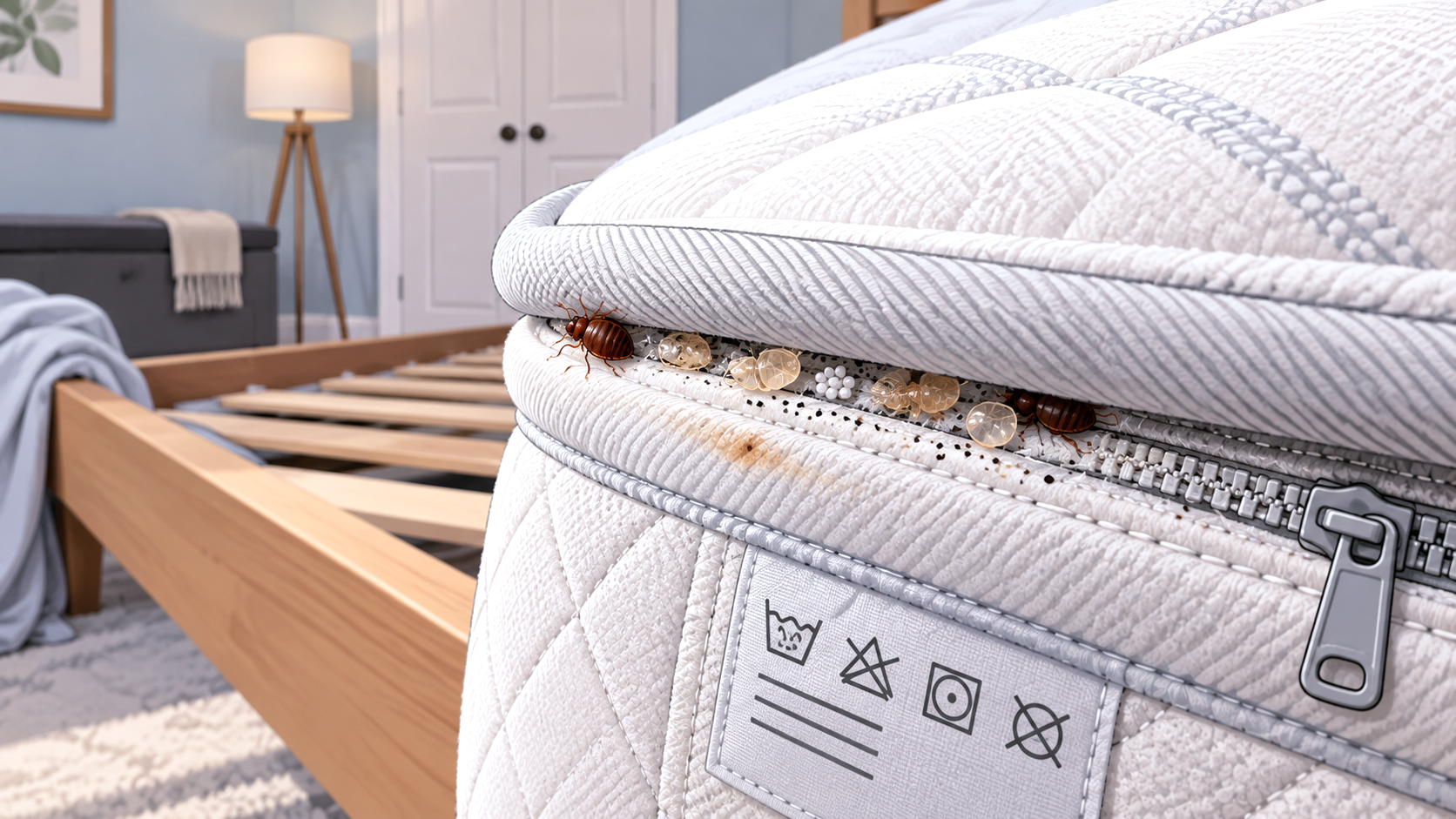
Bed bug signs on a mattress are easiest to find around its edges and structural details, not by simply scanning the open sleeping surface. Seams, piping, labels, folds, and similar sheltered areas give bed bugs the narrow spaces they prefer when they aren’t feeding. The signs themselves can include live bugs, dark fecal spots, pale shed skins, tiny eggs or eggshells, and rusty or reddish stains. Finding several of these together around a mattress seam is much stronger evidence than relying on bites alone.
Check the Seams, Piping and Labels First
The EPA specifically identifies mattress and box-spring piping, seams, and tags as places where bed bugs hide. Bed bugs can flatten themselves into very narrow spaces, so the stitched edges and folds around a mattress provide better shelter than an exposed stretch of fabric.
Run a flashlight slowly along the full perimeter of the mattress rather than looking only at the top. Pay particular attention where piping meets the mattress fabric, around labels and handles, beneath folds, and anywhere stitching creates a narrow recess.
Tufted mattresses deserve the same careful treatment around buttons, depressions, folds, and stitched areas. The relevant feature isn’t the tufting itself but the sheltered gaps it can create.
If you want the complete inspection process rather than just the signs to look for, checking a mattress for bed bugs covers the mattress, box spring, frame, and surrounding bed structure separately.
Dark Spots Are Usually Digested Blood, Not Ordinary Dirt
One of the more recognizable signs is a collection of very dark brown or black spots around a hiding area. Bed bug feces contain digested blood and can soak into absorbent fabric, sometimes producing small ink-like marks rather than loose particles that simply brush away.
The EPA includes dark excrement spots among the physical signs used to identify a possible infestation, alongside live bugs, eggs, shed skins, and rusty or reddish stains.
Fecal spotting can accumulate near places where bed bugs spend time, including mattress seams and nearby harborages. It shouldn’t be assumed that every black speck on a mattress is bed bug waste, though. Our closer look at what bed bug poop looks like covers the characteristics that make fecal spotting more convincing.
Rusty or Reddish Mattress Stains Are a Different Sign
Not every bed bug mark is fecal matter. Rusty or reddish stains can occur when a blood-fed bed bug is crushed against bedding or the mattress.
That distinction matters because people often group every brown, red, or black mattress mark under the same label. Fecal spotting, blood smears, and ordinary household stains can look different once you examine them closely.
Our guide to bed bug stains and smears on sheets deals with those marks separately rather than treating every stain as proof of an infestation.
Shed Skins Can Collect Around Hiding Places
Bed bug nymphs pass through five immature stages before adulthood, shedding their exoskeleton as they grow. Those empty skins can remain behind around mattress seams and other harborages after the live insect has moved elsewhere.
They are pale, translucent versions of a bed bug’s general body shape rather than featureless flakes of material. Several cast skins mixed with fecal spotting or live bugs make a hiding area particularly suspicious.
Because lint, crumbs, insect fragments, and other debris can be mistaken for them, compare anything questionable with what bed bug shed skins and casings look like before treating it as confirmation.
Eggs May Be Tucked Into the Same Protected Areas
Bed bug eggs are tiny, about 1 millimeter long, and are attached to surfaces rather than carried around in an egg sac. On a mattress, that makes narrow protected areas more important to inspect than broad exposed fabric.
Look carefully along stitching, beneath piping, around labels, and inside any accessible fold. A flashlight and magnification can make small eggs much easier to distinguish from lint.
Eggs aren’t restricted to mattresses, either. Females can deposit them in many protected harborages around an infested room, which is covered separately in where bed bugs lay their eggs.
Mattress Color Isn’t a Reliable Shortcut for Inspection
Laboratory research has produced an interesting finding about bed bug color preferences. Experiments with the common bed bug, Cimex lectularius, found that black and red paper harborages were preferred over several lighter-colored alternatives. Researchers cautioned that visual contrast against the white experimental background may have contributed to those results.
Another study using the tropical bed bug, Cimex hemipterus, also found strong responses to red and black artificial harborages compared with white ones, although responses varied with sex, feeding status, and the particular choice test.
Neither experiment tested whether dark piping, labels, or stitching on a real mattress attracts more bed bugs than light-colored versions of those same features. We therefore wouldn’t use mattress color to decide which seams deserve inspection. Check every suitable hiding area regardless of color.
A light-colored mattress or encasement can actually make live bugs and spotting easier for you to see, which is one reason the EPA recommends light-colored bed bug encasements.
Don’t Stop at the Mattress
Finding nothing on the mattress doesn’t clear the bed.
The box spring can provide numerous hiding spaces, particularly around its seams, piping, underside covering, and internal structure. Bed bugs can also hide in cracks and joints in the bed frame and headboard. The EPA specifically includes all of these areas when describing where to inspect around a bed.
That means a clean-looking mattress sitting on an infested box spring or frame can give false reassurance. Inspect the entire sleeping setup before deciding that no physical evidence is present.
Questions About Bed Bug Signs on a Mattress
Can you have bed bugs without seeing anything on your mattress?
Yes. Bed bugs can hide in the box spring, bed frame, headboard, nearby furniture, baseboards, and other cracks around the sleeping area. Low-level infestations can also be difficult to detect, so the absence of obvious mattress signs doesn’t by itself rule them out.
Does one dark spot on a mattress mean bed bugs?
No. A single unidentified mark isn’t enough to confirm an infestation. Look for multiple forms of physical evidence such as characteristic fecal spotting, live bugs, eggs, shed skins, or rusty stains, and identify any insect you find before treating.
Does a mattress encasement stop bed bug signs from appearing?
A bed-bug-proof encasement removes many of the mattress’s hiding places and traps bugs already sealed inside, but bed bugs can still remain on the exterior or establish harborages elsewhere around the bed. The box spring also needs an appropriate encasement if you’re using this approach.
Should you throw away a mattress if you find bed bugs on it?
Not automatically. The EPA specifically advises against panicking and discarding furniture simply because bed bugs are found. Mattresses can often be incorporated into a broader control plan using appropriate treatment and a durable bed-bug-proof encasement.
10 thoughts on “Signs of Bed Bugs on Your Mattress”