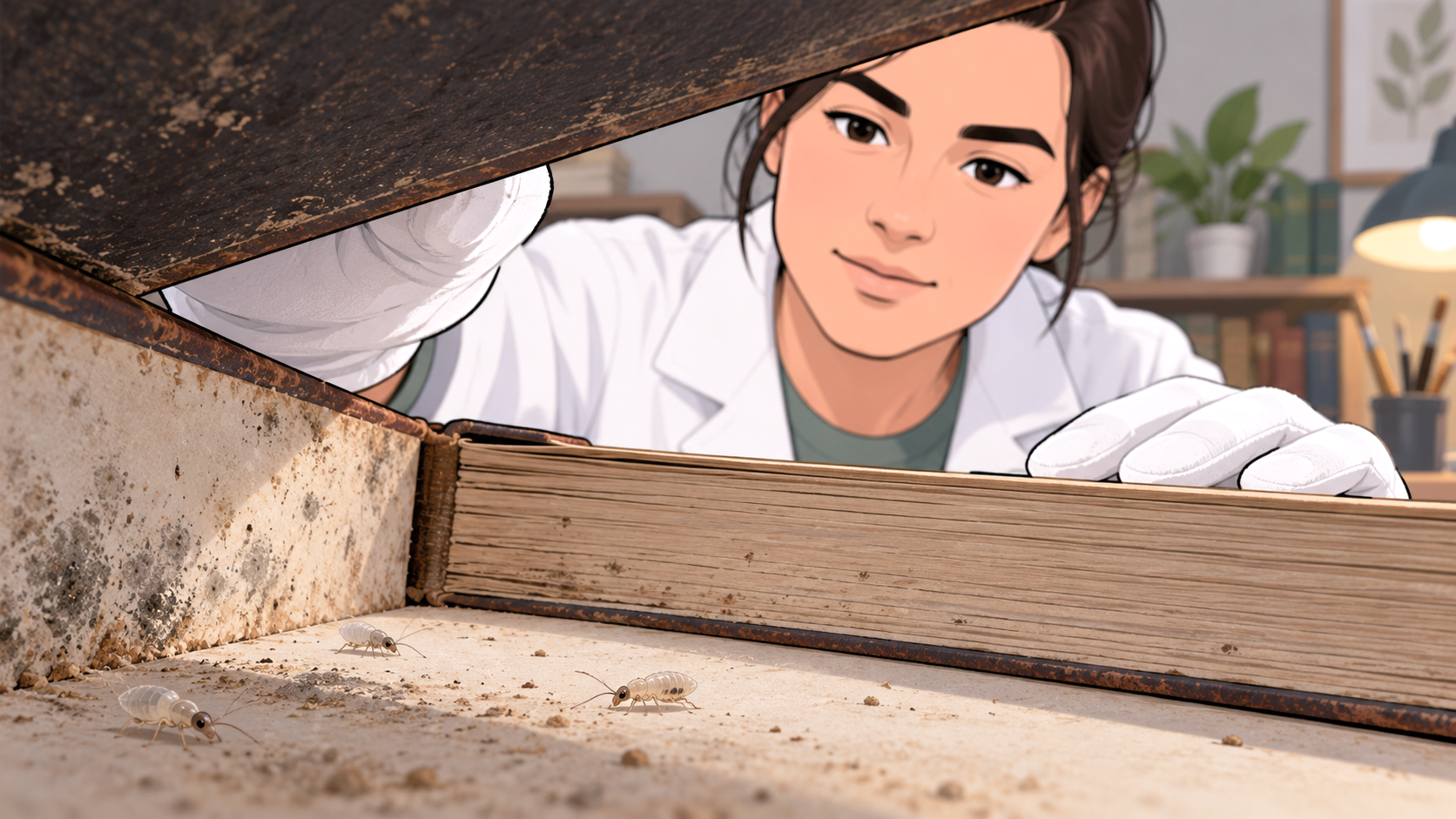
Seeing booklice crawling across a favorite book can make the situation look worse than it usually is. These insects are strongly associated with books and paper, but they are not major paper destroyers. Their main food is microscopic mold and fungi, although they can also graze on some starch-containing materials used in books.
Booklice can cause limited damage to books, particularly by feeding on mold and certain starch-containing materials such as sizing and some traditional bookbinding adhesives. However, they usually cause little direct physical damage. Heavy chewing, large holes, missing sections of pages, or extensive surface loss are more likely to have another cause.
For most household collections, the greater concern is what booklice reveal about the storage environment. A booklice population usually means conditions are humid enough to support the insects and the microscopic fungi they eat, and persistent dampness can damage books even when the booklice themselves cause very little visible injury.
Most Booklice Cause Little Direct Damage to Books
Booklice are usually considered nuisance pests rather than serious destroyers of household property. Common indoor species spend much of their time grazing on microscopic fungi and other suitable food growing on damp surfaces. Books happen to provide plenty of protected spaces where that food can occur.
This is why current household pest guidance describes booklice as rarely damaging inside homes. Another detailed reference goes further and states that booklice do not generally cause direct damage to paper products, fabric, or other non-food household materials because they are primarily feeding on mold growing on those surfaces.
The qualification matters, however, because books are made from more than sheets of plain paper. Bindings, sizing, adhesives, and other components can contain materials that some booklice can graze on. So “booklice never damage books” is too absolute, but treating them as major book-eating pests would be equally misleading.
Booklice Can Feed on Starch in Books
One of the clearest routes to direct book damage involves starch.
Depending on how a book was manufactured, starch-containing materials may occur in bindings, adhesives, or sizing used in connection with the paper. Booklice are capable of feeding on suitable starchy material, including glue associated with bookbindings.
They can also graze on starch sizing in bindings and along page edges. This type of feeding provides a legitimate basis for saying that booklice can damage books, particularly when populations become large and suitable materials are available.
That does not mean every book is equally vulnerable. Modern books can contain very different papers, coatings, and synthetic adhesives from older volumes, and the composition of the material determines whether it provides food. Simply seeing a booklouse on a page does not establish that the insect is eating that page.
They Usually Do Not Eat Holes Through Books
Booklice are surface grazers rather than insects that normally bore or chew large holes through books. Conservation guidance describes their feeding as restricted to surface grazing rather than eating holes in objects.
That distinction is extremely useful when assessing damage. If a book contains deep holes passing through numerous pages, substantial chunks missing from the edges, tunnels through the book block, or severe areas of paper consumption, the visible damage is not characteristic of ordinary booklice feeding.
Other pests can cause much more conspicuous destruction. Silverfish can graze paper surfaces and attack starch-rich materials, while certain beetle larvae can bore through books. Termites can consume cellulose and cause much more extensive destruction when books are accessible to an infestation.
The presence of booklice should therefore never be used as the sole reason to attribute severe damage to them.
What Does Booklice Damage to a Book Look Like?
There is no single dramatic damage pattern that reliably identifies booklice from across the room. When direct feeding occurs, it is associated more with superficial grazing and susceptible starch-containing materials than with deep excavation of the book.
That makes the insects themselves important evidence. If tiny booklice are correctly identified around a damp collection and minor surface grazing is present, booklice become a plausible contributor. If the damage consists of large holes or substantial missing paper, another pest deserves investigation even if a few booklice are also present.
Booklice can create less obvious problems as well. Squashed insects and their waste can stain paper, even when their feeding has not visibly removed much material. Conservation guidance on paper notes that booklice feed on mold spores without usually causing visible feeding damage, while their bodies and excretions can still soil the paper.
For an inexpensive paperback this may be little more than an annoyance. For photographs, manuscripts, archival papers, rare books, or other valuable collections, even minor staining can matter.
Mold May Be Doing More Damage Than the Booklice
A booklice infestation can distract attention from the condition that made the infestation possible.
Booklice thrive under humid conditions that also encourage mold. The insects then feed on the microscopic fungal growth developing on books, cardboard, paper, and surrounding surfaces. In that situation, the booklice are partly a symptom of a damp collection.
Persistent moisture can weaken and discolor paper, encourage mold growth, affect bindings, and create other conservation problems. Paper itself is vulnerable to dampness, and mold can produce permanent staining and deterioration. The fact that booklice are present should therefore encourage an inspection of the storage environment rather than a narrow search for insect feeding marks.
This is why understanding why booklice eat mold is useful when assessing a collection. The insects and fungal growth are often being supported by the same moisture problem.
Booklice Can Be a Warning That Your Books Are Too Damp
A few booklice may cause almost no measurable feeding damage while still providing useful information.
These insects depend heavily on moisture. Large or persistent populations around books indicate that the environment is suitable enough for them to survive and reproduce, which often means the collection is being stored under conditions that are wetter than ideal.
This is particularly important when books are kept in basements, garages, storage rooms, against damp exterior walls, or in tightly packed shelving with poor airflow. Moisture can also be highly localized. A hygrometer in the center of a room may give a reasonable reading while the space behind a bookshelf remains damp because of condensation, a leak, or contact with a cool wall.
For collections, booklice are specifically regarded as a warning sign of excessive dampness. That warning can ultimately be more important than the small amount of material the insects themselves consume.
A Few Booklice Are Unlikely to Ruin a Book
The number of insects matters.
Finding one or two booklice on a book does not mean the volume is being destroyed. Conservation guidance notes that small numbers of psocids on an object are unlikely to pose a significant physical risk, while very large populations are more concerning.
That fits their feeding behavior. A tiny population doing limited surface grazing has very different damage potential from hundreds or thousands of insects continually occupying damp materials.
Their small body size also helps put the risk in perspective. Common indoor booklice are around 1 to 2 millimeters long. They can become extremely numerous, but individual insects are minute.
The sensible response to a few booklice is therefore not to throw the book away. Inspect the book and surrounding collection, confirm the pest, and determine why the area is humid enough to support it.
Large Booklice Populations Deserve More Attention
A heavy infestation changes the calculation because many insects can produce more grazing, contamination, and staining than a few isolated individuals.
Large populations also indicate that reproduction is occurring successfully. Booklice can develop relatively quickly under warm, favorable conditions, so a humid storage area can support overlapping generations rather than a handful of accidental visitors.
The physical damage may still be modest compared with that caused by more destructive paper pests, but allowing a large population to remain around a valuable collection is unnecessary. More importantly, a population that continues growing tells you the underlying environmental problem has not been corrected.
Repeatedly finding adults and booklice nymphs throughout shelving, boxes, and individual volumes is a stronger indication of an established infestation than spotting a single wandering insect.
Booklice Damage Is Different From Silverfish Damage
Silverfish are a much stronger suspect when books show obvious surface damage.
Silverfish feed on starches and carbohydrates in paper products, adhesives, wallpaper, and other materials. Their feeding can roughen surfaces, remove material, and leave irregular damaged areas. Booklice, by comparison, are much smaller surface grazers whose household diet is heavily associated with microscopic fungi.
The insects themselves are also difficult to confuse once viewed properly. Silverfish are much larger, elongated and tapered, with three long appendages projecting from the rear. Booklice have a tiny, softer body, relatively broad head, and long slender antennae.
If a collection has substantial physical damage, identifying whether you have silverfish or booklice can prevent you from treating the wrong pest.
It is also possible for more than one moisture-loving pest to occupy the same environment. Finding booklice does not prove another insect could not be responsible for the actual damage.
Booklice Damage Is Nothing Like Termite Damage
Termites create an even more important distinction because they actually consume cellulose.
A termite infestation can damage books, cardboard, paper, furniture, and structural wood. If books stored near a wall contain extensive feeding damage while nearby wood is also affected, termites require serious consideration.
Booklice do not produce that type of structural destruction. They do not form termite-like colonies inside wood or consume structural timber. Their association with wood, paper, and cardboard is largely tied to fungi, moisture, and other suitable food on those materials.
The difference between booklice and termites therefore matters far beyond appearance. One is usually a moisture-associated nuisance, while the other can threaten the structure itself.
If you see substantial tunneling or wood damage, do not dismiss it as booklice simply because tiny insects are present nearby.
Can Booklice Damage Rare or Valuable Books?
Even minor insect activity deserves more caution when a book is irreplaceable.
A rare book does not need a large hole through the cover for damage to matter. Surface grazing, staining from insect bodies or waste, mold growth, changes to adhesives, and moisture-related deterioration can all reduce the condition of valuable material.
Avoid experimenting with bleach, rubbing alcohol, essential oils, household insecticide sprays, or other liquids on valuable books. A treatment that kills an insect but stains ink, alters leather, weakens paper, or damages an old binding can create a much larger problem than the booklice.
Conservation guidance recommends controlling psocids primarily through drying the affected environment and objects. Rare, historic, or otherwise valuable material with significant mold or insect activity is a good candidate for advice from a qualified book or paper conservator rather than improvised chemical treatment.
Do You Need to Throw Away Books With Booklice?
Usually, no.
A book does not become permanently infested simply because booklice have crawled on it. If the volume remains structurally sound and does not have extensive mold contamination, correcting the conditions supporting the insects can often preserve it.
Start by examining the surrounding collection. Check neighboring books, shelves, cardboard boxes, the wall behind the shelving, and the floor underneath. If activity is concentrated in one damp location, addressing that habitat may solve the broader problem.
For an ordinary household collection, the goal is to make the environment unsuitable rather than sacrifice every affected book. More specific options for getting booklice out of books depend on the extent of the infestation and the value and condition of the materials.
Books with extensive active mold require additional care because the fungal contamination itself is a separate issue from the insects.
Keeping Books Dry Prevents Most Booklice Problems
Dry storage removes the conditions that make books attractive habitats for booklice.
Household psocids are highly dependent on humidity, and populations do not persist when relative humidity remains below approximately 45 to 50 percent. Dry conditions also suppress the fungal growth that supplies much of their food.
For an ordinary home collection, keep books away from plumbing leaks, persistent condensation, wet basement floors, and chronically damp walls. Avoid packing books into areas where moisture cannot escape, and do not leave cardboard boxes of books directly on a basement or garage floor that becomes damp.
If the entire room remains humid, improving ventilation or using a dehumidifier can help. A localized water problem still needs to be repaired directly. This environmental approach is more useful than spraying books because insecticides are generally unnecessary for household booklice when the underlying moisture problem is corrected.
Once the collection is dry, the conditions supporting both the insects and their fungal food disappear. That is the foundation of preventing booklice around books and paper.
Questions About Booklice Damage to Books
Can booklice eat holes through books?
Booklice are primarily surface grazers and are not known for boring large holes through books. Deep holes, tunnels, or substantial missing sections of paper are stronger reasons to investigate other pests.
Can booklice ruin old books?
Heavy populations can contribute to surface grazing, contamination, or staining, and some book materials contain starches they can consume. However, persistent humidity and mold may pose a greater threat to an old collection than the booklice themselves.
Do booklice damage book pages?
Direct page damage is usually limited. Booklice primarily feed on microscopic fungi, although they can graze suitable starch sizing associated with page edges and other parts of a book.
Should I throw away a book if I find booklice in it?
Usually not. A few booklice do not mean a book is ruined. Correct the moisture problem, inspect the surrounding collection, and deal with the insects while preserving the book whenever practical. Valuable or mold-damaged books may require professional conservation advice.
How can I tell if booklice caused the damage?
Booklice damage is generally superficial rather than deep. Extensive holes, tunneling, missing chunks of pages, or severe paper destruction should make you investigate silverfish, beetle larvae, termites, or another cause instead of assuming booklice are responsible.