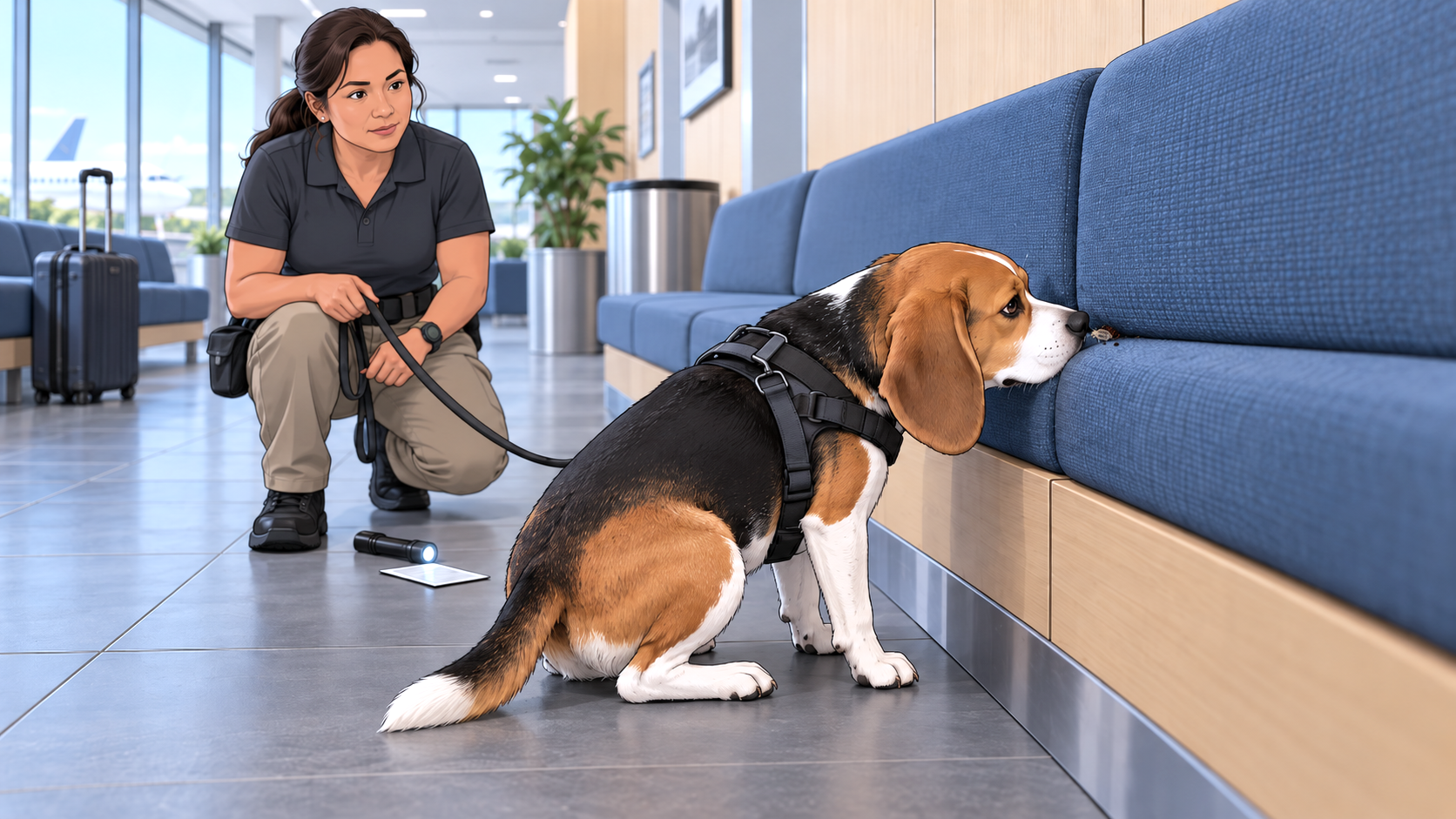
A bed bug detection dog can perform extremely well in a controlled test and considerably worse inside a real apartment. That gap is one of the most important things to understand before treating a canine alert as proof of an infestation.
Bed bug detection dogs can locate live bed bugs and viable eggs, but their real-world accuracy varies substantially between dog-handler teams and even between inspections by the same team. In one field study of 11 teams, the average detection rate was 44% and the average false-positive rate was 15%. A canine alert is therefore useful evidence, but an unconfirmed alert should not automatically be treated as proof of an active infestation.
Accuracy Has Two Sides
Calling a detection dog “90% accurate” or “95% accurate” is not very informative unless you know what was actually measured. Researchers evaluating bed bug detection dogs separate performance into at least two important measures. Detection rate measures how often the team alerts when a confirmed infestation is present. False-positive rate measures how often the team alerts where researchers cannot confirm active bed bugs.
Both matter.
A dog that alerts frequently could detect most infestations while also producing many false positives. A dog that rarely alerts could have relatively few false positives while missing infestations.
That distinction became particularly important in a Rutgers field study of 11 canine detection teams. Across three field experiments, the teams averaged a 44% detection rate, with individual results ranging from 10% to 100%. The mean false-positive rate was 15%, ranging from 0% to 57%.
Those results were far below what the participating companies expected. All of the companies claimed or implied that their inspections were at least 95% accurate.
Controlled Tests Have Produced Much Higher Results
The field results do not mean dogs have poor scent-detection abilities.
Earlier controlled research produced dramatically better numbers. Dogs trained to recognize bed bug odor achieved a 97.5% positive indication rate with no false positives when distinguishing bed bugs from several other insects.
They also distinguished live bed bugs and viable eggs from dead bed bugs, cast skins and feces with a 95% positive indication rate. In a controlled hotel-room experiment, the dogs were 98% accurate at locating live bed bugs.
That difference between controlled and natural conditions is crucial.
A prepared test can control where the target is placed, what competing odors are present and many of the variables surrounding the search. An occupied apartment introduces furniture, possessions, people, previous infestations, inaccessible hiding places, distractions and the behavior of both the dog and handler.
So the question is not simply whether a dog’s nose is capable of detecting bed bugs. Controlled research shows that it can be. The harder question is how reliably a particular dog-handler team performs under the conditions where people actually need an inspection.
The Handler Can Change the Result
A detection dog does not perform the inspection independently. The dog and handler function as a team.
The Rutgers researchers observed several ways the handler could influence the outcome.
In some apartments, old fecal spotting, dead bugs and shed skins were visible to handlers. Researchers noted that seeing this previous evidence may have caused handlers to give dogs unintentional cues, potentially contributing to false-positive alerts.
Handlers also brought assumptions about where bed bugs should be found. Some initially paid little attention to kitchens, bathrooms and closets because they did not expect bed bugs there. Yet researchers found bed bug activity in some of these less predictable locations.
The effect could also work in the opposite direction. During one multi-day inspection, a dog correctly alerted at the locations of bed bugs in four infested apartments, but the handler dismissed three of those alerts because he believed the dog was seeking a reward rather than detecting bed bugs.
That is why accuracy belongs to the dog-handler team, not simply the dog.
An Old Infestation Doesn’t Automatically Explain a Positive Alert
Visible evidence from an old infestation can influence the handler, but that is different from proving that the dog is smelling old shed skins. In fact, controlled research found trained dogs could distinguish live bed bugs and viable eggs from dead bugs and cast skins.
The Rutgers field study also examined apartments with previous bed bug histories. During its blind experiment, false-positive alerts occurred at similar frequencies in apartments with and without a previous infestation history. None of the apartments classified as false positives developed confirmed activity during the following 12 months.
In another part of the study, previous evidence was common in apartments receiving false alerts, but the researchers specifically raised handler cues as a possible explanation.
So an alert in a previously infested room should not automatically be dismissed as “the dog smelling old bed bug shells.” The available research does not justify that conclusion.
Certification Helps, but It Doesn’t Guarantee Field Accuracy
There is no single universal certification system governing every bed bug detection team.
Organizations establish their own testing standards. The World Detector Dog Organization, for example, currently uses a double-blind bed bug certification test. Neither the tested team nor the proctor present during testing knows where the target hides are located.
Its basic scent-recognition phase allows no false alerts and no missed targets. During the room-search phase, the team must locate every target and is permitted one false alert.
Those are demanding test conditions.
However, passing a certification test should not be translated into a guaranteed real-world accuracy percentage. The Rutgers field study found no significant relationship between certification status and detection rate among the teams it tested.
Certification still tells you something useful about whether a team has demonstrated proficiency under a particular organization’s testing standard. It simply does not make every future inspection infallible.
A Canine Alert Should Be Confirmed Before Treatment
This is where the field research becomes most useful. The Rutgers researchers concluded that alerts that cannot be confirmed should be treated as suspect locations requiring additional inspection or monitoring, rather than automatically being classified as active bed bug infestations.
That distinction can prevent unnecessary treatment.
A dog can rapidly narrow a large building down to particular rooms or areas worth investigating. From there, the alert can guide a detailed physical inspection or additional monitoring.
Confirmation may involve finding a live bed bug or other convincing evidence of current activity. Knowing what actually confirms a bed bug infestation becomes particularly important when the only initial evidence is a canine alert.
For difficult searches, the tools used during the follow-up inspection also matter. Bed bug inspection tools can help examine seams, cracks and other hiding places after a dog identifies an area of concern.
A canine team is therefore most useful as part of a detection process, especially when a large area has to be searched quickly or very small infestations are difficult to locate. We would not treat an isolated alert as unquestionable proof on its own.
Questions About Bed Bug Detection Dogs
Can a detection dog find bed bug eggs?
Properly trained dogs can detect viable bed bug eggs. Controlled research specifically tested this ability and found that dogs could distinguish live bugs and viable eggs from dead bugs, cast skins and feces.
Can two bed bug dogs inspect the same room and reach different conclusions?
Yes. The Rutgers field study found substantial variation among teams, and teams tested on multiple occasions did not always perform consistently. Different results therefore do not automatically establish that one inspection was fraudulent or that the infestation changed between visits.
Should the handler know which rooms are suspected before the search?
A blind or double-blind setup reduces the opportunity for expectations to influence the inspection. Current WDDO certification testing uses double-blind procedures specifically so the people present during the search do not know the locations of the target hides.
Does certification need to be renewed?
That depends on the certifying organization. Certification programs set their own requirements, validity periods and testing procedures, so check the team’s current certification rather than assuming an old certificate remains valid indefinitely.