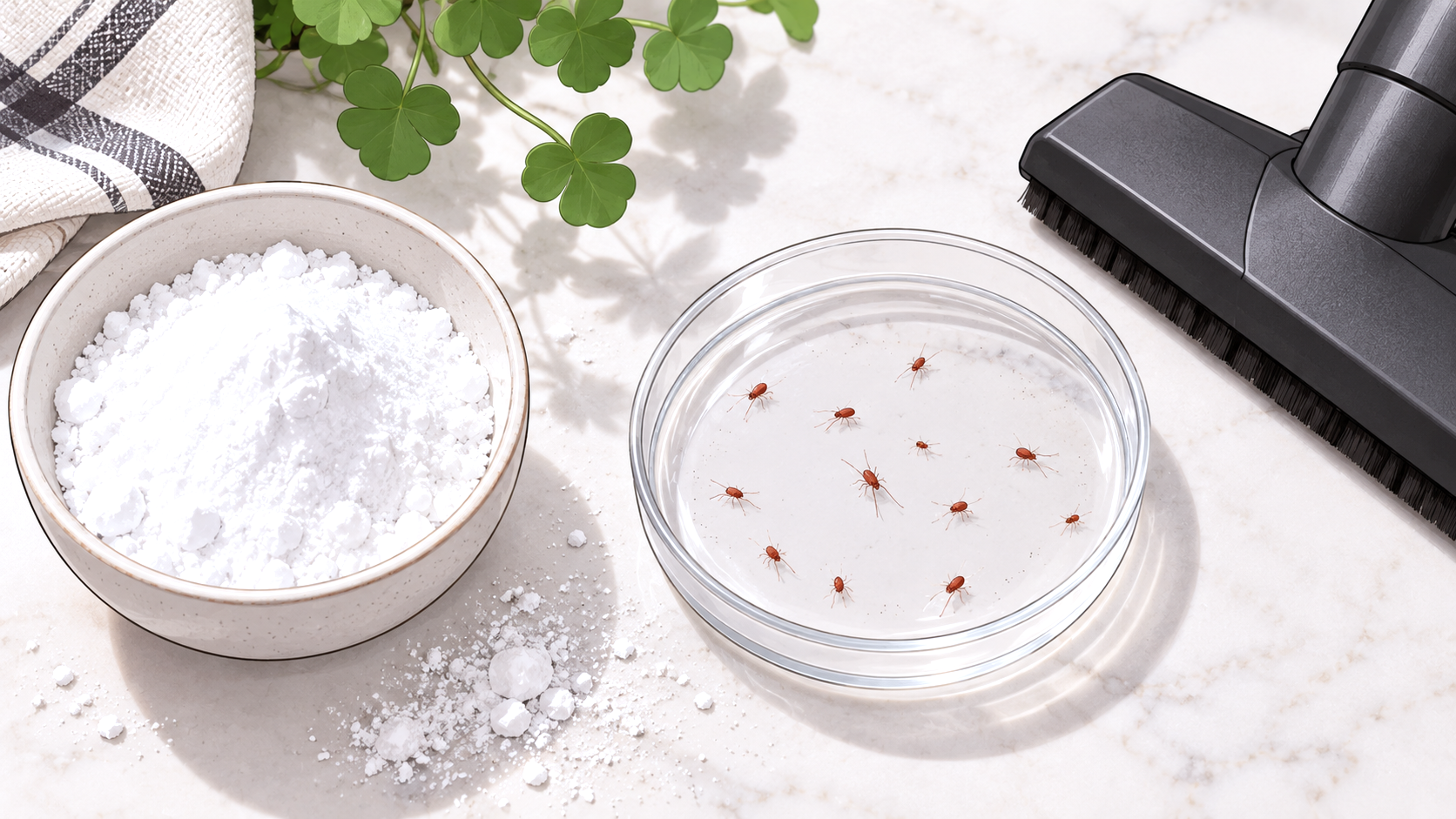
Baking soda turns up in clover mite advice for a legitimate reason, but the reason is often misunderstood. There is no good evidence that ordinary baking soda reliably kills clover mites. It can, however, be used as a fine powder barrier that may discourage the mites from crossing certain entry points. That makes sodium bicarbonate potentially useful for exclusion, not a proven clover mite killer.
This is also a good example of why “pesticidal” does not automatically mean “insecticidal.” Baking soda is sodium bicarbonate, and sodium bicarbonate does have recognized pesticidal applications. Its established plant-pesticide uses are primarily against fungal diseases rather than mites.
Baking Soda Can Form a Barrier Around Entry Points
Clover mites are exceptionally small crawling arthropods. A fine layer of loose powder can create a surface they are reluctant or unable to cross readily, and baking soda is among the materials specifically suggested for creating barriers around windows and other clover mite entry points. Similar recommendations include diatomaceous earth, talc, and cornstarch.
A barrier has to be placed where migration is occurring to have much value. Baking soda around an unrelated section of floor will accomplish little when mites are entering through a window frame elsewhere. Concentrations along window sills can help narrow down the likely route, while mites moving over exterior siding and brick may reveal where outdoor populations are approaching the structure.
Treat the powder as a temporary obstacle rather than a substitute for repairs. Caulking cracks and sealing windows and doors provides a physical boundary that does not depend on loose powder remaining undisturbed.
Do Not Confuse a Barrier With a Desiccant
Baking soda is sometimes described online as though it works exactly like diatomaceous earth, supposedly cutting or dehydrating mites until they die. That mechanism should not be assumed. Diatomaceous earth has established desiccant activity against arthropods, while sodium bicarbonate is a different material with different pesticidal properties.
The difference changes what can reasonably be promised. A mite refusing or failing to cross a strip of powder has not necessarily been killed by it. If the goal is specifically to use a dry material with recognized lethal activity against clover mites, diatomaceous earth has a stronger basis than baking soda.
Spraying Baking Soda on Clover Mite Plants Is Hard to Justify
Sodium bicarbonate is used in some plant-disease treatments because it can alter conditions on leaf surfaces. Registered bicarbonate pesticide uses include fungal diseases on turf, flowers, ornamentals, and food crops. Those fungicidal uses do not establish an application rate for clover mites.
Repeated or concentrated applications can also injure vegetation. Sodium bicarbonate solutions can damage foliage at sufficiently high concentrations, and accumulated sodium can become detrimental to plants and soil. That is poorly suited to a mite that feeds on grasses and numerous other plants. Spraying homemade baking soda mixtures over an infested lawn risks adding plant injury without evidence that the treatment will control the mites living there.
Indoor Mites Do Not Need to Be Coated in Baking Soda
Once clover mites have entered a room, removal is simpler than attempting to dust them individually. Vacuuming captures the mites without crushing them, which is useful because their pigmented bodies can leave reddish marks. Removing indoor clover mites physically also avoids leaving powder across carpets, furniture, floors, and other occupied surfaces.
Baking soda is more defensible at a known entry point than scattered throughout a room. Even there, sealing the opening provides the longer-lived fix. Repeated indoor appearances can indicate that clover mites are continuing to arrive from outside, so increasing the amount of powder indoors does not address where the migration begins.
Baking Soda Does Not Belong on the Lawn as a General Treatment
Broadcasting baking soda over turf is especially difficult to justify. Sodium bicarbonate is a salt, and repeated sodium additions can harm soil structure and sensitive vegetation. Excess sodium in irrigation water can damage growing media and interfere with soil permeability, while baking soda applied to turf can compound salt-related problems rather than correct them.
Clover mite populations around lawns are better approached through the conditions supporting them. Changes to irrigation, fertilization, vegetation immediately beside the foundation, and other habitat factors can reduce the pressure behind outdoor clover mite problems. Where a pesticide is actually needed, use a product whose current label permits the intended pest and site rather than converting baking soda into an improvised lawn spray.
A Few Baking Soda Questions Worth Separating
Can you mix baking soda with dish soap to kill clover mites?
There is no well-supported clover mite treatment rate for that homemade mixture. Adding soap also changes the exposure of plants and surfaces, so an improvised combination should not be assumed safer or more effective.
Will rain ruin an outdoor baking soda barrier?
Yes, moisture can dissolve and redistribute sodium bicarbonate. Its high water solubility makes an exposed powder barrier temporary where rain, irrigation, or washing reaches it.
Can baking soda be put around every window as prevention?
It can be used as a temporary dry barrier where mites are actually migrating, but permanent clover mite exclusion relies more effectively on sealing openings and reducing favorable conditions immediately beside the structure.
Is baking soda better than pesticide for a large infestation?
They serve different purposes. Baking soda may impede movement across a small entry point, while a large outdoor population requires broader management. Persistent heavy activity may justify a properly selected clover mite insecticide rather than expanding a powder barrier into an unsupported treatment.